Top 3 CX Lessons for Converting Detractors to Promoters | INBOUND 2024
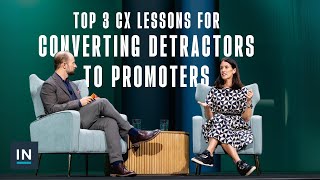
Michelle Peluso from CVS Health explains how they use Net Promoter Score to identify detractors, then target them with AI-powered outreach based on specific triggers like long pharmacy waits or expensive prescriptions. The approach has reduced churn and increased medication adherence.
Questions this video answers
Over 100 million Americans.
About 18 million NPS surveys per year.
About 250 million imputed customer scores in 2025.
Over 100 million calls across CVS call centers.
About 8 million customers in pharmacies every week.
Chapters
Hello, Inbound. How's everybody doing? How are you, everybody? Happy Friday of Inbound. Have you had a nice time? Yeah, yeah, it's been pretty good so far. We've had a lot of fun here the past couple days, but this is gonna be the highlight.
Let's do it.
I'm pretty excited, everybody. My name's John. I work at HubSpot, and I am the Senior Vice President of Customer success. HubSpot loves customers, and we love customer success. But our love of customers pales in comparison to the person that you are going to have the opportunity to hear from today. It is my honor to introduce you to Michelle Peluso. Michelle is a wife, a mom, a passionate leader, a proud godmother, and a friend. I really like including that part. I'm going to add that to my bio in the future. Michelle loves to run. She's an avid reader. She's a longtime member of Nike's board of Directors. At CVS Health, she serves as the Executive Vice President and Chief Customer and Experience Officer. Michelle, welcome to Inbound. Thank you for being here.
Thank you so much. I'm super excited to be here. It's going to be a great conversation.
I think so, too.
Thanks, everybody, this is CVS Team right there in the front.
All right, CVS Team. I like it. They're hyping it up. Hey, everybody. Nice to see you. You all. Thanks for being here. Okay, so, Michelle, let's just get started. First of all, I'd imagine that CVS Health probably doesn't have a lot of data. Huh?
That is not one thing we lack.
I see. Okay, so why don't we just start Getting feedback from our customers is kind of like the centerpiece of building a great customer experience. Could you maybe start by sharing a little bit about the breadth and the depth of CVS's health feedback program?
Well, this is so critical to us. So we have three businesses. Not everybody knows this. We have Aetna, the insurance Caremark, the PBM, and CVS Health. So we serve over 100 million Americans. And what was so critical to us when we started this journey was making sure we knew what our North Star measurement system was going to be, because we want to be able to trace that senior, that. That mom as she's buying her health insurance, she's filling prescriptions. Maybe she's a caregiver for somebody else in her life. She's buying great things in our store, and she's, you know, interacting across the entire spectrum. We use Net Promoter Score as our North Star, and we Collect an enormous amount of feedback. We get about 18 million net promoter score surveys every single year.
Sorry, that was 18 million.
Right. But actually, that pales in comparison because. Because now what we're doing more and more is we're imputing, we're predicting NPS scores. So we in 2025 will have about 250 million imputed customer scores. And that's important because we are scoring call transcripts, digital engagements, store experiences. We know, and we can, with high accuracy, predict what we think you felt about the experience based on all the knowledge we've gleaned over the past few years, having NPS as our North Star.
Wow. Okay. We have to talk about this predictive analytics thing. I think predictive analytics have been kind of something we've all been striving for in this industry for a long time. And it feels to me like we're finally starting to, like, get there, and we're finally starting to get really good unlocks from predictive analytics. And I've never met another CS professional who has unlocked it, I think, as much as you have. So help us all understand what have been the breakthroughs. How do you think about predictive analytics?
Yeah, I mean, I don't think we're getting there. I think we are there, to your point. And, and there's ways that I can help when we can talk about that. But, but, but here's the thing. It's. It's both predictive. But the other thing I want to talk about is proactive. How do you get in front of a problem when you know someone's not happy? How do you get in front of that? And so I think those predictive and proactive are two big unlocks for us. On the predictive side, we have all sorts of scoring mechanisms. Now. We can look with AI's help, at every single call transcript. We have over 100 million calls across our call centers. We digitally score sessions based on, you know, where we know there was friction or whether something was smooth. We can look at operational metrics, like if you waited in line at the pharmacy, if you paid more than $100, if we texted you your prescription was ready and you arrived and it wasn't there, we know what that will do to your net promoter score. So those are all at scale examples of us. We fill 8 million. We have 8 million customers in our pharmacies every week. So we have the ability to really score and predict, not just the people who fill out surveys for us, but based on what we've learned through that body of information. We can predict how other people feel on their journey.
And so, first of all, I find that really inspiring because sometimes I think when we talk about things like predictive impact analytics, they just feel like vague data science things. And what you just told me, it was like so tangible, right?
Well, that's why we got to talk about what do you do with it? And that's the important thing. So when we started our journey, I and the team made a commitment and we had a whole executive session on this. We were not going to ask the. Net promoter survey question unless we were willing to do something about it. And in particular, that we would respond to every single detractor. That's 4 million people who rate a 0 through 6 on an annual basis. We respond to every single one of them. We get back to them with email or a phone call saying, we're sorry this happened. Here's what we're doing to improve it. In some cases, we can intervene directly with the customer experience and make it right. But now let's talk about proactive, because this is where I get really excited about this. Well, this treasure chest of information. And to so think about it, let's take the example of a first filler. Someone who is filling their prescription for the first time at cvs. Maybe their Rite Aid shut down. Maybe their plan changed. Maybe they have a new condition that they've been diagnosed with. Maybe they have a child for the first time and need something different. We know for certain that if you are a first filler with us, if you pay more than $100 for your prescription, no matter what the reason, if your coverage ends up meaning that you pay more than $100, if you wait more than 20 minutes or if we send you a text that says it's ready and when you arrive it's not ready, we know you are going to be a detractor. And so we don't need you to tell us that. We don't need to send you a survey. We should get in front of that right away. So we've wired into these operational metrics. We now will outbound email somebody outbound, text them outbound, call them and say, look, we're sorry, we didn't get it right. We didn't get it right. And here's a chance, you know, we apologize for that. Here's $10 to shop our store. Here's here's something. And what we find is when we do that in the next survey, we see a 30 point NPS bump. People are so appreciative, you know, that we actually got in front of some. It's like when the airlines do this.
Yeah.
You have a terrible flight delay and they send you in advance. We're really sorry. Here's a, you know, $20 voucher for dinner or $10 voucher. We as an industry in healthcare, but across all industries, there's so much more power in this data. And I would challenge every single one of you. You know, what causes dissatisfaction with your brand? You know, those things, those operational things that let someone down. How can you get ahead of that? How can you actually be proactive and be in that customer experience, make it better right away?
I find that really inspiring. I mean, first of all, just the idea of why ask why for feedback if you're not going to act on it? I think that alone is an incredible takeaway for this whole audience. But the second thing is that idea of making it so tangible, Getting it down to the. If a prescription costs more than $100, everybody in this room, as you said, Michelle, probably knows what those things are and can get the data to actually prove it and can then wire a response from your company and get the sort of bump that you're getting.
And here's the thing that I get very excited about too, and this is after kind of four years of intensive data modeling, we also know the financial impact of getting better. Because sometimes you think, well, you know, the CFO is like, oh, I don't want to hand out that coupon. I don't really want to do this. But this is what we know at CVS Health, if you are, for instance, in Medicare, you know, you're a first time Medicare. We know that in the first few months, that's when you have the highest sort of possibility of churning. You're new to the plan, you don't understand it. If we can, we can move from detractors to promoters. With those Medicare customers, they have a 3x less likelihood of churning. That is a massive, massive, massive financial impact. That is thousands and thousands of dollars lifetime value for us. So we know in our store our promoters shop twice as much, spend twice as much, adhere to their medications and churn half as much than our detractors. So the ability to take that information and tie it back to the financial metrics of the company has been an unlock for us. So that we are working with the cfo, with our finance organization to say, how do we make the customer experience better and how do we trace that in the P and L?
Yeah, I think it's actually a wonderful time to be working on customer loyalty and customer retention, because the CFO does actually really care about it because new growth is very hard. I think that's what Yamini talked about on the very first day of Inbound, Michelle, when she talked about how our kind of growth force formula is kind of broken in the industries that we work in. And one of the key levers that everybody can pull is to make their customers more successful, make them happier, and you will get growth as a result of doing that. It's amazing to hear some actual stats to back that up from a company at scale like you. That's right now talking about what Yamini talked about. What's the word of the year at inbound? It's maybe it's a. It's a. It's an acronym.
AI.
AI. It's the. It's the word of the year. Michelle, what is CVS Health doing when it comes to AI, both in terms of engaging customers, but also supporting team members? You have a massive team.
Yeah, well, look, there's so much excitement about AI for all of us. And I think the things that matter to me, and I've spent my whole career in technology, or sort of the intersection of technology and consumer, is, number one, we have to put this in place in ways that can be trusted. That's important. Secondly, it can't just be a thousand flowers booming. We've got a lot of pilots happening. How do we actually have the tenacity and grit to kind of continue to refine models and then make them operate at scale? And then last, I think it's really important to make sure we're tying these back to outcomes that we can measure. And so there are so many places you can imagine at a company like CVS Health where we're deploying AI in trusted ways. We have a really strong principle that AI and humanity have to coexist. We think that's really important for our customers, for our colleagues. So let me just give you a few examples. First of all, in our call centers, many of our agents now are using AI to summarize the calls. And what does that mean? It means two, three, actually really important things. So AI is listening on the call and creating a call record of summary that then gets hosted in our CRM system. That does three things for us. Number one, it provides a great record, a well documented record of the call. So if the caller calls back, that is documented. When you look at our own agent's notes, you know, when they summarize calls, it's a lot of jargon sometimes. And frankly, it can be very hard to interpret. So one, we have a great record of what the customer said. You can imagine how good that is for us to finding root causes, to really understanding what's driving calls, what's causing customer frustration. The second thing that it does is it reduces after call time, because after every single call, remember, we have 100 million calls. After every single call, our agents take upwards of a minute to actually summarize the call. So as you can imagine, you reduce that by 30 seconds, which is what we're seeing. That is a tremendous savings across the company. And third, last but not least, and this is really, really important too, if the caller wants a record. In many cases, we want to be able to give a caller a record back. Maybe it's a complex step she has to take with her doctor to overcome a prior authorization or something. We can then send it on to the caller for a very clear transcript of what the experience was. So that's one example we had many of our agents using, and they're delighted. They can now listen and not be so worried about taking notes. And so, so the empathy goes up as well. Second place, we're using it is something called Knowledge Assist. Healthcare is incredibly, incredibly complicated. And for our agents, it can take upwards of 26 weeks to fully train them to be proficient across Aetna. And questions. Yeah, it's very intense. Knowledge Assist is using AI to help the agent, to help the agent come up with the answer. And we're seeing two huge benefits. Number one, one, we're not putting our customers on hold. That awful thing where they're like, can you just hold please, so I can go research this problem? We don't have to do that with as much frequency or at least for as long. And secondly, we're getting answers back to our agent. So reducing average handle time, accurate answers back to our agent that they can assess, they can decide if this is the right answer to pass on to the customer. And so both those benefits of being more present for the customer, reducing average handle time, our financial benefits, we can really measure. Another great example of how we're using AI. We have 200,000 colleagues in our field, we have over 9,000 stores, 200,000 colleagues in our field. And so, as you can imagine, with 18 million pieces of customer feedback, how does that district leader who runs a bunch of stores, or the region director, or the division vice president, how do they assess what's happening across their really hard. And that's where AI is incredibly useful. We use a platform called Medallia, but every Single day, they're getting a summary of exactly what's happening in their stores, in their district, they're getting measured. We actually use AI to stop bad responses. So if, if someone's going to close the loop with a customer and AI senses signs of coaching, like maybe like, can you give me a, you know, the store manager writes to the customer, I'm really sorry, but these scores are affect my bonus, you know, things that we don't want happening. AI will flag. Hey, this is an issue if there's someone who's consistently not closing the loop. Well, AI will flag to the district leader. Hey, here's two or three people who could use coaching and here's some examples. We're also using AI to write those first responses. So then the store manager or the pharmacy manager can edit. So there are lots of places across our organization where we're using sort of trusted AI at scale and. But I do want to double click on trusted because this field is changing. I've spent my life in technology. This is unprecedented in terms of the rate and pace. And so making sure that you are setting up the right governance models, the right controls, the right tests is really fundamentally important.
Yeah. Michelle, CVS is a gigantic organization. As you've mentioned, many of us work at much smaller businesses and even we have a hard time just getting leadership bought in to even begin to experiment with things related to AI. When you're talking about things like governance and internal trust and internal support to do this sort of stuff. Do you have any advice for us about how to get leadership bought in and structure programs so that it can be safe and effective?
Well, the good news is that a lot of the underlying platforms even small businesses work with have some embedded AI capabilities in them. So if you're working with Salesforce, you're working with Adobe, or you're working with the Microsoft cloud or the Amazon Cloud or HubSpot, a lot of this stuff, there's some embedded capability. And so one thing that's an easy start is to think about the vendors you use today and what capabilities are embedded. And the reason that can be important is because they've often put in layers of security and trust that can help you get started.
Yep.
You're not building your own large language model. You know, you're not trying to do your own thing, that that's a good place to start. Secondly, you want to make sure your compliance officer, your legal officer, whatever the right, you know, your security or CyberSecurity officer, your CISO, even in small companies, you want to get those people together. You want to really think through what are the frameworks. And I would say, like those vendor providers that many of us rely on, they have been very thoughtful about, you know, what do they see company is doing. So it's a great place to ask for benchmarks and for best practices.
Yeah. Michelle's point is so relevant to this audience, I think, because this is the actual point of the way that we build Breeze AI within HubSpot. And I just would just emphasize to everybody here that that AI is all built on top of our existing trusted platform. And so it's a really good way to actually be able to get started and feel like it's going to be safe and trustworthy, etc. So we've talked a little bit about detractors. What about promoters? You listen to promoters too?
Yeah. Well, look, here's the thing. I tell this to my teams all the time. You got to do the hard work to fix the problems. We can't be marketers who look at the shiny object. You gotta do the hard work. But say you do an amazing job, John, right? Like say you move, you know, all those people who graded you 0 through 4, you move them up to fives and sixes and sevens and eights and you're feeling so good. What is your net promoter score? 0. Your net promoter score is 0. Because you only become 100 net promoter score company if you have nines and tens. Promoters, people who love you, people who are excited about you. So the job is both. And fix the problems. Create delight. You can't do. And for us, we have scaled programs to think about creating delight. We've worked. This is culture. We've worked in the Disney Institute. We have six service actions. We train every one of our employees on things we expect and we can talk about those things, like giving a warm greeting when someone walks in a store. There is a 30 point difference in NPS. If we actually greet somebody, offers us not just like a hi, welcome to cvs, but hi, I'm Alana, welcome to cvs. If there's anything at all you need, can I direct you someplace that makes a big difference? Removing obstacles, that makes a big difference. So we have six service actions we train all of our people on to create that culture, but then we empower them. So we have what we call moments of surprise and delight. We give out millions and millions of stickers to our pharmacists, to our friends, to our colleagues, etc. So they can just, you know, give a child a sticker, thank them for, you know, pop ups when they get their first shot. We write notes after we know someone's had their first child and handwritten notes to congratulate them on the birth of their new child. So these moments have been systematized across our organization. But I will also say, and then it's little things, like, I was listening to a story yesterday that I just loved. A man submitted a video with his wife. He's really cranky about some of his new medications. His wife said they had to drive to cvs, pick him up. They're an elderly couple, and apparently he was complaining the entire way. He gets there, and right before they're in the drive through, the wife says, well, look, if I get you a Snickers bar, will you, you know, and he's like, yes, he loves Snickers bars, apparently. So what happens? The wife says to the pharmacist, now remember, Candy's at the front of the store. This is the pharmacist working the pharmacy. Can we get a Snickers bar for him? Instead of saying like, oh, sorry, that's the front of the store. You should park and go in. She's like, absolutely. Hold on. She jogs, gets a Snickers bar, rings it up with, you know, and then he submits his video. He and his wife sitting at home. This video about the smile it put on their face. But it's also big, bold brand actions. And for us, we've done a lot of work on a campaign called Here for her, taking big experiential actions. Women pay way too much money because products are pink, not blue. $1,300 more on average. CVS is the only national retailer that does not charge the pink tax. We in our stores have eliminated, believe it or not, but in 22 states, the only thing that's charged luxury tax in our store are menstrual products. Makes no sense. We absorb that on behalf of consumers. We lower the price of our period products so that girls don't face period poverty. So many things. And if we have a chance, we can roll a quick video to show you some of that work.
Should we watch the video? Let's roll the video.
Here is CVS Health where they're working to eliminate the paint tax to ensure we don't pay more than men for the same thing. Because women's razors are just razors. Here Healthier happens together. Here is CVS Health where they're covering the cost of taxes on period products wherever possible while working to eliminate the tax nationwide. Here, Healthier happens Together. And I say this because it's also. Thank you, thank you. This is, you know, tens of millions of dollars of investment for us, but it pays out in a more loyal consumer. We're seeing the foot traffic, we're seeing engagement from women. So I think it's a small, everyday things and I think it's big, bold brand actions you can take as well.
Yeah, I mean, I love these examples so much. I mean, first of all, small surprise and delight is something that literally every one of us can go back and work on. I've seen the CVS surprise and delight in action. Last Halloween, my daughter dragged me into CVS, oh, probably 25 times because there was a bowl of stickers bars out available and it was like, you know, it was very, very effective. And so. And that's something that everybody here, I think, can do. I think the other thing, like, we talk a lot in this ecosystem, this HubSpot ecosystem about delight and the idea of delight. And I think it's amazing to see like a broad scale investment in delight, like, like you're doing. I think it's very inspiring and it's really amazing to see an example like that.
Thank you.
We're coming close to the audience Q and A section. And so I want to be sure. Can we flash the QR code one more time? We thought during our prep call, based on how amazing Michelle answered all my questions, that it would be amazing for you all to have a chance to ask Michelle Michelle questions. And so, Michelle, why don't we start out. Great first question from the audience. Other than nps, what other metric, what one other metric does CVS track obsessively?
That's a great question. You know, one thing we've been tracking more and more is actually engagement. And I don't mean like how many times they click the Internet, but what we know about health care, and this goes really to healthcare delivery and kind of better medical outcomes. We know that. And I'll talk about seniors in particular. We know that seniors that are more engaged with their healthcare system, that have more trips with their provider, they have more experiences, they actually adhere to medications better and we reduce hospitalization. So we own a company called Oak Street Health, which is nationwide care primary care for older adults. And making sure it's a great example that we know once we get certain people with chronic conditions to see their doctor regularly, to engage with us, et cetera, to take our notes, make sure they're adhering to medicine, we can reduce our hospitalizations by more than 50%, which is a big savings for the country and a big savings, you know, and obviously much better care for adults. So that is something we're doing more and more. How good are we at driving that everyday engagement which has these long term consequences of improving people's health?
Yep. Okay. I think that's very. We talk about NPS at HubSpot a lot too. And you know, I think one of the interesting questions we always have is, you know, what is NPS a leading indicator of? We found very similar to you. It's a leading indicator of financial success. But also I think, you know, one of the things that we've tried to layer much more into our measurement program at HubSpot is the actual outcomes that customers get. You talked about pushing for more outcomes earlier.
Yeah.
Any other thoughts about making that transition from like, you obviously want to be measuring the leading indicators, but you want your team and your company to be obsessed about the outcomes. Any other thoughts on like having a customer centric mindset driving for outcomes?
Well, I mean, I think it's a great example when you think about like medication adherence for something. We know that many, many Americans who need to stay on regular medication for certain chronic conditions, they sometimes stop taking those medicines or they take a medicine and they kind of put it over a longer period of time, either because it's expensive or they don't have time to go refill and get to the pharmacy in time. So that's a good example. We know that detractors especially adhere to their medications less, which we know causes all sorts of downstream impacts. A company like CVS Health is very purpose driven. People come to the company because they, you know, passionately believe in making healthcare better.
Yeah.
So not only do we want to, for our employee base, tie it back to financial metrics for our employee base, we want to make sure we're tying it back to health outcomes because that is very motivating for.
Of course, that's what it is everywhere. Could I also just ask you through that vein, how, how do you actually put customers at the center of the organization? I assume that's part of your responsibility, is to be sure that leadership is constantly hearing from customers, every team member. How do you do that? How do you operationalize that?
Yeah. And look, this is always hard, right? This is not easy. But a few things I would say, first of all, we do a ton of traditional research and I'll just double click on seniors, for example, and there's always some rich insights. We focus so much on the healthcare journey. Finding coverage, finding a doctor, finding Care, et cetera. And when you talk to seniors, there's these moments that matter to seniors that are older Americans that we don't normally think about losing a loved one, moving across the country, you know, becoming a caregiver for the first time. We don't track those in our traditional system and yet we know from seniors that it affects a lot of things. Let's take losing a loved one. When the average American loser his loved one, the average older American loses loved one a lot of things. There's friction, it's difficult, right? Getting your health care situation established, getting your banking situation established without the loved one. But even more, we see there's other things that start to happen. You are at much higher risk of a chronic condition. You are at much higher risk of depression. Time and time again we see you're at much higher risk of going to the emergency room. You think it's a heart attack, it's a panic attack. And so, you know, that's a great example. Moving is another great example. You move 70% of the time, you're going to change pharmacy, you're going to change doctor, you're going to change health plan. So how do we get in front of these moments and actually provide something delightful in the move example, we now send boxes. Remember, we have a ton of first party data. We know you're moving as an older adult. We'll send you a box with a kit on how do you change your prescriptions? A personalized concierge, a community event at local Oak Street Health designed for you to meet other seniors in the community. A few small products to welcome you to your house. And then we'll send a picture frame so you can bring some of what you, you know, you left behind with you. And we'll tell you, you will get your first photos, you know, for free if you come to the local cvs. That's a great example. It doesn't cost as much at all, but it's a great example of getting ahead of those moments that matter that we would not have thought about had we not been intensely kind of surveying seniors and asking them for their feedback in open ended ways about how do they think about health and well being. Not how do we organize for health and well being, but how do seniors think about health and well being?
That's amazing. Speaking of staying ahead, there's a question from the audience about how does CVS stay ahead? You're in a very competitive industry. It's changing fast. How do you think about your competitive strategy and how to stay ahead well.
It'S changing fast, but it has to change faster. I mean, we know this health care in this country still is not what it needs to be. There are some incredible advantages that we have as Americans, but it is not sustainable. The amount of friction, the amount of challenge, and frankly, the cost is not going to be sustainable over time. And so one of the most important things we're working to lead, and we know we have to pick up the pace, is how do we remove barriers to care? How do we simplify experiences for consumers? How do we make, even if we can't solve every financial issue, how do we at least provide more transparency on what things are going to cost? How do we simplify options for you? And this one is a really big one. Again, when you really talk to to consumers all across this country, they desperately want to be seen. That is what they feel is lacking from the health care system. They feel it has gotten transactional. They feel that they're rushed when they're in their doctor's office and they want to be seen. And so what are the things we can do to kind of really embed that across everything we're doing? Which is why these simple surprise and delay things are so powerful. But look, I would be remiss. I say all this. I'm proud of the work we've done. I'm excited about it. But we have so much more to do to truly be an industry that puts the consumer at the center. So the work has just begun.
That's awesome. Well, we're all cheering for you, Michelle. Please join me in thanking Michelle for coming out and talking to us today. Thank you so much.
More from Patrick



A NEW BREED OF PARTNER: The Partnership Ecosystem Model Journey of Patrick Biddiscombe, Part 1








Customer Success Workspace: Never Lose Sight Of What Matters Most | HubSpot Spotlight