Unleashing Your Marketing Team’s Potential With AI | INBOUND 2024
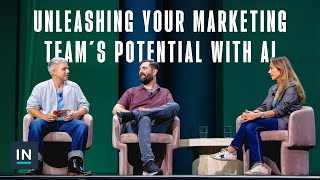
Live Next Wave podcast episode (INBOUND 2024) featuring Matt Wolf, Nathan Lands, and Zeynep Ozemir (CMO, Atlassian). Zeynep describes her path from engineering/PhD in speech synthesis into marketing, Atlassian’s mission to unlock team potential, and practical ways Atlassian is embedding AI into workflows (in-document AI editor, agents/Customer 360, Rovo). The episode reports survey results from ~500 U.S. marketers on AI adoption and use cases (research, content creation, ideation), contrasts views of AI as a creative partner vs a threat, and projects near-term marketing changes (more embedded AI, personalized on‑the‑fly content, faster image/video generation).
Questions this video answers
About 500 marketers across the U.S.
89% said they use AI regularly.
62% said they use AI daily.
95% of leaders said they use AI regularly.
51% said AI makes them do better work; 49% said it makes them faster.
Chapters
Foreign. Welcome. We're about to do a live taping of one of our Next Wave podcasts and excited to have you here to tune in with us. So I'm going to go ahead and get started and I'm going to go ahead and just do it like we're doing our normal podcast. Hey, everyone. Welcome to the Next Wave podcast. I'm Matt Wolf. I'm here with Nathan Lands. And today we've got an amazing episode for you today. We're going to talk about how we leverage AI in our business, in our marketing. And we've got Zeynep Ozemir on the show with us today. She's the CMO of Atlassian. She has a PhD from Cambridge in Speech synthesis. And we're gonna have a fun discussion about how we can actually leverage AI in our marketing today.
So, Zeynep, I wanted to ask you, how did you go from having, you know, getting a PhD and a AI or AI related PhD and then getting involved in marketing? Like how, what was that path exactly?
Well, first of all, thank you very much for hosting me and hello everyone here in the room. It's really exciting for me to be back in Boston because I went to school here and it's always a little bit nostalgic to be in the city. So it starts from there, right. I, I actually studied engineering and then, you know, I had a fast track to AI because my first job out of college landed me in the realm of speech recognition and speech synthesis. Even back then, which should I say this 25 years ago, speech recognition, speech synthesis was driven by AI and machine learning, all of that. So I really liked that. So the story is like, I really like that. Did the Ph.D. and Nathan, in one of your podcasts recently, you were talking about speech synchronization. This isn't how it was. It's one of the most exciting things. Yeah, so that, that was my focus area. And you know, I think, how did I make it into marketing? I think I had the marketing gene in me, you know, the, the Jack of all Trades gene in me. Like for, for all that time, even when I was an engineer and research scientist, I would find myself really liking talking about my work as well as doing it. Right.
So that was that storytelling aspect, the.
Storytelling aspect of it. I was always pitching it to everyone. So I, I did, I did start marketing at. Google is one of the best places you can learn marketing. It's kind of a, it did for me what an MBA program would never be able to do. So that's how I Transitioned into it. And so since then, you know, in terms of what role AI played in my journey, I actually did have a lot of experiences in terms of more. More so B2B companies, B2B tech companies where AI was a big theme in their transformation. Companies like Palantir, Palo Alto Networks, and then lastly Atlassian, where I am now. Cmo. Yeah. And I can talk a little bit about Atlassian if you want, but.
Well, first, so you mentioned 25 years ago you were doing speech synthesis. What was the difference between speech synthesis back then and what it's like now?
Yes, really good question. So I do have a vivid memory actually, of me going into my office when I was doing my, you know, when I was training these speech models, essentially, as you do for the audience. It's like training is a big part of, you know, machine learning. And I remember starting training and then leaving my office in the evening and then hoping that by the time I come back next morning, the training would be complete and I'd be able to play with the models. And I believe I'm just going to make a rough guess. Like, I think it would take a fraction of a second right now to run that whole process. So things have. I can tell you, things have gotten not just better, but fast, much faster as well.
Right, right. So let's. Let's talk a little bit about Atlassian. You know, I bet a lot of people here actually use a lot of Atlassian products, but maybe they don't know the company. So give us a bit about what the company does.
Yeah. Anyone in the audience have used Jira Trello Loom? Yeah, yeah. Okay. Few hands. So Atlassian is a collaboration software company. We have a massive mission to basically unlock and unleash the potential of every team in the world. And I really love that mission and that's why I'm there. So when we look at Atlassian, so when we look at, like, AI in the context of Atlassian, we are. We're constantly questioning, you know, how can AI be a part of the team? How does human AI collaboration look like? How can we help? How can we position AI? In a way, it unlocks human potential, essentially. So that's kind of the way we look at things.
Yeah, very cool. So I know a lot of people right now might see AI as a threat. A lot of people are worried about AI and losing their jobs to AI. How do you see AI and why should marketers care about AI?
Well, there are a lot of reasons why marketers should care about AI and some of those Reasons are reasons that, you know, applies to everyone, not just marketers. Right, I'll come back to the threat question. Let me go through that first. So one of the main reasons we should all care about AI is because we are just inundated. Like we're just surrounded by knowledge, content, information and it's getting increasingly difficult to, to actually make that knowledge work for us. Right? Like build the context. Like really just extract what's necessary for us to do our jobs much better. So this could be in the form of, you know, interacting with knowledge. I mean the way chat has enabled us to do, but also not just in the sort of public domain, but more sort of in the context of, you know, the data that we interact with in the organization every day. It could be on in the context of ingesting and digesting information. Like one of the table stakes features of AI today is summarization, for example. But I can't tell you how many times I summarize documents on in a given day. Like I'll, you know, we at Atlassian, we, we have a very content rich culture. So I receive these long pages, like think about them as documents, confluence pages full of content. And I basically at this point summarize all of them and get the key points. And for all my stakeholders who are watching this, sorry, yes, I don't read the whole document. I summarize it all. But, so that's one area, one area is like how can we manage our interactions with knowledge in a way that benefits us and that AI can help a lot there. For marketers specifically, obviously seeing AI as a creative partner is going to be a key thing in the next few years is already a very key element. I think the way I look at it here is it's really a partnership as opposed to someone doing like AI all of a sudden like being the creative entity in the room and we're completely eliminated. I think the way I look at it is, the way it works for me is that I partner with AI as my secret creative agency and then I actually look at the output and I still modify the output and. But it gives me a lot more avenues of creativity to think through that I wouldn't come up with myself essentially. So that's the, that's the other piece and I think I'd say from a leadership perspective, like marketing leaders, if we think about that, I think AI actually gives a very interesting, opens a very interesting door to setting the bar for the content that you put out. So when you're creating content, normally you're Relying on one person's ability to create that content, which means their experiences and their knowledge, essentially. And that keeps getting better even with that one person. But I think with AI as a starting point, we're able to leverage the entire organization's history as a starting point. And I like that, I like that as a thought of raising the bar in the average content we kind of create. And just to address your question around AI as a threat versus not. Right. So personally, I think of it as something that makes me look much better. But just to address that maybe from somebody else's perspective, we recently had Fei, Fei Li in our team event Right. At Atlassian. And she, she obviously got the same types of questions, but her response, like, stayed with me. So I, I want to share it. She said, you know, human creativity is more profound than what we ourselves give it credit for. So the, the notion being that, I mean, things will evolve, things will change, job definitions will change, but there will be new ways, new jobs and new new ways of doing things. But that doesn't mean, like the human creativity is powerful. So I think it's, I see it AI as a partner more than a threat.
Right.
That's what I always tell people too. I feel like humans are capable of so much more than we currently do.
Yeah.
And AI is just going to enable so many new things to happen that weren't possible before. Yeah. And so that's why I'm like a huge techno optimist. And, you know, yeah, I will bring challenges as well, but overall, I think it's gonna make the world a lot better.
Yeah. Yeah, I think so too.
Sam Altman said similar things as well. He said things that, you know, assuming that AI is gonna take all of our jobs and humans aren't gonna be able to do anything is not really giving enough credit to humans. Humans are gonna sort of figure it out. They're just gonna maybe move up the chain a little bit of the things that they focus on.
That's correct. Yes. Yes. And they would want to, I think, do that. Yeah.
Right, Right. So you, you guys over at Atlassian, you've done some amazing research. You've done some deep dive surveys. Can you tell us a little bit about the research that you gu.
I'm happy to actually share some research points that we internally do. So we're a very data driven company. We ask, you know, customers or prospects, like, a lot of questions before we build products, obviously. And we recently asked marketers, about 500 marketers across the U.S. several questions around AI adoption, use cases Et cetera. So I'm happy to share some of that information. So this was a survey done across the US again, I said 500 marketers of different levels, leaders, leaders, managers, individual contributors and different sizes of, of companies. But one of the, you know, some key points that are worth mentioning is that when we ask them, you know, do you use AI regularly? 89% said they use AI regularly. So that 89% of responders say they use AI regularly. 62% said daily. So daily is an intense metric. Daily active user. So 62% are daily active AI users. What was interesting, actually an interesting detail is 95% of leaders, so subgroup of responders said they use AI regularly. So it's above average above the 89%. So clearly leadership teams, marketing leaders are very much on the. I think it's, it also goes to which use cases they use. So we did ask them what do you use AI for mostly? And the top answer was research. So it goes back to that knowledge discovery point that I made. I think they are really asking questions around understanding several data points, customers, competition, market landscape, etc. So there's a lot of research in there. The next most popular answer was content creation, creating better content. And then I like ideation and brainstorming was, was the third. In fact there was a binary question which I thought was interesting. We asked them in a very binary way, do you think AI makes you do better work or does AI just make you faster?
Right.
And it was, it was probably both in reality, but it was split in half. 51% said AI makes me do better work. And then 49% said it makes me faster. Back to your question though, about AI being a threat or not. So we asked them whether, you know, they think AI whether they have any concerns around AI putting them out of their jobs. 79% said no and the rest said yes. So it's about one in five people still have that fear amongst the marketing audiences.
Yeah. And I know you also sort of asked what are some of the barriers to entry? Why isn't, why aren't you or your company using AI right now? You know, what were some of the reasons people gave for not wanting to use AI?
Yes, that's a really good question. So we did ask them, you know what, what are some barriers for entry if you're not using AI? And I think the top answer was around essentially the company policies, not like necessarily around data privacy and not like allowing them to do that. I think there was also leadership guidance was one. So we don't have Enough guidance as to like, what we should use it for was the second one. And then I just don't know what to do with it was a third one.
Gotcha. So with all of this data that you've collected, all of this research, what do we do with it? How do we apply this information as marketers? How do we use this?
I mean, first of all, I think it's really important to say, yes, marketers are embracing AI. I mean this data is, that gives me a lot of confidence. And they're embracing AI in a way that they're not scared of it. They're, they're actually thirsty for it. From, based on what we can tell, I think there's a lot of takeaways in terms of leaders leadership around having like our, our eyes on the pulse of, of what, what is being used for and maybe being a little bit more deliberate about doing it, scaling some of the successful use cases and actually like getting entire organizations adopting them just to sort of like, because there's clearly a demand and it's being seen as a barrier. So I think that's a, that's an interesting takeaway that I had. And then also one thing that I didn't mention is that marketers say that the biggest challenges they face in marketing is content. The time it takes to create content as well as generic content. Like, they're not very happy with what they're, they're outputting. So I think there's, there's also. That was a great takeaway for me is that, you know, that's the area that, to double down on.
When most people talk about AI, they talk about like all these efficiency gains that you get from using AI. Like, what are the gains you think people get? Like in terms of creative gains they get?
Oh, so yeah, creativity. I mean, as we said, like, that comes back to that whole concept of creative partnership. I think that at this point, if I look at it as a couple of things, obviously content marketing is a big area where our creativity plays a big role. I kind of look at it as short form content, long form content. And I think in, if you're, you know, if you're like me or a lot of people on my team and you're saying, okay, I want to find a really catchy title to this presentation, I want to write an abstract or I want to just brainstorm on different avenues for campaign taglines or something like that, at this point you should just give a chance on that stuff. Right? Like, that's, that's. I feel like at this point that it will actually really help and it will be a gain in terms of getting to a. Going through a creative process faster. So it's, it's, there's a little bit of efficiency still in there, but also potentially unlocking paths, neural paths in your mind in terms of, in terms of new output. So that's one, the other one that's interesting that we're kind of dabbling with a lot is more sort of like on the product marketing realm is we've got say you want to write like a press release or a blog post. Right. I think to get help from AI, there's two things you need there. One is, you know, you need, you've got all of this data around your products, right across your organization. So it's very important to have a way of bringing all of that data and the sources into that creative process. The second thing you need is you need to define what a good press releases for you and that could be past press releases that you've had, but also other companies press releases that you really liked reading. You know, so it's those two things, if you put them together and if you have the ability to actually leverage that data, those data sources to output the next press release you have, that's kind of like the next step in I would say product marketing, which is, which is very interesting. And, and that's, that's an area where we're actually dabbling in a lot with some of these agent frameworks that we are actually developing at Lasting, we have a product called Rovo. It allows us to chat and interact with organizations knowledge base and data. But it also has these agents that help us, these expert agents that help us do very specific things. So for example, the task that I described to, I would do with my communications comms crafter agents and they would kind of like write these things for me. It's a good baseline. Again, the human will always be in the loop. It's all about creating effective baselines.
Now let's, let's talk a little bit more about additional practical use cases for AI. You actually showed us some, some videos earlier of how you guys are using it at Lassian.
Yeah.
And I would love to show these videos to the audience and maybe you can talk us through.
Yeah, absolutely. Yeah.
So if we want to go ahead and roll the first video.
Yes. So I mean this is back to content generation and content creation in context. So the way we actually do context is when we're creating a document like this one. This is a customer case study. We let's say in the process, we want to say, can you help me write a social post here that is 300 words long or can you help me make it punchier? We don't have to go leave our workspace and go to a kind of a chat bot to do that. We actually can do it as we're creating that document and add it to the document on the spot so it can let us like actually mold content in the context. And that's a, that's a big thing because I feel like we're still trying to figure out the UI of AI and how AI gets like weaved into our workflow. Workflows. And I think more and more we're going to see AI being a bit more fluid in these different workflows. If you're in a, in a, in a document, you'll be able to interact with an AI editor. This is Atlassian's AI editor. But like that's essentially brings more value to be on the spot and being able to lean into AI as you're creating content. So that was an example of that, another one that I mentioned. Agents. I mean, I think of taking a step back. Everybody's like talking about agents these days. So taking a step back, the way I, in my human brain, like I, I kind of explain agents is say you're, you're, you have, you're having a meeting with a couple co workers, right. And you all of a sudden, you know, a legal question pops up or an HR question pops up and you kind of slack your or like message your favorite HR person and say, can you join us? We have some questions.
Right.
So it's the same with agents. Like you want to be able to lean into experts, agents, to bring them into conversations, let them help you on the spot in context. That's kind of what we're, what we're like experimenting with, with our products at Atlassian. And as you know, with all companies, we dog food our products. So that's where this next example that I shared with you comes from, which is my favorite agent. It's called a customer 360 agent.
Yeah. And we do have a video of this one. So if you want to roll this second video clip that we've got, this is the agent that they're using here. Atlassian.
Yeah. And, and essentially this is like every interaction you want to have around your customers. So this is quantitative information. Like it's asking how many users are, you know, like are do we have in this customer gives you back that information. Can you give Me like, how many products we have, that customer's footprint, do we have any customer case studies with these customers and what are the benefits they're seeing out of our products? So this agent is the expert in our customer base and they know everything about our customers that anyone wants to ask. So why is that an important thing? To me? This, this was, this is the most mind blowing thing to me as a person. Right. Why is it important? Because some, so many times we're bound to static dashboards that can answer a certain set of questions about any entity, including customers. Right. So you go to a dashboard, you can answer the first, second, third question you have. When you have your fourth question, you either need to know how to write SQL to interact with a database or you're going to a data analyst to say, can you pull this report for me? Like, how many times have we been through that?
I had to learn SQL just for that reason. One of my previous startups.
So the idea of being able to use natural language to interact with, with complex databases and be able to pull any data point from them, I think is a very, very powerful thing for a lot of marketers as well as, you know, all go to market all knowledge workers, I'd say. So that's the piece that actually gets me really excited at this point.
Yeah, yeah. In that video there is, you know, it kind of moves really quickly, but when you ask a question to that bot, it looks like it sort of decides where to send that question to. So it's not like a chatgpt where the question is going and coming back from the the same place every time. It's actually querying the database and figuring out the best place to go and find the answer to that question.
That's exactly right. So it's. Thank you for that observation because it's a really good one. It's actually scanning all sorts of information sources, including databases, third party tools, third party applications, as well as your internal proprietary data and everything. So, so I think that that kind of reasoning is really, really interesting and important.
So Zainab, pretend you have a crystal ball. Maybe you do, maybe you don't, but pretend you have one. What do you think marketing looks like in five years from now?
Okay, yeah, so crystal ball I'll get to. That's the really out there stuff. But even in the next few years, like there's a couple of things I expect to happen as we get to the crystal ball. I think as we discussed, I think the AI will become more fluid, it'll become more prevalent in the context that we're working as opposed to us like going to a chat bot every single time we need to lean into AI. So I think that ui, that, that interaction will, will improve. I think we will improve in our ability to ask AI the right questions and think of like, how do we best make use of AI as well. So those things are evolutions that are continuously going to get better in the crystal. Like the crystal ball for me are a couple of things. Like, in an ideal world, I would love to land in a place where every single person that we're marketing to has a very personalized message, you know, whatever medium we're delivering that message in. And there is a way to actually let AI make on the fly decisions to make our content more relevant, more interesting for, for that person. So I think this has been a marketing dream for many years, but I do think actually we can realize it in the next five years. So that's like one of the things that are, that I'm excited about. I'm also very excited about image and video generation for marketers because I think one of the things that we love to do is express ourselves visually in our storytelling, visually a little bit better. And to be able to make that process, accelerate that process in a way that we can define and prompt someone to create teaser videos for us very quickly and make them effective, that's very exciting to me and I think we're on our path there as well.
Very cool. So what do you think marketers should be focused on right now? Where should their attention be? What they should, what should they go do after listening to all of this?
Yeah, I would say make, make. Make your interaction with AI a very personal thing so that it can actually really hit the, hit the spot for you. I would say, you know, back to like, for me, this, this whole interaction with understanding customers is a very personal, like, this is what I love. So this, that's why this is my favorite agent. Right. But what is, what is it that you want AI to do? Probably there is a way to get there today, right? Like, you just have to figure it out. So for example, I have one person on my team. There's a, you know, my, my kind of leadership team does a weekly roll up to me and then there's one person on my team. Every Friday she will go and ask Rovo, our, our kind of chat, our enterprise chat, offering this question, what have I done? What have I accomplished this week? And Robo kind of goes on everything she's worked on and then brings it back and Then that's her roll up to me. So that's, that's very interesting. That's. It's a personal, the way of, way of using AI. So figuring out what actually moves the needle for you personally is the, is a really good starting point, I think.
So what, what's next for you and at Lesian or Atlassian?
Yeah, yeah. So, yeah, no, I mean, look, I think what we are actually trying to do is work in the middle of this. What I, what I explained as trying to figure out how to weave AI into your workflows. We have a great event in Barcelona in a couple weeks time. It's called the Team Barcelona event. We're going to make a lot of AI announcements there. So I'm very excited to be there.
Can't do the mouth.
What's that?
You can't make the mouth.
No, I, Well, I probably shouldn't. Right. But you know, these videos, you know, point in the right direction I think generally. Yeah.
Very cool. So do you have any final pieces of advice for anybody? We've got about a minute left here, so any, any last words that you want to share before we wrap this one up?
No, I mean, look, I think one of the things that I do want to say is that I really think that the part partnership element is important to keep in mind. I feel like there is a, there's a quite a bright path for us in the future around interacting with AI and learning and really 10xing accelerating learning. So one of the things that I didn't mention is when we asked marketers, what do you want more from AI, like in addition to what you're actually doing right now? One of the things they said is I want AI to help me with new marketing skills. So the, the role of AI in, in actually tirelessly answering your questions is that you can tirelessly ask AI questions. So I think it's a, it's a really big asset in the sense of you don't have to be shy about learning new skills and asking questions. So that's another element of AI. But always consider or think of AI as your partner as opposed to a threat would be my general advice.
Yeah, couldn't agree more. Well, thank you so much, Zainab. This has been a fascinating conversation. Really enjoyed having it with you and we appreciate you joining us on the show today.
Thank you so much for having me.
More from Patrick



A NEW BREED OF PARTNER: The Partnership Ecosystem Model Journey of Patrick Biddiscombe, Part 1








Customer Success Workspace: Never Lose Sight Of What Matters Most | HubSpot Spotlight