Webinar | How to Successfully Migrate To HubSpot CRM
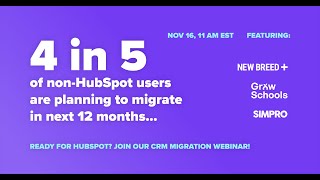
Nick Frigo and Jackie Turbot walk through HubSpot migration with case studies from SimPro and Grow Schools. SimPro consolidated Pardot into HubSpot to reduce forms and integrate Salesforce. Grow Schools timed a Marketo migration with a rebrand and contract expiry, expanding internationally.
Chapters
Well, hello and welcome, everybody. I'm Nick Frigo from New Breed. Whether you're here live or you're listening to a recording of this webinar, we are so glad that you joined this group of experts to learn how to successfully migrate to HubSpot. We know that today companies of all shapes, sizes, growth stages are looking for ways to elevate their revenue performance while they do the hard work of reducing complexity and doing more with less. And as HubSpot's top solutions partner in North America, we at New Breed believe the best way to do that is to build your revenue. Org on and around the HubSpot platform. So that makes a successful migration to HubSpot a really high impact but very high stakes endeavor for your business. So we're excited to have both the expertise and the experience on our panel today. Well, we cover that complex topic if you'll give me an extra slide, a quick introduction on Newbree. So if you're new to the Newbree community, We're the top HubSpot Solutions partner in North America, the only partner to win that three times. And we help companies unlock meaningful growth through professional services and things like revenue operations or rev ops integrations, CRM strategy, demand generation, and web. I'm actually going to pass the microphone today to my colleague Jackie, who can introduce herself, our panelists and guide you through today's webinar. So, Jackie.
Thanks, Nick. So, like Nick mentioned, my name is Jackie Turbot. I actually manage our Revops service team here at New Breed. And Revops is actually my industry. So I've been working in this for about 8 years and I manage all the strategists here that actually do the migrations for our clients here at New Breed. And Michael, tell us a little bit about yourself and about grow schools and what you do there.
Hi everyone. I'm Michael Barber and I'm the VP of marketing at Gross Schools. We help school leaders access money and resources to create thriving schools for kids around America.
Awesome. And we're super excited to have you here. Elise, you want to tell us about yourself and what you do at simpro?
Totally. Elise Singham. I'm digital marketing manager over at Simpro. I work on our growth team. I really email marketing, marketing, automation, lead, nurture, that's all in my wheelhouse. SimPro. We are a global company headquartered in Brisbane, Australia, but we have offices all over the globe, including here in Denver, Colorado where I'm speaking to you today day. Also an office in UK and New Zealand. And we are field service software so looking forward to talking to you guys today.
Awesome, thanks. Really excited to have you both with me today as panelists. So let's start with why. Why do people migrate? Today's revenue and operations leaders are migrating to HubSpot for a variety of different reasons. It unlocks capabilities, efficiency or productivity that'll actually help them grow and scale. It'll consolidate and simplify technology. It aligns teams, processes and data, but really, it future proofs their operations. Oftentimes we hear things like our sales and marketing teams desperately need to get on the same page and are super unaligned. We've had changes in goals or leadership or business strategy and it's brought attention to our subpar tech stack or our CRM or HubSpot just kind of feels like a junk drawer. So Elise, tell me, what were the driving forces behind your choice to migrate to HubSpot and what outcomes were you most eager to drive?
Yeah, well, we've been talking about getting off our existing map. Excuse me.
For a while.
And largely part of that is because we were outgrowing it. We were growing very, very fast as a company. We are a global company. We have acquired other companies that are going to be bringing in as business units. So it was just clear that we needed to move to a different solution that was going able to encompass all of our needs and eventually allow us to have collaboration between our business units. So that was a big driver of kind of looking to move off of Pardot, which we were currently on, into something that was going to be a lot more robust, a lot more enterprise grade and just give us a lot more capability in terms of marketing automation and cross collaboration.
That's awesome. Michael, what about you and grow schools? What was the driving force?
Yeah, there were four major driving factors for us. One, we wanted to right size our platform. The last platform we were on I would consider complicated and really cumbersome, especially for an organization of our size. We wanted to future proof ourselves as well. Again, we had not seen much iteration and innovation on the last platform that we were on for several years and it didn't feel like it was moving forward. We were also trying to bolt on third party tools to, you know, access features that we could see and readily access within HubSpot spot. And this really meant like a patchwork of collection of tools that we were putting together in our tech stack that didn't on any given day we might have an issue or error that we were constantly troubleshooting. So we wanted to reduce the number of tools that we were having Our team manage just from an efficiency perspective. The third we just from a user experience perspective, especially for our non technical teams team members in the building, we wanted a platform that felt easier to use and for those non technical team members to really get behind and not feel like it was adding to their already busy days. And last reporting because of the tech stack we had before, we were cobbling together reports from disparate resources and different sources and the migration has given us the opportunity to change all of that.
Yeah, we hear that a lot honestly the UI and helping and letting people users day to day actually be easier so. But really many are still reluctant or unready to migrate. 35% of non HubSpot users find it difficult to transition off of their current technology and these are real concerns. Leaders are reluctant to put their jobs on the line and make the decision. Status quo bias can prevent action. They can't afford any latency or downtime in production or the lack of knowledge and resources to see the project through in a timely completion. Michael, speak to those leaders out there who are considering but reluctant to migrate. Where would you agree with them and where and how would you challenge them?
I mean beyond the, you know, just the basic idea of like your sanity as a human being and marketer and self care and team bandwidth and you know, breaking stuff that sometimes doesn't need to be broken. Right. A lot of these migrations, I think maybe the biggest hurdle is it works. Why would we want to fix this? Why would we want to go through this massive change inside the business? And so you have to spend a lot of time figuring out what are the reasons behind making this decision. Whether it is a fiduciary monetary related reason or whether it is to help the long term viability and efficiency of the team, what's going to be the ROI of this sort of migration? Right. Especially when you're investing such a large sum of money not only in just your licenses, but in cost to get you across that migration finish line and ongoing as you try and improve the platform that you're moving to. So I totally appreciate that anyone that's in this position of making this decision and selling it inside the organization might second guess just their basic sanity of wanting to go through this sort of process. I think the thing you have to realize though is that at the end of the day, beyond the creative capabilities of our teams these days, if we're going to perform well as a team, we're only as good as the tools we have at our disposal. And so for us going back to some of the reasons why it was necessary to make this change was that we weren't realizing the full potential of what we could do from our revenue operations perspective by the tools that we had at our disposal. It was pulling us back, limiting how we could get to know both our leads and our prospects and our customers. And with these sort of big projects, as a leader you have to think about what the balance of the short term challenges over what you're going to get from the long term. And with any project like this, if you can, you know, create that imbalance, that long term past, these migrations are going to be a lot easier of a moment, a lot better horizon, a lot better experience for the team and an experience and an end user experience for your customers. Hopefully that can, you know, outweigh the second guessing of making, you know, this sort of migration and challenge yourself that, you know, the insanity of these projects, which they can be if they're not managed well, can hopefully be outbalanced by what you're going to get by the benefits of making that transition, that migration.
Yeah, that's for sure. It's always hard to make the leap and make the decision, but just because it's not broken doesn't mean it's actually working efficiently and effectively for you to grow. But Elise, what about you? What do you agree with leaders who are reluctant to migrate and where would you actually challenge them?
I mean, I completely understand the reluctance to migrate. I mean when you're looking at it, you're thinking this is insurmountable. But it's kind of the point of, and I agree with everything that Michael said is start thinking long term, start thinking longevity, start thinking again about that future proof that you brought up. I think a lot of it also is that we are, as we kind of grow, new people come in. We inherited a lot of like legacy systems that were just not working for us. So that was part of the first thing to go and then start reevaluating everything that we did. Is this actually functioning for the team? I also agree, kind of the point that Michael brought up, it was very hard for the team to use. I still struggled a little bit with trying to get in there and really learn it. And it just wasn't a great user friendly platform. So it was definitely looking like all signs were pointing to it's time to migrate. I would say don't be afraid to do it. It does take time. Treat this as your Marie Condo cleansing moment where you can get rid of all of that old stuff. We were kind of looking at our Pardot database thinking, oh gosh, how are we going to clean this up? This is your time. So I was really, really excited to do that. It really gave us an opportunity. Just kind of look at all of our processes, all of our lists, all of our campaigns, all of our segments and honestly I feel like we probably migrated about 15 to 20% of it and redid so much else and now we are set up for success moving forward.
That's such an awesome call out and I love the analogy. Really put these migration pros and cons into perspective. I'm going to take a couple minutes and walk through the quantitative impact and ROI of HubSpot migrations so New Breed recently published the State of HubSpot, a proprietary sorry report that surveyed 1000 plus revenue leaders. We found a decisive preference for HubSpot. Shockingly, not 80% of non HubSpot users are either contemplating or actively planning a migration to HubSpot Hubs in the foreseeable future. We found revenue driving outcomes. 80% of respondents reported improved customer acquisition costs, bookings and revenue since starting to use HubSpot. And we found clear correlation for partnerships. 87% of respondents who implemented HubSpot with a solutions partner noted improvements in new customer acquisition rates. So let's talk about different migration types and approaches. As we walk through these examples, consider which one most accurately describes you and your organization. To keep things simple, we'll use two axises to describe migration types as X axis we have scope. To the left is partial migration where you'll only move a part of your tech stack or a part of Your operations to HubSpot. To the right is full migration where you'll move all of your tech stack or all of your operations to HubSpot. It's important to remember though, you can actually find success across this spectrum. The most important thing is to design and execute a migration that is purpose built for your company's needs and goals. On the Y axis we have support. On the bottom is a migration done in house where all of the strategy, configuration and change management is done by you and your internal teams. On the top is Partner led where a Solutions partner like us, New Breed and our Revenue operation strategists lead the strategy configuration and change management in conjunction with your stakeholders. I'm going to be a little transparent. While you can find success across this spectrum in house, migrations, even just partial ones can take significantly longer and have real opportunity costs for the teams responsible. Let's bring in our panel here to learn more about their specific Migrations. Elise, can you give us some background on SimPro's migration? What was the business scenario and context surrounding this migration? What triggers internal or external factors made at the right time and what were your target outcomes for the process?
Yeah, so we kind of touched on this a lot. Is that where we worked before? I would say again, Pardot is becoming in my opinion a legacy system. It has not grown the way that some of the other maps, specifically HubSpot have in this industry. And so we just didn't have the functionality just brief aside lens of an email marketer, I didn't have a B testing, kind of a big deal. So there was some things that I really needed to get in terms of actual functionality in part and that's just from my perspective everybody kind of had their own gripes. So it was really time for us to look at a different system. Additionally, we had this whole other piece which was consolidating our business units and being able to collaborate across marketing processes which is just such a tremendous opportunity for us to do as the SimPro group. So really, really excited to do that. So that was really the opportunity is hey, let's do this, let's just start getting everybody into one portal, let's start looking at our systems, let's look how we can collaborate, let's look at what we can do across our databases. So as we started doing that we really did audit our full system, painstakingly audit our full system, look at the workflows that we had, look at the automations that we had, see what we could do, see what we could get rid of and honestly we were able to massively pare down our marketing operations processes. For instance, we had hundreds of forms global company, each region had their own form. We have three, I kid you not, we have three now forms and that's because now we have the automation capabilities to be able to create workflows globally. And it has been night and day difference and so I'm really, really excited to just have that data cleanliness to get in there and feel like I'm not being overwhelmed by the amount of data that we have and again that future proofing so that as we continue to grow we are not suddenly iterating and having that much more. We already have the groundwork laid out so it has really created this smoother transition. The overall outcome I would say was really trying to create a seamless integration between HubSpot and Salesforce. We're still a Salesforce user company that was going to be our CRM. We needed to make sure that those two systems are talking to each other and that we have good processes coming in between both of them. And so we're really been lean. We've leaned very, very heavily. Jackie, as you know on the RevOps team as far as all of those fine tuned details and all of the property mapping. I'd say if we tried to go it alone, there's no way we could have. We just didn't know what we didn't know. We had to get through and make sure that there was, we were counting for everything and we also had to bring in many, many members of our team, our salesforce admins to make sure that everything was airtight, we weren't going to miss leads, our forms were functioning how they were. So I'd say the outcome is really to make sure that everything's talking to each other, that our processes are working correctly. And then it's just we are monitoring, monitoring, monitoring all the time and making sure everything's working well.
Yeah, it was a for sure team effort but a good one to get us there.
Yes. Yeah.
And how would you place SimPro in the migration that we did with you on the map that I mentioned and showed?
I mean absolutely we were fairly significantly partner led. There's some things that absolutely had to happen in house. You know Newbree just wouldn't know completely what forms we're using, what things can, we can retire, what kind of our list segmentation is. So that was definitely a partner effort as far as us kind of telling you guys, hey let's migrate this, everything else can go. But again without really the RevOps team and kind of telling us hey this is the best practices, this is what we need to map out. We now have life cycle stages that we really didn't have before. Helping us get custom properties in place so that we didn't compete with our other business unit. Again, that's just not something we would have known to do. So we did lean very, very heavily on the new breed RevOps team in order to kind help us make the best decisions and set our portal up for us to really get in there and take ownership of it.
That's exactly what we're here for. To really help drive the strategy, not just help physically move the assets. Michael, same question for you. Can you give us some background on Grow School's migration that we assisted with? What was the business scenario and context surrounding the migration? What triggers internal or external factors made at the right time? What were your target outcomes for the process?
Yeah, so in similar fashion we had a really interesting scenario going on inside of our organization. One was we were starting an international expansion. So we are growing outside the US and into the uk, Europe and Australia over the next UK starts next year. Australia will quickly follow after that. And we wanted to make sure as a part of this migration we could begin to do business internationally without making significant changes to whatever platform selection we were going to make. So that was definitely one making sure that we had everything in place, you know, to, to be GDPR compliant and et cetera in different markets from process data and our platform. Two, we were rebranding the company. So for 17 years we were known as Charter School Capital and we announced our rebrand on November 2nd to grow schools. And so this was an important moment for us as well just in the history of the company and really a great timing as far as I'm concerned. I have reflected the last few months on it probably wasn't the most sane decision as the marketing leader at an organization to take on a rebrand and a migration of our demand gen stack by any stretch of the imagination. But as I'm sure Elise and other rev op experts in the room would know, it's much easier to do a clean cutover from a new brand, a new website to onto a new platform. It is an additional complication to have to do that when you're migrating to an existing platform, an existing brand, all your dot coms, your apps, et cetera. It provides layers of complexity in the background. And so for us it was a nice moment to be able to go okay, at 12, excuse me, at 11:59pm Eastern Time on November 1st we let everything in our old tech stack and our company brand go and at 12:01am Eastern we were grow schools and moved the entire organization and our tech stack over. And so we we intentionally timed it that way because it did reduce some complexity, although drove my team to some significant nights, sleepless nights if you will, over the last few weeks and few months. But all in all a good moment to do it. You know, truth be told, the third reason was our contract was expiring with our existing platform and so we wanted to time it around that obviously from an economics perspective not having to carry. If anybody is in the Adobe marketo ecosystem you'll know that they do not have month to month contracts. So we had a firm date where we had to cut over in time this with and it worked out as like about two to three days crossover between platforms which was perfect for us, you know. 3 the other thing was we had leadership changes. I have, I've worked around the business at agencies, at gross schools for almost a decade and then late last year was asked if I was interested in coming in to lead the team and I said yes and went through the entire recruiting and application process, eventually landed the role. And so I was new in the decision making seat and I made a very typical new leader decision which was we are going to do this migration because we had suffered for many, many years. I was the consultant, the external consultant sitting there going why are we utilizing as I've described, a bazooka to kill a bumblebee for us, Marketo is just not right sized at us for, for our organization. And so that I was really intentional in coming in and saying we are going to make this change because we need a platform that our team can utilize to the best of their ability and that's much more right sized for us now, but also has the ability to flex and grow for those that have been in. You know, I've been around Marketo for almost 13, 14 years at this point and it's always, it's generally always been and started as a mid market tool but certainly post acquisition with Adobe it has really shifted as well as Adobe has to be fully focused on the higher end of higher end, larger size, mid market to enterprise sized organizations. Whereas we knew HubSpot could fit us now and can fit us in the future. And we still feel like HubSpot wants to support our sized organization now and in the future and that we didn't feel that with the Adobe Marketo team. So a lot of different scenarios that drove us down this decision, you know, very similar to, as Elise mentioned, this was an opportunity to rethink what we were doing from a rev ops perspective from top to bottom, whether it was, you know, looking at all our automations and our workflows, looking across our lead scoring models, looking across our form strategy, how we were leveraging landing pages, similar to Elise, we did a consolidation of forms before we did this migration in preparation for this where we had way too many forms and got us down to like three or four and we've made that transition as well into HubSpot. But it was really about making sure that we really just realigned our RevOps processes with the rebrand and gave us a moment just to rethink everything as we went through this process. The outcomes for us, you know, besides as I've mentioned on the sanity side of the conversations, was not to totally lose our minds in this process. We wanted to Ensure that fundamentally we didn't break anything that was working for the business. Rethink places where we had time to strategically think about this new platform and what we could do with it. Whether that was lead scoring, whether that was automations, whether that was interactions with our customers and really provide a reset moment for our marketing operations team as we were resetting the brand. And so for us that, you know, we feel like we, we, we've made that outcome, we've realized that outcome over the last few weeks. You know, given that We've been on HubSpot for a total of 14 days at this point, we feel like that outcome has been realized and continues to get realized today and, and hopefully we'll continue to do so in the future.
It's awesome that you're realizing that just 14 days in. But where would you place grow schools migration on the map that I mentioned before?
Yeah, very similar to Elise. We were definitely more, you know, on that full migration or should I say more on the partner led side of the migration. I'd say we were probably a little higher than where this, this mark puts us, but generally in the right place and you know, doing a full migration. In terms of scope, we really leaned into the resources with the Newbery team. You know, we're a small team. We had largely worked on executionally from a marketing ops perspective. We had one internal team member as well as an agency and a consultant that we worked with when we were in the marketo Adobe environment. And so not a ton of HubSpot knowledge and so we wanted to make sure we had the capabilities of bringing in a partner that we really trusted to get us through, to get us through this transition. We did do a lot of the actual executional elements of the migration ourselves just because of some of the expertise we have in house with our IT team and a few new members we've added to the team over the last few months. So similar spot but just as much, just as much of leaning into the new breed team for the knowledge on what works that what, what didn't. How we could think about the processes we our past processes and how we had to rethink about them in HubSpot because fundamentally things are very different. How you operate the tech stack inside of of HubSpot so really leaning into that thought leadership from the team and the knowledge that we wouldn't have had. We're also on sfdc, on Salesforce and the business runs on that platform. So making sure that we were doing all the appropriate mapping and just better understanding how Those integrations work at a fundamental level because it's obviously quite different than within the marketo and Adobe Tech stack. So really for us, the value was not only in the handholding through the process, but also the amazing knowledge transfer that your team provided through, through this migration as well.
Yeah, that's awesome. And Michael, we actually got a question in the chat that I want to throw to you. So, reflecting on the migration, were there any important things that you did during the migration that you would recommend to someone who is approaching a migration?
Oh, this is a good one. So the easiest one and probably the most relative to this conversation is that migrations, if you've done this migration process before, and I've been fortunate to do, to do, I think three, I was thinking about this last night. I think this is like my third or fourth major platform migration in my career. They require expertise. You know, this isn't even as like I've been in this business a long time. I've been leading marketing teams for a long time, both on the agency and brand side. And I will consider myself an expert in a couple topics. Migrations is not one of them. And as a leader, you know, I have to fundamentally lean into the relationships I have with agency partners and the relationships I have with my team and their expertise on telling me where I need to go. I'm pretty good, I would say, as you know, painting a 30,000 foot view of how these, how these migrations go. But when you get in the weeds, that requires a dedication and expertise that you're not going to get where I am in my career these days. And so we really, you know, I would say, number one, find your expertise. Whether it is, you know, some you're going to have inside of your team, some you're not going to have, you know, inside of your team. You've got to find a partner that can complement, you know, that knowledge that's inside of your organization versus that knowledge that's outside of your organization. You have to, you know, as a leader and I think as any practitioner in our business, you have to be focused. Okay with feeling dumb. Like, you know, there's any. There's a number of moments through this process where I've been like, I have no idea what this team is talking about, but I'm going to go back and figure it out and, and then I'll be much more informed when I come back to the conversation. And I've had to say to my team, like, you know, I'm sure, Jackie, you talked to your team member, Wyatt who we worked with. There's times I was literally sitting on a call where I would just be silent and then I'd need 24 hours to go digest like everything had been said and be like, okay, I've overlaid what I learned. I've overlaid now what I think the business needs. And here's what we need to, you know, we need to make happen. And so you've got to be okay with feeling that. And that's never, you know, a good feeling. It feels, you know, it doesn't feel stable and good to feel stupid and dumb. At some times you have to be okay with saying, no, that's not going to work. Like, you need to get really clear through this process of getting really good at like, yes, that's what we need. No, that's not we need or we've got to go make this decision before we can get yes or no. Because gray areas become really challenging during these migration processes. You know, lean into the leadership you're getting from a partner, from your team. Lean into that unknown. You know, your job, whether you're a leader or inside of these organizations, you know, managing the day to day of these sorts of projects, is to really, like, make sure the team is executing and allow them to go run what they're doing. And so get that knowledge, get that expertise, lean into your partners and be okay with feeling like, hey, I don't know anything, but I know what the business needs. And it's about reflecting those business needs and creating whatever the tactical executions of what that requires inside of these platforms for us.
Yeah, that's an awesome checklist. Thank you. And thank you both for sharing. It's really interesting to me to hear the similar reasons that lead companies to migrate and yet how specific the challenges and approaches can be. We're going to move in a direction to talk through migrations themselves, what goes into them, how to make sure they're successful, and how to avoid some of the most common issues and mistakes that we've seen throughout our time of doing quite a few of these. So before I ask Elise and Michael to share their experience here, I want to give some structure that really applies to every migration, regardless of whether it's onto HubSpot. At the highest level, migrations proceed something like this. You audit and uncover, you workshop and plan, you migrate and execute, you QA and refine, and then you train and adopt. So on audit and uncover, this stage is where you'll dive headfirst into the platforms involved in your migration. If you're going from Marketo to an existing HubSpot instance, for example, you'll need to audit both to fully understand what's happening with your objects and the data in both platforms. New Breed has done over 500 of these projects at this point and developed a very robust template to gather and organize this information, which can honestly be staggering in size for large and complex, complex organizations. Your true goal here is to just surface everything that can potentially be migrated. Deciding if you will migrate all of those things happens in later steps. So while we're on this early step in the migration process, I'll pose an open question to you, Michael. How can revenue leaders out there best prepare for a migration? How can they adopt the right mindset, expectations and partnership? Kind of like what you were just referencing?
Yeah, I mean I would, I would lean back into my answer around expertise. Right? You've gotta, you've gotta, you've gotta identify the team that's gonna be involved in this from the very beginning and do some sort of chart of, you know, the role they're gonna play inside of, of this migration. Again, you're going to have perspectives from, you're going to need to bring in perspectives from a variety of the business through this audit and uncover step as well. That's the other thing is this is not about, at the end of the day, it's not about only creating a platform that works for your team. It's about ensuring that what comes out of that platform drives knowledge inside of the business, across the organization. And so you need perspectives about what has historically worked, what has historically not worked, and be okay with hearing things that are really challenging to you as the marketing leader revops individuals inside of the organization because you're going to hear a lot of, I think, honesty through this moment of the process. You know, expect that things aren't going to go to plan as well. That's the other thing as you're thinking about this audit and uncover step is that you're going to maybe not uncover every single stone and you need to have certain like decision making criteria. What I will say is in this audit Step is at least put a framework together as a team to decide, okay, if we find something farther down the path, how are we going to react to that? How are we going to operationalize that inside the project? Are we going to make it part of this initial migration or are we going to create a bench of things that are going to happen after that initial migration is done? And the last thing that I will say is especially at the leadership team, at a leader Level is your role is to help again, your team execute and get out of their way as to say this. Paint the picture and the path and allow the team to execute what they know how to do because they know how to do it better than you do.
That's a great transition into the workshop and plan side of things. So once you audit your platforms, it's time to talk to your people here. You'll take the objects and the data that you audited and make collaborative decisions about what to keep and migrate one to one, what to modify and change so that you can use it better, and what to sunset or leave in the old system and just not migrate at all. This may be one of the most important stages for a successful migration, specifically into HubSpot. Because HubSpot does things slightly different than other CRMs and platforms. This stage is where you make choices about how your revenue tech stack is going to function and how it will bring your teams and your data into full alignment. Elise, I know this planning was a central part of your migration from Pardot to HubSpot. What did you and our new Breed team go about? How did you and our new Breed team go about making decisions on the functionality and settings for your new platform? And how did you gain alignment with the right stakeholders? And how did this stage in your process ultimately deliver a successful migration?
Oh, wow. Yeah, you're right. This process was the big chunk of the migration and I would say you're doing yourself no favors if you just migrate everything as is. We migrated very, very little as is. That's why the audit phase was so important to really go through everything. It was almost kind of like a crawl walk run where we do look at everything and not necessarily think, okay, we're going to redo all these process. So you kind of take the bare like what can I not live without? And then how can I expand this to make this greater function between us and our other business unit? How can we have this be scalable? So there was a little bit of that. So a lot, a lot did a lot did sunset a lot to get modified and that's okay. The other big piece, and Michael hit this dead on, is you have to have your team of stakeholders. Honestly, my knowledge, my ownership is only one ton, tiny little bit of the actual marketing automation platform experience. So we had to have our Salesforce admins, we had a half marketing ops, we had to have our team members over at Clockshark, our business unit, everybody weigh in. As far as what pieces do we need to account for just to make sure that we're not overrunning any processes and that our workflows were really moving smoothly. So. And then as far as creating ownership, I think that that's what made this ultimately successful is everybody owned their piece. Everybody knew exactly what it was that they needed to account for, and they needed to make sure that wasn't going to fall through the cracks. So overall, I feel like that was the most critical piece. And the workshopping part, I would say it did take us several months, and because the more kind of stones we uncovered, the more we realized, oh, that needs to be fixed, that we probably can modify. Is this process really working for us? I can't. I gotta say, it was a process. It wasn't just a, we're going in with this plan and this is how it's going to be. And honestly, I fully expect it to continue to be a process because I think that now that we're in the portal and we're really getting our feet under us, we're still looking at things that, oh, you know what? I think we can do that a little bit better. And I think that we can automate and is this really working for us? So I would say to anybody, like.
More from Patrick



A NEW BREED OF PARTNER: The Partnership Ecosystem Model Journey of Patrick Biddiscombe, Part 1








Customer Success Workspace: Never Lose Sight Of What Matters Most | HubSpot Spotlight