Why Community Matters Now More Than Ever With HubSpot Co-Founder Dharmesh Shah | INBOUND22
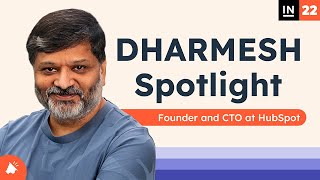
HubSpot co-founder Dharmesh Shah explains why community matters for both personal wellbeing and professional growth, sharing a framework for building ideal communities around identity, diversity, and learning. He announces HubSpot Connect, a new platform designed to connect growth professionals.
Questions this video answers
June 2006.
connect.com.
Inbound 2011.
2017.
Chapters
Greetings fellow humans. Whether you're joining here in person or you're home in your pajamas, which I fully endorse. Welcome. I'm Dharmesh. I live on the Internet, but I was born in a tiny town in the state of Gujarat, India. Any gujus in the house? My family. My family. So there was no hospital in the town that I was in. So I was born at home with a midwife. There were no phones in the town that I was in. So the answer to the question, who are you going to call? Nobody. We don't have any phones. Do, do, do. Anyway, I'm sorry. Grew up on Ghostbusters, so I was also an introvert. So I was a tiny disconnected dot in the massive graph of the universe. And when friends asked me, hey Dharmesh, do you want to go out and do something? My standard response was, sorry, I've already done something this month. Over time I've come to think of my introversion as more of an attribute rather than an ailment. So when I see people in real life, I don't put up my hands and say, hey, hey, step back. I've tested positive for introvert. Fast forward 20 odd years and yes, they were odd years. Changed 18 schools. I moved to the US and I got my first computer. My mom bought it for me using most of her life savings. That first computer cost more than the family car, but my mom somehow knew it was going to be important for me. Mom always knew she got me. So with that computer I was able to teach myself to code. But then I could connect to services like CompuServe and America Online, which let me do this magical thing, connect with other like minded people. There were online communities for everything. Word puzzles, classic Bollywood songs, competitive Rubik's Cubing. Yes, that's a thing. I was a competitive Rubik's Cuber. Made it all the way to state finals in Gujarat. Didn't win. Came in second. Did not make me a loser. Did not make me a loser. I'm from India, so it made me more of a disappointer. Once I discovered community, I never look back. It's the one place I felt like I truly fit in community matters. And when I think of community, I think of people as dots because dots and lines form graphs and I love graphs. And so when I see an audience like this, I picture a bunch of dots. I find that to be calming and, and soothing. Many years ago I had a completely non calming, non soothing day. I was having that awkward, anxiety ridden first day of school. Only I'm not 7 going to grade school. I'm 37 and starting grad school. So yes, I was having one of those how do you do fellow kids moments. It's the first day of class. I have to get there super early. Like 8:45am for me, that's super early. I'm a night owl, so the only reason I'm up early is if I've been partying all night. Okay, fine, you got me. If I've been coding all night, that morning I had to wake up at 7am like a farmer. By the way, do you know why farmers get all the accolades and awards? It's because they're outstanding in their field. Sorry, I get to tell three dad jokes in every talk. It's in my contract. So I got there early to grab a seat in the back row. Specifically the back row, because that's the easiest place to avoid eye contact. You know what I'm talking about? Back row. You get me? You get me? So there I am in the back row. I don't know a single soul. And once again, I'm a disconnected dot. Only this time, I decide to do something about it. So I set up an online community website for my classmates. There were 85 of us. Every single one of them joined the community. Now, this didn't make me the life of the party. It made me the admin of the community, which is way cooler. At least in my head. The site had interest groups, and the most popular was poker. I was not a member of that group because poker requires picking up on subtle signals. I'm terrible at that. Ask anyone that's tried to extract themselves from a conversation with me about graphs or frameworks. By the way, do you know the two best pro tips for winning at poker? Number one, keep them guessing. Number two. So that was a second dad joke to those of you that say, hey, wait a second. That doesn't really qualify as a true dad joke. To them. I say it was a parent. Two down, one to go. So that student website was my first exposure to the power of community. And I learned that a community does not have to be huge in order to be valuable to its members. It just needs to connect the dots. Sorry, I keep pointing at the dots because I have dots up here. Anyway, it's a me thing. So turns out of the dots in that class, one was an exemplary dot. And I don't use the word exemplary lightly. I don't use it at all. That was my first time. The dot called itself Brian Halligan. He and I connected and we hit it off. And we ended up starting HubSpot together in June of 2006. Yeah, we became BDS. BDS best dots forever. Now. It wasn't a bromance. It wasn't like we were Owen Wilson and Vince Vaughn high fiving each other all the time. No, it wasn't a romance or a bromance. It was a growmance. Our mutual passion was helping companies grow. And instead of giving each other the look, we co authored a book. It was called Inbound Marketing. Some of you OG's may have read it. Thank you. So Inbound was about pulling customers in instead of pushing messages out. It was about adding value before you take value. Inbound wasn't a product, it was a philosophy. And so while we were growing HubSpot the company, we grew Inbound, the community right alongside it. And now here we are celebrating 16 years of both HubSpot and this inbound community. Thank you. Thank you. It's been really gratifying over the years to watch you grow your companies, develop your careers, and share your creations. And speaking of sharing creations, in 2011, I created my own dot. Well, technically, my wife Kirsten created him, but I was there with helpful tips like Breathe and Push. We named our little dot Sohan. Well, actually, I wrote a Python program to generate Sohan's name. And that last sentence should tell you everything you need to know about me. So I introduced Sohan to you at Inbound 11. And I shared my joy, my excitement, my confusion. It's like, where's the USB port on this thing? How do I upgrade the Firmware? Then in 2017, I lost a major dot in my life. My mom passed away that year, and I shared an emotional moment with all of you. That was the hardest talk I've ever had to give. It's been five years now, and I still get emotional and I can't make eye contact with my family over here, so I don't tear up. And I connected with many of you that year as you shared your own stories of loss. As humans, we have a craving to connect. It's one of the defining characteristics of our species. And there have been times where I felt down, dejected, disconnected. With the challenging times we have now, you may be feeling some of that too. Nothing seems to be working. I'm clueless. Why can't I figure this out? Everybody else probably has this figured out. I'll let you in on a secret. Nobody has it all figured out. You are not alone. And that's where Community Comes in a community, whispers to you with a quiet confidence. You belong, you have value, you matter. Doesn't matter who you are or where you are or how the numbers look, you matter. As Yamli said, we're living in a crisis of disconnection. She's right. Community can help. That's why community matters. But communities don't just help with our personal relationships, they can help us professionally too. They can help you grow your company and further your career. If I were to describe inbound in modern terms, I would call it value led growth. So here's the evolution of value led growth. At HubSpot, many of your companies likely had a similar evolution. It starts with sales led growth. That's just a person selling to another person. In the early days of HubSpot, Brian was doing all the selling. So for us it was Brian led growth. And the value sales added to the process was consultation. The best salespeople consulted with customers, helped them understand their challenges and connect them to possible solutions. Then came marketing led growth. The value being added here was content. Things like blogs and white papers and videos. This didn't replace sales. This fueled sales. And then there was product led growth. Value here code. In HubSpot's case, we have our free CRM and our free suite of connected applications. And now there's community led growth. It's the new kid on the block and it has all the right stuff. You just have to take it step by step. Thank you. The value added with community is connection. So how does connection create value? So let's say you're experiencing some challenges at work. Rather than tap dancing around the issues, you can tap someone on the shoulder in real life or virtually and ask them. Has your organic search traffic taken a dip this year? Has your sales cycle gotten longer? Are there any tactics you've used that have worked? That ability to connect and trade notes and share experiences and ideas is invaluable. So communities can add a lot of value by allowing people to connect. But how does one craft the ideal community, the one that maximizes the potential value for all the members? I think there are several elements. The first is the community needs to support identity. And it's not just about knowing what companies you've worked for, what roles you've had, or what schools you went to. It needs to go deeper than that. It needs to know what products you use, what you're looking for, what you care about. And I'm going to geek out with you a little bit on graphs. It'll be brief. So imagine one big Unified weighted graph with nodes and edges, connections between dots, and every person, every company, every product, every course, every event and every other community is a node in that graph. That would be totally awesome. What would be awesomer is if it were a weighted graph. Imagine if each node had like an authority value with something I call node rank. It's like Google Page rank, but applied to the professional graph. At 2 o' clock in the morning, it's gonna hit you. It's like, wow, that was a big deal. Anyway, we'll move on. Thank you for indulging me. The next thing you need in a community is diversity. The community should bring together people with common interests, but different backgrounds and experiences so you can connect to people that are in other roles, other industries, other geographies, other cultures. The more diverse a community, the greater the potential for high value connections. Next, community members need to have a way to engage each other. And like me and Brian back in the day, you want to create a growmance. You want to gaze fondly into each other's dashboards instead of long walks on the beach, you want long talks about reach. The community also needs a way for people to take action and conduct a transaction. The community should have a marketplace right inside so that members can buy and sell products, services, content, anything. And last but not least, there's learning. And this could be as simple as someone posting in the community. It's like, hey, I'm thinking about starting a new customer community. Should I get my teenager to help me set up a Discord server? Or should I look at a product like circle? Like, what do I do? So the community should help you connect the dots between the things you need to learn and the product, the content and the courses that will help you learn them. So that's my framework for creating the ideal professional community. Yes, I wrote a Python program to come up with the acronym. Just. Yeah, Just so you know, I love frameworks even more than I love graphs. So we've been talking about the power of a professional community and how to craft it. So as you might have figured out by now, I care a lot about community and you might be wondering, okay, so where is he headed with all this? Where's HubSpot going? And to answer that question, I'm going to have to do something I have never done on the inbound stage. I'm going to let you take a peek behind the curtains and tell you about how HubSpot works and how we make key decisions. So just June, this past June, HubSpot leadership team had a Strategy off site, which is shorthand for let's cancel all our meetings for three days and replace them with even longer meetings. The theme of the off site was thinking think big. To set the stage, I started with a quote from one of my favorite leadership thinkers, Ted Lasso, who said, don't bring an umbrella to a brainstorm. We wanted to have open minds and open hearts as we talked about big, bold, audacious ideas. By the way, do you know if Ted Lasso can jump higher than a Lego tower that's six feet high? Absolutely. Because LEGO towers can't jump. Dad. Joe. Quota reached. Achievement unlocked. Thank you. I'll be playing all week. So, at the off site, we focused on the most important core guiding principle at HubSpot, which is solve for the customer. Whatever decisions we make and bets we place, we want to be in alignment with that core principle. So how do we best solve for the customer? Of course, it starts with a fantastic platform and product, and I'm thrilled with all the work the product team has been doing that Steph shared a bunch of stuff with you. Amazing, amazing stuff. However, we've long realized that great software is necessary, but not sufficient to solve for the customer. We also needed to provide great content, too. That's why we've invested in content so much over so long. It may sometimes feel like there's, like a media company embedded inside of HubSpot. That's because there's a media company embedded inside HubSpot. But even software and content don't get us all the way there. There's still one missing piece. You guessed it, community. HubSpot aspires to be software. As a service company, our mission is to help millions grow better. So at this off site, we decided to make a big bet and kick off something new. Which brings me to this moment. This is a cue for myself, although you're welcome to breathe as well, just so I don't pass out on stage. So this is a moment I've been looking forward to for years, and I'm thrilled to share a new initiative that HubSpot has kicked off. It will be a connected community that helps you connect the dots. We creatively named it HubSpot Connect and it will live@connect.com it will be the connected community for growth professionals. Thank you. Thank you. I too am very excited. This is me excited. That's. Yeah. So HubSpot Connect will be based on the ideal framework. It'll combine a network, a marketplace, an academy, and pull it all together in one place. Visualize Here is a Venn diagram. Because I love Venn diagrams. It's the order is frameworks, graphs, Venn diagrams, which is also an alphabetical order, which makes me even happier. Little things. Little things. All right, so thankfully we're now starting from zero. HubSpot has an audience of millions and we'll be working to turn that audience of millions into a connected community for the benefit of all you docs. The second guiding principle at HubSpot is to simplify. We want our products to be easy to use, our platform to be easy to build on, and our community to be easy to connect with. And we want Connect.com to be an open community just like Inbound is. So it doesn't matter what CRM platform you're on, doesn't matter what products you use, doesn't matter what sportsball team you cheer for. You are all welcome in this community. We won't be able to do it all at once. We like to dream big and iterate small. Here's a glimpse of the big dream. Imagine years from now the community has millions of members and you can connect to those millions of members. Here's some examples. Imagine using Connect to hire someone with verified experience using a part of HubSpot, like hiring an ops person that's used our custom objects feature. Imagine you're in HubSpot Academy and there's a connect button and so you can join a study group for any course in inside HubSpot Academy. Imagine you're a creator and you want to create a specialized course for social media growth in the higher ed industry for Latin America. That's something HubSpot would never be able to do. And that's the power of community is that all of us together can do something that none of us individually can. So I've been excited about this for a long time. Gives me goosebumps, just like my first computer. But please note, this is not a product roadmap. I'm not promising features. I don't do that. It's in my contract. HubSpot Connect is still a tiny dot, but I'd love for you to join me in this community. You can create a free account and claim your username and future bragging rights that you joined when there were fewer than 10,000 members, not 10 million. Community matters. It can bring together people that are different introverts like like me and extroverts like my lovely wife Kirsten. She's been to every inbound. It can bring together people that might not have otherwise connected. It helps us avoid that awkward, anxiety ridden first day of school. A community gives us a space that shrinks the space between us. And who knows? Maybe, just maybe, it even helps us find true gromance. Usually I end sentences with a period. But after this talk, there's still so much to be written. Written by all of you. So rather than end with a period, I'm going to end with an ellipsis, otherwise known as thank you.
More from Patrick



A NEW BREED OF PARTNER: The Partnership Ecosystem Model Journey of Patrick Biddiscombe, Part 1








Customer Success Workspace: Never Lose Sight Of What Matters Most | HubSpot Spotlight