Why Creators Will Replace Your Entire Marketing Team In 2024
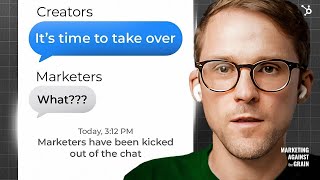
Kieran Flanagan and Kip Bodnar argue creators will replace marketing teams by owning distribution and audience instead of chasing narrow conversions. They stress building broad reach first through partnerships and customer networks, then monetizing attention via media deals and promotions.
Chapters
Did you know that creators are going to replace your entire marketing team in 2024? Now that is one of four unconditional truths that we share about marketing. And in this episode of Marketing Against Grain, we tell you why distribution is undefeated. We tell you why storytelling is unconditional. We tell you why marketers are going to win in an AI era. This is a very special episode of Marketing against the Grain. We recorded it with the nearby podcast. That's Jared Fuller and his co host, Isaac Morehouse. I'm Kieran Flanagan, the CMO over at Zapier, co host of Marketing against the Grain. I'm here as always with Kip Bodnar, the CMO over at HubSpot. Let's get in to Marketing against the Grain.
I have a really good tee up for Kip, actually, because we were at the Pavilion Summit, Kip, about six, eight months ago in San Francisco and you were speaking on stage, I believe the question was asked, quality versus quantity. And I thought your explanation and what you said, I haven't forgot since I heard it. What I heard you say was, I've never gone wrong with more. And so distribution is undefeated. Is that a tee up?
Well, yeah. Look, Kieran, you and I, we worked together for a decade before you went over to Zapier. And the thing we would always come back to, so we'd have problems, we'd be like, struggling, you know, for a month at HubSpot, we'd be like, oh man, what's, what are we going to do? And we'd always come back like, oh, we just need more signups or more leads or like more distribution. And it seems stupid, but like, it's harder than just doing, oh, we're going to tweak the conversion rate of our website or we're going to make better marketing automation. Like, my belief in this world is that most marketers, especially the ones that aren't very good, they want to do conversion rate fixes because it's easier and more in their control. Where distribution requires longer lead time, more creativity requires you to be much more aggressive. Like, Kieran, you're one of the best distribution minded people on the fricking planet. I've learned more from you than anybody else. Like, give everybody your 60 seconds on, on distribution.
It's a guiding principle of how I structure most things in my life. In that I'll give you the tail. The tale of two dinners, right? So I went to dinner with a founder and we were sitting down talking about his business. He wanted some advisory work. And when you do advisory, you usually get equity. So you're betting on that company. So you have to like be really diligent. Do you believe in this founder? Do you believe in this company? So we sat down and had dinner. We were talking about his product and his product was. Had broad appeal. Like it not mass appeal. It's not B2C, it's B2B but had broad appeal. And he's asking his marketing team to do all this hyper segmented like marketing only, only market to the segments that I think I can convert really, really highly. I'm trying to explain to him the thing you want to value is digital real estate. Whoever owns digital real estate wins, right? I have another dinner with a founder much more recently and I was thinking through, should I do an angel investment in this company? That founder didn't spend much of their time talking about the product. At the start of that meeting. They talked about this incredible distribution engine they were going to build. Everything was about how they were going to suck in a mass amount of market and then they were going to have their own distribution engine to be able to convert onto that product. That first dinner was three years ago. That company has shrunk and they have shrunk for a core reason. Because if you spend your time doing all this kind of hyper personalized marketing, you are always leaving yourself in the position that someone else will usurp you and take the rest of the market away from you right before you've even figured out that it's happened. That other founder I invested because I'm super bullish on a founder who thinks about distribution first. For me, that's the way that marketers think. Like Kip and I were in a meeting once before and I was like to camp, hey, like we've got this big problem, right? Like how do we actually grow here and here and here? We. We came to the conclusion that instead of having a blog that did 3 million visits a month, we should have a blog that had 15 million visits a month. So we just did that. Right? And the other thing I'll just like ran that out with is people don't get creative about how you monetize demand. They think the only way you can monetize demand is on your own product. We always believe that digital real estate gives you leverage in other areas. I can monetize that demand for my partners and my partners can promote my brand. I can monetize that demand on my own product, ads for my own brand. That's why HubSpot built a media network. And so you have to be creative around what you can do with that digital real estate. And just to end that, I think the thing you want to keep in mind, Kip's quote is really great. Like, if you have one takeaway from this segment, take that away. But the other one that I really love is like, own the real estate, do not rent the real estate. I think you're in a much stronger position when you do that.
Yeah, it's still not the norm, I would say. But like people understanding, if I can have a point of view and build an audience around that point of view, build trust in some market around that point of view. And now I've got, I can roll out to them, I've got a market that I sort of own. I can roll out to them products later. Like the distribution comes first in many cases. And you see obviously more extreme examples in B2C where you've got, you know, Mr. Beast can launch a candy bar and people will buy it and it will shoot to the top because he's, he's already got the trust of that audience.
Well, there's an important distinction to make here, right. And the important distinction to make is most people, if you go back to Kieran's story from just a minute ago, who want, who want to do that over segmented marketing, they want to do it because they don't believe anything. They don't actually have a point of view. They're like, well, I know I have this widget and I know this specific group of people wants my widget and, and I'm going to figure out how to sell them as much of my widget as possible. That's some really shitty marketing. The best people are like, oh, I believe this thing in the world to be true. I think I can get millions of people to believe this thing to be true with me. And if they believe this to be true with me, they'll buy whatever I sell. And there is a huge difference between those two scenarios.
When you're doing the I don't believe anything. So I'll send the targeted email and do the targeted event and do this targeted thing. Someone else does have the belief and by the time you've woke up, most of your market is over here and you're left with a couple of people that you've been focusing on over here. And that's when things become really problematic for you.
And that, you know, it's interesting when you rally people around a belief. This is where, you know, kind of the near bound concept can come into play. That Buyers are influenced. You know, what does Jay McBain say? There's 28 points, 28 moments along the buyer's journey. And they're influenced by many, many different people along that process. And so being able to surround them with multiple voices. Cause if you build a movement that's bigger than just like your company trying to go to one potential customer and convince them to try a product, but if you have a movement around a set of ideas, I mean, we talk a lot about category design, et cetera. Now you've got all kinds of voices who are talking about this, and your potential buyer, your customers are hearing about it from other people, not just your company.
And.
And that's when the magic happens. That's when that gets easier.
Well, if. If you. If you kind of go with what you guys are talking about with Near Bound, which is. Right. How do you. How do you do that? How do you line up partners, customers, the people in your community to really help you go to market? You know, I. I think there are two things I would have everybody take away. The first is when Kieran and I, when we did distribution for a long time at HubSpot, one of the core line items on any distribution chart or report was co marketing. Like, how do we partner with adjacent companies to get new avenues of distribution? And most teams just don't prioritize that and don't figure out how to nail that. And it's a huge opportunity. And I'll tell you the cheat sheet right now. If you talk to somebody who's another company who's adjacent and you talk to somebody there who is actually good at marketing and will follow through and do the work, it will be successful. That's like literally the only variables. And we've seen that time and time again. And then HubSpot co founder Brian Halligan would always say, like, oh, I want to partner with these companies. I want our brands to rub up against each other, right? He's like, I want their brand to rub off on my brand. And that kind of brand transfer is a huge part of working with other companies or your customers so that you can build brand equity through that.
You have to have something to trade. I would just, like, make sure that people understand. Coming back to why distribution people don't think creatively about it, every time you try to do co marketing, it's really traded against, like, do we have a quality of distribution? Or we're in the same range. Like, if we were trading baseball cards. Not that I would ever do that, because baseball is one of the oldest shots fired that has ever been created in the history of mankind. And we all know this. Even if you secretly pretend that's the.
Guy who watches soccer.
If we were trading baseball cards, right, we would not trade them unless there was equivalent value of those things. Right. And so the reason that it makes sense to kind of build that real estate again is you think creatively about it. You can trade that off in other ways. And co marketing is like one of the best ways that we did it at Hustle.
Yeah.
I mean I was in the. In the seat. So I was telling Isaac I'm like, go Google this. And just to sure it's still the case is the phrase does that make sense? And if you go Google it, the phrase what will pop up is an article that I wrote on the HubSpot blog about why does that make sense? Is the worst question you can ask in sales. Now, why is that particularly relevant? It's because at the time HubSpot CRM, right, inbound sales, y' all were trying to.
More from Patrick



A NEW BREED OF PARTNER: The Partnership Ecosystem Model Journey of Patrick Biddiscombe, Part 1








Customer Success Workspace: Never Lose Sight Of What Matters Most | HubSpot Spotlight