Why Netflix, YouTube & Spotify Bailed On Apple Vision Pro
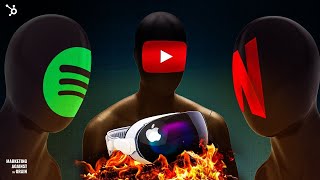
Patrick Biddiscombe breaks down why Netflix, YouTube, and Spotify didn't launch apps for Apple Vision Pro at release. Apple positioned the headset like the original iPhone, creating a new category, but the device's 2-hour battery, weight, and early sales of around 180k-200k units made it a risky bet for streaming platforms betting on mainstream adoption.
Questions this video answers
February 2nd (shipping/pickup date mentioned in the video).
About nine minutes.
Approximately 3.8 million views (at time referenced).
$3,500 US.
About two to two and a half hours.
Chapters
Something big is coming on February 2nd. Apple Vision Pro finally gets to the hands of everyone. I ordered one.
I am so excited to give it a try today.
I'm here to tell you why Steve Jobs will be so proud that Apple Vision Pro mirrors the original iPhone launch so very well.
Not three separate devices. This is one device.
I'm going to break down why the.
Marketing around Apple Vision Pro is a masterclass in product marketing that everyone should learn from. And I'm going to take you into my thoughts around what Apple Vision Pro and AR and VR mean for the future of marketing and how you can start preparing today for the long term evolution of how AR and VR are impacting the marketing industry. That and much more all in today's show. Let's get into today's episode. There are exciting things happening.
We are very close to Apple Vision Pro being in everyone's hands on February 2nd. I ordered one.
I cannot wait to have one.
So let's get right into it. Apple a week ago released pre orders.
For Apple Vision Pro. I'm a sucker.
I ordered one. I'm an early adopter. Go ahead, make fun of me in the comments or what have you. So I will be back with a part two of this where I am doing a first take, like initial review, hands on after like a few days with it.
I get it very soon. I'm super excited on February 2nd. Let's first though break down what's actually happening here. Apple Vision Pro is Apple's first take into the virtual reality augmented reality market and they aren't calling it that, they're calling it spatial computing and they're trying to create a new category.
So first marketing lesson here is you.
Have Apple doing its Apple thing and not wanting to participate in that classic AR VR category, instead trying to create a new category of spatial computing, which I think is a smart move for them. The second thing they're doing is they're very clear on their branding so that spatial branding is through everything.
Like you can take spatial videos for.
Example with the Apple Vision Pro or watch spatial videos. There's a lot of that spatial branding tied to different applications and features within Vision Pro. What they've also been very clear on.
Is that it is not just a.
New device, it is a completely reimagined operating system, marketplace and ecosystem.
Even if you think that Vision Pro is is the dumbest thing in the whole world, one of the reasons you should watch today's show is just for the conversation we're about to have about.
How good the product marketing video was for it.
It was just an incredible product marketing video.
I will tell I'm going to show it right now.
It is probably one of the best product marketing videos I've ever seen. And the reason it is is because.
This is a highly complex product, right?
Like you know, if you have glasses.
Or contact lenses, you have to have special inserts. There's a whole new like look and.
Tap user experience that's unlike a phone, unlike a computer. They're actually encouraging you to get a.
In person demonstration of it. It's that new and that transformative.
Like when I ordered mine, the default shipping was for me to pick it.
Up at the Apple Store, not my house. And that tells you that they're really.
Trying to get the education because this.
Is a step function different.
This is a transformational product. And where Apple has been largely in the business of building an iterative product, like you think about something like the iPhone or the MacBook, they've iterated on that and they've made it a lot better.
But it hasn't transformationally fundamentally changed over the last decade, for example, right.
And so when you look at Vision Pro, it is masterful. So they have this very complex product that they're encouraging in person demos but they have this challenge of like how.
Do you communicate it in a video?
And so I've got the official Apple walkthrough.
It is on YouTube.
It has 3.8 million views, little less.
Than I think five days since being published.
And I want to show you the part of the video that really sold me over which is the work use cases. And you know, this is a marketing and business show. And so it's only going to make.
Sense that we spend a lot of time talking about the work use cases.
Of Vision Pro and you can place it wherever you want.
What I love about this video is.
It'S showing you that Vision Pro is not just a new operating system, but.
It is an entirely new workspace. And instead of having these big 2730 inch monitor setups, you can have a Vision Pro and have basically an infinite workspace.
And that to me is crazy, right? Like you could be on a plane.
And have essentially like a three monitor setup doing your work, which is crazy to me.
Right?
And this is how they're demonstrating.
They're talking about spatial audio and they're.
Doing a really great job of talking about product features in the flow of.
How you're going to use this product.
And what I love about this video is they're showing you how you can set Up a workspace that's gonna flow with you regardless of where you're looking. And you could put an app window that you don't use that much up in a corner and you can look to it occasionally and not be in your core field of vision. This is the part that really made.
Me be like, oh, I gotta try this thing, because I could see work.
Travel, being on an airplane, working from.
Different locations, having the ability to have.
Essentially a three monitor setup on the go like that is amazing.
What's more amazing though, and what I want to talk about here today, is.
How they really paralleled the Apple Vision.
Pro marketing to the iPhone marketing.
So if you remember Steve Jobs original.
Keynote around the eye iPhone, which I probably have watched like a dozen times, I think it is one of the single best business presentations of all time.
These are not three separate devices. This is one device and we are calling it iPhone.
But one of the things that Steve.
Did a tremendous job on was showcasing the value.
That first iPhone was really expensive, really expensive relative to all the other cell.
Phones in the market.
And so there's a lot of skepticism.
About cost and value. Right.
And so what Steve tried to do.
A very good job of saying is.
Oh, you're taking all of these other things and you're making them into one device.
Oh, you're taking your ipod and making it part of your phone.
You're taking your camera. Remember people used to carry cameras. Crazy, I know, but people used to carry cameras.
You're taking your camera and making it part of your phone. Right?
You're taking your maps and making it.
Part of your phone.
So you're taking all of these different use cases that you had kind of standalone devices for and you could do that in one place. And so not only did it seem cheap compared to the cost of all of those things separately, it also seemed better because you're like, oh, wow, I.
Don'T have to carry like five different devices. I can just carry this one thing and will do all the same things as everything else.
That is a mind blowing proposition.
And this is exactly what they've done with Apple Vision Pro.
If you watch this video, I encourage.
You to watch this product video.
If you're a marketer, if you're a CEO, I encourage you to watch it. I've watched it, I think four times so far. I encourage you to watch it like.
Half a dozen times and take notes while you're watching it and really try.
To reverse engineer what they're doing here. And that last first clip I showed you was just them basically saying, hey, Vision Pro replaces your two 27 inch HD monitors, right?
Like that was one of them.
They have another clip that's all about a theater experience. And it's like, oh, Vision pro can replace going to movie theater, replace that use case that you have for your.
Big screen TV and that surround sound system, right?
Like, then they have a FaceTime use case where oh, Vision pro is going to make the experience of talking to.
Somebody, make it feel like you're right there with that person. You don't have to hold a phone.
In real or an iPad or a Mac in a really clunky way.
It makes it completely natural, right?
So they're taking these specific use cases.
That people find very valuable and they're.
Just going through in a very short and simple way. It's only a nine minute video for a highly, highly complex product, right?
This is a product that costs $3,500.
US so high price, highly complex. They've got everything down into like nine.
Minutes and some change.
And they've been able to do that.
Because they're very clear on the story and the beats of that story. And it's all anchored around that original iPhone approach of how do you break down the key use cases that in.
A way that people are like, oh, wow, this really expensive thing, it's actually cheap. Oh, $3,500. Well, it replaces my MacBook, my big screen TV, my home theater stereo, it replaces my monitors, my work screens, all of those things.
That's the argument they're trying to make here.
And I think it's a very amazing.
Masterclass in product marketing. I encourage everybody to check it out.
All right, that is the breakdown of.
The marketing behind Apple Vision Pro.
Now I want to talk a little bit about the technology itself and the pros and the cons, my take on.
It and what it means for all of us.
The first thing that I really believe is that Apple Vision Pro is very.
Much a parallel to the first generation of iPhone.
And the first generation of iPhone was a transformational product that was really for extreme early adopters. It didn't work as well as it should have. It didn't have 3G connectivity. It was exceptionally expensive. What they have done here is we're.
Seeing the same thing with Apple Vision Pro. This is a product for early adopters.
The biggest issues are battery life and weight. I have watched probably almost every review because Apple had a very subset, a small subset of reviewers who got to.
Try Apple Vision Pros, from Marquis to.
Ijustine to everyone in between, the sentiment largely has been, hey, this thing is.
Heavy and I don't know how long I can wear it for, which is a big concern.
And it's honestly my biggest concern going.
Into using Apple Vision Pro.
But they're gonna figure out, wait, not on this first gen one, but they're.
Gonna figure it out on the second or third gen, right?
They're going to.
That is a solvable problem over time. The next issue is battery life.
Without being plugged in, you're looking at.
Two to two and a half hours of battery for the Vision Pro. That is Nowhere near a MacBook or a iPhone level of battery life. And that is also going to be a problem for some people.
But given the weight, I think it's.
Probably gonna be more of a stationary plugged in device than like walking around your house constantly with it.
So I think those are the core summary of the two biggest concerns that people have. Every, all of those same reviewers who have those big concerns also note that.
It is a completely new and different experience and it felt kind of magical to them.
And so what does this tell me.
If I'm a marketer? What does this tell me if I'm a business owner CEO?
It tells me Apple's got a really interesting platform on its hand, but it's.
Going to take a little bit of time. You know, the initial estimates are that Apple has sold somewhere between 180,000 to 200,000 units of the Vision Pro at its initial release. And you're not going to have mainstream business value till there are millions or tens of millions of devices out there. And this is why companies like Netflix, like YouTube, like Spotify are not initially building apps for the Vision Pro.
I think they're waiting to see, hey, is this going to be a big.
Enough and vibrant enough ecosystem that it's worth having a team of developers maintaining this app experience?
I think it will be long term.
Personally, because I think Apple is the best company in the world at building remarkable hardware and software together.
And the thing that's really interesting to.
Me about the Vision Pro is if.
You look, look at all of the.
Apple products over the last 15ish years.
The biggest criticism is like, oh, they're really well designed, they have some really good software, but the hardware itself is.
Like not cutting edge. It's like a step down from what it probably could or should be.
And the Vision Pro hardware is not that. It is very cutting edge hardware.
And they made the choice to sacrifice the weight for the cutting edge hardware. And I think they had to, to make some of the core features of Vision Pro actually work and come to life. I think they needed that hardware. And so what I think is going to happen is it is going to be a platform that people adopt. I think the question is, what is the size? Is this a niche market where you have maybe 5 to 15 million people.
Using it, or is this a big.
Market where you have hundreds of millions of people adopting and buying this product over the next five to 10 years? And that's the big question. If I was a marketer and I was looking at all this and being.
Like, what do I need to do?
What do I need to think about first?
You don't need to think about much.
For the next six to 12 months is what I would tell you in terms of like, urgent things you have to do.
Because Apple is really going to be.
Getting this product out on the market to people like me who are extreme early adopters, getting feedback and probably very quickly working on a V2 that will probably come out somewhere in 14 to 24 months from the launch of this product. But you need to first pay attention to the marketing. Apple did the category creation, the messaging, the use cases, the features. It is a masterclass in product marketing.
And if you don't really study this.
You'Re missing out on a huge opportunity to learn. The second thing you have to do.
Is look at the features and look at how a lot of the early users are using it and what it might tell you about future consumer behavior.
For me, an example, if you watch the demo, Apple clearly has a focus on spatial video, kind of immersive VR video. And you can take it with the.
Vision Pro or you can take it.
With the iPhone 15 Pro. We've talked a lot about video on the show, Kieran and I, and video.
Is only going to become a more.
And more important part of your strategy.
And if this product takes off, it's.
Only going to double down on that.
You can imagine a world where you, you are creating apps with kind of.
Spatial video experiences for AR and VR purposes. Right.
I would also encourage you to look at the FaceTime experience, where FaceTime on.
The vision Pro creates a Persona of you talking. So it's not like a live video.
Of you wearing a headset and looking goofy.
It's a AI generated Persona of you and all of your facial movements in real time that are taken by all the cameras on Vision Pro. I think that's a future way of how you might have virtual collaboration, virtual meetings. And we know those are huge forums for Marketers and how they do their work and how they influence their customers. So I would be studying that, trying that and understanding, huh, is this something that we think is going to get to be mainstream and have a real impact here? The third thing is how is media consumption happening?
Are people really consuming media here and should our video advertising formats and our.
Video formats change and do we need to have either more cinematic, more spatial, other types of video formats to succeed long term? Do we need to continue to think about how we're invested in video quality, video production? The last thing I would say is.
What do we think the future of.
Advertising is going to look like in this VR AR world where you have this kind of near infinite canvas where.
You have a lot of people using.
These highly deep immersive apps and less contact, switching across a bunch of apps and social apps on things like their phone.
You're going to have to create richer.
More valuable experiences in a world where AR VR has mass adoption. Like I said, I don't think that's the next year. I think that's probably somewhere in the three to six year time horizon. If Apple can really pull off Vision Pro and mimic a lot of the success that the iPhone had in the early days.
But I still think it's not going.
To mirror the iPhone growth curve in terms of absolute numbers. Might be in terms of like percentage.
Of adoption, but it's an expensive product.
I think it's going to be an expensive product for the, for the, at least the next two to three years though. Also know that it is called Apple Vision Pro, which means that it does open the door for them to just create an Apple Vision product that is not professional, that is lower, lower priced hardware where they could have a more mass market audience. And I would expect to see that happen as well. The other thing I would tell you in kind of closing is that I.
Think this is going to be a.
Watershed moment for the adoption of AR and VR. And the reason I say that is.
There'S a lot of things just happening in the world. Like over the weekend this really blew up.
On Twitter, Disney shared that they have created a kinetic floor that allows you.
To basically walk in place. So if you are in a VR or AR environment, you can walk and.
Move around and not like run into walls.
You can just completely Explore in a360.
Environment in a way that we haven't.
Been able to before.
So it's not just Apple, right?
There are a lot of companies who thinks this experience is worth it for people like I remember the first time.
I used virtual reality, it was at a museum when I was like 12. Like, this has been decades in the making to get to the point where.
We'Re coming and I think we're starting.
To hit an inflection point.
When that core inflection is, I don't know. But I know that it's going to be the culmination of not just the.
Work Apple does or Meta does or.
Disney does, but it's going to be the work of all the companies working.
In the AR VR space together, innovating to actually build an experience that is a step function, different, more magical, more valuable.
You know, one of the things, if.
You watch the show ever, we always have first principles. And one of the things that we come back to on our first principles is that you have to have an experience, a product, a marketing message that is 10 times better, 10 times more valuable than the competition. And that's where AR&VR needs to get to.
And Apple Vision Pro is a huge.
Step in that direction. But it can't get there alone. It's going to need innovations like this one from Disney Research and many other companies to really get the entire market to take off. But Apple's one of the biggest companies in the world as they go, so does markets. And so I expect we're going to see growth in this market. The question is how much. So if you're a marketer, study Apple.
Study the use cases that early Vision.
Pro users are using with this product.
And understand how long term that might mean the different skills, different investments you.
Need on your marketing team to create the content, the product marketing, the video marketing, the advertising that you're going to need to actually tell your story. Well, this has been marketing against the grain.
I will be back very soon with.
A follow up to this with my hands on review of Apple Vision Pro. I will see you all very soon.
This data is wrong. Every freaking time.
Have you heard of HubSpot? HubSpot is a CRM platform where everything is fully integrated.
Whoa.
I can see the client's whole history. Calls, support tickets, emails, and here's a task from three days ago. I totally missed HubSpot grow better.
More from Patrick



A NEW BREED OF PARTNER: The Partnership Ecosystem Model Journey of Patrick Biddiscombe, Part 1








Customer Success Workspace: Never Lose Sight Of What Matters Most | HubSpot Spotlight