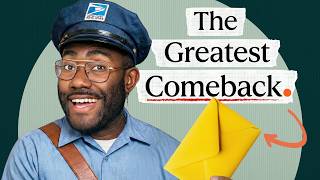
Direct mail is outperforming digital ads because physical mail triggers different brain responses and holds attention longer. Canada Post research and Temple University fMRI studies show people process mail with less cognitive strain and more motivation than digital ads.
Questions this video answers
104% (one hundred and four percent).
It increased by 17% each year (2020–2022).
41% (reported as $5.6 billion wasted).
1994 AT&T banner ad CTR: 44%; modern average banner ad CTR: 0.05%.
Direct mail: 17 days; social media: minutes.
Chapters
Like Voldemort, direct mail is back, my friend. Old is new again. And if you're not taking advantage of printed mailers, you're probably missing out. Direct mail has the power of history, emotions, and even one second. So direct mail. Here are some facts. Over the last decade, the average weekly mail volume has increased by a hundred and four percent. From 2020 to 2022, annual revenue in direct mail went up 17% each year. And you want to talk about demographics? I know we're all trying to reach Gen Z and millennials. Actually, here's the thing. If you're focused on digital ad spend, there's a good chance you're wasting your money. A report by Nex & Co. Found that 41% of total digital ad spend in 2022 went to waste. That's $5.6 billion just down the drain. And that's including the big players. For you and me and other small businesses we see, any part of our ad budget can be the difference between a good month and a really bad one. Now, if you want to make sure you're not wasting that digital ad spend, my friends at HubSpot can help. Check out the free digital advertising mock up linked below. After years of growth and adoption of digital advertising, with companies slashing print and traditional media budgets, digital ad spend is now facing a difficult reality in the current online landscape. Ad blindness. You see a webpage like this and your first instinct is not oh, I wonder what useful, fun and delightful things these ads surrounding the article I want to read whole. Whether consciously or unconsciously, you ignore them. Users have become so accustomed to seeing ads on web pages that they hardly pay them any mind at all. That problem is compounded as publishers add more and more ads to a page, all of them fading into the periphery. Here's a bit of history for you. The first online ad back in 1994 was a banner ad by AT&T. Now I need to ask, are you sitting down, my friend? Good. That ad had a Click through rate of 44%. Today, banner ads have an average click through rate of 0.05%. The Internet and its consumers have changed. Ad blindness and ad blockers are a reality that we all have to face. So why would direct mail offer a solution here? Why would an industry that peaked in 2007 have anything to offer the business owners of today? Let's talk about it now. Our YouTube analytics tell us many of you are Gen Z. So Corbett is telling me you might need an explainer on what mail is when an envelope and A mailer love each other very much.
And that's how you get mail. Mail is an altogether different experience than a digital ad. It's physical, held in the hands and examined away from a screen. Mail faces less competition than the crowd.
Of digital ad spend.
It's easier to remember and easier to grab a customer's attention. It can even trigger an emotional response and higher desire. But you might be thinking this only has to be true for older people, right? Well, not quite everyone wants to reach Gen Z. And I suppose we still care about Millennials for at least a few more years. And guess who likes mail in general, Gen Z are more excited about mail.
Than they were a year ago.
Millennials have shown to be big fans of direct mail. They're the most likely age group to visit a brand site after receiving mail, and they spend more time on sorting and reading mail than the average consumer.
But why? Why is it that mail is able to grab our attention in a way that digital just can't match? Why does mail have a 17 day lifespan compared to social media's mere minutes? To answer that, we need to head north. Good people at Canada Post partnered with a firm, True Impact, to conduct a study into how effective direct mail is. Three metrics were looked at. One cognitive load, the mental ease of processing a piece of information. 2 motivation, how persuasive the piece of material is and 3 attention, how long the user focuses on the content. The team found was that the cognitive load of direct mail was significantly less than digital, 21% the motivation 20% higher. Putting these together, the study found that the direct mail crosses the important motivation to cognitive ratio value of 1, the persuasiveness outweighing the effort. Exactly what you want in an effective piece of advertising. What they also found is that these results get even better when you engage senses beyond touch, like smell. Ah, that's a winner.
So now we know how mail works. We know a bit about why it works. But let's go one level deeper. The magic or science really behind direct mail comes down to the different ways.
It affects your brain.
The Canada Post study, for example, used EEG brainwave measurement to help determine things like attention, attentiveness and cognitive luck.
For this we have to thank the ever growing field of neuromarketing, the nexus point between neuroscience and marketing. We're gaining more insights every year into how advertising and marketing affect the brain. And mail has some unique effects. Let's take a look at another study. Researchers at Temple University used FMRI scans to scan brain activity when engaged with physical versus Digital ads, and the F stands for fun. FMRI or functional mri, simply means the imaging is measuring changes in the brain versus a static recording.
What the Temple researchers found was that print media more strongly activated an area of the brain known as the ventral striatum. This small brain structure is the part of the dopamine pathways of our brain and has been found to indicate feelings of desire and valuation.
Don't worry, this isn't the Imagine Buy button that has been mythologized among advertisers amidst the rise of neuromarketing. Turns out we don't have a single region of the brain that we can use to trigger buying behavior, and it's probably for the best that we don't. Still, the Temple study and the Canada Post study are significant. Direct mail has an effect on the brain that digital simply can't replicate. So direct mail has no drawbacks then, right? No, of course not. You and I both know that every kind of advertising comes with its traffic. Here's what you should consider when adding direct mail to a multipronged advertising strategy. Frequency is where art meets science. You don't want to send mailers out too often or they will go the same way as the crowded banner ads of digital. Consider staggering portions of your list with different frequencies until you find the sweet spot. Keeping your mailing list up to date is crucial. USPS can validate the addresses in your list, and this is something you should make a regular part of your workflow when using direct mail. And of course, working with print advertisements means new considerations for your budget. In a world of heavy paper stock embossing and gold foil, which is my favorite, it can be tempting to go all out on your direct mail campaign. But be sure to treat it like any advertising campaign and keep a close eye on the budget. Consider the mailer from the beginning of this video. What did it do? Well, a strong brand presence.
Make sure the colors and fonts of your identity are present and clear in the printed piece. Make it personal, tweak the advertisement by demographic, or even set it up to include the customer's name. People love to receive mail that feels like it's for them. Have a clear call to action and offer. Take advantage of technology like QR codes where you can and implement a trackable digital offer to see how successful your campaign is. The best practices of ads are also applicable. Lean into your brand identity, make a compelling offer, and lean on the creativity you already use in other advertising. How can you leverage the powers of touch and even scent to create a compelling mailer. How might you marry digital and physical advertising into a cohesive strategy? The possibilities are yours to explore, my friend.
But why now? Why should we not let direct mail go the way of so many other past advertising trends? With the pandemic and the rise of telework, more people than ever are stuck looking at their computers and phones all day. There's a broad craving for experiences outside of the screen. The competition in digital ad spaces is harder than ever, and direct mail offers a way to grab real physical attention. We're seeing direct to consumer and even financial technology businesses surging back into the space. And for good reason. It's got science on its side. If you're looking for another way to effectively reach your customers, check out this video for the perfect email marketing strategy. Now, if you'll excuse me, I got some direct mailing to do, my friend. Until then, I'll see you next time.