Episode 03: A Conversation With Paul Cheek of the Martin Trust Center for MIT Entrepreneurship
Paul Cheek runs MIT's entrepreneurship center and explains their engineering approach to startup education. They focus on founder-led everything and the right order of operations for early startups. Alumni include HubSpot and Biobot, and the center is now grappling with how generative AI commoditizes business plans.
Chapters
Foreign.
It's very nice to have you. Thank you so much for taking the time to be here with us at One Valley. And we're super excited to talk to you about your upcoming book and all the work that you've done at the Martin Center. So why don't we just get started with a short intro. Tell us a little bit about you, a little bit about what you're doing at the Martin center and how you're supporting entrepreneurship at mit.
Absolutely. And thank you for having me. It's great to be here. So I'm an entrepreneur. I love entrepreneurship. I love building businesses from 0 to 1. I'm a software engineer by training. I started a number of businesses, and now, as you highlighted, I have the opportunity to serve as the Executive Director of the Martin Trust center for MIT Entrepreneurship. And, you know, one of the things that I absolutely love about the Trust center is it's what I wish I had when I was starting my first business, the Trust Center. Here we get to experience the magic of entrepreneurship at mit. That magic, right? The idea of, like, taking this research, the technology, the science, and commercializing it, spitting it out of MIT with the goal of having an impact in the world around us. The Trust center is a super special place amongst a vast entrepreneurship ecosystem here in Cambridge and Kendall Square, and a vast ecosystem even at mit, which makes entrepreneurship here just so special.
That's great. So can you tell us a little bit more about that? What are some unique approaches or strategies that MIT employs to foster innovation and entrepreneurship among its student and community? Given that you've got the Martin Trust center, you've got the Sloan mit, you've got so many fantastic resources on campus.
Oh, definitely. And we try to make the most of those resources, just like entrepreneurs have to do. So, you know, for us, what are some of the unique approaches? Let's see. Well, first of all, we take a very systematic approach to designing the structure of our ecosystem, of our programs, of our courses and all of that. And even in our connections to other parts of the ecosystem, the systematic approach, it's kind of like this engineering mindset. Exactly what you'd expect from mit. And, you know, we use that not just in designing how we interact with students and entrepreneurs, but also in terms of what we teach them. So we take this engineering approach to entrepreneurship. We take people through a systematic, rigorous structure to learn the first principles of entrepreneurship. And we believe that's really important. And we've seen the success that it's had looking at some of the companies and individuals who've come through the trust center over the course of the past 10 years. The results are absolutely astounding. 69% of the companies that have come through our startup accelerator are still active or have been acquired, which for us, that's a wonderful success metric. But that brings me to the second unique strategy or approach, and that's our focus on the individual, not the startups. You know, we don't believe that entrepreneurship and startups are the same thing. Entrepreneurship is a mindset, a skill set and a community mode of operating. So we focus on the individual in doing so. When we do our research to look at who's come through and what is success, we look at what have the individual people done, not just the companies that they've created. And for us, that's extremely exciting as well, because when we look back at these past 10 years of running this Delta V accelerator program, what we've seen is that, you know, of all the individuals who come through, yes, the companies they've started have raised $1 billion. That's super exciting to us. But what's more important, and our kind of North Star, is what did those individuals go on to do? The research shows that those individuals started 130 additional companies. Those 130 companies started raised $2 billion, not the $1 billion that the, the companies that came through did. So this focus on the individual, and then, you know, the other thing that I would mention is our honest broker approach. We're an academic institution. We're here to teach individuals to become entrepreneurs. So our honest broker approach says that I'm never going to take a piece of my students business. The people who work here are never going to take a piece of students business. The center is never going to take a piece of students business. We're here to help students. And one of the things I was just exploring with somebody else, this, this idea that the second we create any sort of a financial incentive for our students, you know, investing in them, things like that, all of a sudden they're not going to share with us the biggest challenges they're facing because they want to hide that, right? Naturally. And so what this allows us to do, this honest broker approach allows us to build the safe space in the community within which they can share some of the most challenging problems and learn from things that aren't going right, learn from that failure, you know. You know, we kind of believe that nobody's right. It's just the data that's to win. So, you know, come back with, with evidence. We can help you do that. These are the things that make entrepreneurship at MIT and our approach at the Trust center somewhat unique. You know, not to say that others don't do these things, but this is what makes the Trust center such a special place.
Yeah. And I think I. So just to, I think just to kind of round all of that out with, you know, the systematic approach, the honest broker approach and the focus on the individual. I actually am concurrently mentoring with this organization locally called the Enterprise center of Johnson county. And they're using the MIT VMS process.
And so we call it the Growth Mentoring service here. And I think all of those three elements are very common even in that approach, because it's really about, it's a very strategic sort of process. It's about an 812 month process where they kind of help you help the individual founder get from one place to the other. And again, all of the mentors, there's generally teams of mentors because like you mentioned, the community aspect of it is really critical. And again, nobody is allowed to engage in any business dealings. You can't become an equity advisor in the companies that you work with or take their services. So it just sort of all brought it, you know, it became, made it very real for me because I am experiencing exactly what you talked about, the uniqueness of the MIT approach in my personal sort of experiences with, with the ecjc.
So, yeah, we love, we love vms. VMS is awesome. One of the other many programs, centers and entrepreneurship initiatives across campus here at mit.
Yeah. And so talk to me about. I know that, you know, with a lot of federal funding, the tidal wave of funding going in to innovation and entrepreneurship on campus, right now a lot of universities are thinking of basically launching their own seed funds. Right. Seed stage funds to invest in their founders and entrepreneurs. How do you sort of respond to that given, you know, given what you've seen works at mit, which is slightly different from how they're perceiving it.
Yeah. What I would say is like, look, we're educators. Our job is to educate. Our job is not to invest. And we need investors, Right? Entrepreneurs need investors. We need investors so that we can build these companies that are going to scale and have massive impact for us. The approach that we take is that we don't invest in our students. We do provide grants to the student teams that have come through that have proven that they are serious. But at the Trust center, we don't invest. And so I think it's just a need to make sure that the best people to be investing are investing and the best People to be educating are educated.
Yeah, that makes a lot of sense. So your book, the Discipline Entrepreneurship that you've written in partnership with Bill Owlett and then you've got your follow on book Startup Tactics has really become a cornerstone for aspiring entrepreneurs. Could you highlight a few key principles from the book that you believe are particularly relevant in today's evolving landscape?
Yeah, and I'll. Maybe I'll come back to this a little bit later. I think there's, there's three key things that I would share with you about the book that make this so important. A lot of people talk about founder led sales, right? The idea that the founder needs to be able to sell the product and needs to be able to do that forever. We can't just go hire a bunch of salespeople to sell something that we don't know, we can sell ourselves. And so this idea of founder led sales, well, I would argue that in the earliest stages of building a new venture, we need founder led everything. What does that mean? Right. Startup founder, an entrepreneur does not have the resources to go and hire a bunch of people with different specialties. So they need to be well versed in all the different functional areas. My co instructor in the course upon which the book is based, the class we started several years ago, we've tested and iterated on and now we're pushing it out to the world through the book. He always reminds me his name is Nagarjuna Vena. He's the co founder of Bitsite and a senior lecturer here at MIT Sloan. He says, look, we need to teach them just enough to be dangerous in each of these functional areas. They don't need to be an expert, expert recruiter, but they need to know some of these first principles of recruiting just so that they can go and they can find the right people. They need to know just enough about marketing, just enough about product design so that they can get kind of like the first amount done so that they can get some traction, ultimately resulting in them raising money so they can go out and hire people to do all these different jobs. This is the idea of founder led everything. The second thing I would share with you is this idea that raising money is really hard, Right. Especially right now with that being the case. Right. We have this belief that raising money and building a good team become a lot easier once you've built a good business. When I say a good business, what do I mean? I mean we've got data points that show that this business is de risked. How do we de risk that business? It's by leveraging this founder led everything so that you know, we can get that early traction. The book is designed to help entrepreneurs who maybe haven't started a company before, even if they have, but to figure out how do we take those first steps in every functional area to get traction, Traction customers, product funds raised. And that is the sequence we go through. And that's the third thing is this idea that order of operations matter. The idea if you build it, they will come. It's garbage. It just that's not how it works in most cases in entrepreneurship. So the order of operations that the book follows, it teaches students. You know, it starts with foundations. It says here's how to set goals. So we haven't set goals yet. Why are we doing anything else? Right, because we don't know whether the activities we're doing contribute towards our next milestone. Starts there with goal setting foundations. And then we go to market testing. Can we prove that somebody wants this product? We think they do before we've ever built it, before we've ever invested in product development. That goes through market research, marketing, sales, things like that from the market test. If go to product development, product design, user testing, doing some lightweight engineering. And then once we've got a line of customers waiting down the street from our market test, we've got a product built from our product development, we go into the fourth stage and that that's focused on resource acquisition. That's going and acquiring additional money, fundraising, it's acquiring additional time hiring and recruiting so that we're best set up for success to grow the business and have an impact. These are the things that I would share about the book and you know, within our tons of examples and ways of applying these different functional skills in the context of an early stage venture.
That sounds so exciting. I can't wait to get my hands on the book when it's out. Once you.
I know. Me too. Me too. I can't wait to hold the finished book in my hands and it's coming up quick here. I'm hoping to get an early copy myself in the next couple of weeks.
Very, very exciting. Yes. Please make sure you send me a copy once it's. Once it's ready. I cannot wait to read that. I think it's the way that you've presented the ideas. It sounds like it should be essential reading for any first time founder, early stage founder, anybody who's trying to even think of sort of dabbling into entrepreneurship, which we know just from the latest numbers is more than half the American population at Least the young people of America right now. Everybody is considering entrepreneurship to be sort of a viable way to build wealth and sort of launch their career, basically. So.
Well, one thing I'd add on there, you know, like, we've got more people becoming entrepreneurs, but we need to make sure that we have well trained entrepreneurs. Right. You know, they say entrepreneurship can be risky and I, I think you can decrease the risk in a systematic fashion. Right. And that's what the book is designed to do. It's designed to decrease risk for entrepreneurs by, by providing this education within and on the topic of education, right, there's the book, but there's also a whole, a wealth of educator resources that I've published online so that educators were thinking run workshops or want to run a course. They can go and get the slides, the assignments, the workbooks. They can get everything they need to kind of kickstart that process, which is all pulled from the course that I teach here at mit. You know, one of the things also coming back to your first questions, like what makes the approach to entrepreneurship unique at mit? It's like we're very open, right? We want to get this stuff out there so that we can collectively help create more entrepreneurs.
I mean, because you, you were also. I used to be in the edtech world, so I remember that MIT was one of the first with the MIT OpenCourseWare. So you are.
Exactly.
Very, very broadly, you love to sort of broadly share what you learn and make everybody better in the process. So it's exciting that MIT, being such a strong institution and being such a powerhouse, has that sort of approach.
Well, and we can't do it all ourselves. Oh my gosh, there's no possible way. There's way too much to be done. And it's exciting to see what folks in, in, in Denmark, in all these places around the world are doing when they take the educator materials that we publish and they apply it. Right. And they're coming back and they're sharing with us and we're just going to keep iterating in collaboration with everybody because, you know, nobody should own entrepreneurship. You know, we're all out there on this mission together.
Right, exactly. So let's get back to a little bit on the, on the education side, you know, so with the academic rigor of mit, how do you balance that with the practicalities of entrepreneurship, which can be very challenging? So how do you ensure that students not only grasp the theoretical concepts but also develop that hands on skills necessary to kind of actually succeed in the real world? Because it's one thing to learn how to conceptually build a business model canvas, and it's a completely different thing when you actually have to build a business model canvas. So how do you sort of balance those priorities?
Yeah, this is such a good question. It's one of the hardest things, I think, for entrepreneurship educators to do. The good news is for us, it's baked into the motto of MIT men's and modest mind and hand. Right. This idea of going out and doing so. One of the things that we've developed this belief around is full stack entrepreneurship education that thinks about what we're very used to. The theory and the practice, right, the theory and the practice working together. But we've introduced the tactics as well. Theory, practice and tactics. The theory being the things that don't change over a long time horizon.
High level strategy, things like that. We look at the practice as the, the concepts, the frameworks that we can use. And for us that means developing a business plan mostly. And then, you know, when we think about the tactics, those are the actions that people take. And that's what we've introduced with the new book, with the new course, all those sorts of things. My belief is that you can't fully grasp entrepreneurship by just reading a book. I think if you talk to any entrepreneur, they will share something very similar. Right. You know, when we teach in the classroom, we want to make sure that there's also an opportunity and avenue for students to take what they're learning in a classroom and apply it outside the classroom in practice. And so one of the things that we do and we design the different programming and resources within our offerings is yes, we teach a lot of courses, but we also run these programs that are co curricular programs and those are designed to allow students to get out there in the world, to give them the time to do this, the time, space and community to do this with kind of like the white glove mentoring, white club service, mentoring, office hours workshops, things like that that help them as they do so. So for example, we've got a large foundational class which we teach a discipline, entrepreneurship. We have the tactics class where we teach the tactics. We also have programs like Fuse and Delta V, that startup accelerator I'd mentioned earlier. And they share the same language and curricul the courses so that when students are working with a mentor or an entrepreneur in residence here, they're all speaking the same language and everybody has this shared experience together. And you know, you say, you know, how do we balance the, the concepts and the hand hands on Skills. It's one of the things that I saw for years and years and years in working one on one with the students as an advisor to them was simply that many of them were putting together these amazing business plans. But what I felt like was missing were some of the, the actions that they need to take. So, for example, I'd done a lot of office hours around doing digital marketing to get early customers. We wound up turning that into a workshop. That workshop became so popular, they said, all right, along with all these other workshops, we should put a class together around this. And my goal had been to, to.
Increase the, the level of traction that people have applying to our capstone program. And we're starting to see some of that happen. You know, people ask me, what does it take to get in? Well, it's like the bar raises every single year. So figuring out how do we help people take a business plan that they built that's really good, and how do we figure out how to help them turn it into a business? That's how we try to balance this. And we run a lot of experiments too.
Yeah. And I think, I think that sort of just speaks to your engineering background as well. I think the fact that you're constantly sort of experimenting, letting the data speak to you and getting that feedback loop before you make any iterations, I think is, is really is. And as engineers, I mean, you, you kind of have to solve the problems with both the theory and the actual tactical practice. So.
The cross center, it's completely baked into how you're approaching, you know, how you're approaching entrepreneurship education. So as you know, as being an educator, an entrepreneur yourself, and a mentor, what are some common misconceptions or pitfalls that you often see your early stage entrepreneurs encounter, and how do you help them navigate these hurdles?
Yeah, well, I think for me as an entrepreneur, I want to guide them with some of the academic curriculum and all that, but as an entrepreneur, I want to share with them the real world examples of, of, hey, I tried that. It didn't work. Hey, there's this other person. They tried that. It didn't work. Think things along those lines. I could give you a whole list of misconceptions. We actually keep a list of misconceptions that we introduce to entrepreneurs right as they're coming into the ecosystem. But one of the things that I see all the time among student entrepreneurs, they think they can do everything for everyone all at once. Which.
Entrepreneurship would be a lot easier if it were that way.
I've tried that. It just doesn't work. Right. We can't solve for everybody all at once. Even if we have this core fundamental technology. Me being a software engineer and having so many engineering students here at the Trust center, you know, we think we can develop this core technology and it could apply to so many different people. Let's serve all of them. It's finding that focus. Right. You know, and so I remember I was just catching up with one of our alumni companies just about a month ago and we've had these regular conversations about, about how best to tackle these two kind of separate customer segments. And you know, they've, they found their way to really narrowing in on one of them and channeling all of the somewhat limited resources that any startup has towards that one group to be far more effective. That's one of those like finding that focus. The next one that I would talk about is starting by building the product I described kind of in this, this, this approach in the tactics book, right. There's an order of operations here that, that, that matters. Now, could we sit down and build a new product that we believe people want today? Yes, AB, Absolutely. I've done it. And it doesn't always work that way. And so, you know, it's really expensive first of all to sit down and start building product.
But it's even more expensive once we've built that and we find out that people don't actually want that specific product exactly how it's built to make the changes that we need to. So, you know, I'm always challenging entrepreneurs to think about how do we instead validate that people actually want what we think they do so that when we finally get to that, that, that point in time where we can develop product, we're ready and we know what to build. And, and that's, I would say probably the second, the third is I get a lot of students who, you know, think they don't need to understand the first principles. The first principles are something I didn't realize I needed until I learned them. And this is one of those things, you know, people come in and they're going a thousand miles an hour, right, Building this company and they're off to the races. And what I've, what I've recognized is that with such limited resources, entrepreneurs need to make the most of them. And some of the first principles, some of the like kind of foundations of entrepreneurship are things that can allow them to be more scrappy in, in some regard. Right. And can allow them to put those resources to more efficient use to get to the next milestone. So that they can get more resources. So, you know, that would be kind of the third that I would share with you here. Understanding the first principles, which I think of as being just so important.
Yeah, and I think it's so true because even in my work with, with a couple of just, you know, online sort of venturing models, I've always found that early stage founders, they all, at least, at least in this new generation, everybody wants to solve all the problems. Right. They've sort of, they think that they found the, the groundbreaking technology and nobody's done it before and they're going to change the world. And all that is well and good. Right. Having that social impact orientation. But ultimately, like you said, success matters in doing one thing first well and then moving on. Right. So it's nail it before you scale it.
Yes, absolutely.
Otherwise you really can't support anybody that you're trying to solve for. So.
So related to that, I'm sure, you know, at the Martin Trust center, you've probably witnessed numerous success stories and challenges over the years, especially with your entrepreneurs and your alumni entrepreneurs. So can you share a compelling example of a startup or an entrepreneur that emerged from the center and went on to make really significant impact and along with some of the lessons maybe the center learned, maybe the founder learned along the way?
Yeah, for sure. There's been a lot of companies that have come through the Trust center over, over decades. Right. You know, if we were to think about some, some really good examples and some really good lesson learned. Lessons learned. I might start with HubSpot. You know, HubSpot's a company that now has, I don't know, 7,500 employees, $30 billion market cap. And, and you know, the, the founders came through the entrepreneurship classes here at mit and when, you know, I think about that as a company, the journey they've been on, it's, it's phenomenal. And there's an awesome article or, or LinkedIn piece, LinkedIn post that Brian Halligan posted that I would really encourage people to, to check out. You know, he highlights in there a bunch of different things. He might have, you know, 10 or 20 different lessons that he learned that he's kind of documented for others. One of them is to keep, keep your head in the sky, but your feet on the ground. Right. This idea of like being able to, to share this compelling vision of the future state of the world, you know, for your company when the stuff on the day to day is like not going exactly as it is always, right. There's a lot of challenges in front of us right now, but we still have to share this, this, this wonderful vision. He talks about the competition as well. Right. To, to be aware of the competition, but not necessarily to follow in their footsteps. And this is something that really rings true to the way that we teach entrepreneurs build a good business. There's always going to be competitors somewhere. Right. Don't get too distracted by them early in the process. Know where you stand and have your leg up against the competition, but don't over index on the competition. Yeah, I would really recommend that article that, that's. Yeah, it's on, it's on LinkedIn on Brian Halligan's page. You know, one of the other examples that comes top of mind that came through the trust center, came through our Delta V program a number of years ago, is called Biobot Analytics. Biobot is a company that, you know, you want to talk about impact. Wow. They've done a phenomenal job of having an impact in the world around us, seizing the window of opportunity. One of the key learnings was, you know, when the COVID 19 pandemic hit, their business changed a little bit. Why? Because they were detecting COVID 19 in wastewater and their reports are actually what I refer to all the, all the time during the pandemic. It's what that everybody started to refer to because it could give an indication of a COVID 19 uptick in a community two weeks prior to test result data. And you think about the number of lives that they must have saved in building this company and serving so many customers through the pandemic, it is, it's really inspiring. But that lesson learned of finding those windows of opportunity when people need what you have, a pandemic hits, all of a sudden, everybody needs biobug.
That. Yeah. Wow. That, that is, that is definitely. That is very impactful, for sure. So I think, you know, related to that, obviously it's an analytics company and, and with the rise of technologies like AI, blockchain, biotech, what emerging trends or industries do you believe hold sort of the most promise for entrepreneurs in the coming years and how, you know, Biobot clearly capitalized during the COVID 19 pandemic. But how do you think, you know, new entrepreneurs can prepare themselves to capitalize on these opportunities?
Yeah, you know, I, I think there's one big concept here that is very front and center for me right now that I'm, I feel like I've seen the future, to be honest. You know, yes, there's going to be plenty of opportunities across industries. Right. And, and you Know, I would say here we see AI, health, life sciences, things like that as some of the, the biggest and with the most interest. But what I would say is generative AI has, is going to have a significant impact on the field of entrepreneurship. It is going to impact entrepreneurs everywhere. It already is to some extent. But the thing that I'm seeing happening and my belief is that business plans are going to be commoditized. What do I mean by that? I don't mean just any average business plan. What I'm referring to is the fact that anywhere around the world with access to the Internet is going to have access to an extremely high quality, comprehensive and rigorous business plan. It why? Because generative AI can do what would typically have taken three to six months of in depth heavy research to put together and condense that down to couple hours. Think about that. For we talked about the uptick in entre number of entrepreneurs. If we can equip those entrepreneurs to be far more effective because their starting point is not just an idea, but it's something closer to a comprehensive, rigorous business plan, we're going to see not just a lot more entrepreneurs, a lot more highly impactful entrepreneurs. What does that mean for them? I believe that with the rise of generative AI technology for the business planning process, we are going to see the needs of new entrepreneurs change. New entrepreneurs are going to need to strongly emphasize with this new time they have in the business planning process, they need to emphasize primary market research, getting to know their customers as well as they know their best friends. They need to prioritize these skills. The tactics to take that business can put it out into the real world. And third, they need to really emphasize their leadership capabilities because their job will not just be starting, it will be leading and making sure that if they're able to get that early traction, they can lead a team to increase the impact exponentially.
And I think I'd like to add a fourth, which is where your tactics book, right? Like the tactics that you teach are going to become even more important because a lot of that research and the theoretical conceptual stuff is already done. But like we talked about, how do you take a business plan and make it into a business that's going to become the shift and focus of new entrepreneurs?
No question about it. And that's not to say that entrepreneurs don't need to understand the theory and they do. And I'm a huge believer in that. It was one of the things I mentioned earlier. But I do think that their, their focus and emphasis will change.
So what Are some initiatives or projects currently underway at the Martin Trust center that you're particularly excited about? And you know, you mentioned gen generative AI sort of shaping the future of entrepreneurship education. But what are some things that initiatives that you're taking already and how do you envision those sort of shaping the future of entrepreneurship education at MIT but also globally given that, you know, you quite broadly share everything you guys learn at MIT with other institutions as well?
Yeah, no question. And the first is directly related to your last question, which is around generative AI. And.
The one that I'm super excited about is actually what I came to MIT to build, which is our software platform which looks very different today than it did when I started.
It's called Orbit. And Orbit is the entrepreneurship platform for students here at MIT and now a little bit beyond MIT as well. What we've developed with Orbit is not just a software platform. It is the tool set for entrepreneurs of the next generation. What do I mean when I say that? Well, our research and development team at the Trust center has invested a significant amount of time resources in building out the generative AI systems to help entrepreneurs build these business plans in no time at all. Now when I talk about this with a class or a large group that we have visiting, I demo it and sometimes I just see people's jaws drop. They are truly amazed at what they can see. There was a student the other day said, oh my gosh, wow. I feel like I don't need to do any of the homework for the rest of the semester. And it's actually correct in some regard. But the point here is that it's advancing the field of entrepreneurship, making better entrepreneurs.
This tool is one that it's not just generative AI. It looks at it with our evidence backed frameworks and curriculum and it integrates the two. What does that mean? It means entrepreneurs are not just leveraging AI. It means that they're doing it in a way that provide that is educational that we know works. And that's the thing that I'm super excited about with Orbit. So Orbit would be one of them. You know, the next that's on my mind that I'm really excited about is our certificate programs, especially for undergraduate students in our school of engineering. So we think about, you know, we have all these different departments that teach different types of engineering and I've done a lot of research with individual students, undergraduate students who come through our classes and programs to understand what it is that they need. The engineering certificate program, we're seeing incredible growth in and this entrepreneurship certificate provides students a semi structured pathway to learn about entrepreneurship through both academics and co curricular programs. Not just during the semester, but during summer, during their, their January break as well. And it helps them to learn in the classroom, apply outside of the classroom, what they've learned and see what works. Now, you know, this program for me is, is something that's designed for what I would have wanted. It doesn't take them away too much from their major course of study. It's not designed to take away time that they want to be spending on sports, on, on social life, on, on music, whatever it might, might be. And that's one of the other initiatives that I'm very excited about. And you know, our, our, the third thing I'll mention is our focus on content. It's been a strategic priority for us for a couple years now. Of course, you know, my new book's coming out, but you know, we, we're looking to have a few more books coming out over the course of the next few years as well.
Great. So it, everything you mentioned, it sounds like, it just, it sounds like it's a very connected ecosystem. It's a very collaborative ecosystem. Right. And we know that collaboration and networking play a pivotal role in building a very strong and supportive entrepreneurial ecosystem. Which is very evident from the way that, you know, from the kinds of companies that MIT has sort of germinated and have come through the program. So how do you, how do you sort of, how does the Martin Trust center facilitate connections between students, alumni, investors, industry experts? So getting beyond outside of the campus to sort of create an entrepreneurial, you know, community for your.
Student entrepreneurs?
Oh, a great question and one that, you know, everybody building an ecosystem needs to be thinking about. We always start with this question. It's fundamental question to our curriculum as well that we always ask the students to consider. Who is your customer? Right. Who's our customer? Our customer at the Trust center, primary customer are MIT students. What do they need? What's the problem they face? What we try to do is we try to make sure that the connections we're building for them match up to the problems, the challenges that they face at every single different point in the journey. So for example, right, A student's coming into our on ramp program. It's called Start MIT for them. We're going to match them up with an alumni mentor or a mentor from the local ecosystem who can work with them, them kind of ad hoc as they're exploring through this program now, as they advance, right. They might come through One of our foundational classes, one of them is called New Enterprises. And in this class, we match up students, we bring in students who come through the class in the past, and they'll sit across a table for a 15 minute mock board meeting so that they can have people poke holes in their business plan. And that's really important for them. And it's a great way to engage those who want to be working with the students. And, and you know, that's mentors, alumni, entrepreneurs, sometimes faculty members. You know, we do that and then we say, all right, look, well, for the students in our capstone program, Delta V, the accelerator, for, for them, they need something that's a little bit more hands on. It's not meeting one person for one time or kind of ad hoc. For them. We build custom curated mock board of directors. These boards of directors, over the course of the summer for those three months, they decide how much of the grant funding the students receive. So we, for every team that we accept, we sit down and say, all right, what expertise do they need? We take a systematic approach to that as well. You know, we might say for one team, they need industry experience, they need functional experience, specifically in hr, because they're gonna have to be thinking about their team and they're gonna need a lawyer on their board who has experience with startup ip. And we build this custom board that meets with them three times throughout the summer. And in many cases, those board members will actually wind up working with the teams well beyond the program. And then lastly, investors. Right. How do we engage with investors? We engage with investors in a variety of ways. The biggest way is through our new fundraising boot camp program that we run that's designed to help students.
Prepare and go through the fundraising process live, setting them up with mock investor meetings with different panels of different types of investors, and, you know, always making sure that we're holding true to that honest broker policy by introducing them to, like I said, a variety of different investors. These are some of the ways in which we think about engaging with our mentors, our alumni, the trust center community, again, all with the goal of helping the students and meeting them where they are, regardless of where they sit in their entrepreneurial journey.
Wow. And so elaborating on that a little bit more, Paul, how would you. What kind of advice would you provide other startup support organizations or other entrepreneurship support organizations that potentially maybe not live on a university campus and maybe they're outside of the US how should they think about fostering and nurturing the next generation of entrepreneurial leaders?
Yeah. Absolutely. Well, specifically, community, I think, is such an important thing. We talk a lot about education. We talk a lot about.
You know, physical space. Right? Having a physical space for people to come to. But the most important thing that I would emphasize is community. Having a trusted community who's there for the right reasons that entrepreneurs can go to is really, really important. And that's not a community of people who you just ask, hey, can you do this thing? Right? It shouldn't be transactional. It should be, you know, a relationship that's built up over the course of time and again for the right reasons. They're there to help. Why? Because they've had success themselves. Because they genuinely want to support the next generation of entrepreneurs. You know, whatever the reason might be, just making sure that that community exists and is strong and is being pulled together regularly. Right. Not. Not once a year. Right. Not. Not every so often, but there's some regular cadence to bring those groups together. One of the things that I was most surprised by when I came to the Trust center for the first time was the power of the community. What you can make happen by, you know, giving to the community first. Right. Providing your support and expertise, but then what you can take out of it as well. I've been very pleasantly surprised, and I would encourage everybody running entrepreneurship ecosystems to be thinking about that. The power of that community you're building.
Thank you so much for all your time today. I think as we wrap up, I know we're almost at time here, but. But I'd love for you. You're an author. You've obviously done a lot of research, excited to, you know when your book is out. Excited to get my hands on it. But what are some of your favorite books on innovation and entrepreneurship?
Oh, gosh. Well, I have to say my book, of course, but I'm biased. I'm biased there, you know, I do. I love the Discipline Entrepreneurship book, the book upon which mine is the follow on, you know, if I were to think outside of that innovator's dilemma, you know, you know, book books like these that. That are really, really powerful and helpful to entrepreneurs. You know, it's amazing the what, you know, what you can learn out of a book and the power of what happens when you put that book in somebody's hand and they're able to take it, digest it, and go act upon it to increase their odds of success as entrepreneurs. It's. Yeah, it's really powerful.
That's amazing. Thank you so much. I really appreciate all the time you gave us, and thank you for just, you know, being open to chatting with our audience. And we wish you all the best and again, you know, exciting for your launch and all the best for the. For the book.
Oh, thank you. Let's go.
More from Paul

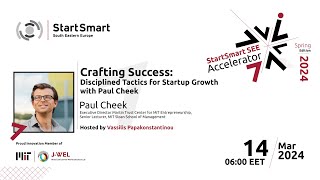
WEBCAST: Crafting Success: Disciplined Tactics for Startup Growth with Paul Cheek