WEBCAST: Crafting Success: Disciplined Tactics for Startup Growth with Paul Cheek
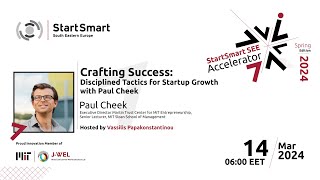
Paul Cheek, MIT educator and entrepreneur, breaks startup growth into 15 disciplined tactics across four stages: foundations, market testing, product development, and resource acquisition. He uses examples like Livy, which built a 1,500-person waitlist before launching, to show how structured experimentation and founder-led execution beat guesswork.
Chapters
My name is Vasiliso Apocostadino from Start Smart Southeastern Europe, formerly known as MIT Enterprise from Greece. We are a nonprofit association based in Athens with close ties to mit focusing on promotion of technology driven entrepreneurship. Among other programs, we run the Start Smart Southeastern Europe accelerator which focuses on early stage entrepreneurs and helps them take their ventures to the global market market. Since 2013 we have launched.
10 rounds and accelerated more than 230 ventures and about a third of them keeps growing and have raised more than $300 million. Last week we opened up the applications for the Spring 2024 acceleration edition and this is a very valuable program especially for early stage entrepreneurs and I think you will get a sense of the value that this program gets to you through this webcast that we have today. A big part of the program is based on the discipline entrepreneurship material taught at mit and Paul will, with his new book will extend this amazing work focusing more on tactics. So if you are an entrepreneur you get your applications ready, you can scan the QR code in my background or go to startsmart se.org keep in mind that this is the first of a series of workshops webcasts. We're having another one next week and the week after to meet more of our alumni and other partners. A Few Words About Paul Paul Paul Chick is a serial entrepreneur in the tech space. He's also an entrepreneurship educator at mit, software engineering, author and patented inventor. He's the Executive Director at the Martin Trust center for MIT Entrepreneurship, a Senior Lecturer at MIT Sloan School of Management, author of the discipline Entrepreneurship Startup Tactics which is coming up. Paul has been with MIT for years and he was the first hiker in residence and mentor and advised thousands of entrepreneurs that went to conquer the world. So without further ado, let's hear from Paul what he will have to say about his tactics. If you have questions, you can put them in the Q and A section or we can have a discussion afterwards. So Paul, thank you for coming and joining us. Looking forward to the amazing tactics you're going to share with us.
All right, Vasilius, thank you. Let's do this. Let's make it happen. Before we begin, I'd love if everybody could just quickly throw in the chat. Are you an entrepreneur? A startup founder? Are you an educator? Are you an investor? What are you? If you could just quickly throw that in the chat, I always want to get a sense of who's in the room with us here today. And Costas, you can put in for everybody you represent within the classroom.
There. So if you Wouldn't mind just dropping that in. Okay. Startup founder. Startup founder, educator and co founder. Excellent, excellent. We can play both roles for sure. Founder, founder of startup, Lunar Cargo, Proud startup or. Okay, good. So we've got a lot of startup founders in here. Investor, great. George. And, and folks doing tech transfer. Great. So we've, we've got a really good mix here. Now what I really like to do is, is, is start off and share a little bit with you, but then open it up for questions. Open it up for questions from, from you all. Whether that's about the accelerator program, that's about startup tactics, whether that's about entrepreneurship more generally, so that we can all make the most of this session here together. So the first question that I must start off asking all of you is are you a scientist? Now I know the answer to this question because I asked you to put in the chat what type of a role you have. The thing that I would ask you to consider is whether or not you have a lab coat in the closet. Right. Startups we think of as having some level of risk involved, but it is truly calculated risk. What do I mean by that? You know, we say that entrepreneurship is not neither an art nor a science, it's a craft, it's something in between. But there is an element of science that you can bake in. Right. When we don't have all the historical data that an established organization has that they can use in their decision making process, we need to go and collect that data and get unique insights. As a startup organization, that data can allow us to make those decisions that will increase our odds of success. So how do we get it? Well, we can get that data by employing the scientific method. The scientific method, right. Saying we've got a hypothesis, we're going to run a structured experiment to go into, see what happens when we put our belief out into the world in front of customers. When we test with them, we come back with data and that data gives us the answer we're looking for to then go and take the next step, run the next experiment, just like we would do if we were sitting in a lab. These are the things that can help us as entrepreneurs to increase our odds of success.
We've always thought about entrepreneurship and entrepreneurship education as a combination of theory and practice. And what we believe is that there's more to it than that. And that's what we've been developing at MIT is this full stack entrepreneurship experience. Vasilius, you had mentioned startup tactics. This is the forthcoming material that I want to share A little bit more with you all about. But when I think back to the first company that I started, it's the education piece that I wish I had more of. The education piece can help us to learn a systematic approach that will help us to increase those odds of success. There are three things that I always hear from startup founders. There's three things that really pop to the top. When I think about every conversation I have with an entrepreneur or with a startup founder, there's three things that I hear more than anything else. What do you think those three things are? What do you think they come to me looking for help with? You know, I work with so many startup founders. These three things I'd ask you to just throw it, throw it in the chat. What do you hear? I like that. Ashar is not a scientist, but troubleshooter. Product market fit from Heather. What else do you think I hear most frequently from. From founders. That's a good one. What else do you think I hear from them?
Take your best guess and throw it in the chat. What are founders looking for?
Yeah, Money. Money. I see that pop in the chat. Funding. Yes. How can I raise money? Right. These are the things that most often pop to the top. And you know, it's funny, I see money keep popping up here. Vicki Partners. Okay, that's a good one. Vasilius, you put how to get customers. You know, I kind of wish that was the thing that I heard more of a team. Yes. Team is a big one. Team is a really big one. Counsel and advice. Yeah, generally counsel and advice. But the things that I hear most frequently are, yeah, it's not even about go. Go to market or getting customers. Sometimes I wish that's where more of the questions went. There's three things that I hear most often. I think we've really hit a couple of them here in the chat. Right. The first one is, hey, we want to build our product. Right. We really want to build our product. Can you help us? Can you help us figure out the best approach to do that? This is one of the top things that I hear. The second one that I would share with you all is that we need a technical co founder. Right. Or we need to build our product. We need team. Right. It might be a technical co founder. It might be a business co founder. Whatever the case, the theme here is around team. This would be the second. The first one's product. The second one is team. The third one you all nailed, this one is, you know, we need to raise a one million dollar seed round. Right. And the number's not necessarily the point here. It's about the fact that they need money. And these are the three things that I hear most often. But my response to them is always, well, why should you be building a product now? Why should somebody come and join your team and why do you deserve to raise a round of funding? Right. And, and what I'm getting at there is mostly, you know, what traction do you have to justify bringing somebody onto your team or building the product or raising that money? Right. You know, when, when I think about it, if you're trying to recruit a co founder, whether they're technical, whether they're a business co founder, it's the idea that they have so many opportunities in front of them, why should they choose to come join your team? What do you have to convince them? What traction do you have to convince them? What conviction have you built yourselves? What confidence do you have to move forward? How can you convince an investor to say, yes, this is the opportunity. This is a de risked opportunity. And these are the things that I always want to help these entrepreneurs do so that they can wind up building that product, they can wind up recruiting people onto their team and raising money. So that's where the entrepreneurship education trio comes in. The third piece of this are the tactics. The tactics, the, the execution skills, the, the, the actions that we can take. You know, when we think about disciplined entrepreneurship in this methodology and Basili as this a big part of the accelerator program, we think about this as taking the idea that we have and building a really comprehensive, really rigorous business plan and discipline. Entrepreneurship is the framework that I wish I had years and years and years ago. And now we think about, well, how do we take that plan and turn it into a real business? And this comes back to one of the other things that I saw in the chat. You know, a question of, you know, how do we get customers? What the go to market. We can build the go to market plan, but how do we actually go and do that in the early days of starting our business? And so this is what we look at. We look at this in startup tactics. How do we take that really, really strong plan and put out to the world? And I'll walk you through a little bit more of what's involved here. This, this follow on to the 24 steps. But before we do that, you know, one of the things I heard from, from a student after we kind of walked through this process the first time is, hey, Paul, this is awesome, but what is a tactic, right? This word? I think we all have some sense, but it's important to define it. And a tactic is an action carefully planned to achieve a specific end. Right. The key word here is action.
Right. And this is really important within the context of an accelerator. Right. We've got to be out there taking action, making things happen. Not just putting together a plan, but putting that plan out to the world around us. So then the question I would ask you is what are the two most precious resources that we have as entrepreneurs? Throw that one in the chat as well. What do you think the two most precious resources we have are?
Time and feedback. I like the feedback idea. That's not one that I usually think of, but I think that's so important. That's what helps us to. To build this clock speed in the iteration cycles. So. So time is absolutely one of them. What's the other one?
Idea. Idea. Okay. Many. Not the idea. Not the idea. Important, but not the most important factor. It's the team over the idea. The why is a driver. I like that one a lot. The background, the team. So it's not team is kind of like time, right. The more people we have, the stronger those people are, the more we can use that time with efficiency. There's something else, right? And you all nailed it earlier. And that's the money. Right? Time and money. The two most precious resources we have as entrepreneurs are time and money. So then the question becomes, how do we make the most efficient use of those two resources? Yes, of it. That's. Yeah, exactly. Right. Exactly. Right. Right. How do we use this time and money as efficiently as possible? It comes back to that data that we need to capture as if we were scientists. Right. You know, sometimes that experiment's not going to work out, and that's okay. But our focus as entrepreneurs needs to be on making as much progress as we possibly can with the most limited amount of resour. The most limited amount of time and money. And that is what tactics aims to do.
So why is this so important? Right. We know that we've got limited resources. Why are these tactical approaches so important? To look at that in more detail, we need to go back 2500 years. What happened 2500 years ago? There's a book that was written. That book was written by a Chinese military strategist. Some of you might be thinking about what that book is. The book is the Art of War by Sun Tzu. And in the Art of War, Sun Tzu says, strategy without tactics is the slowest route to victory. Tactics without strategy is the noise before defeat. This nicely encapsulates the need to not just have a high, high quality, comprehensive business plan, but to know how to put that plan into action. And so this is truly the ethos of what these tactics are. And this is our need to say, look, not only can, you know, we figure out what we want to do, but we know how to do it. And how to do it is oftentimes different than what we would do intuitively. Right? So for many of us, we might be used to working in a larger organization. And when that's the case, you know, the strategy and the tactics are just a little bit different than when we're trying to build something from the ground up. So this idea from the Art of War is something that manifests within the design of these tactics. When we talk about successful entrepreneurship, we talk about needing the spirit of a pirate and the skills of a Navy seal, and both are important. I have a hunch that you all already have the spirit of a pirate because you're here, right? You have the spirit for entrepreneurship, you have that ingrained within you, and you likely have many, many skills. The question is, do we have the entrepreneurial skills? And that's something that we seek to always build up. So the tactics focus more specifically on the skills that we need to take that plan and put it into the world.
Now I'm constantly reminded that while we are focused on the skills that we need, my. My co instructor here at mit, his name is Nagar Junivena. He reminds me often that, you know, entrepreneurs need to know just enough to be dangerous in every functional area. So, you know, for example, my specialty is software engineering. That's my core competency, that's my core skill set. But in order to get a business from zero to one, you know, we need to know just enough about every single functional area to be highly effective. We need to know as entrepreneurs, as founders, just enough in every functional area to get the business off the ground so that we have that traction that will allow us to go out and, and to get more resources, more time, more money. It will allow us to fundraise and it will allow us to hire more people. The challenge that creates for us as entrepreneurs is we need to learn not just about engineering or not just about marketing, or not just about sales or just about fundraising. We need to know just enough in every single functional area. People often talk about this idea of founder led sales. The founders are always doing the sales, and they should be. My belief is that founders need to know just enough about every functional area to get the business off the ground. And so what we really need is founder led everything. It's tricky because as entrepreneurs we have to wear so many different hats. Right? We need to be the CEO, we need to be the product manager, we need to be the chief marketing officer and the VP of sales and the head recruiter all at once. And we need to know when to put hats on and when to take them off. The tactics aim to give every entrepreneur just enough education in how do we do marketing. But it's not how do we do marketing at a big company and run a variety of different large campaigns and put up billboards. It's how do we leverage rapid experiments like scientists with low budgets to go and to get concrete data from people we don't know about whether they want what we have, whether they're going to come in and they're going to join our wait list or they're going to pre order our product or whether they're going to buy the product we've already built. These are the approaches that we intact that are trying to be scrappy, to use the least number of resources possible.
I just love school is follow instructions, follow instructions, follow instructions. And the real world is try, fail, learn, reform. Goal is to get every entrepreneur something somewhere in the middle. Right? I aim for it to be in the middle because I think we can all use a little bit of instruction when we haven't done every functional area within the context of an early stage startup yet. And just a little bit of a say. All right, what direction work. Let's go try some things. We'll, we'll, we'll, some of them will fail. We'll learn from it and we'll refine and so that's where these tactics aim to sit.
Do you know what PEMDAS is? Perhaps we have some, some, some, some math folks here in the webcast with us. Pemdas, it's, it's a math term. And, and PEMDAS stands for a number of different factors in the order of operations for working through a mathematical equation. And pemdas, it does, it stands for parentheses. Uh, you know you, you go on. Right. And, and exponents and multiplication subtract. Why do I highlight this? Right. We talked about some science needing a code and mix. I'm talking about. Right. Where does this come into play? PEMDAS comes into play because it touches on the order of operations. DOS is the order we follow when we. But my belief is that there's also a strong order of operations that we can follow to increase our odds of success in Building a new entrepreneurial venture. The order of operations is something that, you know, I believe is oftentimes misunderstood by entrepreneurs. And it comes back to those three questions that I promote mostly from founders like, hey, we want to build, where are we in the venture development process? And so this order of operations that we present in the startup tactics follows what's been time tested and proven and that can help you to get customers before you've ever built your product. The 15 tactics to turn your business plan into a business. From startup tactics, walk you through four stages, starting with the foundations, moving on to market testing, looking at product development and resource acquisition. And when I say resource acquisition, I'm thinking about going out and getting more of those two most precious resources that we all have as entrepreneurs. That's time and money. So let's take a walk through, let's go down the road.
Now.
We start by looking at the foundations. We look at our goals and the systems that we're using to track those goals. So this approach says before we do anything, we should figure out why we're doing it. We start by looking at our long term vision, the milestones that will work us towards that vision and make sure that we have the systems in place to track our progress towards these goals. Goal setting, I believe to be something that we all think we're really good at. But then when the rubber meets the road and we put them down on paper, they're not often quite as good as as we believe they are. And you know, we test this over and over and over again by looking at how do we create the most alignment amongst your team with the best goals possible. Once we have those goals set, we know what we want to invest our time in and we move on to market testing. Market testing says, all right, can we do some market research, some early rigorous primary market research to get to know our customers as well as we possibly can? Can we build some visual assets that help to explain this complex solution that we envision really quickly in a limited amount of time with somebody's limited attention? And then can we use those assets and the learnings from our market research to go and run some early marketing campaigns with the mousetrap approach that allows us to test a value prop with people out in the world that are highly targeted based on our beachhead market from disciplined entrepreneurship? And can we do some outbound sales outreach early on to validate that people want what we have these two tactics, marketing and sales. We don't just look at them as, hey, let's market some stuff let's sell some stuff. We look at it with that scientific method in mind by saying, we hypothesize that this Persona wants this or that, this Persona wants that. And we run experiments to come back with data to say, this is our actual Persona. We've dug into the details of it. We know that this person wants what we think they do. And at the end of market testing, we aim to always come back with customers. We should have a list of people waiting down the street to use what we think they want before we've gone any further. Once we have that list of customers, we move on to product development. This stage of the tactical journey looks at building out the product roadmap aligned back to those early organizational goals we set. In Tactic one. It looks at product design, right? Getting just enough product design done so that we can do the next tactic of user testing, putting that in front of people and taking a structured, rigorous approach to saying.
What do we need to learn about how people interact with this proposed solution? And then doing some engineering, taking that list of customers, taking our product design and what we've learned from the user testing process and saying, all right, let's go build the smallest possible version that mvbp, the minimum viable business product from disciplined entrepreneurship. Let's go build the thing. And we look at exactly how to do that. Once we have our line of customers waiting down the street, the street to use the product we think they want and we've come back and we've actually built that product, that's when we migrate and we begin to focus a little bit more so on resource acquisition. Resource acquisition looks at the legal and finance elements of building this business and getting it off the ground. That's how to incorporate what considerations we should have. Building the financial model, the pro forma, how are we actually going to build this business, what expenses we have, and from there, the pitch, just talking about. We look in detail at how to craft a story, how to craft a story that's going to get people emotionally engaged, vision that we have, and that with them, the journey that we are going on. And this becomes extremely helpful in the subsequent two tactics. The next one is fundraising. Not just how much do we want to raise and how should we think about fundraising, but how do we actually do it? How do we identify investors, what assets do we need to be able to send out to them, how do we do the outreach? What kinds of introductions do we want to get? How do we get those introductions to investors? That's what we look at in fundraising. And once we have that money secured. It sets us up nicely to move into our final tactic, that is hiring. Hiring looks at not just, you know, what's the HR plan and how do we build the team, but it looks more specifically at, you know, how do we craft that job description, how do we get candidates lined up to come and join our team, what do we send out to them, how do we think about compensation, all these sorts of things, especially at the early stages of a business. As we work through these tactics, you'll see that we wind up with the last two, fundraising and hiring. Fundraising getting us more money and hiring, getting us people and the equivalent of more time. These things are really important for us to continue moving through this process to get more customers and to advance our product development from the earlier stages. I saw somebody commented about the illustrations, huge shout out to Maria Sarsace, who is the mastermind behind communicating these complex entrepreneurial concepts in such fun and engaging illustrations. You know, Marius and I went back and forth on this specific overall illustration together for so long, and he figured out how to craft this in the exact right way. Where what you see here is, of course, goals in the forefront and resource acquisition way in the distance, migrating from, you know, you know, the, the grassroad, the jungle in foundations to the dirt road in market testing to the brick road in product development and the highway and resource acquisition. And, you know, when we look at this illustration, the thing that I want you to consider is how while we start with the foundations and we go from foundations to market us in product development to resource acquisition, you'll notice that the grassroad continues on forever, right? And they wind up blending together. Because then once we've gone through these tactics, once we apply them all in harmony over the course of time as we continue to develop this venture. So there's a lot here and there's even more things kind of baked in to this illustration that don't always meet the eye. We've got more information about that online. I'd encourage you to go and check that out. But really what's important here, it comes back to Pemdas, to the order of operations and to our quest for more resources. That's the fundraising and hiring. So does it work? We have tons of examples of this stuff working. One wonderful example is a company called Livy, founded by Anisha and Madeline. They'll be.
In the book. You can read more about this. But, you know, when they went through and, and they were building their company, Livy, before they ever built product, they ran a whole series of experiments to look at what is the value prop that really resonates with their target customer and come back with concrete data that says, this is the value prop, this is the right one. You know, they ran all these experiments, they wound up with 1500 women, their customers, on the wait list before they built any product. And this approach gives confidence and conviction to say, we've got the thing, we're going to keep moving. This is what we need to build. There's way more details on this specific example included within the book. Another example is a gentleman named Camilo who started a company called Memorable. And Memorable is a company that does complex advertisement analysis and redesign. He leveraged these different experiments to go and to build a variety of changes within his company. Now, you know, for Camilo, they were already off to the races. They'd already raised a bunch of money, they'd already signed up some customers. And he used the tactics to actually increase the efficiency of his business, to find ways to be more effective. So, you know, with the assets tactic for, for example, he developed what you see on the right static here, but an animation that describes in a very short period of time exactly how their product works. He saw 123 increase in the book, a demo conversion in two weeks. He leveraged the sales tactic to sign and onboard four Enterprise, brand name B2B customers. And when he thought about his team, you know, he was able to use the tactics and think about what's the culture, what's the organization, what's their talent pipeline to get new people into the business. So this stuff works. It's all available to you. You can go on, you can go on the website, you can download all of the materials, the workbooks, the playbooks. It's all available for you there. I'll leave this with you and it'll of course be available in the reporting. But you can grab these workbooks. You can start going through them now, depending on which functional area you need to use within your business as you seek to expand it. Of course, the book is coming out April 2nd. The book will have all of these tactics, tons of examples, and access to all the workbooks as well. We're very excited for the launch and excited to share more about it with you, Vasilius and the team in Greece. And the thing that I want to leave everybody here with today is that there is an order of operations for entrepreneurs. We can follow it to increase our odds of success and define success as we move through the development of our venture. So that's what I'll leave you with here today and I would love to open it up for, for any questions. And Vasilius, back to you.
Thank you, Paul. This was amazing, pulling all these things together. I've been teaching the digital entrepreneurship book content to the National Technical University of Athens and the tactics part was really missing because it was difficult for people to extrapolate, especially for younger, less experienced entrepreneurs to get there. And two things that come out of the, the whole presentation is that data driven entrepreneurship drives success, reduces risk, which is very important for the entrepreneurs and the investors in the room. And essentially you want to approach entrepreneurship in the form of experimentation, structure, experimentation. Sometimes the word experimentation has a negative connotation because it feels like you're just throwing things up in the air and you see what sticks. This is not the way to do that. As you said, the structure approach to, to get the, to, to test the results in each case and adapt your course.
So.
On that, Vasilius, on that, like that's so important. It's the structure. I believe that, that we, as humans, we operate best with structure around us. Right. You know, when we think of entrepreneurs, there's a misconception that entrepreneurs have no structure. It's like they wake up in the morning and they decide what they want to do for the day and, and they can do whatever they want. And it's like that's not the case, right? In, we have plenty of structure, right? You know, there's, there's goals, there's metrics, there's specific job titles and roles. And, and I believe that, you know, for, for us as, as entrepreneurs, we need structure as well. The challenge, the difference is we have to build it ourselves. And those early tactics help to do that. But yes, structured experimentation, not just experimenting and throwing stuff at the wall to see what sticks.
I think one of, one of the questions in, in the, in the chat was, you know, I, which I think represents a lot of people in the room is that, you know, I've, I wish I had, as you said, like you know, a year ago, six months ago or whatever, this book, and I've started working on that. So the first question I would like to pose on behalf of everything else, everybody else, before we get into this discussion is can you, can you explain how even though you have been down the road, you know, a few steps, is it, does it make sense to retract your steps and start from the beginning or how, how do you approach like, you know, we have these new 15 tactics. Do we start from scratch or we try to and get to get them into our, Our own thing.
Yeah, this is a great question. And, and, you know, broadly, when I think about that, right. If we're already here, but we haven't done what's over here, that's okay, right? And that's going to be a reality for, for, for so many founders, so many entrepreneurs. The thing that, that I like to say is that they're best learned in order and then executed in harmony together. Right. And what I mean by that is, you know, setting goals as the first tactic, you're going to be constantly revisiting that. Right. If you set goals today, for the next three months, for example, you need to be checking in on that every single month, potentially every single week, to see, are we on track, are we not? And so, you know, coming back to, I believe the question that you were referring to in the chat was around if we've already created a product but not exactly clear who the end user is, or are there multiple potential users. You know, when I think about that question and the specificity included is, hey, maybe we've built the product and that's just where we are right now. That's fine. Right? But then we need to figure out, right, what are the goals given where we are today. Right. So I would recommend going back to the beginning, both of tactics, to the goal setting, but also to the 24 steps. Because the first question that we ask ourselves and every entrepreneur is, who is the customer? Because if we don't know exactly who the customer is, we don't know what product to build. Right. We don't know how we can help to solve somebody's problem. And, you know, the engineer in me is thinking, well, great, we can go build the product. But, you know, there's this old saying, if you build it, they will come right. From the field of dreams. Perhaps you've heard it, I believe that's a load of garbage. Right. It is very rare that that happens. And so figuring out who we're building it for, really narrowly defined, I would start there. That's where I would recommend starting before we continue on with the product development, just to make sure that if we build this thing, there's going to be people who actually want to use it.
Yeah, you're right. You're right. Sometimes it's important to backtrack a little bit, to take some distance from what you're working on, because otherwise you cannot see the issues. So anybody has specific question to poll or raise, raise, you know, comments or whatever, keep it short, please, but, you.
Know.
Yeah, Nicholas, I see you deep in thought. Deep in thought.
If we don't have any.
Specific question.
You'Ve seen a lot of entrepreneurs, so. Jennifer. Yeah. You can unmute.
Hi there. Thanks so much, Paul. Sorry, it wouldn't let me unmute for a second, but now I was able to. This is awesome work. And I'm curious for people who are interested in starting startups and perhaps are going to be joining a program at mit, what do you recommend as pre work? Like would it be reading this and the 24 step book? And do I understand correctly that the order of them is first you start with disciplined entrepreneurship steps and then you do startup tactics steps?
Yeah, Jennifer, great, great question. Right. And what the order of operations between these two. Also very important. Yeah. You know, when I, when I think about, you know, like pre work going into any program. Yeah. I'd recommend starting by just reading through it. Right. But they're designed and they're easy reads. Right. They're, they're not, you know, they're not super dense, but getting that background, that context in your head and then, and then thinking about, you know, the, the reference books. Right. So you're going to refer back to them as you go. I would start by thinking about just the first few steps of discipline. Entrepreneurship, market segmentation, Beachhead market, end user profile. I would start there. And you know, that's where primary market research comes in. We've got tons of resources on primary market research. You know, it's also included as tactic number three. So I would kind of start with both. And I think the best way to learn them is to think about, you know, the structure and the framework of the 24 steps and then to go into the tactics. But I think you'll start to move through them together as you go. And everybody has a slightly different approach to that. We're actually seeing a lot of folks around the world teaching them in different formats, like together or separate. But I would recommend for you, yeah, explore them both, get the context and then start moving through the first few steps of disciplined entrepreneurship.
If I may add, I think this is kind of like trying to learn a programming language. You cannot learn the language first and then start playing around. You have to do that almost concurrently. Like, you know, these. As Paul said, both books are very lightly written in the sense that you can just refer to them even independently. You know, you, you want to focus on a very specific step or tactic. You don't have to read all the previous ones. So my recommendation would be not to take them serially. You can take Them like, you know, as, as you move on and, and forth. Abed. Hi, everyone. I hope you can hear me well.
Very well.
Well, I really like the illustrations. I am a bit of a. Or I used to want to become an illustrator when I was young.
So I really like illustrations.
Very well done, Paul. My question is.
No, no, no, that's not me. I can't draw. I can't draw.
Oh, okay.
That's Marius. That's Marius all day, every day.
All right, so well done, Marius.
Kudos.
Question to you, Paul, is if my idea is more creative than practical. If, let's say the.
The sort of. The problem of the industry that I want to get in has already been solved, but I think it's kind of like outdated or kind of like 20 years old.
How, how do I go about doing the market research? Because a lot of people might tell me, like, I don't need this.
Yeah, okay. Okay, cool. So the thing I would say is I wouldn't be discouraged by the fact that there's some other solution that's been around for 20 years. There's always new opportunity and surely somebody still has a problem. The question is, is what problem are you trying to solve and for who? Right? We start with that question, like, who is the customer? You've probably got a good sense of that already. But now it's your job to leverage that early primary market research to determine what's their biggest pain point, what's the thing that's going to move the needle for them. And it might not be what you've already imagined. You've got to kind of like step back from what you believe today, right? What solution do you think you want to put out into the world and just listen up, get to know them as. As people, right? And understand, do you have a group of very similar people who are facing the same problem? A problem that's really significant for them because if you can't solve somebody's problem, you're not going to create value. And if you can't create value, you're never going to be able to capture value. Right? You never. Nobody's going to pay you, essentially. Right? And so for you, when you think about this process, your job is to create value and capture value so that you can do so in the long term.
And, you know, it's not always going to be exactly what you imagine. Your initial idea. Know that. Your initial idea, yeah, it's a good starting point, but it's going to change. It has to change. If it doesn't change, we. It's probably a sign that we're.
We'Re biased and we're trying to just go take what we want to do and push it out to the world. So know that you're going to have to, to change your approach, your perspective based on what you hear from the customers who you interview.
Great question. I bet.
I, I think that Marius had a question.
You're muted. Hold on.
Of course, yeah. Thank you very much. Can you hear me?
Yes. Marios.
Paul, thank you very much for the precise presentation. I would like to ask if there are teams within university context, like research teams, that they want to valorize research results.
Are there specific tactics to follow and can be.
Can get use of what you suggest? Because the thing is that most of the times within research teams, we have the solution and we have to find.
Who has the problem.
It's exactly the opposite way. Rather than finding a concrete problem, finding a specific customer or a Persona and addressing his or her problem, usually you have the opposite way. How might research teams.
Make use of your framework?
Yeah, great question, Mario. And it's funny because I was sitting down with a research team just last week and look, these are entrepreneurial frameworks, right? They're, they're designed to help you take something into the market. They're not designed to validate research results necessarily. Right? And so what I would encourage any research team to do is to say, look, we've got our technology and that's great. It's over here. There are tons of different applications of this technology or this science or this solution, if you will, that, that we could take and go approach, right? And say, look, we're going to apply this fundamental research here, here or here. But like I said, if you build it, they will come. It's not always true. And, and you know, trying to go and tackle all of these can put you at a disadvantage because you have limited time and money. This was the exact conversation that I had last Friday at lunch, right? It's, we've got all these things, we want to change the world, but the amount of time we have to go do all those, it's super limited. So we've got to pick one. We've got to pick the one that gives us the highest likelihood of success today. That's one. And it doesn't have to be big. It needs to be a reasonable S size that we can go after and invest all of our time, energy, attention and focus on, right? Because if we can get that one market, if we can get one use case, one application of this research, we can then we'll have the resources to be able to say, all right, let's go to the next one and then to the next one and then to the next one in, in a way that allows us to continue to be scrappy. So my recommendation for you would be to focus extensively on the first step in the 24 steps and that is market segmentation. You've got to figure out what are the different markets, what, what are the different segments of each market and what are the use cases in each to figure out where do you start? Because we can't tackle all, everything all at once.
If I may add, there is another webinar coming next week on the 19th, same time. There will be announcements shortly afterwards where we are hosting. Panagota will be doing the moderation. We are hosting three deep tech startups coming of the research labs that they were part of the program the previous years, Twin Biotech and one in energy. And I think they can share some insights about how they choose their very specific thing. But what Paul said is, yeah, it's true. It's very tempting to start looking at the very big picture. Like, you know, especially younger entrepreneurs with limited experience, they've been, you know, know, they keep listening to the media talking about the big problems that Elon Musk or anybody else is trying to solve and they try to go for the moonshots. Moonshots are, are great, but there are so many simpler problems that you can hone your skills on and then get ready. I mean, the moonsaults will be there and there will be new moonshots. Like, you know, start with the lower hanging fruits and build from there. So, so we have a couple of questions in the chat. One of them from Heather is how to know when to stop your experiments and then we'll.
Yeah, I love this. I love. This is a great question. And you know, it's, it's interesting because there's no one example, there's no one use case. Right. It's not like a certain amount of time or necessarily a certain amount of data that we get back. The thing that I would encourage you to do is think about does the data that we've already gathered as we're running this experiment give us the confidence and the conviction to move forward. Right. We could talk about statistical significance of the information we've collected. Right. And the different hypotheses we're testing. But my recommendation would be to say, especially in the early stages when we're not going to have, you know, some expansive data is to say, do we feel really confident about this. Right. And so I would say run them as, as quickly as you can with as small budget as you can and to say look, in a few days, in a few hours you look at it, in a few days you look at it. And if you have enough data to support a path forward and that experiment and figure out what the next experiment is, don't stop experimenting but just figure out what is the time to transition to the next one, to text test the next hypothesis. That would be my recommendation. It's not, it's not a perfect formula. We just need to have the conviction ourselves as founders to, to go down one path over the other based on the data we have on hand.
As we are wrapping up, there will be a great opportunity. As I said, the poll is coming to Athens and we were having a very interesting event on June 26th. You can, you can get online to find, to keep the updates as they are coming up. One last question that I would like to ask you, which I think it's.
Very relevant, is how can startups balance the need for quick wins, as we said before, against long term vision and building the interest. So, and in what ways acceleration programs like what you do the Delta V or Start Smart or other. What is the why sustainably accelerators get higher success rates than the average? You know, whatever it's 10% is the.
I don't know what it is exactly, but I know what you mean and I know what you're getting at. Because when we see the teams that have come through over the course of the past 10 years as part of the Delta V program and you know, 69 of them are still active or have been acquired, you know, we think about what makes for that success. You know, when, when I think about this, right, what, how do we balance the, the long term vision and the short term wins? It's, you know, is the team aligned on that long term vision? That's the first thing. If I were to take every co founder on a team and sit them down together, but separately and say write down the vision you have for the company and then we look at what they've written down. If they're not all the same, you know, we're going in different directions. So that's the first part is aligning on that vision. The second part is figuring out are we looking at the shorter term milestones that get us to that vision? Are we looking at them in a way that's constructive as a team? Are the things that we're spending our time on every day, do those actually contribute to the shorter term milestone? Because what we look at often is like if you look at an entrepreneur's to do list, it's filled with a bunch of activities. Do those activities contribute to the next milestone? Not always. We got to figure out what we can cross off that list. The short term wins, right? We've got to make strategic decisions. And that comes back to, you know, what we're talking about, the beachhead market, right. How do we go and run a quick experiment to get, you know, some really concrete data? How do we go get five customers to say yes and give us a credit card number to sign, a letter of intent? You know, those short term wins can help us move in that direction. But what we might. We have to define what a short term win is, right? We could say a short term win is developing a new feature. But is that, is that a win that gets us closer to the vision? Right. Maybe from a product perspective, but not from a business perspective. If we just build a product, then we won't have something that's sustainable, that can continue to support itself over the long term. And so that's really what I come back to. So how do we make sure we're doing the right things in the right order at the right time? When we think about accelerator programs, they have structure, right? We talked about structure earlier, Vasilius, right? It's like we need structure as entrepreneurs. And accelerator programs give you structure, they give you programming, right? So there's some form of education around them generally, and content, there's accountability, right. You have other people to hold you accountable and to make sure that when you said you're going to do something, you actually do it. And, and you know, the other thing I would say, being community, right.
You know, it can be lo, not just, but as a team, having other people who are going through that process together and working alongside them, having people to bounce ideas off of becomes so important. And that's something that if you're just off building a company, you don't always have. So you get that, that built in accountability from this community. And you know, of course accelerators oftentimes come with, with.
Structured connections, but just being a part of that community and the network beyond that accelerator program, really important because, you know, oftentimes we're going off starting a new company. Some people might have connections in the industry, others might not. But it's connections to industry professionals, to potential customers, to partners, to advisors, to potential investors. Right. You know, thinking about the process we go through and the second to last tactic. Fundraising introductions are a huge part of that. And a cold introduction to an investor, you know, cold outreach to an investor generally doesn't work that well. So building yourself a network by leveraging an accelerator program can be a huge help.
You're absolutely right. I think there will be a need for a psychotherapy book. The third book after the tactics should be on psychotherapy of entrepreneurs. Because I think this is an important part of the accelerator programs. We are there to to hear all the concerns and all the.
Insecurities and try to take them to the next step. So thank you, Paul. It was amazing. We are looking forward to have you in Athens. For all of you that you decide that there is interesting things to learn from the start. Smart accelerator Scan the QR code or go to to the link and start working on the application is not that difficult, but it will change a lot in the way you are approaching things. Everybody will get a copy of the video recording and mark your calendars for next Tuesday.
On the 19th we are having the entrepreneurs and on the 26th we're gonna have another webcast with somebody from EIC who will talk about especially to the deep tech community, how eic, the European Innovation Council, will help. So thank you, Paul. Thank you everybody for joining. Have a nice evening. Afternoon, depending on where you are.
We'll see you in Athens.
Thank you. Bye bye bye everybody.
Bye everybody.
More from Paul


Episode 03: A Conversation With Paul Cheek of the Martin Trust Center for MIT Entrepreneurship