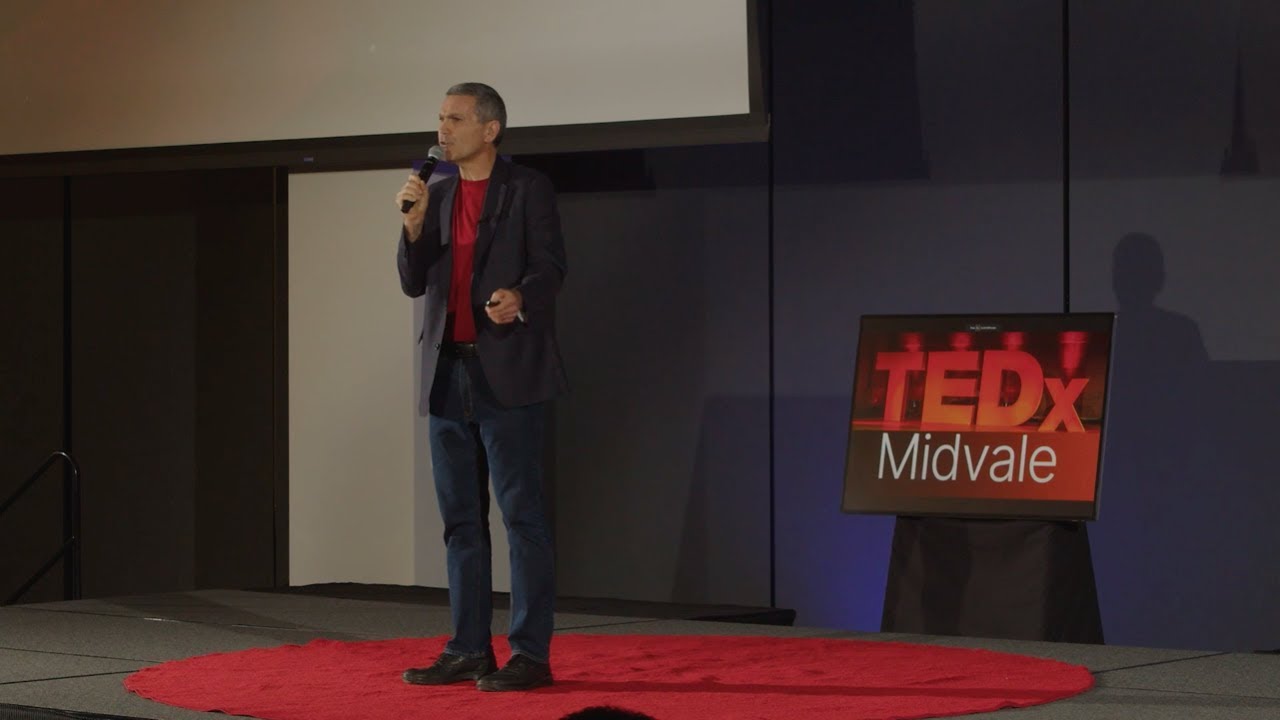
In this TEDx talk, Pete Alexander shares his deeply personal journey from a chaotic, dysfunctional family marked by multiple marriages, alcoholism, abuse, and traumatic events to a place of emotional healing through reconnecting with his inner child. He begins by illustrating the extent of his family dysfunction, recounting harrowing experiences such as his mother's alcoholism, a forced interview with her, an attempted sexual exploitation, self‑harm encouragement, and his stepfather’s suicide. At age 25, Alexander entered the Adult Children of Alcoholics 12‑step program, where he first learned the concept of the "inner child" and began to act as his own loving parent. Twenty‑two years later, a chance encounter with a child drawing on an airplane sparked an accidental reconnection with his own inner child, leading him to create a simple paper‑folding art exercise that evoked a powerful emotional release. He then guides the audience through a visualization exercise designed to revive childhood creativity and sensory memories. Drawing on Jungian theory and John Bradshaw’s work, Alexander distills his experience into three actionable lessons: (1) extracting positive insights from past pain, (2) allowing oneself to laugh freely, and (3) practicing forgiveness, illustrated by a heartfelt note from his mother before her death. The talk concludes with an invitation for listeners to engage with their own inner child as a pathway to resilience, joy, and personal growth.
Chapters
¡Ah! ¡Uh!
Thank you.
We all have an inner child inside of us, a version of ourselves that once dreamed fully, laughed freely, and knew joy before pain. But what happens when life teaches our inner child to hide? So, show of hands, how many of you experienced having your parents divorce when you were a child? Looks like about 30% of you. Well, The dictionary definition of family dysfunction has a picture of my family on there. My parents combined had 9 marriages, 7 divorces, and 1 widowing. My sister, a 100% blood sibling, is from a different marriage. She's the product of my parents' first marriage, And I'm the product of my parents' second marriage. Yeah. Your story may be different, but we all know what it feels like to carry something heavy from the past. Now, I didn't notice the dysfunction in my family until I was 7 years old, when my parents divorced for the second time. Not long after, with all the alcoholism and feelings of abandonment, My inner child went into hiding. My outer child had to become an adult raising me because my mom was too preoccupied with alcohol and her relationships. I remember thinking back then, this isn't what Disney movies— I decided to interview my drunk mom. Mom on Christmas Eve. And during this interview, I asked her why does she drink so much. Here's a snippet from that interview.
Interview me, interview me, and that's it. Okay, all right. When I pass out, I pass out. Uh, Glory, when did you really stop drinking? Um, I used to think, and at the most, Pete Alexander teaches, 2 drinks an evening. Really? Yes. And then I used to go on coffee. Well, why do you drink about, you drink about 6 drinks a night, so in one, about maybe from 6 to 9 o'clock, you've already inhaled about 6 or 7 drinks. Okay, have you paid for them? No. But why do you drink them? I'm asking you, did you pay for them? No, but why do you drink that much? Forget it. Forget it, Didi. All right then.
This wasn't just a conversation between a mom and her son. This was a 12-year-old child trying to make sense of a world that had become unpredictable and out of control. No child should have to ask their parent why they drink so much. But I did. When I was 13, my mom talked her 46-year-old friend into seducing me. When I was 14, my mom and stepfather encouraged me to slit my wrist in front of them with a kitchen knife. And when I was 22, My stepfather made sure it was me who found him when he decided to commit suicide by hanging. The PTSD that I experienced when I was young made me who I am as an adult, while my inner child continued to hide for many, many years. Psychologist Carl Jung has been credited with coining the inner child phrase over 100 years ago. When he theorized that this inside part of us influences everything we do and the decisions we make. And extensive research published in the National Library of Medicine has long suggested that the quality of our childhood relates to later-in-life mental and physical health outcomes. Now, I didn't even realize I had an inner child until I was 25 years old, when I entered the 12-step program Adult Children of Alcoholics, and dysfunctional families. The program taught me how to become my own loving parent, teaching me first to like and then love myself instead of hating myself like I was doing. Entering the program truly split my life into before and after. Interestingly though, it wasn't for another 22 years until I reconnected with my inner child, and it happened by accident. I was flying home from a conference, and in my aisle sat a small child, maybe 5 years old, who was drawing a picture. And the picture she was drawing, it reminded me of artwork that I used to enjoy when I was very young. Let me share with you this fun creative that awakened something inside of me. Maybe it can do the same for you. So first, what you do is you start with a blank piece of paper and you fold it in half, and then you write your name in pencil above the folded line. Then you fold it back over and you scribble on the outside of where you wrote your name, and then when you open the paper back up, then you'll see that there's a faint outline of your name below the folded line. You go ahead and you stencil that in, and then you start coloring it to your creative heart's desire. And as you're coloring it, maybe it starts to take the form of something like a fish, or maybe something like a totem pole. You know,— Remarkably, while I was creating this artwork on the airplane, a wave of emotion came over me. I started crying because I was reconnecting with my 7-year-old for the first time in approximately 40 years. Luckily, I was sitting in a window seat and I could look out the window as I was having this breakthrough, because with the tears in my eyes, it would have looked much more like a breakdown to the other passengers. That moment on the airplane was not just emotional, it was transformative. Now, I'd like to facilitate a quick visualization exercise to help take you back to a time before responsibilities, before self-doubt, before life told you you had to be an adult. Let's see if we could tap into something that you loved to do as a child, something that made you come alive, and see what it can teach you today. Visualization is a powerful tool we can use for reconnecting with and healing our inner child. It allows us to tap into memories, emotions, and subjective thoughts that may have shaped us. By intentionally visualizing comforting scenarios, we can— we can nurture self-compassion and resilience, according to the groundbreaking work by John Bradshaw. So if you'd like to participate, go ahead and close your eyes. Take a deep breath in. And I want you to go in your mind to when you were very young, maybe 5, 6, 7 years old. What creative outlet did you enjoy? Was it artwork? Was it music? Was it dancing? What was it? Now, let's see if we can reconnect with that activity. So what do you hear? Do you hear laughter or your favorite music? What do you smell? Do you smell crayons on a summer afternoon? What do you feel? Do you feel grass under your feet? As you're dancing? And what do you see? Do you see the blue sky of a sunny day? Whatever it is, take it all in. Now take another deep breath in. And gently open your eyes and notice how you're feeling now. Pretty good, huh? That's likely your inner child smiling inside of you. Reconnecting with our inner child allows us to learn 3 lessons that foster emotional intelligence and resilience. Lesson 1: Positive insights. Instead of being stuck in the past, think about a positive insight from what happened. My family's dysfunction motivated me to get my college degree so I could get out of that environment, pursue my degree and my career, and work on myself in the 12-step program. Is there a positive insight you could reflect on from a challenge in your past? Lesson 2: Laugh freely. Reconnecting with your inner child means embracing the sense of wonder and playfulness that we often lose as adults. But we can tap back into that when we laugh like we did as kids. You know that unbridled, carefree laughter that lets go of inhibitions? When we laugh like we did as children, We don't care what other people think. We just let the joy flow. And by embracing silliness and not taking ourselves too seriously, we open the door for joyful bliss. For whatever reason, my inner child absolutely loves the sound of whoopee cushions. Whoopie cushions! Oh my gosh, it never gets old. When we allow ourselves to laugh freely, we get stress relief. The tension just melts away and we become more relaxed. It's like a reset button for the mood. Bottom line, when we laugh more, we live better. What's one way that you could add more laughter to your life. Lesson 3: Forgiveness. My mom was a wonderful grandmother to my two kids, and this allowed me to forgive her for the atrocities that happened to me when I was young. Interestingly, not long before she passed, she wrote me a note that I want to share with you today. Sorry, it's kind of emotional, so— Pete, all my love. When I come to an end, I want you to know how wonderful you've been to me, trusting me with Nicole and Chris. They are my heart, and this is thanks to you, Pete. You made my twilight years worth living. I felt young and loved when Chris and Nicole were near me. Thank you for all the good times we spent together. May God bless you and take care of you always. Is there someone you could forgive so that you could let go of that toxic rumination? Family dysfunction does not define us. It's an opportunity to rise above it. Today, I invite you to reconnect with your inner child, and not just for healing, but to uncover the joy and strength already inside of you. Thank you.