War, AI and lack of funding: how can CEOs be confident in their decisions?
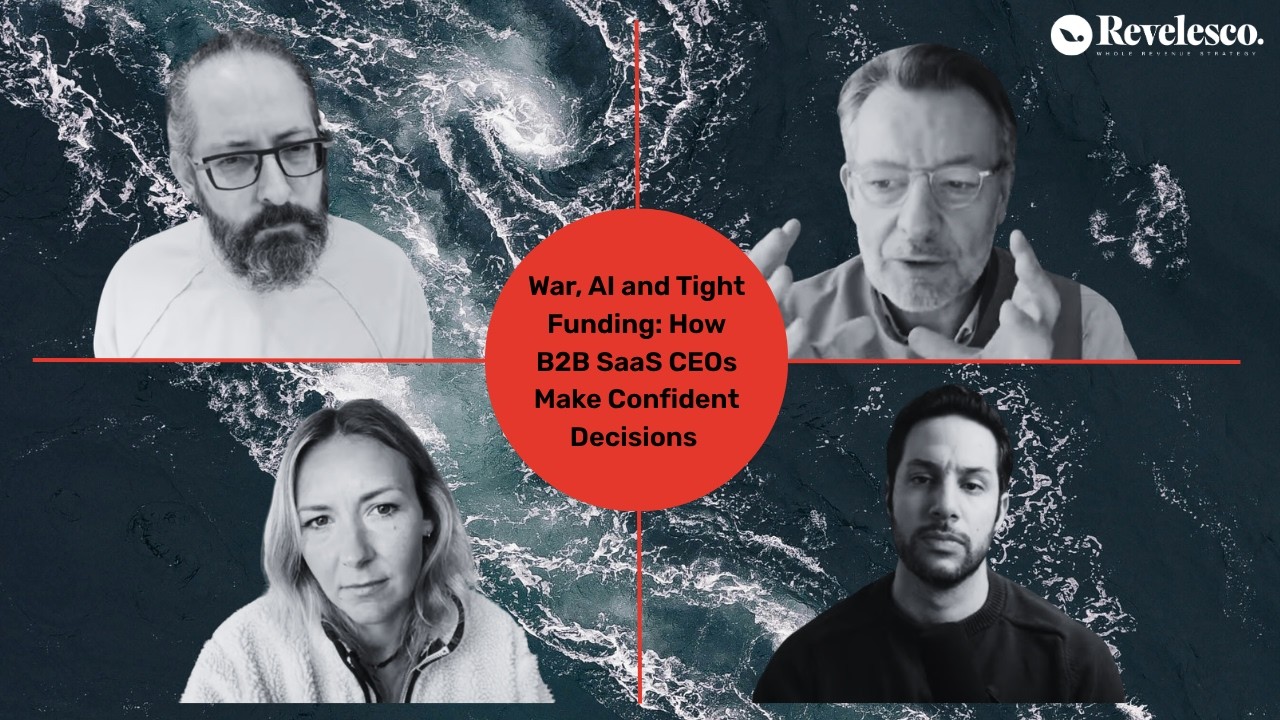
In this Revalisco‑hosted panel, Emily introduces a "perfect storm" of three converging crises that are destabilising B2B SaaS companies: (1) escalating geopolitical conflict in the Middle East, (2) rapid AI‑driven uncertainty in hiring and product‑market fit, and (3) a severe contraction in venture capital funding. The discussion brings together three specialists – Pete Crosby (CRO & CEO coach), Ben Rosner (strategic communications & former IDF strategist), and JP Alves (finance director & former CFO) – who each present practical lenses for CEOs. Ben outlines the current Iran‑US‑Israel conflict, its impact on oil prices, data‑center availability, and the need for clear, multi‑audience communication (board, team, customers). He proposes a three‑principle communication framework: state what you know, what you don’t know, and what you’re doing; filter signal from noise; and avoid mistaking optimism for a plan. Pete shares a strategic decision‑making toolkit: envision future scenarios, revisit the SaaS Pyramid (primary, secondary, tertiary product layers) to prioritize mission‑critical offerings, and continuously reassess product‑market fit, rarity, and ICP focus. JP emphasizes rigorous cash‑flow forecasting (daily/weekly), distinguishing fixed vs variable costs, stress‑testing scenarios, and protecting against cyber‑risk, especially in Europe. Across the conversation, the panel stresses the premium on human judgment in an AI‑rich environment, the need for board members with geopolitical expertise, and the importance of talent retention through transparent communication. The overall message is a set of actionable frameworks that enable CEOs to turn uncertainty into opportunity rather than risk.
Chapters
Hi there. My name is Emily. I'm the co-founder of Revalisco. And today we've got a hot and exciting panel with world-leading specialists in their category. The objective of today's call is to give clarity and confidence to CEOs of B2B SaaS companies who are having to make critical decisions whilst we live through a convergence of crises. We've got geopolitical chaos. The US is at war with Iran. Australia has begun to stockpile oil. Our clients in Dubai, at the time that we record this, are watching active conflict outside their windows in the streets where they live. And it's not just about war. There are tariffs, there are changes in international policies, and it's causing mass instability for businesses and supply chains. The second key challenge is that we've got a global intelligence crisis. AI is making hiring and product-market fit really uncertain. So how do CEOs manage and take advantage of this without setting themselves up for failure? And then the third key element of this perfect storm, which is making it really difficult for B2B SaaS CEOs, is that we have got capital contraction. Funding is harder than ever to secure. Investors are asking to see strong retention numbers, and they're looking to see these much earlier than in previous years. And predicting retention in a world where future market opportunity is also really difficult to predict is even harder than ever. So to help bring clarity and confidence to our CEO listeners as they're making critical strategic decisions, we have 3 world-leading specialists on the call today. to talk from the lens of their specialist point of view. So welcome Pete, Ben, and JP. I'll give a quick introduction to all 3 of you. So Pete is a full-time CRO with more than 20 years of experience running revenue functions from Series A to IPO. He's a CEO coach and advisor coaching more than 40 CEOs at any one time. And he is also my co-founder at Revolesco. So welcome, Pete.
Thank you.
Nice to see you all.
We also have Ben Rosner. Ben is a strategic communications advisor. He is the former head of strategy and crisis communications for the Israel Defense Forces, serving in times of peace and war. Before becoming our strategic communications specialist at Revallesco, he was a director at a top global strategic communications consultancy in New York. And he also represented Israel in the United Nations and Security Council. We are really excited to have all three of you and Ben on this call today because Ben has a lens shaped by a military strategy and geopolitical risk and corporate communications. So welcome, Ben.
It's great to be here.
And also, last but definitely not least, we have JP, John Paul Alves. So JP is Revalisco's finance specialist, and JP has led over 20 funding operations, 10 acquisitions, 2 IPOs. He was the finance director at AOL France, group CFO at Virgin Media, group CFO at Viadeo, and is currently the CEO of a French biotech startup. So welcome, JP.
Thank you for the invitation, Emily.
So today we want to understand from the lens of each of you, so strategy, communication, and finance, what is it that allows B2B SaaS businesses treat this current perfect storm that I described earlier as an opportunity and not a risk? So let's jump in. Ben, I'm going to come to you. You have got an incredibly unique lens on what's happening in the Middle East right now. Can you give us a picture of where things stand and why our clients should care?
Yeah, certainly. And there's so much going on. And the long and the short of where things stand from where I sit, the American administration at the beginning of all this, they just simply got tired of what they perceived to be bad faith negotiation on the part of Iran. And from my experience being in diplomacy and in that world, Iran has some of the world's best negotiators. We're talking about individuals who are simply world-class at speaking the language of diplomacy, but also being able to stall when they need to. And so the height of this perceived bad faith negotiations, it took place when the United States offered a lifetime supply of civilian-grade nuclear material to be able to power civilian infrastructure for the Iranian economy. And that was an offer that the Iranians refused. They said, we want to continue enriching on our own. And from the US point of view, that was the end of negotiations. And what ended up happening in what can only be described as an absolutely extraordinary moment, You have so much of the Iranian senior leadership, including the Ayatollah. They all coalesced at his residence in the morning, and I have to tell you, I've never seen a morning attack like this. But the U.S. and Israel, they took an opportunity to strike, and that was the beginning of Operation Epic Fury. And so since then, Iran has made some massive strategic mistakes by attacking countries across the entire Gulf. So the UAE, Qatar, Bahrain, Kuwait. Saudi Arabia, and the instability has led to oil crossing north of $100 per barrel for the first time since 2022. AWS centers in the Middle East have gone down because of Iranian strikes on the availability zones. And so as a response to all this from the EU, typical and usual in these cases, these are countries that typically favor long-term diplomacy over any type of military action, and they ended up calling this an aggressive escalation. And so all of this that's going on, all this speaks to the instability, to the panic that Iran is feeling. And from their point of view, part of the reason they end up attacking some of these countries is to be able to make these countries feel an economic pain so that they could in turn try to pressure the United States to stop this campaign. It ended up having the opposite effect. So when we look at the situation from a bird's-eye view for our clients and for other companies that are operating in the region, the question is, how do you maintain operational stability and communicate in these moments of uncertainty and crisis? How do you keep people aligned? How do you make them feel supported so that they can keep operating? And this is important, especially when you think and consider all of the key areas of influence in the region, the Straits of Hormuz, the ability of the Gulf countries to produce oil, this is going to affect data centers. All of this is certainly in play right now.
And what should a CEO be doing about this from a communications point of view?
Yeah, I mean, that's a big question, right? How should you be responding to this? And it's quite frankly, you have 3 audiences. These are 3 different conversations. Your board, Your team and your customer. So for your board, if you haven't been doing this already, I highly recommend increasing the update frequency that you have immediately. I think if you're in a situation where your board is coming to you and asking, what's our geopolitical exposure here? What is it that we should be expecting? You're already behind the eight ball, right? So being able to send a one-page memo is really important. So what's your revenue? concentration in the region? What is your client dependency in these affected areas? What is your infrastructure exposure if you have that? And so, being able to talk about the different scenarios that might happen and what it is that you will be doing to respond to them should they take place, because board confidence, they lose it when they're surprised. But on the other side, if they see a proactive CEO, that's when you have an opportunity to gain that confidence. So, that's your board. When it comes to your team, Your people, they're all reading, they're all watching the same headlines. And so they want to know, does this affect my job, my colleagues, my safety? And answering those operational questions with clarity is of the utmost importance. And so what we don't want to be able to— what we don't want to do in these situations is editorialize anything from politics. This is, from my time in the military, I can tell you that the single most corrosive thing inside organizations in a crisis is an information vacuum. And so that's where rumors live, that's where fear takes hold, and that's where your best people start looking for work elsewhere. So being able to fill that vacuum with factual clarity so people know what's happening, what you do know, what you don't know, what, what they can expect— that's what people need. And then lastly, for customers, be the one to reach out first. Brief factual note We've reviewed exposure. Here's what we've done. Here's how we're protecting continuity for you. That single proactive message changes the way they view you from a vendor to a partner. And the companies that go quiet during these crises tend to either fray or undo relationships that took years and years to build. And if there's one thing I'll say here at the end to that, to that particular question, It's also what not to say. And anything that takes a political position on the war, anything that is performative, anything that signals panic, that's not it. This is the moment for operational competence, not LinkedIn hot takes.
My experience is that when you look at the discussions among the board, I never saw, I never heard anything about geopolitical threats or linked with the company. And it's interesting because I have the impression that now we are discovering this, right? It's brand new. I was in a meeting last week. It was very interesting about— there were a large number of board members gathering together in a meeting, and all of them were then starting to say, okay, we don't have any advice from a geopolitical point of view, right? So the consultants on geopolitical topics are really demanded.
Yeah, I think that it's an interesting point Jean-Paul makes because most board members are chosen because they have financial expertise or they have commercial expertise, not because they have the kind of experience that Ben has got, that they can advise on a war zone. And I wonder if this is going to be an interesting shift for the midterm future. Some of Ray Dalio's work, his Principles book and his thinking on the big cycles, what's really clear from his work is that just like 100 years ago, we are in this ridiculously unsettled period. And while the trigger for this call today might be potential long-term war with Iran, the reality is it's just geopolitical chaos is what's happening. I've been asked multiple times on calls with CEOs that I work with how other clients are responding on tariffs. Now, as we know, as far as I'm aware, most software companies are not directly affected, but Tons of us are indirectly affected because our own clients are affected by the uncertainty over tariffs. And so if it was tariffs yesterday and COVID the day before and war tomorrow and oil prices next week, it's going to be something else next. And having the right kind of advice around us to ensure that we are well prepared to mitigate future risk, that is going to be essential. And I agree with Jean-Paul. I think Especially startup and scale-up boards. The only advice that we tend to be able to give is if you're as old as Jean-Paul and I, and you did a couple of crises before. But we're still not experts in geopolitics. So I think that's going to become a real issue.
There's a really important takeaway from all of this, in that it's judgment is still at an all-time premium. There's a recent Wall Street Journal article that they reported that lawyer fees now have just gotten to and past $3,400 per hour. And it used to be unthinkable about even $2,000 an hour. And now we've crossed this new threshold. And what was remarkable about this article is that clients are not pushing back because in, in moments of just compounding uncertainty, The value of sound human judgment—it goes up; it doesn't go down. And so, when we think about the global adoption of AI, AI is compressing the value of routine work towards zero. But it's not—at least for the time being—it's not compressing the value of clear thinking under pressure. And what these CEOs need to offer their organizations right now because. AI and whatever else, it might give you an answer. But the question is, is it the right answer for your organization? Are you willing to stake the future of your entire company and all the people in it and all your ecosystem on an answer you get from ChatGPT? Or are you going to look for 2 people who have been through major events like JP with IPOs and Pete through crises? Are you going to look for advice from individuals like that? to help you steer and navigate the continuing uncertainty that is coming from all sides today, not just from this particular event, but all the cascading events that are happening because of it.
Jean-Paul, a sort of a follow-up question. Jean-Paul, you said that the one thing we can do as leaders is look back on what's happened before. Now, I was talking about the Ray Dalio work where he looks back on every empire that's ever existed and tries to work out what's happened. You mentioned 2001, 2008, 2012, 2020 COVID, now 2026. I'm interested in, even though each one of these events has got differences, what the biggest lesson that you have learned is and how it's affecting the choices you're making in the organization where you're CEO today.
My main lesson is to, to remain calm, really. Because you have a lot of pressure. In fact, when these kind of things happen, everyone is looking at you. And it's, you know, you want to demonstrate that you are handling the situation, right? And but I think that the biggest mistake would be to say, okay, we are going to do that immediately, right? So stay calm and try to assess What's going on? And to start initiating some kind of stress tests, but in a very calm way, right? What will happen if this happens? What will happen if the crisis remains for 2 months, for 1 week? Because in fact, the impact will be completely different. We need to avoid to overreact, really. So first, you're looking for your cash, you're looking for your stress. What will be the impact of the oil price? Prices? What will be the impact if the war is enlarging? Right. And comparing this with the previous crisis we have had to face, probably the closest one will be COVID, because this happens very suddenly. And now I have the impression that we are a bit in the same situation, despite the fact that this was foreseeable, from my point of view, at some stage, right, at some stage.
So, Pete, Let's imagine you are the CEO of a B2B tech startup and you're doing $20 million in ARR. You're thinking about cost cutting at the moment, but so are all of your clients. So can you take us a step back and talk to us about how you would position yourself in a way to ensure that you are not the cost that is cut?
Yeah, it's in fact, it's It's pretty much, for the last several years, the question that we have asked whenever we do a triage with an organization at Evalesco. We will ask this question right at the beginning. Why shouldn't someone cut you? Why would a finance director not say to their CEO, gosh, do we really need to spend this money? Are we really getting value from this? And that question, of course, has just become much more pertinent and much higher at the top of the list. If I was the CEO of a $20 million business, the first thing I would do would be to look at my product offering through the eyes of my clients and through the prism of what we call the SAS Pyramid. Now, you will remember probably that there are 3 layers to the SAS Pyramid: primary, secondary, and tertiary. And the problem is that most of us are in the tertiary layer. I will explain what each one of those are briefly. But of course, the goal here, when finances are tight, when risk is high, when it's hard to decide what to do, when cash must be conserved, naturally you cut tertiary, you think about cutting secondary, but you probably retain primary. So primary are usually platforms. It's things like AWS, for example. Doesn't mean you can't be swapped out. Doesn't mean the budget can't be cut. If you are— Shopify is probably a great example. If you are an online e-commerce retailer, you can't cut Shopify because that is the way you appear in front of your clients. It is absolutely mission-critical to what you do. So you retain it or you retain a competitor. At the secondary level, what could we think of there? Maybe ServiceNow might be a really good example. Secondary layer, it means that if integral critical workflows are run through this platform. You would survive without it, unlike in the primary layer, but you would probably be less profitable. You'd be less successful. You'd find it harder to deliver a service to your customers. You don't really want to cut anything in secondary if you can help it. But the tertiary layer, these are often described as nice-to-haves. And we're recording right now on Riverside. It's a brilliant piece of software. Both you and I love it. We subscribe. But there are other ways we could do it. We could record it for free on Google. When it comes to the tertiary layer, you instantly ask yourself, can I cut this? So if I'm the CEO of a $20 million business, I want to be absolutely sure which layer I'm in for my client base. And then I want to make sure that I drill deeper so I can get toward either the secondary or primary layer. If I'm in the tertiary layer, the risk is too high. So I'll summarize quickly. Things. Where am I in the SaaS pyramid? How far toward the base am I? Secondly, how mission-critical is the product that we provide to the client base? Does our client base really believe that? And remember that as founders and entrepreneurs, we often get very excited about our products, but is our client really regarding the thing that we've got as genuinely mission-critical? And then third, is there rarity?
JP, what's your view on that from a finance perspective when it comes to cost cutting and what CEOs need to be thinking about in times like this?
Well, the first move before moving to cost cutting is to be sure that your view on cash forecast is accurate. And don't hesitate to make your cash forecasts almost in a weekly period, even probably in a daily period, because SaaS, in fact, the impact, the immediate impact, you can start to feel these hints that can bring some big damages after 2 or 3 or 4 weeks even, right? If you start to show that you are, for example, the rate of cash collecting is decreasing or things like that, this is probably the beginning of a small issue. So cost cutting is, in fact, it's linked with the geography, as Pete said. It's obvious that in Europe it's much more complicated to make cost cutting in a very short period of time because we are protected with different laws, etc. And in States, it's the— it's not the same concern. So it depends where you're located. But the, the thing regarding cost cutting, you, you need to start working on your cash forecast. Always keep an eye on your cash forecast because this is bringing the ways you can work on your cash, on, on your cost cutting. On top of that, you need to be— to have a very good view of what is a fixed cost and the variable cost, because the variable costs are increasing dramatically due to this, uh, to the side impacts of the oil price increasing very quickly, right? And we can assume that, for example, this will have a big impact on all these AI tools. And if your SaaS business is using already AI tools, the cost will for sure increase very quickly as well. And the second point, we have a major at least in Europe, we have a major risk of cyberattacks, right? We need to be very, very careful because it's probably the best way to lose bunches of money and revenue just because we didn't spend enough time looking for the cyber risk. In Europe, we have been very naive, I would say, regarding cyber risks. We could have an enormous financial impact.
I would like to pick up briefly on the other point that Ben made as well, which is, to my mind, the differentiator that's going to set us apart is the quality of our people. And one of the problems that happens when you cut costs and when you, for very good reasons, have to be very, very tight with your finances is you can end up losing good people or you can end up frightening away good people who will go off to somewhere that they perceive as being more secure. So we all know that funding is incredibly difficult. You said it right at the top of this broadcast, Emily. There is a, there's a throttling of available capital because the money that is out there is going to large AI players who are consuming huge amounts. That means if you're running that $20 million startup you mentioned to me earlier, probably going to find it harder to raise money. Therefore, your people are probably going to be wondering, is this a secure place for me? So coming back to what Ben said, that's why it's the moment to communicate honestly about what's happening, to deliver safety where there is safety, but not where there isn't, and to be as transparent as you possibly can. Because when you don't fill those gaps in, People fill it in for themselves and that's when they go. If you lose your best people, you pretty much guarantee defeat. You guarantee failure. And it sounds so flippin' obvious. You know, when Ben says it, I'm nodding along because I agree. And I think a lot of people would agree with that. And yet, how many startups and scaleups do we see where there are— there's toxicity, there's misalignment, and those things come because the CEO doesn't know what to say. Or he does say something and she does say something, but the team below don't pass it on to their team and you get misinformation and confusion. And to me, that's every bit as critical as everything else we've discussed.
And that happens as well because there's so much uncertainty and things keep changing as well. So it's a really difficult thing for a CEO to get right. So, Ben, I want to ask you more about what the framework for communicating change looks like inside a SaaS business. Is there A framework for helping CEOs understand what to talk about, what not to talk about, when to communicate?
Yeah, completely. The framework from where I sit, it's very simple. Typically the instinct is when things like this happen is to go quiet, to wait for clarity before responding, to have all the answers. That's the most dangerous move. And these storms are taking place, they're accelerating, they're not pausing. And so the framework has 3 principles. The first is say what you know, say what you don't know, and say what you're doing about it. And so that structure works for every audience— boards, teams, clients, just, just across every audience you might consider. The second is to separate the signal from the noise for your people. Now, your job as CEO is not to have all the answers. It's to help filter chaos from the organization so that your people within it have a clear picture of what actually matters and what doesn't matter. That's the job of a CEO in these situations. And then last is to not confuse optimism with a plan. So your team and your board, your customers, everybody's going to see through any type of performative confidence. And true credibility comes from being able to show that you understand the severity of the situation, but that there is a response to it. You have a plan in place, not pretending that everything is fine.
Pete, what would you say if I was to ask you, how should CEOs be thinking about a framework to approach reviewing their strategic position in times like these?
Yeah, well, the first step is to look at what you think the future looks like. And naturally, that's particularly difficult during any kind of uncertainty. But that is the job, that's the task at hand. What are the potential futures for the market that we're in and the potential futures for adjacent markets that we could equally well be in? That kind of analysis, we at Revalisco, we have a complete framework for that. I won't go into all of that now. It will take too long, but you can go through which strategic choices could I make. Having done that, then I would encourage— and honestly, any organization we work with, I encourage them to do this even in good times at least once a year— it's go back to the fundamentals. And the fundamental for any business when they're thinking commercially is what's the pain, the problem that we're solving? How severe is that pain? Have recent events in the markets that we're looking at caused that pain to become more severe, or has it remained static and another pain has become even more serious? Where would they rank this in severity? And again, we have scales for them to rank that kind of level of discomfort. So the example I tend to give to people when they're trying to understand pain like that is the idea of my chest hurts. If your chest hurts, what we worry about is that it's our heart. When we worry that it's our heart, the risk is high because the risk is to our life. Therefore, we choose to do something about it. So we're looking again at our markets and understanding how serious is their pain. We're able to then evaluate how suitable we are for the market versus how suitable we were a year ago and in a year's time. So the framework is to be constantly reviewing, to not be married to any decision that we've ever made. Unfortunately, what I see a lot of bad CEOs do is they make this choice and then it's almost as if it's like it's part of their own status that they have to be right and they stick to it. But the reality is, with all of this new information coming at us all this time, all the noise and the signal, We've got to be willing to completely change direction. Recommendation is you review any choice, any big choices that you've made using that framework. What pain are we solving? How mission critical are we at solving that pain? How unusual, scarce, rare are we to do that? And what does it mean for the ICP that we're going to go to? And then finally, what does it mean for narrative? And so in the context of this perfect storm, How do I find opportunity instead of succumbing to risk?
That's really interesting. So are you saying that CEOs really need to— would they go take it back a step and understand their ICP to ensure that their product is critical and rare for that specific ICP? And if they're actually targeting broader than that, then they should narrow down?
Absolutely. The definition of ICP and the tightening of what you're going to go for becomes more and more important. I think that the rule of thumb here, if you remember anything from this little segment, is the questions that you should have always been asking yourself, you now have to answer with much more precision because they become so much more fundamental. You can't get lucky now. You've got to be really, really good. And that means you've got to ask yourself those questions in a really precise way and then answer them with similar levels of Thank you.
So, with oil prices increasing, as a CEO, you've got all of your team, they're providing you with the numbers. What questions do you need to be asking your team to sense-check those numbers and make sure that you are setting yourself up for success for the foreseeable future?
So the first thing is that legacy budget is over, is dead. So you need to start working on a new budget. You need to know what is the reserve you have in front of you. What can you do with the reserve of cash you have in front of you? Then you will have to forecast your revenue impact. It's not the same crisis that the one we faced in 2008, for example, right? So it's much more sudden, I would say.
Yeah.
And so probably we need to be careful with overreacting and then really keeping focused on the cash approach.
What's an example of overreacting? What would— what decisions would a CEO be taking?
Laying off 50% of your crew, stopping all the developments.
Right. Can I just jump in there, Jean-Paul? What is your mental model for knowing I'm overreacting or actually, no, I need to act now? How does a CEO listening to this call today understand which way to go? Gosh, I shouldn't overreact or I need to act decisively. I mean, that is the really hard thing to get right, isn't it?
This kind of Major events happened already in the past. The reality is that nobody was able to forecast what will happen afterwards, so the situation became frozen. When something is frozen, best cash is king again. Cash is the blood of the company. You need to start cutting everything you can cut slightly, and then starting to rebudget probably. your business, because this will bring you time to think about what you're doing and time to see what will happen afterwards.
JP, you mentioned protecting cash flow, assessing cyber risk, staying calm. Is there a particular order of review or process that a CEO needs to think about?
I think that the first is to say, where are we? Right? Then to assess the main risks. What will happen? Where are my risks? But this can be done quite easily. And then I would work on cash. Definitely, this will be my second point immediately. I need to assess my situation in terms of cash. And then the third point will be very quickly to start initiating stress test scenarios. So it means that I need to remain very agile.
Thank you. That's really useful. And for anybody listening, if anybody would like more details on any of the frameworks that we've discussed on this call, you can contact us directly and we can share exactly those with you. Thanks very much.
More from Pete

Why leadership offsites fail - how to turn them into your competitive advantage
Why culture will be the biggest strategic driver for B2B SaaS and AI-native businesses in 2027.

How to Make Your SaaS Indispensable: Criticality & Rarity Talk with Pete Crosby, CEO at Revelesco


Whole Revenue Strategy: Why Revenue Isn't a Sales Problem | Pete Crosby, CEO at Revelesco


Revelesco helped me sleep better at night. The reassurance every scaling SaaS CEO actually wants


Inputs vs Outputs: Charlie Casey on LoyaltyLion's 2x ROI Growth Audit | Revelesco Case Study