Peter Szabo explains that a single underlying cause—"mixed neuro associations"—drives self-sabotage: simultaneous positive associations that pull you toward a goal and negative associations that pull you back toward safety/identity. He illustrates with examples (a man wanting more money but procrastinating) and personal anecdotes (his father’s anti-rich messages; fear of losing loved ones). Practical advice: clearly define the goal, list reasons you want it, list what you fear losing if you achieve it, identify conflicting associations, and use memory-flipping to reframe negative associations into positive ones so your whole being can pursue the goal.
Chapters
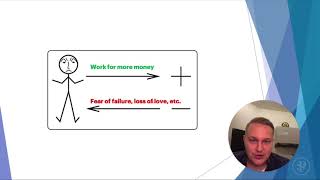
So why do people self sabotage? It's because of one thing. Mixed neuro associations. So let me explain. If you look at this guy, clearly he's not too happy. And that is because he wants to get to somewhere. He has a reason to get there and say he wants to work for more money, right? There's an outcome he wants to get. He's got reasons to get there. He thinks if he makes more money, it'll meet, mean more freedom or more travel or giving back, whatever that is. So that's motivation that gets him going in that direction. Whether it's his own business or getting a raise, doesn't matter. That's his underlying motive. Now Bob over here, for instance, he takes these steps, right? He starts working, but eventually he feels the need to procrastinate, right? Like I don't want to work too much. Let me put on Netflix, watch the new episode of whatever show, right? Or let's put on Amazon prime and watch Invincible. It's a really good show. Essentially he takes two steps forward and three steps back. And why is that? Well, because he's got stuff pulling him backwards. He's got other neuro associations too. Now these associations mean that in his mind he's associated money to these positive things that pull him in that direction. And. But at the same time, he's associated more money to these negative things that pull him back to his safe spot, back to his norm, back to his identity, right? He may fear failure, like, what if this doesn't work out and then I'm embarrassed and my family and friends will not like me, right? Or what if I put something on the Internet and people will chase me off of it with pitchforks and fire, right? For me, one of them was fear of losing my loved ones, right? If I make all this money and I start traveling more, not gonna see my friends and family as much and I really don't want to, you know, leave them behind. I don't want to lose out on their love. To me, it's very, very important. Now, I didn't know this for the longest time. I only figured it out looking back in hindsight. And that was a huge thing holding me back. So when I resolved it, I was able to move forward and I was able to actually turn this into an opposite and a positive, right? I was afraid more money would mean more distance between me and my loved ones. But I realized more money can actually mean a good thing. It just depends how you look at it. It can mean now I have more resources and now I can afford to fly them out with me. Now I can afford to just put them on vacations and spend more time together and grow even closer. So you need to figure out what is this that you want as step one, step two, figure out why you want to get there. Literally list 10 things and a piece of pen, piece of pen, piece of paper with a pen. Or you can do it on your laptop. And then you also need to figure out what is it that you know, you would want to avoid if you reach this goal. What is it going to cost you if you reach this goal? What are you going to miss out on if you reach this goal. Now we don't typically think about these things, right? They're unconscious processes, but they literally guide us, these neuro associations. So we really need to figure out where is the conflict of interest within yourself. And when you figure that out, you need to deal with them, you need to reframe them, re position them in a way so that they support you, right? A lot of people don't want to make more money because deep down they think that'll make them a bad person or that it's evil and it's not the right thing to do. And really it's simply because you were raised around people who told you those things. I remember my dad when I was younger and he'd say like all the rich people are evil. The Rockefellers and Rothschilds, they'll stole from people. And you know, I'm not here to discuss history, but from a perspective as a young kid, I just believed him. He's a, you know, he was a big source of authority for in my life, you know, big source of love. After all, he's my father. So I just went with it. I trusted it, I didn't question it. And then I realized later, as I was trying to build my business, well, I would be taking these steps backwards. And it made no sense, right? Because logically I thought, well, this will mean a better life for myself. I can give back to my family, I can pay it forward in charities, I can do all these amazing things. But deep down I didn't want to be a bad person, right? And then later I had to realize that was one of the strings pulling me back. I had to get to the root of it, the memory itself, right? It's not the thought, it's not the belief. Because a lot of people try to change those things, but need to ask yourself what's really the root cause that's causing it. And that was the memory itself. So I went back to the memory using memory flipping. I changed that. I flipped it that said, look, money in and of itself is neutral. It doesn't make you a good or bad or righteous or not righteous person. It's what you do with it, right? You can use money for evil. Of course, people buy wars with it and guns and all these different things. And not that I'm saying guns in and of itself are bad things. If you're killing people with it, you know, not very nice. But it's what you do with it is what matters, right? You can use it for good. You can use it to support causes that you like. You can use it to spread a message that makes a difference. So it's all about perspective. And when you realize that this is what I want and you align your full being that going in this direction will be a positive thing for myself and others, then you will unlock massive motivation, discipline, progress and momentum in that direction. And all these, you know, ideas that come up when you want to procrastinate or just give up or unconsciously self sabotage are going to diminish over time and you'll really just be able to unleash this growth and trajectory towards what you want. Okay, so that's the bottom line. Figure out what's the conflict of interest within you, what's the mixed up neuro associations that you have. Write them down and then use a technique like memory flipping to deal with the negative ones. Flip them to the opposite and positive so that your full being can go in that direction. And when you do that, there's nothing that can hold you back. This is Peter Szabo and see you in the next one.