5 Marketing Pitfalls Costing Home Service Businesses 8 to 10% of Their Revenue & How to Fix Them
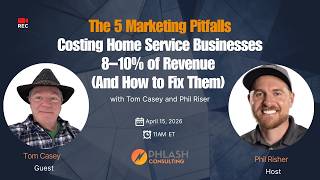
In a live YouTube session, Phil Risher and contractor‑turned‑entrepreneur Tom Casey dissect five common marketing mistakes that drain 8‑10% of a home‑service business’s revenue and outline concrete fixes. They define the pitfalls as (1) misunderstanding customer triggers, (2) focusing on media channels before crafting a compelling message, (3) over‑relying on tactics instead of a cohesive strategy, (4) prioritizing reach over frequency, and (5) underspending on marketing. For each, they explain why it hurts contractors, share real‑world examples (postcards, radio, mailers, SEO, estimate calculators), and prescribe actionable steps: map external/internal triggers, build a single, resonant message tied to a specific pain point, split the budget between short‑term activation and long‑term branding, concentrate frequency on hyper‑local neighborhoods, and allocate 8‑10% (or more for aggressive growth) of revenue to marketing. They also discuss measurement (lead‑per‑spend, ROI dashboards, match‑back mail analysis), performance‑based agency compensation, hyper‑local segmentation based on house age/type rather than homeowner demographics, and the importance of brand consistency across every touchpoint. The conversation ends with Tom sharing his contact email for free 45‑minute strategy calls.
Chapters
Welcome to our live event. We're going to be talking about the 5 marketing pitfalls costing home service businesses 8 to 10% of their revenue and how to fix them with Tom Casey and Phil Risher. With that being said, Tom is here. If Tom, if you don't mind just giving us a quick overview of who you are, maybe 2, 3 minutes, how you got into this helping people, and then we'll get into the pitfalls and some other great conversation as well.
No problem. So first of all, I'm a third generation SOB. That's the son of a boss. Grew up in the trades. HVAC's his primary trade, but as my career progressed, plumbing, electrical, generators, and home energy solutions. So basically most of the house. I'm a big guy on reality over theory. We were just talking off podcast how I've got the gray hairs and the scars and the wrinkles and the stress marks from running my own businesses. Um, I've actually founded 5 businesses, scaled them, and exited them. Um, Connecticut, South Carolina, and Florida. Um, the issue today we're talking about is spending money, our money, our cash, our blood, our oxygen, and questioning the results. If that's you, then you're in the right place. Because we're going to talk about that from a real perspective. And I'm going to talk to you about it from my perspective as a contractor and as a founder. I sign the front of paychecks, not the back of paychecks. So this is a real-world situation. And I'm hoping to reframe kind of your whole thinking and strategy, not just like dance around the edges. Let's kind of get right to the heart of the matter.
Yeah, I love it. We were talking offline, I'm from home service as well, and I felt a lot of these same pain points. So we're all in alignment here that there's things that need to change in the industry and also knowledge that needs to be dropped. So with that, Tom, do you mind starting out? What are those 5 pitfalls and let's deep dive on them and how can we fix them? And I can add some color commentary as well as we talk.
All right. 5 pitfalls and kind of in order, I believe the first one is triggers. We'll talk about triggers and what those are and what they mean to our marketing. The second one, these are pitfalls, by the way, so I'm stating them in the negative, like thinking about it the wrong way. Yes. Media over message.
Hmm.
Focusing on media platform before the messaging is right. The third one is tactics over strategy. Focusing on tactics instead of strategy burns lots of money. The fourth one is reach over frequency. Getting to a lot of people, but not at any frequency that makes a difference. And the fifth one, even though we're talking about spending 8 to 10% and wasting that money, the fifth one is underspending, not spending enough money on the marketing for the results you're trying to accomplish.
I love it. Let's hit it. All these things I have, uh, uh, thoughts on as well. So I love it. Uh, let's start with triggers. So what does triggers mean and how is this a pitfall?
Trigger is simply this: what makes a prospect call? Plumbing business, cleaning business, electrical business, HVAC business, painting business, landscaping business, virtually any business, pizza business, funeral business. What makes a prospect call? And there's two types of triggers. There's an internal trigger. So pizza, everybody loves pizza. I want pizza. I look for pizza. You don't have to sell me pizza. I'm going to buy pizza anyways. That's an internal trigger. Like, I want it. It's desirable. Then there's an external trigger. External trigger is for things that I'm not thinking about. They're out of sight, out of mind. Something's got to happen in order for me to be triggered to buy it. And in most home services, that trigger is a bad thing. There's water leaking on the floor. There's water leaking through the ceiling. I have no power. There's stains on the side of my house. I've got bugs. My grass is dying. You know, the paint is peeling. Something external. I don't want it. I have to have it. But it's a grudge. I don't want it, but I need it. And here's the thing about triggers. Here's the mistake. We can't inspire someone. We can't motivate somebody. We can't discount our way into somebody buying something that they absolutely don't want to buy. So here's $10,000 off a new HVAC system. Well, I don't want an HVAC system.
Yeah.
Well, you can give me any amount of money off it. I don't want it. And so most of our ads are like talking about what our thoughts are, what our desires are from a trigger. Like, People want a new water heater. No one woke up this morning, Phil, going, hey babe, you know what we're gonna do today? Let's call the plumber and buy a new water heater. I heard they're really sexy and exciting. It didn't happen, right? So that's the trigger is an error because we don't understand the buyer psychology and what's making them pick up the phone, get to the keyboard, whatever it may be. And the reason that's important is your marketing, the likelihood of your marketing arrives at the exact moment the external trigger is triggered is almost 0%.
Yep.
Your postcard arrives in the mail when the water heater goes out. They go to the mailbox, walk inside, water heater fails. That just doesn't happen. Right.
Yeah. Yeah.
So that's a big mistake. We burn a lot of money trying to motivate, inspire, or discount our way into a sale. Yeah.
The discounting our way into a sale, I think, is— it can hurt a lot of people, especially if you're just running like Meta ads and you're trying to create demand for your product, opposed to where are people going when they actually have an issue for those internal triggers. I think a big shift for a lot of home service businesses is in the dream outcome scenario, which is when someone calls you and they try to diagnose their own problem, like, "Hey, I need a new toilet," you have to ask them why do they need a new toilet? Is it the thing's leaking? Is it cracked or broken? Because that is truly the internal trigger that creates the dream outcome, which then now you know what you're actually working towards. And I think a lot of people, they don't know this and they just allow people to diagnose. The one thing that sticks out to me is John, he has exterior cleaning and holiday lights. Business. And I feel like those two things have two separate triggers. There's like an internal trigger. Yeah, possibly.
Yeah.
Like internal trigger of exterior cleaning where it's like, my house is dirty, I want this clean. But it could also be an external trigger of like, oh, I saw your Meta Facebook ad, you know, and it's like, oh, this looks really cool. But then there might be an internal trigger on top of it or something like that.
Yeah. So like, uh, soft washing, pressure washing, house cleaning, sometimes in like a social media land. Facebook, Meta, you can have like dramatic changes like here was before, here was the after. And that could trigger somebody going, oh wait, the before kind of looks like my house and I would really love it to look like that house. So that's a trigger that you're inducing. But it's still something that people, they've been living with that dirty house and haven't decided to call you yet. So you, how do you trigger that? And then of course you have on the phone like, hey, I need a new AC. Great. My company on AC, I would show up to your house and go, Phil, I see we're here for a new AC. I'm in the AC business and even I don't want a new AC. What's going on?
Yeah.
Like I, it's just, we want to sell the things, but really nobody wants the things. Imagine we open, we open businesses to sell people things they don't want.
Yeah. I got you. So the, so the pitfall really here is that you need to understand what your client's triggers are of what gets them moving the needle and not try to discount your way to get them to take action. Actually draw upon what those triggers are and be in the places that the triggers happen.
You can't discount your way. So I would venture to say if we pulled, you know, 1,000 people and we send them a postcard for $2 off a large cheese pizza on Wednesday, they're going to hang that one on the fridge. We send them a postcard for $1,500 off a new AC system, they're going to throw it in the garbage. $2 wins, $1,500 goes in the garbage. I want the pizza, I don't want the AC. So discounting is not going to help you. And so a lot of the marketing is concentrated on discount, discount, discount, and they're avoiding the below the waterline. What's the other part of the iceberg that would make somebody think they want what you're selling or what's in it for them? Mm-hmm.
I like it. All right. Next up, we have media over message. And before we get into this, by the way, guys, we're live. So if you have questions or you want to ask Tom something, shoot it in the chat and I can pop it on the screen and we can talk about it as well.
Absolutely.
But with that, uh, number 2, media over message. And I, I know why this is a pitfall for me, but I'm curious to hear what you believe is a pitfall for this.
So usually we're contractors, we're really good at plumbing, we're really good at painting, we're really good at pressure washing, we're really good at whatever we do. And we can talk about that till the cows come home, but we're not marketers. And so we kind of get focused on where to market versus what we're gonna say. So I need to be online, but what are we going to say or do online? Yeah, I need to send mail. What are you going to say in the mail? I want to be on the radio. What's our radio gonna be talking about? And so if it boils down to this, if you have boring, crappy, overly technical message and lingo and spiel, it's just white noise. It doesn't get anywhere. I always often tell my contractor clients, media won't matter if your message sucks.
Hmm.
So somebody goes, I tried mail, it didn't work. And I, I'm very curious, like, that's interesting. Tell me what happened. And then they usually show me some things and I'm gonna go, yeah, Phil, you're exactly right. Mail will definitely not work for you. What do you mean? I'm like, there's nothing here. Yeah, it's terrible. The message is terrible. I tried billboards. They don't work. Show me your billboards. Yep, you're right. They don't work. Radio. Radio is a big one. People like, it doesn't work. Your radio ads suck. You listen to the radio, 99 out of 100 of the ads really do suck.
I'm curious to get your thoughts on like, what is a good message versus what is a bad message example? Like those ones that suck, like a mailer. Like what is bad about it and what would be a good looking thing?
So sometimes the messaging is terrible because it's all watered down. So we send a piece of mail and we want to talk about all the services we have and like we just sort of show up and throw up with things. There's not one thought, there's not one thing for someone, the customer or the prospect to latch onto versus like, you know, the concept is a confused mind always says no. And if you're throwing things at me like pressure washing and decks and staining and then all of a sudden my brain is like, oh, it's too much. The part of our brain called Broca, which protects us from things we don't need or danger, goes, danger, danger, Will Rogers, go away. This is not a good message for me. Versus like a simple succinct message about one thing. You know, is your house ready for summer? Is your water heater ready for, is your drain, like there's something that just gets to the heart, one thought that we can build all the messaging around it. I'll give you an example. My son has a garage door, garage door business that we launched called Wagmore Garage Doors. And when we, when we went out to the, to the market and sort of surveyed what are the concerns for garage doors, it's gonna surprise people. But you know, the number one complaint of garage doors is they're noisy.
Yeah, I know. 'Cause I have that 1-month-old I was telling you about and it wakes them up.
The noisy garage door is what people are afraid of. And then the second thing that goes with that, It's so noisy they're afraid it's going to fall down. And it's very, very rare a garage door would fall down. Yeah. But we look at garage door marketing, it's like, um, all about opener, smile of your house, all this stuff. And it's like, wait a minute, what the people are thinking about is noise. So why don't we make our messages around noise and get that all dialed in? Then we take that message, that singular message, We put it on Meta, we put it on billboards, we put it in mail, we put it on radio, we put it everywhere because the message now resonates. So no matter where we put it, it has a better chance of going. Does that make sense?
Oh yeah, I love it. I think for the first part that you started at was what are my customers actually saying? And then using that to start with the messaging where a lot of people go to ChatGPT and say, what is the reason I should market my thing? Da da. And you got to start with like the actual things that your customers are saying and then build from there. The other thing I would say, Tom, that I uncovered at my home service business was because we did a bunch of stuff. So what we did was we built a content calendar and we still do this to this day. And every single month, like in HVAC, it's like, okay, we should be talking about spring inspections only. Then we should be talking about allergies and indoor air quality. Absolutely. Then we should be talking about ductless systems this month. And then like our social media, our email newsletters, our mailers and everything is all wrapped around one central message that's cross-selling a certain service. I think a lot of people miss that and they just blast out random things to people like what you're saying. And that's how you can clarify your message over the media, not the media's platform that's broken.
So the two, two thoughts there. One, like, uh, my company in Florida that I sold a few years ago, we did heating, cooling, plumbing. We focused on drains and water heaters specifically. So we wanted to talk about that. We did electrical, we did generators. We did a lot of things, right? Yeah. So. We would, we had to talk about multiple trades and have a content calendar.
Exactly.
So inside of that calendar for like mail, there'd be a theme for the month. Like right now we'd be talking all about AC, getting your AC ready for the summer.
Yeah.
But on social media, we'd have like week 1 would be out water heaters, week 2 would be out electrical, and week 3 would be about drains. So we had this consistency of We're going to keep putting out a thought, but only one thought. When we talked about drains, we only talked about our $93, it's free drain offer. That was our whole drain message was we'll come out for $93 and clear any drain guaranteed. And if we can't clear it, it's free. That's all we talked about. And we got a lot of other plumbing things because of a singular thought like, oh, these guys are plumbers. We didn't leave confusion because plumbing is a lot of things. Painting's a lot of things. So, um, that definitely is a way, but even sort of take it the other side of that is our most popular campaign we ran and we run all around the country for different businesses is when your water heater breaks, we get there fast. When your garage door breaks, we get there fast because the two questions people ask on the phone When they call in, or what, how much is it going to cost? How much you charge to come out? And when can you get somebody there? Yeah. So your marketing could answer the two questions that they want to call about. Imagine that idea, Phil. Like, they're going to call and ask this question. What if we already answered it? When they call, they're like, yes, I want this, I want the drain cleaning, I want the pressure, I want the inspection, I want the whatever, because they already know what it's going to be.
This is exactly what we did at my home service business. On our website, they asked the exact questions: how much does it cost, when can you do it? So I built an estimate calculator to give them an estimate, and I built online scheduler to get them scheduled. They come to the website, that thing generates 300 leads a month still to this day, just from that thing.
So 100% people want to know how much. And so as contractors, mostly, you know, our defense is this. I'm probably, I'm probably the only contractor in the world who did this originally. How much you guys charge for water here? Well, we got to come out, we got to look at it. There's all kinds of things you don't understand, blah, blah, blah. Well, I don't know the price of— I'm a plumber, I'm a generational plumber, and I don't know what heaters cost between $1,200 and $5,000. Which one do you want? Like, I know the number. Answer me a couple questions, send me a picture, I'll give you the price.
Exactly.
And so if your marketing message solves that, so right there you could go on social media and be like, when your water heater breaks, you get there fast, call for a free virtual estimate over the phone. People are going to call because that's what they want.
Yeah, exactly. And now in the day of AI, you can build a simple estimate calculator and those questions, pop them in there, trade your email address and phone number, and then put them into a nurture sequence. This is what we do. Put them in a nurture sequence and then boom, you have it all done and the messaging lines up. So I love it. There's, there's so much when it comes to the message over media.
Any—
for anyone that's watching this, anyone that says like Meta ads don't work, Yelp ads don't work, Google ads don't work, Angie doesn't work, they don't work for you because you don't have a game plan for it. Mailers don't work. All of these things can work if you do it right. And I think that's what you're getting at, Tom, is that they can all work. You just got to have a system for it. And the message matters the most.
If a particular thing isn't working, before you blame the media or the platform, we got to take a really hard look in the mirror at the message.
Yep.
And maybe we're We can't see the forest for the tree in our own business because we think it's this amazing message. And my cousin's a graphic designer, my wife's a marketing person, and they all suck at it. It's just being what it is. Yeah. It's just like, here's the thing that I would say to people, what's your favorite customer? The guy who's like a do-it-yourselfer guy, knows everything, did all the research online. That's your favorite customer, right?
No.
That's, you hate that guy.
Yeah.
Well, we as contractors often are that guy when it comes to our marketing vendors.
Yeah, we're gonna—
we did all that, and we're doing— we're just doing to our vendors what we hate being done to us.
Yeah, it's good, man. Um, all right, tactics over strategy. Talk to me about this one.
So basically, um, you're playing checkers when we really should be playing chess. Uh, and the biggest thing about tactics over strategy is to think of your, your marketing it in two silos. So you have a marketing budget, but then you have to break that marketing into two silos. One is a short-term sales activation, things like AC tune-ups, water heater flushes, things to kind of make stuff happen now. And the other is into long-term branded responses to hammer home the message, like when your AC breaks, we get there fast. When your water heater breaks, we get there fast. You know, um, whatever. Same-day guarantees, uh, if you have warranties like the last, uh, air conditioner you'll ever buy. Like, one is short-term sales activation, call now, and one is, um, becoming the company that people think of. The goal of the marketing is to be known, liked, and trusted. Known, liked, and trusted. And the ultimate measure of that is that trigger happens, that water heater breaks, that stains on the house, that pest in the house, whatever the trigger happens, and who does the customer think of first and feel the best about? And it's not going to be all based on special coupon discount rebate. It's not going to be based on that. It's going to be on a core message. That is memorable about your company. And I would say this, think about the big insurance companies. Okay? The big insurance companies are awesome at this. So in your mind, picture these insurance companies, whichever ones you want to picture, and think about how different they are. None of them say the same thing. If I said to you, 15 minutes can save you 15%, which insurance company is that?
Geico.
Geico. If I said Flow?
Progressive.
Yeah. I mean, it's so obvious and their messages are so different. Mayhem. Like people remember that.
Yes.
And they do have offers. They do do other marketing, Phil, for short-term sales activation, free quotes to get this thing and fill this form out. And they're on social media. They're all over the place. but they also have this massive part of their budget set up for just making them known in their world. Now they have multimillion dollar budgets we don't have, but we can do this on a very small scale, a neighborhood at a time to be the guy that everyone knows about. Like I had a friend of mine who had his fleet was all red and it would be like Home of the Little Red Trucks. Imagine that's a bizarre theme. Yeah. For a guy who built, I think when he sold it was over a $100 million business.
Wow.
And they were the home of the little red trucks. Right. And so those things can matter. And so tactics over strategy, the biggest thing is dividing the budget. So if you have a 100% budget, say $100,000, most companies are going to say split 50% short-term, 50% long-term. And so an example might be short-term digitally might be pay-per-click, LSA, things like that, paid, paid social ads. Long-term would be SEO, AEO, like generating things that you're not paying for the leads, but you're putting in all the hard work. You, if you go all paid, that's not working out so good for people right now.
That's right.
If you didn't do any type of paid, you probably are not getting as much as you could either. So it's like the balance of those two things. That is usually a huge mistake when I look at people's budget. And then even within that, we'll talk about like how, you know, are you, what are you spending digital versus print versus media or, you know, news. It's like getting that balance right for your market. And if any, if any marketing person, any marketing consultant, any coaching company says, here's the way you divide it up, run away.
Yeah.
If they haven't asked you a whole bunch of questions, they don't know about your company. They don't know about your market. That is what I used to say in my business. Diagnosis or prescription without proper diagnosis is malpractice. If they're prescribing your solution, spend this much, then they probably are committing malpractice on you. And so we have to go and say, well, like if you're in Los— I have a client in Los Angeles, radio's impossible. That's a moonshot. It's so expensive. So you're not going to have a radio budget. But mail is amazingly good for, like, you can super target and skip all the places in LA you don't want.
Yes.
So there's, there's that idea of long-term versus short-term. And I think the message everyone should understand that you have to split the budget. And the reason we're burning money is we're usually spending too much of it on short-term sales activation. And here's the thing about short-term sales activation and discounting and specials is they work less and less well. Over time.
Yes.
So $59, $59, $59, got a bunch of calls month 1, less calls month 2. All of a sudden it's like, here's what they say when you're on the phone with me, Phil. It's like, it's not working. It used to work. It's not working. Because it's called market fatigue. The message is fatigued. And so you're only just always yelling sales for things people don't want. If you're like a grocery store and you're always talking about sales, that's a good thing. People buy groceries every week. People don't buy our stuff every week. They buy it in like year terms. Average length between like plumbing service calls and HVAC service calls is every 3 to 5 years. Replacement water heaters, 10 years. Replacement HVAC systems, 15 years. 15 years. Yeah. You know what I mean? These, it's not the same. So we've gotta get the, the long-term message to the long-term budgeting and the short-term budgeting, right?
Yeah. Makes complete sense. I think a lot of times businesses, they just focus on the short-term cuz they just think that they just need customers. I need more leads. I need more leads, I need more leads. And they're constantly in this hamster wheel of just spend more on ads, spend more on ads, more minutes. But then they don't actually build a brand that can sustain throughout, that gives them— and then their cost per lead goes way through the roof. And they think that they just spend more on ads to grow their business when really they need to be building a brand and nurturing a relationship with their customers.
It's crack. You get addicted to crack. And, you know, drug dealers give you the first hit for free because they want you to get addicted to it. So if you get stuck on paid ads, whatever form it is, short-term sales activation, yeah, then it's working less and less well. So what are you gonna do? You gotta buy more, you gotta buy more, you gotta buy more.
Yep.
And so your cost per lead goes up. It's just like you say. And if there's a market shift, like AI totally changes the rule, Google's algorithm shifts like it did, now you're like in no man's land. And the, here's the bitter pill to swallow in order to get off of that. Drug, you got to detox a little bit. You got to like go through some pain. So you might be down on leads. You might have a couple of months of like, we're not hitting our marks, but we're transitioning over to a long-term strategy. Yeah. Short-term sales activation is like hunting. You go out, you shoot, you bring it back, you skin it, eat it. If you don't go hunting, you don't eat. Long-term Branding is farming.
Yeah.
The crops come up every year. You still have to tend to them, but they're always there. So a combination of those two things is the best meal you can have at the table.
Yes.
Yes.
Something that's passive. Branding, both big ones. I agree. One of the hidden things that I found with this at my home service business was that those short-term sales activities, a lot of marketing agencies, that's really what they push because they get a commission based off of what you spend on ads. So they're constantly like, like if they're a drug dealer, they're constantly like feeding you more drugs.
You need more. I want to sell money. I make more. And that's one of the challenges I'll talk about at some point that I like, how does the company I'm buying from make money?
Yeah, it's ridiculous.
And are they, if they're, are they in the best interest? So, um, if all you make are hammers, then everyone needs a hammer.
Yeah, exactly.
And a lot of the marketing companies, if I'm a digital guy, I could be a great digital guy, by the way. I'm not knocking digital. I love digital.
Yeah, we do digital marketing, my company.
Yeah. So, and print, and I love it all. Like, I'm a huge mail fan. Like, I am a mail zealot. I love it. I can own the mailbox. You can own the neighborhood. But I think being honest about mail, if it's like dump your 100% of your budget in mail, then I'm selling you a hammer because I sell hammers.
That's right.
Uh, if I'm saying go all paid ads, I'm selling you a hammer because I sell paid ads. That's a problem. And I think Mark, uh, companies, contractors not having to be marketing experts, but sort of directing the marketing, like here's what we want to do. I want to have this budget a certain way. I want to see things a certain way. Um, but yeah, the, the motivation is what are you selling? You know, are you selling me, um, a new website because that's what you do? Do I really need a new website or don't I need a new website? Exactly. And that's a lot of it. Do I really need to rebrand my fleet or do I not? Do I? There's a lot of, there's a lot of that going out there and there's some great vendors, by the way, some world-class guys doing these things. So I don't want to like leave like this idea like they're taking advantage, but it's not a fit for every company to do everything and chase every shiny object. Yeah. One of the— you run a trade show floor.
Yeah.
Any industry, you, you're, you need a lot of things according to the trade show floor, but you showed up with a successful business at the trade show.
That's right.
Come on.
So, well, yeah, that's one of the things that I uncovered was with these agencies and dealing with it. One of the things that we did in my company is we're on performance pay. So like my account managers or consultants, we call them, they only get paid when they have clients. And they're not incentivized on like ad spend or anything. They're only paid on if the business is growing and they want to stay with us or not. So it creates some type of level playing field that at least like they're incentivized to keep clients and to help them grow their business as opposed to like hitting measurables of ad spend or certain things. That's one way to get around it, I would say.
Yeah, I think there's, there's some companies out there like the radio company we use, they were paid based on our performance. So what was our revenue for the previous 12 months? Whatever our revenue went up as percentage, that's what their fee went up. If our revenue went down, their fee went down. Yeah. So you're like, you'd be like, wow, they got a big increase this year. That means we had a big increase this year.
Yeah. Yeah.
Like I'm willing to pay more because they're generating the things. And so I think everyone should be put on performance. You know, the mail, the mail should be at, have matchback reports to say, You mailed these people this many times. Here's the business that came out of it. And I don't, I'm not a big, like, call tracking, all that stuff to me is like a big distraction mostly. And the digital guys like it because they get last click attribution from Google. I think if we say like all your marketing, your vans in the neighborhood, your yard signs, your mail, your social media presence, your Google, all these things add up. But if you want to see like relatively is mail working, for example, let's mail and let's go look at only the houses we mailed to. Exactly. Say, what was the lift? What happened in those houses?
Yeah, because you can pull the zip codes and addresses of new customers.
You can see exactly what's going on. So that's more of like how you'll go back and be like, is this working? Is this not working? And your digital agency, you know, you could be asking the digital agency like, what did we do this month? What did we update? What's going on? And see, and most of the times we ask those questions, they're like, uh, well, I'll have to get back to you on that. Because they didn't do shit. They charge you your $2,000 monthly fee and they do damn thing.
Exactly. So the cookie cutter factory, man. I— trust me, this is what I think. This is exactly what I face, so I get it.
Yeah, yeah.
Um, all right, reach over frequency. So reach over frequency, talk to me about it.
So, um, a lot of people think it's better to talk— hit as many people as possible a couple of times versus the right people 10 times. And, um, I would say it's better to reach 2,000 people 10 times than it is to reach 10,000 people 2 times. 2 times is not enough frequency to become that 15 minutes will save you 15%. It's not enough to become flow from Progressive. It's not enough to become mayhem. It's not enough to become that shit. Person in that 5-mile radius, that neighborhood, that that's the water heater guys, that's the painter, that's the roofer. And so it's always go, go deep, go deep into the neighborhood, go deep into that target before you go wide. Now there is some balance there, 'cause obviously when you're looking at long-term and short-term, you're probably overlaying these things, right? So SEO, you can be really deep and strategic. Into a specific area and a specific type of work you want to do. Like we're doing this on garage doors. You know, our maps are unbelievable in a very short period of time because we are so hyper-targeted on this geography and cities and these specific services, not garage doors. Big wide term, hard to get there. So, um, the same thing can be done for like when we were doing plumbing. I always say, what kind of plumber you want to be? There's lots of plumbers. There's a drain plumber, there's a water heater plumber, there's a water treatment plumber, there's a fix-it plumber, there's a repipe plumber, there's a sewer plumber. Yeah. It's not just plumbing. So like we were water heaters and we were same-day water heater guaranteed and we just went water heaters. These G.O.s, water heaters, end of story. And so we got the most leads because we were very, uh, exact match kind of thing, right?
Yes.
The same can be done with mail. The same can be done with where your billboards are. The same could be done where your radio stations are. You can be very, very like specific on frequency. So here's the thing. Radio. When I first started doing radio, I never thought I could do radio back in the day. Don't have the budget for that. Well, I was taught. That I could go on a little dinky radio station that was like specialized. One of them, we went on a religious station, we went on a little local like talk station, and we were able to dominate it. We had so much frequency on that station that we became a household name to their listener base, which allowed us to grow. And then we had to move to the next radio station, the next radio station, versus I want to go on the big radio station that everybody listens to. but I can only go on like 4 times a week. Yes. Which means I have the frequency of like zero. Yeah. Which means I'm literally lighting my money on fire. Yeah. It's not, I'm not getting anything for it. I'm gonna mail 100,000 people twice. Once, here's what HVAC guys do. We're gonna mail them once in the spring, mail them once in the fall. And I go, you're better off taking your team on a vacation.
Yeah.
Because that's not going to do shit for you. You might get a few calls, but there's, you're not enough to become like a, a known commodity. You're not building your brand. You're not being the one, what they think of first to feel the best about. To be known, liked, and trusted takes frequency. And here's how frequency works. Nobody's remembering the plumbing company. No one's remembering the house wash company. No one's remembering the electrician. They're just not, not until you're like massive and you've done this for a long time and you just are the guy who dominates the neighborhood. But what they're going to do is they're going to go on and you probably know for any, any trade, the most popular search has some, something resembles like plumber near me or something near me or whatever, or cost, or it's a very generic search term, which is super expensive to be competitive. Yes. But, um, if you have the right content and the right SEO and all the right things working, um, you can still show up. And what you're looking for is they don't know who to call. They're looking at this list of plumbers and they're like, I don't know who to call. And then they go, oh, Wagmore Plumbing. I, they send us mail. I see their billboards. I hear their commercials. That's what frequency does. It's when they go to do the search, 'cause they are gonna go to the search, right? They're gonna go to their phone. They're gonna do something. No one, no one has your number in their phone unless they're like a long-term friend and they love you. They're like, oh, call Wagmore. They're like, who do I call? Yes. And even if they know you, they gotta probably look up you online for the phone number. Yes. That's where Google gets credit for like being the lead, the, the, the lead source.
Everything's Google.
Everything's Google. Google's the toll, like when you get off the highway, you gotta pay the toll.
Google's the toll.
Yeah. I know. Period. But that aided recall of like looking at a list of contractors, not knowing anybody and going, I've heard of that one. How about this? You go on Facebook and neighborhood groups are like, I need a plumber. Who do you recommend? And they like, everyone's like, Bob, Fred, Joe, Sally. Like it's just a list of random people. When you're looking at that list, you're like, I recognize Bob. I've seen Bob. I know Bob's trucks. That's what frequency does. Frequency in the mailbox, frequency in people. I don't, here's what most contractors say, like for mail. Well, I throw my mail away. Don't forget, you're not your client.
Yeah.
Mail works. Actually, it's working now better than ever because people are getting out of the mailbox, going online so much. It's unique to be in the mailbox. Yeah.
And it's also the eyeballs of it. Like even if they take it and throw it in their trash, they still looked at it and saw your logo and your name. They're not going to sit there and read the whole thing with their glasses, you know?
So, so getting that frequency, getting that frequency up, you know, and there's numbers like how many times frequency before someone remembers you. Yeah.
I mean, it's usually like 7. I think Google did a study that it was like 7 times or 7 hours.
It's up now. I think it's like double digits now.
Double digits.
Yeah. Because there's so much noise out there.
That's what I was gonna say is that there's this trust regression that's going on where people do not trust anyone anymore. So the more that you can be building a relationship with your customers, yeah, better.
And here's the thing that's interesting, back to message over media. If your message is really good, they can hear it less and remember it easier. Yes. Yes. If your message is really shitty, they have to hear it a lot more and still might not remember it. Yes. So having that 15 minutes saves you 15%. That's an easy one to latch onto.
Yes.
Right? So yeah, frequency always wins to the point where if someone's like, I want to mail twice, I'm like, I won't even recommend somebody to you. I can tell you who I use, but they're going to— the strategy you're doing won't won't work. So I don't want to be associated with, hey, I spent all this money and it didn't work.
Yeah, it's the same thing with email marketing. And we get this pushback a lot, which is like, oh, well, I do kitchen remodeling, so they only get one kitchen, so why would I keep emailing them? Well, do you do other things? Do you think these people move? Do you think they talk to their family? Do you think you want to offer another service at some point? It's like, you got to be top of mind and at least be in their inbox or something. It's free email marketing, at least. Come on.
Frequency, frequency, frequency. Yeah. All right. People don't have enough posts on social media. Like, my social media doesn't work.
Okay.
You don't— the only time you go on it, you try to sell me shit.
Yeah, it's a billboard for— exactly. All right. So the last one here is underspending. Before we get to that one, guys, we're live. So if you have questions, drop them in the chat. I also have questions that people pre-submitted, so I'll go through those after this. But let's hit number 5, underspending, and what the pitfall is there for us.
So the real simple thing about budget is this. I think of budget as the fuel for your business machine. If you're gonna fly your business machine from New York to LA, it takes a certain amount of fuel. If you only put enough fuel in it to get to Montana, well, guess where you're landing? You're landing in Montana. So those percentages vary by trade. Usually it starts off for easy math at 10% and it can adjust up or down from there based on the, how strong a brand is, what the market is, you know, the, the, desire for growth. 8 to 10% for most contractors is going to be moderate growth. You know, you drop down to the 5 to 7%, you kind of maintain maybe some minimum growth. And if you're really aggressive, you're opening a new territory. Like my son's business, Swagmore Garage Doors, you know, he's got a new territory in Jacksonville, lots of competition, big city. He's spending like 15%. Like he has to go higher to even make a dent. And so that hurts, you know, that launching first year kind of numbers because you're, you're you almost 50% more than you would typically be spending on marketing.
How does, how does, how does your son balance out like how much he's spending? Like is it mailers over here for branding? They get his work name out there. Is it ads?
Like, so obviously they got their, their truck wraps right. They get the uniforms right. They get their signage right. They have all their yard signs. They have their door hangers. They have their equipment stickers. Direct mail is a big part of it. Both prospect mailer, existing client, they mail all their clients every month. They do radius mailers, they do a project, they mail around there. They just dip their toe on radio on that little, again, talking about they can't afford radio. So here's what they did. They took a local country station and they just bought nights and weekends. That's what they could afford.
Yeah.
But you know what? Already people are listening. Already people, the ads are kick-ass, by the way. They're such great ads. Nice. That already people are like, I heard you on the radio. I called you because you're on the radio. Like the ad is so memorable that that's— you can go look at our reviews. People are commenting about the damn radio ad in our reviews. I called them because of the radio and they're amazing and everything he said is true. So he's balancing that a little bit. A lot of, a lot of we can't, he can't, but he can't fight in the paid world because we got a big giant companies like PE type guys and franchise guys.
Yeah, I get it.
So I'll give you an instance. I don't know if it'll relate to anybody, but as of yesterday, their budget for LSA was $8,000 a week.
Yeah.
Which they can't afford to spend. The good news is they're not getting any leads, so they're not spending it.
Fulfilling.
Yeah. That's what I was gonna say. It's not even making a dent. They called Google and Google said, yeah, you're gonna have to come up substantially to even be in the game. So yeah, there's big companies setting budgets of who knows where. And then pay-per-click, they were told to even make a dent, you'd be at $7,000 in this market. They don't have that money. So they're going SEO, they're doing all the content type stuff. Uh, lots of YouTube videos. Um, just really trying to hammer the content, be the, the, the agile small player to just do things big companies won't do. Um, take a little more risk, be more personal, be more authentic. Um, and so it's working, it's moving the needle. They're getting, they're getting a lot of leads through SEO and AEO. Um, and they, they do some supplementing with aggregators, like Angie in particular is probably a good one for them.
Yeah.
So yeah, it's, it's definitely that mix of digital, mail, radio, but a lot, I would say everything's geared and his, his strategy's all geared around content, content, content. That's great. And the mail reinforces that and everything reinforces around the same content message.
Yeah. We had a guy, a $1.5 million HVAC contractor and he had 300 million dollar HVAC contractors right around him. And he had been working with an agency before for 3 years and they were running Google Ads for him. It's like, bro, what are you doing? What are we even doing here? So within the first year he had 6,000 people in his database. He never emailed them once or did any, and we're like, dude, this is a gold mine. And in 12 months he had doubled his revenue to $3 million and not spend a dime on Google Ads. I think a lot of people just get sucked into the trap with agency world of just spend more on ads and the quick wins and the, the, the that, that thing.
Yeah.
Oh, go ahead. And then I'm gonna ask you a question off of that.
No. Yeah. I, I think that, uh, paid had its day in my mind, and I'm not saying it's not there, but I think, yeah, you have to, you have to have a channel. I turn on search right now and what comes at the top of every search is not paid ads. So it's more about, in my world, digital in my mind, and you're, you're more, uh, expert than me, get on the map. Dominate the map, figure out how to get on the map, get your, your, get the business profile, get that thing jacked up on steroids, get that YouTube channel going, respond to those reviews, respond to the reviews in ways that enhance your keywords and your key geos.
Yep.
Um, do all the little things that are, that little guys will do initially because they're trying to compete with you, then they'll fall off. Yep. And big guys can't be bothered. They can't scale. It's too, they have too much going on to do that granular level of local SEO type content work. And that's right. I'm saying SEO, but I'm telling everything helps SEO. Yeah.
It's more content is now truly SEO and you doing real content. One other scrappy thing, Tom, that we implement a lot and it helped us was actually building B2B partnerships because the big guys will not go out and build referral partnerships. Like if you do garage doors, like go find epoxy floor companies and build a referral network and have them send you leads coming in. Because the big guys will not do that. And you don't have to pay for any leads or customers until you actually get a customer referral from them. And it crushes for, for guys that are like sub $10 million.
The messaging at Wagmore he's building is truly local and it's shop local, save local. And they just literally this week are launching their page where they're putting up their partners. Oh yeah, they're only local people. So then we have a, you know, and we're giving them the code for their website to backlink to our website. And so in this space, you know what that does? It's all of a sudden A big franchise is not taking the time to do that. A private equity isn't taking the time to do that.
They're not building relationships in the neighborhood that's going to get them referrals. They're not going to do that. And that's the, that's the hidden secret for a lot of these businesses. I do want to ask you this. I'm going to pop this on the screen because Ross asked us at some point, would be nice to hear how you gain visibility into your marketing data. So what's working, ROI, etc., what software you typically use to achieve this, etc. I know how I did this at my home service business and how we do this for clients now, but do you have any thoughts on this, Tom, before I chime in?
So my answer usually gets people groaning and not thinking I'm a crazy person. Yeah. But how I look at my ROI is I know how many leads I need. I know what my budget is to spend in a particular month. And all I measure is that for my marketing. Did I stay within my spend? Did I get my leads? I don't micromanage like all the lead sources. Now, truth be told, I did have a dashboard, which is a third-party dashboard through a company called Ethos that kind of pulled it together at some point, but it was never completely accurate because you're trying to figure out. And we did try another vendor that's out there now that says they can trace it all, but they really couldn't trace it all. So the ultimate, the first place I start with my KPI in my ROI is did I stay within my spend and did I get the number of leads that I wanted?
I love it.
If that's a no, like what if I underspent but got my leads? Hey, that's, I don't need to go digging. I'm ahead of the game. What if I spent but I didn't get the leads? Now I would be like, okay, let's sort of start to pull the layer back a little bit here. Inside of our CRM, we are able to do some tagging and we've created some AI channels that like automatically can hear the words and try to sort them into a place. At least we can definitely sort out Angie. We can definitely sort out LSA. We can definitely sort out our website. We can definitely sort out, you know, if they say, I got your postcard in the mail, we can sort those things out. But it's all kind of a relative guess. And so I think our approach is to do more legwork up front to make sure it works. So, Ross, we do say for a mail, for example, we'll really strategically look at the neighborhood. In mature businesses that we owned and I worked with, we take your existing customers, we map them, say, where are you doing the most business? And then once we know where you're doing business, we look at the type of house, the age of house, the value of house, the income of the house, all the sort of demographics of the house and the owner and go, okay, Where are there more of those people? Like a fish finder, right? Where are the fish swimming so we can mail to those fish? We're already successful. The message works. They like what we do. Let's go find more of them. Then we'll do the mail, for example. This is sort of an example. Then we'll do the mail and then we'll mail month 1, month 2. By month 3, we're going to do what's called a matchback. We're going to go say, hey, okay, mail, mail guys. Hey, Chris, we want to know like what the results are. And we feed back the data team our our data and then they come up and say, here's where we mailed, here's where we didn't mail, address, the lift, all the addresses. Like, and it's not this big complicated thing. They make it like super simple. And so there are times, Ross, where we're like, well, shit, that didn't work. And so we have to look at, was it our message? Was it not? There are some times where maybe it wasn't the right spot, but usually we show the lift. And so a typical mail lift, we'll see like, hey, mailer number 1 didn't move the needle. We lost money. Mailer number 2, we got close to breaking even. By mail number 3, we're past breaking, you know, we're moving. And so most marketing takes 6 to 9 months to take hold, especially on the branded side. SEO is not, you can't start SEO today and be working next week. You can't start billboards, you know, you can't start radio, you can't start mail. So it's kind of controversial where like a lot of coaches are like, put tracking numbers, do this, do that. What I found on tracking numbers, and I had, I was the guy, I had tracking numbers on yard signs, door hangers, business cards, everything. I just, when I saw the data, it didn't like compile out. So I felt like I was spending a lot of my overhead money measuring something. And then, uh, what I've gotten really good at over the years is trying to get down to what's the ultimate KPI.
Exactly.
That tells me if I'm on track to decide if I'm gonna go digging. Yep. And so, uh, for my marketing, it's my total spend versus the total number of leads. And then of course I'll reference to say it could be a situation, Ross, where I spent within budget and I got the leads, but my revenue's not right. That's not a marketing problem. Now to me that's an operational problem. That's a sales problem. I have to go someplace else.
Exactly.
And so the ROI part is a, is a term that probably I'm the, maybe, maybe Phil, you'd be the guy. Yeah. I'm the marketing guy saying I don't look at it like that.
Yeah. I can tell you what I did and what we do for businesses now. We pull leads year over year, job count year over year, estimates created year over year, estimates closed year over year, total revenue and new customers year over year. This is like what you're talking about, Tom, where you can actually see the full scope of it because if our leads are up but our job count is down, that's an operational issue or a lead quality issue. So then we can figure out what the leads are. That gives you like the holistic macro. As far as return on ad spend or return on investment for ad spend in particular, we do tracking numbers and tracking forms, but we pull all the data from their CRM and then we produce the return on ad spend report so that way we know as a company what should we scale up or down. Where to your point, Tom, a lot of times they throw it back on the owner and there's a whole big mess and then it's not getting, you know, getting attributed correctly. So what we do is we run every ad to a landing page and on that landing page we have tracking forms and tracking phone numbers. Those things go into a special Google sheet. That Google sheet gets audited against your CRM data. and then it pulls a return on ad spend number so that we know that this worked or it didn't work. What I would say, Ross, as far as software, it's what I just explained to you seems very manual and hard and difficult, and it is. So there's not like some magical software out there that's going to pull return on ad spend. I would say that there's one tool out there called Searchlight, which links up with ServiceTitan, which has gotten the furthest to getting this accurate as possible. But it's still, to Tom's point, is your CSR going to put in the right lead source? Is the data going to flow in correctly? And maybe, maybe not, but that would be my two cents on the ROI piece. But great question, because this is one that comes up a lot, especially with mailers. I mean, for sure.
Everyone always asks the question, what's the ROI? And I'm like, well, ROI and marketing, Ross, is really one of the questions I say, and typically the contractor doesn't like this answer. Depends on how good your brand is. If you're an unknown brand, like I was working with somebody this week, last week and this week, and it's like they have like, I don't know, 20-something reviews, like they're not responding to their review. They're a new company, but it's like marketing is going to take a long time to work for you.
Yes.
No one knows, like, trust. No one knows who the hell you are.
Yeah, they hear a podcast, you're an unknown.
So if I mailed and you mailed, my mail's going to have a better ROI because I have a good brand. And so that's where that long-term, short-term comes into play too. The better the brand, it's like that rising tide that raises all boats.
Exactly.
And we think the brand is not, by the way, it's not your logo, it's not your wrap, it's not your website. It's every single thing you're doing.
Yeah.
It's the way you answer the phone. It's the uniforms your guys wear. How they drive their trucks. It's when they open the doors of the trucks, does shit come flying out or is it organized in there? Yeah. All that sending messages, all called brand signals. It's sending signals and signals and signals. Does your website line up with your social media and does that line up with your mail and does that match your radio commercial and does that match your, like, if that stuff's discombobulated, then it's a, it's a broken chain. The, the, the customer's like, I don't, are these the same people? You won't see that from the Geico, the Gecko, and you won't see that from Flo. You won't see that from Doug from Liberty Mutual. They're, I mean, they're consistently, watch those commercials and tell me the colors seen in every one of those commercials. Some of the uniforms that they wear. Tell me this, everything. They never break brand code. Coke never goes away from red. UPS never changes brown, right? It's just, these are brand codes that have to be followed. And so the ROI question a lot is, And what I usually find, Phil, and I don't know, when I, when I, someone asks the ROI question, it's, it's one of two people. It's somebody who's very sophisticated with a very good brand. That's a good ROI conversation. Or it's somebody who has no brand presence whatsoever. Yeah. That's a horrible conversation.
Just lead gen only. Yeah.
It's just the two ends of the spectrum there where they're like wanting to know, cuz this guy's real sophisticated and he has the models and probably the software. Marketing team to measure it. And this guy's like desperate for his spending money and it's not working. And how do I know it's going to work? Yeah, the middle 80% of the people are like, am I in budget? Am I getting my leads? And am I year over year? Is that working? Like you said, that's, that's where the meat is on the bone.
Yeah, that's why we always say start there. Pull your leads year over year. Am I up or down? Am I hitting that number? And then work backwards from there, but don't get too far into the weeds. All right. We got a couple more minutes. If you have any questions, drop them in the chat. I have another question over here that someone submitted about segmentation and owning the neighborhood. So you alluded to it a little bit about pulling your database of like your top people and then segmenting it out. But how do you, is there any other segmentation tricks or hacks of like dominating specific areas? Could be mailers or yard signs or a culmination of all those things.
One of the mistakes we make a lot in segmenting is we start to look at who the homeowner is. What's their income? What's their education level? What's whatever? And that could lead to wasted money. And I'll use mail as an example, radio as an example. If I'm working in the house on this street here and they're a great client for plumbing, HVAC, painting, whatever, and they're the perfect avatar, they make the right amount of money, they have 2.3 kids, they're the right age range, all that stuff, like great.
Yeah.
Does that mean I'm going to drive past the next 12 houses on their street to go to another neighborhood that has the same homeowner demographic? Or does every house in that neighborhood fit my profile? Yeah. So again, kind of like the ROI thing.
Yeah.
I'm not a big— I look at demographics of the owners, absolutely. But it's more like average household income. I don't really care. I'm looking at what type of house uses my service. So when They pull my data, Phil. I'm like, where are we doing the work? Tell me about the house.
Yeah.
What's the value of the house? What's the age of the house? What type of house is it? And so then I could find houses like that because I found whether it's empty nesters, single moms, gay couples, no matter ethnicity, blue collar, white collar, the house is going to need a water heater. The house is going to need painting. The house is going to need to think. So that's the first segmenting is what type of house. So I think everyone should develop an avatar of their house and like literally make a picture of it. Say that's the house we want to work in. So if you drive around town and see one of those neighborhoods, give me the damn addresses. And then as far as frequency goes, you want to again, go deep before you go wide. So you find where those houses are, maybe a neighborhood you're already in. So you, so you have 50 customers in a neighborhood of 800 people. A lot of potential there. So you're like, okay, we're going to mail our 50 people a client mailer every month, but we're going to mail the other 750 people a mailer every month, these same 750, around something. And I might even go talk to some of those 50, like, can I buy you coffee? Why do you use this? What do you like about us? What— I'll go see if they did any reviews. What are they saying in the reviews? I'm definitely going to feature their review in the ad. If they'll let me take a picture of them, that'll be even better. Like, I'm here with Phil Risher, your neighbor. Like, that's the kind of strategy and social media and and stuff like that. Then of course you want to build your, your website has to have like hyperlocal pages for not just that city, but that neighborhood, that service in the neighborhood, like water heater, Nocatee, like it's so specific. And then the reviews are from Nocatee and they're about water heaters in Nocatee. Who do you think they're picking? Who do you think AI is serving up when you have a page for a water heater in the community with reviews?
Exactly.
Nobody's doing that but you.
No.
You get the damn leads. And so that's how we segment the business. And then, um, is that making sense so far?
Makes complete sense. And I love it. I love the segmentation piece about not homeowner-based, but home-based, because I think a lot of times people get wrapped up in that, but it's like, if it was built 20 years ago, it's going to need all this stuff if they haven't done it.
So it's like, right.
Don't get too wrapped up.
You're finding your houses, like people like, I want houses over 20 years old. I'm like, no, you don't. Because they probably already did change.
Exactly.
So you're probably looking for houses between 10 and 15, they're like ready to go. Yep. And then over 30 because they're ready to go again.
Yeah, exactly.
You know, um, so that's, that's kind of learning. Uh, so if you're a painter, like, how often do they paint in your area? Like, I got painters in the Great Northwest, in the, in the San Diego area, and New England. Like, those are 3 different It's all painting, Phil, but they're totally different timelines. An air conditioner in Florida does not last as long as an air conditioner in Michigan. Period. Full stop. End of story. So you have to like, what is your thing? That's where coaches kind of get a little sidelined. They're not understanding the market nuances that we have to understand as a contractor. But segmenting would be house timelines of when things happen. And then neighborhood-wise. So like I really like for, for mail and social media and other things, HOAs, uh, specific neighborhoods around like school areas, families. Um, the, the, the poor man's way to, to do market research where the more affluent people live is go find all the Starbucks in your area. They've already done the work.
Yeah. They know where to put them.
Put a pin where Starbucks is. And go, tell me everything what's around Starbucks. And there's probably a lot of good stuff near Starbucks. And then you go, go drive around, take your, take your car, your truck, go drive the neighborhood, see things. I would go there a few mornings with a cup of coffee and just see what, what trucks come and go.
Yeah.
For any services. Yeah. And then I would go do research on that lawn company, go research on that plumbing company, or research on that painting company to say, what is their messaging? How is it resonating in this neighborhood? So I can create my custom message for, so my son's company, Wagmar Garage Doors. Everyone in that neighborhood is talking about this. They have these guarantees. We, you need to have that too. You need to have something uniquely yours, but it's got to fit. That's like this really cheap, practical reality over theory market research, right?
Yes. I love it. The Starbucks pin drop. That's a, that's a good hidden, hidden trick.
And then if you know your neighborhood and you drop mail there, then do the same thing, drop a pin and do your social media around there like for the next 4 weeks about what you sent them mail. Now what's happening is the frequency's going up. They hear whoever they're seeing, they're hearing, and it's like, oh, my, my water heater broke. Oh, who do we call? Oh, I recognize those guys. I seen them. They don't, don't even know where they seen them.
Yeah.
They sent me mail. I, I saw 'em on Facebook. Like that's the game to own the neighborhood. And then once you dominate that neighborhood and you're like, we're doing really good there and we have a budget. What do you do? Go to data. Say, hey, Chris, show me a lookalike. We love this neighborhood. We love everything about it. And you go to the next neighborhood and you don't reinvent the wheel, Phil.
Yeah, I love it.
It already worked over here. Just restart it over here. Yeah. And yes, you can have a mail campaign over here and a different mail campaign over here. That is possible. It's not illegal. It's doable. And so you kind of, it's almost like the funnels, right? Like where, where is the funnel? This is a mature funnel. I'm introducing more things. Here's this new funnel. I got to start with the entry, the big no-brainer offer over here on this other side to get that neighbor to start to call me. I love it. That's how you do it.
I love it. You dropped the gems at the end throughout, but like that's, those are like Good thing they stayed till the end. So, Tom, where should people go to learn more about you or to get in contact with you? What's, what's your, you know, giveaway to them?
So it's real simple. My email is memorable. It's my initials, TC@tomfromflorida.com, and Florida spelled out. So send me an email. And if you want to have more conversation about this, you want to jump on a call, What I, what I always do with anybody is jump on for like 45 minutes and just have a great conversation, learn about you, learn what's going on, what's working. Sometimes we just solve your problem right in the 45 minutes, but mostly what I'm doing is discovering things so I can kind of point you in a direction. I don't sell consulting services. You cannot hire me. I don't sell products. I won't sell you anything. What I'm doing, I basically do a lot of work for big entities consulting for them. And so I'm trying to pay it forward, help the contractor. And I'm learning, by the way, I'm learning from you in the process. My son's got a business. I'm learning, I'm hearing things and, you know, help him understand things. But this is the old story of baseball has been very, very good to me. So I pay it forward after 4 years in the trades. So yeah, just TC at Tom from Florida, and we can have a great conversation and, uh, see how I can help you out.
Love it. Well, Tom, thanks so much, man. It's been great, uh, conversation. And thanks everyone for showing up and, uh, in interacting in the chat. And we'll see in the next live event. Tom, take care, my friend, and look forward to continuing the conversation.
Thanks, Phil.
Got it.
More from Phil




The companies that win the next five years won't be the ones gaming the system.


