How Zach Grew His Home Service Business From $500K to $50M (Without Buying Companies)
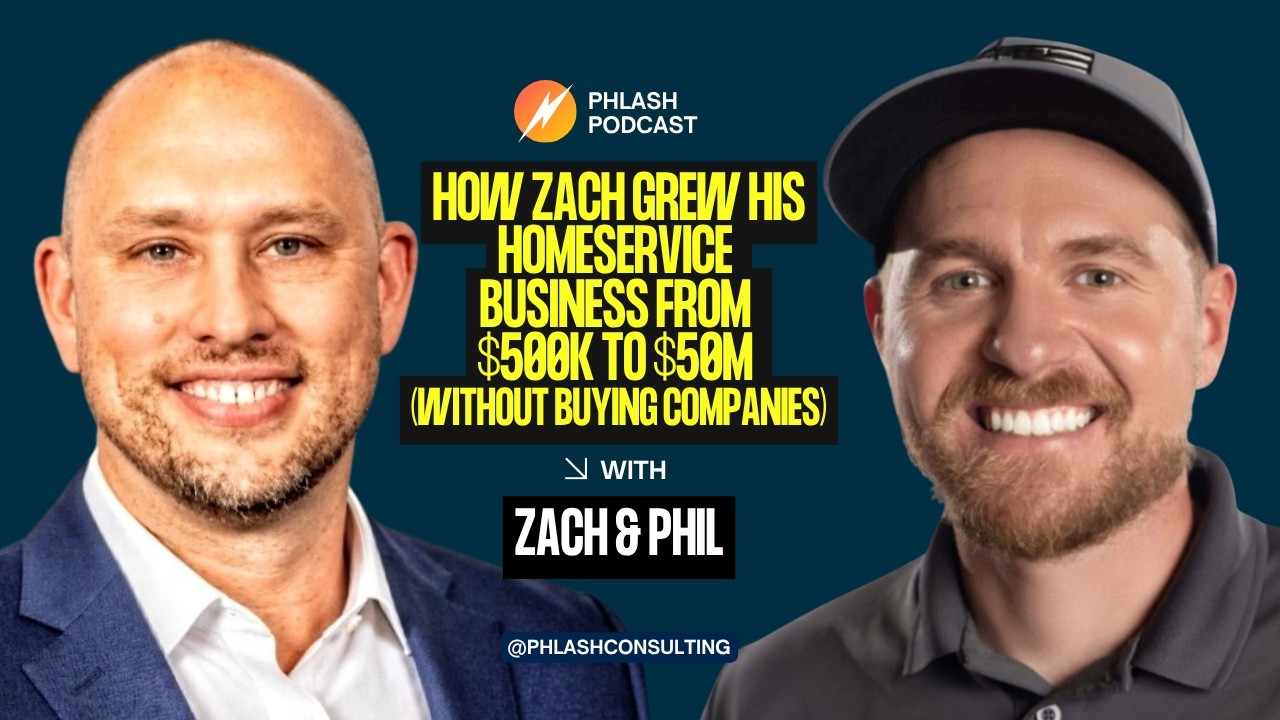
In this interview, Phil Risher talks with Zach Krieger, the growth officer of Ayers Basement Systems, about the 18‑year journey that took the company from a $500,000 startup to a $50 million home‑service business without any acquisitions. Zach explains how he entered the business after leaving college, the decision to grow organically across Indiana and Michigan, and the systematic approach they used to enter new markets (market‑size analysis, competition review, leadership placement). A major turning point was the late adoption of the Entrepreneurial Operating System (EOS), which forced the company to document processes, hold L10 meetings, and create a 3‑step core process that is now 90 % complete. People are the core of the strategy: hiring based on trust and cultural fit, providing clear advancement roadmaps, offering commission/spiff incentives, and fostering an entrepreneurial mindset among technicians. Customer experience is measured through layered NPS/happy‑call surveys, real‑time feedback while technicians are on‑site, and a renewed focus on Google reviews as a raw quality signal. The conversation also covers cross‑selling through recent acquisitions of an electrical and a plumbing company, the importance of transparent financial literacy for staff, and Zach’s vision of building a 100‑year‑old, durable company that balances human capital with robust systems. He mentions early thoughts on AI, mentorship, and invites listeners to connect via the company website and LinkedIn.
Chapters
Welcome back to the show. I'm your host, Phil Risher, and on today's episode, we're talking about scaling from literally $500,000 to $50 million over a 19-year period with Zach Krieger. Thanks so much for joining us today, man. Really excited for this conversation.
Yeah, me too. I'm looking forward to it.
Yeah, even pre-show, we're talking about delivering great customer value, building long-term sustainability and growth. It's awesome. So can you walk me through, like, how did you get into the business? I know pre-show you were telling me your dad was minority owner, but how did you end up getting into this business and becoming this growth officer inside of your company?
Yeah, I mean, I'm 18 years deep into this, this journey now, and I remember looking back on college, being in my third year, you know, junior year. I've got pretty decent grades, but burnout is quickly approaching. And I actually made one of the scariest calls of my life back to my dad saying, hey man, I'm not sure that education's for me. And I was expecting, you know, a crazy kind of dragged out conversation. And one, one question later that changed my life was, why are you still there? And so next thing you know, I'm coming back home, figuring out my life. And, um, he had joined a small company called Ayers Basement Systems that had 21 people at the time. And he said, you know what, I think this is a great opportunity for you to kind of get your feet wet in business. You know, why don't you join at the ground level and we'll see if we can build this thing together. And next thing you know, fast forward 18 years later, yeah, we've grown tremendously and have kept the heart and soul alive. And our purpose remains the same, to redefine the industry. So we're alive and well and man, seems like a long time ago, but here we are.
Yeah, I love it. That's so cool. I think for a lot of people it's like, eh, education isn't for me. But then when they finally realize this opportunity in the trades, in home service, it's like, wow, you can make a bunch of money and make a lot of impact. And it's really a great opportunity. So can you walk me through like the business now? Basement Solutions, like basement waterproofing, encapsulation, like that kind of stuff?
Yeah, so foundation repair, concrete leveling, lifting, egress windows. If you have a wet basement, we can dry that up. If you have a nasty crawl space, it's got mold and wood rot all over the place, we can encapsulate that and take care of that too. So really expanded the service lines over the last, you know, 5 to 10 years.
Okay, awesome. And how much has expansion come from, I don't know, maybe buying other locations or opening new locations versus just like dominating a specific market? Or what's the mix been? Or maybe you took it in different chunks, or what was that like?
Yeah, honestly, it's all been organic growth, believe it or not. We've, we've just taken on new markets. Obviously, we're Northern Indiana all the way through the entire state of Michigan, and we've got, you know, regional plans to continue to expand over time. But all of that, the last 18 years has just been finding really good people and honestly getting better at what we do every day.
Awesome. Okay, so all organic, which is pretty amazing considering 18, 19 years and like $50 million of revenue generated annually. Can you walk through like, let's say you were going to go and pick another new location, like how do you go in and like greenfield it and, you know, plug someone in? I'm sure you have a system or something to like open up a territory or market, but what does that look like?
Yeah, a lot of it has to do with due diligence and figuring out, you know, what the market can bear, looking at, the existing competition and really just trying to get ahead of what leads are going to look like and what the demand is going to look like. I think once we're in that ballpark, I think everything else, we've already got the groundwork laid for plans for bringing on basically everything on the front end and making sure that we've got the right leadership in place. So as far as market expansion goes, we're still a couple of years away from a brand new market. But Detroit was something that we just kind of moved into and got really comfortable in the last couple of years. You hear, especially in Michigan, Oh, Detroit's not that much different than Southwest Michigan. I can tell you right now, it's way different. You know, the people are different, the culture is different, the traffic is different, everything is different. So we just decided to bring this idea of redefining the contracting industry east, and we're getting a really good response to that.
Yeah. Okay, that's awesome. So when you're like, let's say you're open up Detroit, is it you open up another Google Business Profile, you join some BNI groups, you run ads? Like, is there any like secret sauce or is basically just like do those things?
Yeah, I mean, you just hit a lot of— you just hit the big ones. I mean, really, a lot of it has to do with honestly just getting out, pounding the pavement, looking at your, your, you know, your Google Business Page. You just mentioned that your LSA is up to speed. You know, some people have to think about creating a lot of different plugins for your website. That's a huge one that helped us. And then from there, I mean, it's really just focusing on the people. And that's, that's really the bigger part of, I think, the discussion for me today is taking this into you know, longer-term sustainability. And then talking about people, I think that's something that's often overlooked with growth is, yeah, let's just go in there like a bull in a china shop. We're going to— we're going to take the mark, you know, we're going to take the market share and smash all of our competition. Well, the question remains, like, how are you going to do that? And for us, it just remains focused on the people.
Yeah, I love it. Okay. So specifically, people listen to this show are like $1 million to $10 million home service businesses. And at least this is what I found. And maybe you have some thoughts on this is like 1 to 3 million, it's usually like a guy out there trying to sell and like figure out his life and like systems and processes. And then 3 to 5 is like scorecards and data and building that leadership team. And then 5 to 10 is like you got to have really great people that can carry growth forward. Can you walk me through like that shift from 1 million to 10 million or like that growth period of like what changed in the business? Was it like we implemented EOS, we did this, or what were some of those big shifts that were like monumental, would you say?
Yeah, I mean, when you go from an owner-operator hat that's responsible for all the promises, you know, that are created and then delivered to the customer, you're wearing every hat. It's really hard to start to transition that into a trust period where you're bringing on other people and you're handing off and deleg— really, if you're a master delegator at that point, you're going to get really good at teaching people what that value delivery and creation is so that they're communicating exactly what's in your head. And I think that's one of the biggest shifts to begin with is You got to bring on people that you know and trust that are going to be able to perform the way that you once did. Uh, you talked about EOS. That came in for us at about, you know, we were late to that game, uh, $25-30 million somewhere.
Oh wow.
And we didn't have a lot of process and system development. I mean, obviously we had a tribal knowledge and that's what got us to that point, but we really started to, you know, bring in predictable success when EOS came into play. And so you know, about 4.5, 5 years ago, you know, we kind of looked at each other and said, dude, if we don't get this thing under control, like, I don't, I don't want to grow a $50, $60, $70 million business that's got $70 million worth of problems. So we better, we better figure this out right now. And so we got really blessed with an EOS implementer that is, quite frankly, challenging us to become a better version of ourselves. But that has really, really tied down process.
Yeah, I love that. I think, yo, when people like hear, like when they finally realize about EOS, they're like, oh my gosh, where's this been my whole life? Like, why didn't I not have these L10s? Why did I not do one-to-ones? Why did I not do big rocks? Like, it's like such foundational things, but it's like no one teaches you this stuff. Like, you don't know until it actually is out there, like for real. Um, so that's definitely a big one. Uh, so in like, like the $5 to $10 million range, um, one of the biggest things that we see is people spend a bunch of money on ads, like pray to the Google gods and throw things out there without having like good numbers or salespeople are bought in, you know, long-term people. How has that been for you about like actually thinking about growth? Is it just like, hey, we need to find really good people and then we'll find the leads and opportunities for them or hire the people and then they'll go find the opportunities or what's that been like?
Yeah, I mean, you think about, you know, Jim Collins, "Good to Great." And it's that model, right? First who, then what. And I think that's the model that's always taken us from, you know, each stage of incremental growth is to figure out you gotta have people that number one, understand, for us it's our purpose, mission, and values. And you know, they have to espouse, they have to at least be living, you know, what we're thinking. And they may not articulate it the same way, but when they read our manifesto, they're like, oh my God, this is what I do every day. You guys just put words to it. And so you have to find those people and, It's hard. It's difficult. You have to do hundreds of interviews to fill a couple positions. And if you're not committed to that, you're going to be committed to whitewater for the long term, and you're going to be in the washing machine for a very long time. And I think the, the businesses and the leaders that understand that this is a people game, they're the ones that make, you know, pretty significant progress very quickly.
I completely agree. And I think the hardest thing is the 1 to 10 million, it's like, I just need a guy that fogs a mirror and stick him on a truck and like get him out there to, you know, help me. But to your point, it's like, no, there's a lot more intangibles as you are attracting these really good people. Is there anything in particular we talk about, like building long-term sustainability for the, for the brand and the business? Is there anything that attracts these people in? Like maybe there's rev share, profit share, anything else? It's like a big thing that we hear is like there's no good people out there. PE just pays these people way more. They don't want to work for me. So I'm just trying to hear like on your side of it because it's worked for you. Like, what are those things that you can hang your hat on that this is working?
Yeah, I mean, especially combating PE these days. I mean, the number one thing that you hear about private equity is you're just a number. They don't care about your family. They don't care about your personal story or your advancement goals. You know, what do you want to achieve in your life? You know, it's all these different things. And so I think getting back to the fact that these are human beings that are coming to work for you that have real families, that have dreams and aspirations, that want to make something of themselves. And number one, they want to make an impact in the work that they do. They want to significantly feel meaning from the work that they do every day. They don't want to just punch a time clock and get paid. You know, we've gone toe to toe with PE personally, and we've gotten people that have made the U-turn and went, "My God, yeah, did I make a couple extra dollars? Sure." But was it worth it? No, because at the end of the day, I'm treated like another cog in a wheel, and they don't care about the end, the end user, which is really me. And I think that's a, that's a big difference when you come work to with Ayers Basement Systems and our family of companies. We're going to get to know you at a very deep level so that we can build this long-term relationship. And, and again, going back to sustainability, how do you build a company that lasts beyond your own lifetime? And that's something that I'm working on. It's very, very near and dear to my heart and it's near and dear to my leadership's heart, is like, we gotta have people that are rooted in our company for a very long time so that we retain institutional knowledge, number one. Number two, we can build a sustainable growth plan with people that already understand what we do. And then number three, we wanna bring in young people that, again, espouse the purpose, mission, and values that we've set forth to achieve. And to be honest with you, when I say that, it sounds very simple, it's very difficult over a long period of time to hold that North Star and burn it very, very bright and never let that go out. So I'm really proud of what my team is doing because they take, they take that purpose, mission, values like that is the most sacred thing in our business. Without that, I don't know where we would be. Yeah.
Dan Martell says this and it's so good. It's like you need to have a vision or a goal so big that your team's goals can fit inside of it. And I think a lot of times What you just said is like, I want a business that outlives me, right? Like this grand vision that all your team is like, okay, I can fit in here somewhere, I can grow in here somewhere. And that's what people want. Of course, they want an opportunity to grow. But a lot of times as business owners, we never cast that vision or talk about it. It's just in our head. Maybe one day we get there and actually laying it out there gives them this, wow, I can grow here. Are there anything in particular that's like I'm sure you've had to figure this out, but I want to ask you about like, okay, a guy came in, do you have like a growth map for him to like get to the next level or how do you like show them the opportunity for growth?
Yeah, so we have different levels of advancement that are spelled out. So no matter what position you come into, there's all these different olive branches and roadmaps that you can take depending on what you want to accomplish. And the cool part is, is you know, the more knowledge you accumulate, the easier it is for you to transition into those other areas of the business. And so we just look at it as, you know, a development opportunity for our team so that, you know, we can make them the most robust, knowledgeable. And I always looked at it too, like, you know, I tell all of my staff, I'm like, listen, you have to be— you do have to be excited when somebody gets like a ridiculous opportunity that they have to go take that, that honestly they leave Ayres and they go do something different. Because they're going to become a leader or they've got an opportunity that they just can't turn down. It's like Airspace Systems should not be your life. It should be a vehicle to get you to the life that you want. And if that means that you got to go somewhere else, obviously we're going to miss the hell out of you if we spent a lot of time together. But we're also going to wish you very well and we're going to be proud that we set you up for success to take that next step.
Yeah. And I think as a leader, just even saying that out loud is like It, it, you have to say it out loud, but then it also, your people are going to feel that because that's how you treat them and you want them to be successful and hopefully you can help them be successful in whatever they want to do. So I think that's great. Another thing we talked about pre-show was delivering great customer value. And I want to dig in on that in particular, because when we talk about foundation repair or any of these services, I think the value is just like, I need a guy to come fix a crack in my basement or like, I got this musty smell. Can someone fix it? I'll call a plumber. How do y'all go about delivering great customer value and what does that mean to you?
Yeah, I mean, to go back to the statement that building a company that's going to outlast my own lifetime and our leadership's lifetime, you can't do that without this idea of compounding customer trust. And so for us, every interaction that we make with a customer is another layer of compounded trust with that customer. If you look at it as either strengthening or weakening long-term trust, I think that that really gives you kind of the intrinsic value of what sustainability can look like. And I think everybody's really quick to hop to marketing and sales and think like, oh my God, I'm just going to blow leads out of the water and I'm going to make all these sales. Well, what if you measured your customer satisfaction and then tied that back to what those results look like? I think that's one thing that gets overlooked is like, Oh, the customer paid us, so they must be happy. Is that true? Is that always true? Are you calling your customer back to talk to them about their experience? And are you measuring the different— for us, it's gears, not departments. Are you measuring different departments and levels of customer satisfaction? And how do you know what they're delivering? So I think that's something that we just peel the onion back and we try to measure that in every gear and figure out are we really satisfying the customer? Not just that they, you know, gave us an 8, uh, Net Promoter Score, which means that, you know, they're okay with the money that they paid, uh, paid for the service, but they're not going to go out and rave to their family and their church members and everybody that they know to tell, to tell them about Ayers Basement Systems. So I think it's exceptional customer, you know, exceptional customer experience will lead to compounding customer trust. And if you do that over a period of years, the profits and the sustainability of the business just goes up tenfold.
Yeah. I experienced, so I used to work at a home service business and before that I worked at Enterprise Rent-A-Car through their management training program and they did Net Promoter Score at a local service business. And the way that they coached us to do it was to ask 3 questions at the end of every service. How is everything with the customer service? Is there anything I could do better next time? And if they said yes, then what can I do to make it up to you? And then they called random customers every single month and ask them their net promoter score, and then they scored our branches based off of that. And I, when, when I went to work at my home service business, we were $3 million. I'm like, why are we not doing happy calls and asking these people, like, was it even a good experience? Like, is there any questions they have? Like, it's just like crazy. So for y'all, is it happy calls, or is there anything else you do for a net promoter score to generate that number and figure it out?
Yeah, there's, there's 5 different questions that our team asks, and you'll have to forgive me, it's been a while since I hopped on a net promoter score myself, but, uh, They ask 5 different questions. And then I love the one you said about, can we make it up to you? We ask something similar, like what could we do now, you know, to make that a 9 or a 10 and to get that top score so that you will refer us. But we're also doing, we just started doing this, we're calling people live while our guys are on the job site.
Mm.
Because we just want to know what's going on, like live.
Yeah.
Hey, how's our team's cleanliness? How's their language? Like, are they being respectful? How are they treating your family in their home? Like, we just kind of wanted to know that. So we're doing both of those right now. That's kind of a beta test. And it's really cool when they're talking to the, the office.
Yeah.
While the installers are there, because you can, you can fix stuff in real time and you also get a pulse on what's going on with the crew. And if there's anything going on, guess what? You can fix it while you're there, which is pretty sweet.
I love it. So it's funny because at Enterprise we used to do 2 calls. So we would rent someone a car, they'd rent the car for like, you know, 2, 3 weeks, whatever, if their car is in an accident. So we would call them the next day after they got in the car just to check check, like, you got any questions about the car?
I've heard, yeah, I've heard about this.
Yeah, so it's very similar, like, you're actively using our service, so why don't I just check in to see if you have any questions or anything? It allows you to manage the process all the way through and fix any issues as they arise. So I love that. I think it's really good. You mentioned about the plus or minus interaction-wise. We have a saying at Flash, you can't get lifetime value without a lifetime relationship. And I want to hear from you because from what I know about foundation and basement stuff, it's like one and done type of services. But do you have any cross-sell services or like repeat type things? Or is it like one and done? Is it mostly just word of mouth that happens? Or what does that look like?
Yeah, so we're really blessed. We acquired an electrical company and a plumbing company back in 2020. Nice. So that we could control the quality and service, you know, that really became, made us more of a turnkey service for our customers. And so yeah, we're able to offer all different kinds of cross-selling. I mean, from generators and whole home rewires to, you know, changing out a toilet and, and cleaning your drain, that kind of stuff. But at the same time, we also offer ongoing services from Ayers. And so, you know, these services are just like a car, right? You're not going to drive 700,000 miles without getting an oil change. It's the same thing with mechanical issues that customers may face in the systems that we sell. So Yeah, we're going to want to come back and reinspect and check everything out that we did to make sure that honestly we can find any problems before the problems find the customer. And if we're doing it right, you know, we're also having discussions about other things that they may not have known that cropped up or things that may have changed that we talked about in the past. So it's just another good conversation to get in front of the customer and figure out more about how they want to use that space. Is it where they want it to be? Is there anything else we can help with and really make sure that they got everything that they needed?
Awesome. So definitely, obviously a plumber, it's like, hey, some musty smell, something's leaking. Makes sense. Like, okay, maybe we do this electrical generator, same thing. It's thunderstorms. Like, have you ever thought about this? That I get that. I want to hear specifically. So, so a lot of times this is an issue is they have technicians out in the field doing stuff, but they don't have cross-sell opportunities that arise because they don't have a system for it. How do you all make sure, like, do you track your technicians' cross-sells? Do you give them like 1% if they cross-sell something? Or how do you make sure that that happens when you have these opportunities?
Yeah, so they've got, they've got spiffs out there on commission so that they're, you know, encouraged to bring these things up. But at the end of the day, you know, I think again, this goes back to the sustainability piece of just framing it correctly for the installers. I mean, if you're going out and you're saying, guys, I want you to sell a lot to our customers, right? That's a lot different than saying, hey guys, I want you to truly be the best inspector and expert in your craft. And to be able to do that, I want you to find everything that this customer could use to get to their end result, to get to their key outcome. And if you do that, not only are they going to win for the long term— their house is going to be safer and more efficient— but I'm also going to reward you using a commission structure so you can earn more for your family. And so I think at the end of the day, a lot of these operators and guys who have done the work for a very long time forget that we got to teach people how to think. This isn't just about turning a wrench. It's not just about telling the customer, oh, hey, I cleaned up after the job. This is about framing young men's thought processes so they can go out into the world and be successful.
Yes, I love that because this happened at my home service. We did duct cleaning and then we also did dryer vent cleaning. And the problem is that we would go out for duct cleanings and I would tell our guys, like, you always need to check for a dryer vent cleaning because it's a fire hazard. If we were just there and you did not check their dryer vent and their house catches on fire tomorrow, they're going to say, why didn't you check my dryer vent? And they would say, well, we don't want to be upsell or sell. And it's not about sales, it's about service and making sure that their home is safe. If they want to do it or not, whatever. But I want to make sure the home is safe. And exactly what you're saying, it's not about selling them the dream. And if it makes sense to sell them something, great. But it's more about serving them well and making sure that people serve like our clients well. And that's what it comes to.
At the end of the day, this ties back to our purpose to redefine the contracting industry. You know, there's a lot of bad contracting out there. And I think unfortunately the stereotype and the bar for contracting is very low. And so I think the, the people who are trying to get from, you know, $500,000 up to $10 million, they just have to be convicted in the fact that however they feel about serving, you got to transfer that to your team. And if the people aren't getting on board with that transference or they don't want to, can't, whatever, you got to look for the next person that feels that same level of conviction that's going to go out and really, really provide the value that you once provided. The only way to scale is through other people. And so I think, you know, I think people, all they want to do is they want to reward somebody for turning a wrench. We're not doing the work, right? 50% of this is the experience that you create. The other 50% is the work. So unless you can, uh, unless you can transfer that to the next guy who's going to pick it up, carry the torch, and do it as good or better than you, you're going to be stuck at the level you're stuck at for a very long time.
Yeah, we had a saying, sales is service. It, it's literally you're trying to serve someone better by recommending things to them. It's not you trying to sell them to make a bunch of— line your pockets with commission. It's literally to serve them better, and if they want it, great. So I think it's great. Um, I'm curious about— so building this sustainable company, like you mentioned to outlast you, like what does that look like? Like, you know, is there like employee stock option plans in the future? Is there other, like how do you like conceptually frame that 100 years out of like what's this gonna look like? Maybe you haven't thought, I mean, I'm sure you thought about it, but I'm curious like your mindset.
Yeah, I've spent some time thinking about that. I don't think I've got a full formulation, but the words that come to my mind, right, is human and operational durability. You know, I don't know what that's going to look like, you know, 20 years from today. Obviously I've got some plans that I'm working on to figure that out. Yeah, but I think at the end of the day, again, it goes back to alignment, right? I have to get all of the things that are in my head out to the people in the workforce. And to be honest with you, that's another— that's another thing I wanted to touch on is like, you have to be willing to share things that I think a lot of business owners don't want to share. They don't want people to know the financials. They don't want people to look at P&L. They don't want people to understand a balance sheet. They don't want people to be able to debate and sometimes argue and sometimes win, uh, you know, fights with them about the right thing for the business. So I think if, you know, to get to 100 years, right, it's going to take a lot of transparency. It's going to take a lot of trust. Um, most importantly, it's going to take, you know, like I told you before, keeping the same human capital in place for a long period of time. But that word durable just continues to echo in my mind about systems and processes. I think we're in a space now where, you know, you look at the 3-step core process documenter through EOS, right? A very little known and very, I would say, even less used tool in the EOS toolbox. You know, we're about 90% complete. We're going to be 100% complete moving into 2027, and that's going to be the clarity that the business needs to run forward toward predictable success. And so So I'm just really excited about this, this word durable. My team's going to hear a lot about it in 2027 because that's what we're building. But to give you the, you know, to give you the secret sauce on that, I'm still, I'm still working on it.
Yeah. Something that I, I know I keep bringing up enterprise, but when I think about like a, like a longstanding company, like enterprise for me, a $37 billion family-owned business, not franchised, like still family-owned business. And one of the things that they did was all the way down to the branch level, even every employee knew the P&L of their branch. And the branch managers, we got paid off of the P&L. So like everyone's looking at the numbers, obviously they roll up and get bigger and bigger. But you mentioned about like gears or departments. It's like, okay, well that in and of itself can be managed within a P&L and a balance sheet and have budgets that they can manage themselves, which then rolls up to a greater thing. But it's like giving someone the ownership and the ability to make those decisions and hold them accountable for that, I think allows you to create entrepreneurs type of people that are going to be building with you. Not for you.
Exactly. And to me, again, that goes back to trust and transparency. I mean, a lot of these businesses out here, you know what they want? They want robots. They want cyborgs that are just going to do their bidding. At the end of the day, I want human beings that can think for themselves, that are empowered to make decisions on the fly. And that takes a lot of trust and it takes a lot of commitment, which, you know, at the end of the day, it just makes it more fun to work when you have— I love that term entrepreneurs. When you have 300 entrepreneurs working together, how much fun are you having, you know, together trying to build the business? Versus the genius with 1,000 helpers at the top that's waiting for the next question to be answered.
Exactly. So good. Cool, man. Well, anything else that you want to share or talk through, or where should people go to learn more about your business or you if they want to connect?
Yeah, I mean, I think the other thing I just like wanted to frame this one more way is like this idea of a 100-year company. Again, I want people to think about the consistency of the customer value that's delivered. One of the things that we're working on this year and it's really hard to do, is raising the bar on Google reviews. You know, I think Google reviews are probably one of the most undercapitalized things in a business. It's, it's raw feedback right from the chief quality officer, straight from the customer's mouth, right? And if you're not looking at that really objectively and measuring yourself against what that customer said and putting your ego to the side and saying, you know what, maybe we do suck in the areas that this, this customer is saying, maybe we need to take a hard look at this area that we just got bashed on instead of, you know, going to the fight, taking the fight to the customer. It's like, no. And so I'm reorienting our, our company standards on Google reviews right now. I think it's one of the biggest things we have in terms of the fight with competition. You know, we're going to win that fight in 2027. We're going to, we're going to bring it to them in 2027, which is really honestly just going to help our customers in the long run. Our future customers are going to win from our mistakes from the past. And so I'm just really excited about Google Reviews. I'm also excited about AI. My God, is AI going to be this new tool that we all better hop on and understand very quickly because it sounds like ChatGPT is already giving Google a run for its money in terms of search. So we're getting it on in the AI space and I can't wait to see what that brings. But if you want to check us out, um, go to goairs.com. You know, you can check out all of our stuff. You want to hit me up on LinkedIn or you want to shoot me a DM, you I'm known in that space for interacting with a lot of people. I'd love to help anybody that I can. That's one of my other side gigs is I love mentorship. I've been very blessed with people pouring into me and I love pouring into other people. So if you want to hit me up on LinkedIn, I'd love to have a conversation, but really appreciate you having me on today. And if there's anything I can do, Phil, let me know.
Yeah, for sure. I love it. I want to share something about reviews. So if you're listening to this and you're like, hey, I don't know how to show my customer value or what's going to stand out. One of the really cool things that you could do, we used to do this, was go to your competitors and look at their 1-star reviews and see what their customers are complaining about. And then that will tell you what you need to do inside of your customer process to actually fix it.
There you go.
I love that. It's really good, like raw, you know, chief quality, like this is the issues in the space. So don't do that and do something different. And they're going to tell you all the problems that your competitors have. Which is a beautiful thing. So, Zach, awesome, man. I love it. Ayers is A-Y-E-R-S. Go Ayers.
Ayers Basement Systems. A-Y-E-R-S.
Thank you. Yeah. Awesome. Zach, thanks, man. Look forward to continuing the conversation.
More from Phil




The companies that win the next five years won't be the ones gaming the system.


