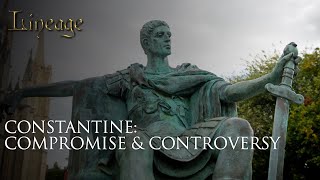
Constantine became emperor in 306 AD and claimed a vision before battle led him to convert to Christianity. His shift transformed the Roman Empire from pagan to Christian, turning temples into churches and gods into saints. The speaker argues this created two Christianities: a mainstream compromised church and a smaller persecuted one that kept apostolic purity.
Chapters
As we trace back our spiritual lineage to the early centuries, we find the Christian Church a maligned religion. It was not popular. Many of the Christians in the early centuries paid the ultimate price for their faith with their lives. The Colosseum in Rome stands today as a testament of this fact. Under pagan Rome, the Christian Church struggled along. But one thing was sure, the intensity of the persecution kept the Church free from nominal and lukewarm Christians. If you were a Christian, you had to be all in. There was no middle ground. But in the 4th century, an event would come along that would change all of that dramatically. The conversion of Constantine changed the course of history for the whole of Christendom. And the roots of that come down here to York, England.
In 306 AD, Constantine was declared emperor here. His father Constantinus was in Britain from 305 to 306 AD and Constantine was with him until his death. He was then declared emperor. But it was not to be a smooth sailing. There were counterclaims to the emperorship from Licinius and Maxentius. And it was before a battle with Maxentius that Constantine felt he needed more help than just the soldiers he had. And so he sought the help of God. He believed he saw a cross in the sky and heard the words of by this sign you shall conquer. He took this as a sign to convert to Christianity and a major switch began to take place. Rome would go from being pagan to papal, from paganism to professed Christianity. Many historians debate the authenticity of Constantine's conversion. Was it a deep rooted biblical conviction or was it a political ploy to to keep a divided empire together? One thing is sure though, that after his conversion, practices crept into the Church that previously had no place there. Temples that were pagan were changed to Christian. The Pantheon in Rome was changed into a Christian church and the names of gods were changed to Christian saints. For example, Jupiter became St. Peter and the list goes on.
Some were happy for these changes and welcomed the lack of persecution and their newfound status. There were many Christians all over Europe who resisted these changes. For them, the persecution continued as they stayed out of line with the Mother Church. These were Christians who were maintaining the pure apostolic faith that was handed down to them over the years. There were scattered groups of people all over Europe. In northern Italy, in southern France, the Celtic Church here in Britain and in various other places. The Bible refers to them as the Church in the wilderness in Revelation chapter 12 verses 6 and 14. They were not always the biggest, they were not always the largest, but God would always have a people that were true to him and that were faithful to His Word. And so from this point on, two branches of the church would emerge. The recognized the mainstream, but the compromised church, and then the persecuted, often the smaller, but the pure church. The question for us today is, which one of these two are we a part of? May we never compromise truth for popularity. May we be faithful to God and to His Word, no matter what the situation is.