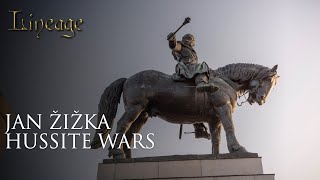
A narrated YouTube segment about Jan Žižka and the Hussite Wars. It describes the execution of reformer Jan Hus (here called "Hussen/Hassan Jerome") sparking unrest in Bohemia, the rise of military leader Jan Žižka—his blindness, invention/use of war wagons, and remarkable record (reported >250 battles, undefeated)—resistance to multiple papal crusades (crusades mentioned in 1427 and 1431), Žižka's death from the plague, succession by Procopius, and a negotiated peace that incorporated four Bohemian demands concerning preaching, communion, vernacular worship, and clergy jurisdiction.
Chapters
The execution of Hassan Jerome had caused a national uproar. Back in Bohemia, he was believed to have been a faithful teacher, and as is often the case now that he was dead, his writings attracted an even greater interest. The Hussite wars commenced about four years after the death of Hussen Jerome. In the year 1419.
As Pope and emperor united to crush the Hussite movement, the Lord raised up a deliverer. Ziska was one of the most able generals of his age and was the leader of the Bohemians. He had lost sight in one eye during a battle in 1410, and later in his life he would lose sight in the other eye as well. But he would still lead his armies into battle after battle without losing. He is one of the few generals about whom, it can be said, never lost a battle in war. He was a military genius and is credited with inventing an early form of the tank. They were called war wagons and they were wooden boxes that were reinforced with steel on wagon wheels. And he would send these into battle with people inside and load them with cannons and crossbows and pistols. Despite having mainly peasants as soldiers, with the use of clever war tactics and with Providence on their side, the Hussite armies were able to repel the numerically larger and better trained papal armies.
Ika would fight over 250 battles in his lifetime and would withstand two full Papal Crusades against. But he was not to die on the battlefield. Instead, he would fall victim to the black plague. But before he would die, he gave his men some instructions, telling them he still wanted to go with them onto the battlefield. He told his men to make a drum out of his skin, which they did, and they took this drum made with Giska's skin and would beat it as they went in to battle.
His place was filled by Procopius, who was a skillful and brave leader, and in some aspects, a more able general. The enemies of the Bohemians, knowing that the blind warrior was now dead, thought they would now be able to win. The Pope launched another crusade against the Bohemians in 1427, where he was defeated. He then launched another crusade, where he was defeated again. In 1431, under a new pope, a fifth crusade was launched. But once again the papal armies were soundly defeated by the Hussite forces.
Realizing that they couldn't conquer by force, they resorted to diplomacy. A compromise was entered into that, while appearing to offer freedom of conscience, really betrayed them into the power of Rome. The Bohemians had specified four points as a condition of peace with Rome, and these the free preaching of the Bible, the right of the whole Church to both the bread and the wine in the communion, the use of the mother tongue in divine worship, the exclusion of the clergy from all secular offices and authority, and in cases of crime, the jurisdiction of the civil courts over clergy and laity alike.
At last the papal authorities agreed to accept the four Hussite Articles. But that the right of explaining them, that is of determining their precise import, should rest with the Council, that is, with the emperor and the Pope. On this basis, a treaty was entered into and Rome gained by dissimulation and forced fraud. What she had failed to gain by conflict. For in placing her own interpretation upon the Articles as upon the Bible, she could pervert their meaning to suit her own ends. Oftentimes, when Satan is not able to defeat us through open confrontation, he tries the tactic of compromise. It's something he's done repeatedly throughout history and throughout the Bible. May we be careful, wise and discerning, and most of all, resolute. And that we stand for God through whatever tactics Satan uses against us, whether it's confrontation or whether it's compromise. And that we may always stand for God.