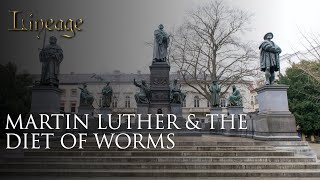
Pocket Pastor's YouTube narration recounts Martin Luther's arrival at the Diet of Worms (arriving 15 April 1521), the public interest in him, and the two formal questions posed at his trial (whether the books were his and whether he would retract his opinions). Luther categorized his writings into three groups (harmless/beneficial on faith and works; denunciations of papal corruption; attacks on defenders of papal evils) and refused to retract, delivering his famous statement ("Here I stand. I cannot do otherwise. So God help me. Amen."). The video frames his stance as an attempt to reform the Church from within and highlights the courage and lasting influence of his defence.
Questions this video answers
15 April 1521.
(1) Whether the books were his; (2) Whether he would retract his opinions.
"Here I stand. I cannot do otherwise. So God help me. Amen."
Chapters
Luther had been called to trial, and he arrived in Worms on 15 April 1521, and he caused quite a strange stir. People were dying to see him, and his place of residence was constantly full of people who wanted to spend a few moments with this brave man who was willing to take on the whole Church all on his own. Luther's very appearance was a victory in itself, for to be condemned and excommunicated, and then be given a voice in trial, undermines the authority of the one who excommunicated him.
Noted that Luther, at this stage of his life and ministry, still had no intention of breaking away from the Church. He commented that nothing could be gained through schism, and he hoped to reform the Church from within. One of the key principles of the Reformation that Luther accepted and held onto resolutely was that the Bible was the foundation of all Christian belief and practice. Thus, when accused of error and heresy, he simply asked his accusers to show him from the Bible where his error was.
As he was about to enter the room, a few people spoke words of encouragement to him, in particular one army general who told him that he was about to make a more noble stand than he and any of his captains had made on the battlefield. He told them that if his cause was just, and he was sure of it, to go forward in the fear of God.
At the trial, Luther was asked two things. Firstly, were the books his, and secondly, whether he would retract his opinions. Luther responded and said that the books were his, but he asked for some time in order to craft his response as to whether he would retract or not. This convinced the assassination assembly that he was not acting from impulse and would later give further weight to his answers.
The next day, when Luther responded, he divided his writings into three different sections. In the first section, he dealt with faith and works, and even his enemies declared that these were not only harmless, but also beneficial. In the second class of books, he denounced the corruptions of the papacy, and to revoke these would strengthen the tyranny of Rome. And in the third class of books, he denounced those who defended these very evils. While Luther admitted that perhaps he could have been a little bit less harsh in his responses, even these he was not willing to retract. At this point, Luther had spoke only in German, and he was now asked to give his response in Latin. Despite being tired, he was able to do this, and it gave further weight to his response. As everyone in the chamber heard what he said for the second time, the spokesman now pushed him for an answer, asking him the question, will you or will you not retract?
Standing here on this very spot, Luther gave a response that has become famous over the centuries. Unless I am convinced by scripture and plain reason, for I cannot accept the authority of popes and councils, for they have often contradicted each other. My conscience is captive to the word of God. I cannot and I will not recant anything, for to go against conscience is neither right nor safe. Here I stand. I cannot do otherwise. So God help me. Amen.
The assembly stood in amazement, speechless at what they had just seen and heard. He was again asked if he would retract, to which he responded, may God be my helper, for I can retract nothing.
The courage that Luther spoke with at this trial has inspired many people since then to stand for God in the face of opposition and against the odds. In Mark 13:9, the Bible tells us that one day we may have to stand before kings and rulers. May we be faithful to God, that if we have to stand, we would do so with boldness and unflinching courage in the face of trial.