3:19
In 1588, Spain sent 130 ships to invade England. English fire ships scattered them near Calais, and only 67 made it home. Elizabeth I's famous Tilbury speech and the Armada's defeat are framed as evidence of divine providence.
In 1588, Spain sent 130 ships to invade England. English fire ships scattered them near Calais, and only 67 made it home. Elizabeth I's famous Tilbury speech and the Armada's defeat are framed as evidence of divine providence.
The mid 16th century saw the rise of Protestantism in England, initiated by King Henry viii break from Rome and nurtured by Edward VI and a nine day queen, Lady Jane Grey. This was brought to a halt during the reign of Mary Tudor who reinstated Catholicism in England and earned the title Bloody Queen Mary for her role in the murder of over 260 Protestants. Things changed when Elizabeth I came to the throne. She reinstated Protestantism and cemented earlier reforms that had started and established the Anglican Church. Catholics though viewed her as an illegitimate queen because they never recognized King Henry VIII's divorce from Catherine of Aragon, thus making his marriage to Anne Boylan, Elizabeth's mother, illegitimate, thus making her an illegitimate queen in their eyes. Rome then wanted to establish a Catholic monarchy and attempted to do this through a military invas.
On 28 May 1588, the Spanish Armada, a fleet of 130 ships set sail from Spain to England. One of the largest fleets ever assembled at a huge cost to Spain, it had almost double the firepower of the entire English navy, almost guaranteeing an easy victory. They were first sighted on July 19th in in Lizard, Cornwall and the news was relayed to London via a system of beacons.
Sailing up the English Channel, they missed an opportunity to attack the English fleet stuck in the tidal mud in Plymouth, hoping to reach the Netherlands to pick up 30,000 soldiers to battle with the English. They dropped anchor in Calais.
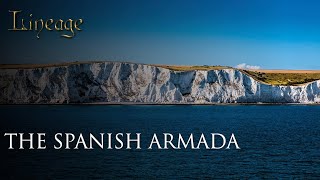
On 29th July across from the cliffs of Dover, over in the French waters of Calais behind me, the Armada was attacked by eight English fire ships that came in, broke their formation, allowing the smaller and more agile English English ships to come in and wreak havoc.
The Armada broke up and sailed up the Channel to the North Sea while being pursued by the English ships. They continued around Scotland, but much of the fleet crashed onto the rocks of Scotland and Ireland, as in their hasty retreat that many of them had lost their anchors. Of the 130 ships that originally set sail, only 67 of them made it back home.
Unaware of the Armada's fate, the English militias assembled in Tilbury, Essex, where Elizabeth was invited to inspect the troops. Wearing a silver breastplate over a white velvet dress, she gave a famous speech. My loving people, we have been persuaded by some that are careful for our safety to take heed how we commit ourselves to armed multitudes for fear of treachery. But I assure you, I do not desire to live to distrust my faithful and loving people. I know I have the body but of a weak and feeble woman. But I have the heart and stomach of a king and of a king of England too, and think foul scorn that Parma or Spain or any prince of Europe would dare to invade the borders of my realm.
When it was clear that the Armada's attempt to overthrow Protestantism had failed, England was relieved and Elizabeth I. Let us thank you. Service to St. Paul's Cathedral that was attended by almost as many as her coronation. Many took the defeat of the Armada to be a sign of God's favor and the inviolability of the rule of the queen and her realm. Protestantism was uplifted and medals were inscribed that bore variations of the inscription. God blew the winds and they were scattered. Or he blew and they were scattered. While historians debate exactly what was the factor that led to the defeat of the Armada, one thing is clear. Providence played a key role now in our lives today. It may not be on such a grand scale as the Armada back then, but God still moves through providential circumstances. He doesn't always speak audibly. He doesn't always have a bloodless handwriting on the wall as in Daniel, chapter 5. For God's still rules in the affairs of men and in our lives today. He still moves through providential circumstances. May we be open to his leading in this manner.

Why Is There so Much Killing in the Old Testament? Part 2 | Table Talk S03 E10

Why Is There so Much Killing in the Old Testament? Part 1 | Table Talk S03 E09








