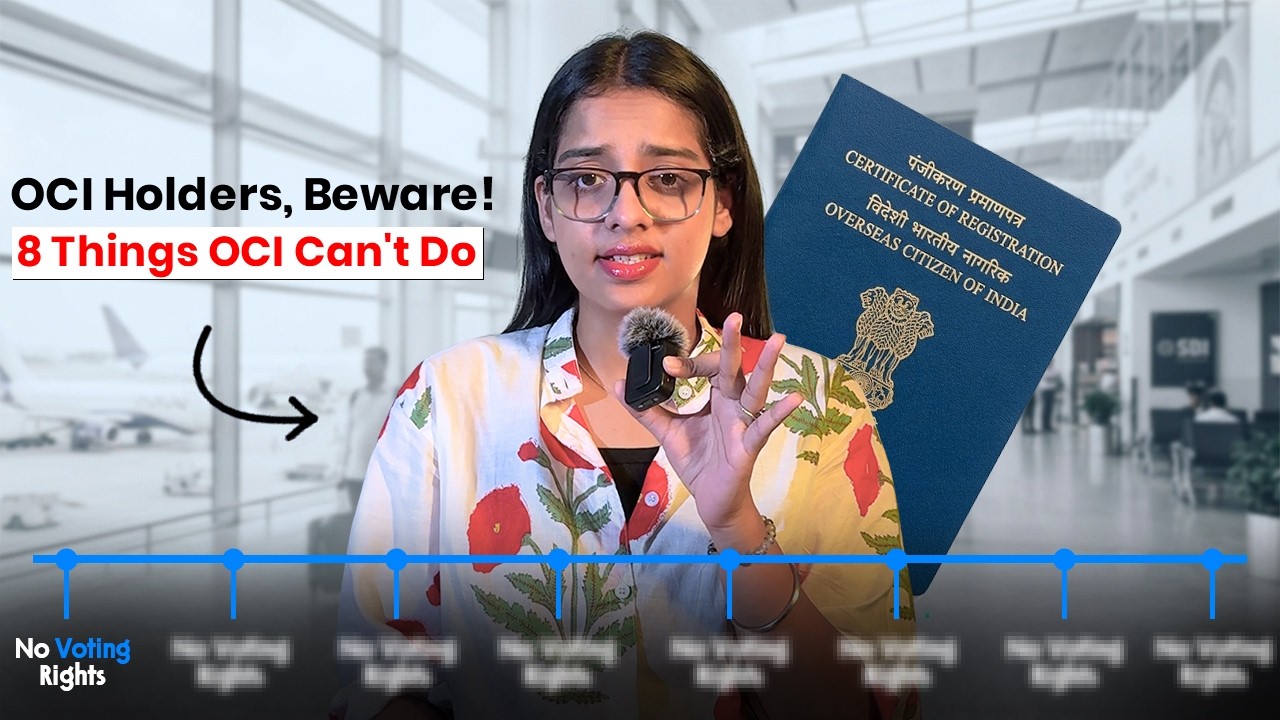
In this VisaMint explainer, the host outlines eight key limitations that apply to Overseas Citizen of India (OCI) cardholders, clarifying that while the OCI provides a lifelong visa and many economic rights, it does not confer full citizenship privileges. The video details: (1) lack of voting rights and eligibility for political office under Section 7B of the Citizenship Act, 1955; (2) prohibition from holding constitutional or most government positions unless a special central order is issued; (3) property purchase rules—residential/commercial allowed but agricultural, farm, and plantation land barred except by inheritance; (4) banking constraints—OCI holders can open NRE/NRO accounts but cannot maintain regular resident savings accounts without updating KYC; (5) requirement to obtain an Indian driving licence for long‑term residence; (6) activities that need FRRO or Indian mission permits (research, missionary work, mountaineering, journalism, diplomatic internships, visits to protected zones) as per the OCI Notification 2021; (7) education rights—eligibility for national entrance exams and admission to premier institutes, but exclusion from citizen‑reserved seats and government scholarships; (8) parity with Indian citizens for entry fees at monuments and heritage sites. The host also provides a 2026 update: the OCI system is now fully digital (eOCI), physical cards are optional, passport changes must be updated on the OCI portal within three months (or a $25 fee applies), and PIO cards are no longer accepted. The video ends with a call to comment, subscribe, and follow for future OCI updates.
Chapters
You have an OCI card, which means lifelong visa to India, no registration needed, live in India for as long as you want. Sounds like you have the same right as an Indian citizen, right? Wrong. 8 restrictions can catch you completely off guard if you do not know them, and especially with the new 2026 OCI rules being in place. Namaste NRIs, welcome back to VisaMint, your one-stop guide for everything OCI passport and NRI documentation. If you are new here, we simplify the most confusing NRI rules so you do not have to take any stress. Now let's break down all the 8 restrictions every OCI holder must know before moving themselves to India. No voting rights. And this surprises a lot of people. OCI cardholder cannot vote in Indian elections, not in local elections, and not even in the state. They cannot also run into general elections as well. You cannot run for any political office. No contesting Lok Sabha, Rajya Sabha, or state legislative seats. The OCI card gives you nearly every economic right of an Indian citizen, but political rights, they are completely off the table for you. This is clearly defined under Section 7B of the Citizenship Act, 1955. India does not allow dual citizenship, and voting is a right reserved strictly for the Indian citizen. Restriction number 2, no constitutional post. You cannot hold any constitutional post. That means you cannot become a president, vice president, governor, or serve as a judge of the Supreme Court or any High Court for that matter. And it does not stop right there. OCI cardholders are generally barred from government employment as well. You cannot take up government jobs unless the central government issues a specific special order for the particular position for you. So if you are planning to move back and join civil services or any government role in India, your OCI card will not let you do that. So you would need to apply for a full Indian citizenship first for that matter. Restriction number 3, property registration. And this is the one that trips up the most NRIs. Property restrictions. Now let's start with the good news. OCI cardholders can buy residential and commercial properties in India. Apartments, villas, office spaces, all of that is allowed for you under the FEMA rules. You have the same property purchase rights as NRIs in these categories. But now comes the catch. You cannot purchase agricultural land, farmhouses, or even plantation properties. This restriction specifically applies to you regardless of how you plan to use the land. Even if you want to buy agricultural land and use it for non-agriculture purposes, it is still not allowed. Now there's one exception, which is inheritance. You can definitely inherit agricultural land from a family member. You can hold it, but if you want to sell it, you must sell it to an Indian resident. And keep this in mind that all the property transactions have to be routed through property, through proper banking channels, which is your NRE or NRO accounts as per the FEMA regulations. Restriction number 4, banking limitations. OCI cardholders can open NRE and NRO account in India, which is the same as the NRIs can do. You can hold fixed deposits, invest in mutual funds, and manage your Indian income through all of these accounts. But here's what most NRIs do not rely— you generally cannot open a regular Indian savings account as long as you hold a foreign passport with an OCI status. Indian banks treat you as a non-resident for banking purpose. This also means FEMA rules apply to all of your transactions, including the repatriation of funds. So if you are planning to move back permanently, you will need to update your residential status and KYC with your bank accordingly. Restriction number 5, driving license. If you're planning to visit India for a short trip, your foreign driving license might not work in some situations. But if you're planning to live in India for long term, your foreign license may not be legally sufficient. You need to apply for an Indian driving license for that matter. The rules vary slightly by state to state, but in most of the cases, if you are residing in India for an extended period, you will need a valid Indian license. The process for this involves submitting your foreign license, address proof, and in some states, appearing for a driving test as well. Do not assume that your US, UK, or Canadian license will automatically work in India as well. Check for this information with your local RTO before driving for the long Restriction number 6, restricted activities requiring special permission. And this is the one most OCI cardholders have no idea about. Under the OCI Notification 2021, there are certain activities that you cannot do in India without getting a special permit from the FRRO or the Indian Mission. These include research work at Indian institutions, missionary activities, mountaineering, journalism and media work, or working as an intern or employee in any foreign diplomatic mission in India. You will be also needing special permission to visit protected, restricted, and prohibited areas notified by the central government. This includes certain border areas and sensitive zones. So if you are an OCI holder planning to do any kind of research or journalism or any kind of work connected to the foreign organizations in India, you will be needing a permit sorted before you even start. The employer or the institution is also required to verify that your necessary Restriction number 7, education rights. And this is actually good news for the student. OCI cardholder students can appear for national entrance exams like JEE and NEET in India. You are eligible for admission in Indian educational institutes, including the IITs, NITs, IIMs, and AIIMS, and other central universities. OCI cardholders can even receive parity with NRIs for educational fees at many institutions. But there's a loophole. You are not eligible for government Not scholarships. eligible for seats reserved exclusively for Indian citizens. That means reserved category seats for SC/ST and OBC quotas, those are only for the Indian citizen. You will typically be considered the NRI or foreign national quota, and the admission rules and the fee structure under those quotas will differ from university to university. So check the specific institution admission policy before you're applying. Restriction number 8, which is entry fees This is a small but also a nice benefit. OCI cardholders are treated on par with Indian citizens for entry fees at monuments, museums, national parks, wildlife sanctuaries, and historical sites across India, which means that you won't be paying the inflated foreigner price at the Taj Mahal or any other monument. Just carry your OCI card with you as proof. It can save you a significant amount, especially if you are traveling across India. And one quick 2026 update you should know. The entire OCI system has now gone fully digital. You can apply for an eOCI card. Physical cards are optional and all applications must be submitted online. Also, if you get a new passport, you must update your details on the OCI portal within 3 months. Otherwise, there is a fee of $25 applicable onto you. PIO cards are no longer accepted at all. If you still have one, you need to apply for a fresh OCI card immediately. So which of these 8 restrictions surprised you the most? Comment below and tell us. We will read each and every comment of yours. And if you are planning to move back to India or are already living on an OCI card, subscribe to VisaMan because we cover every OCI update, rule change, and NRI tips so you're never caught off guard. Hit that subscribe button, turn on the bell icon, and we shall see you in the next video.