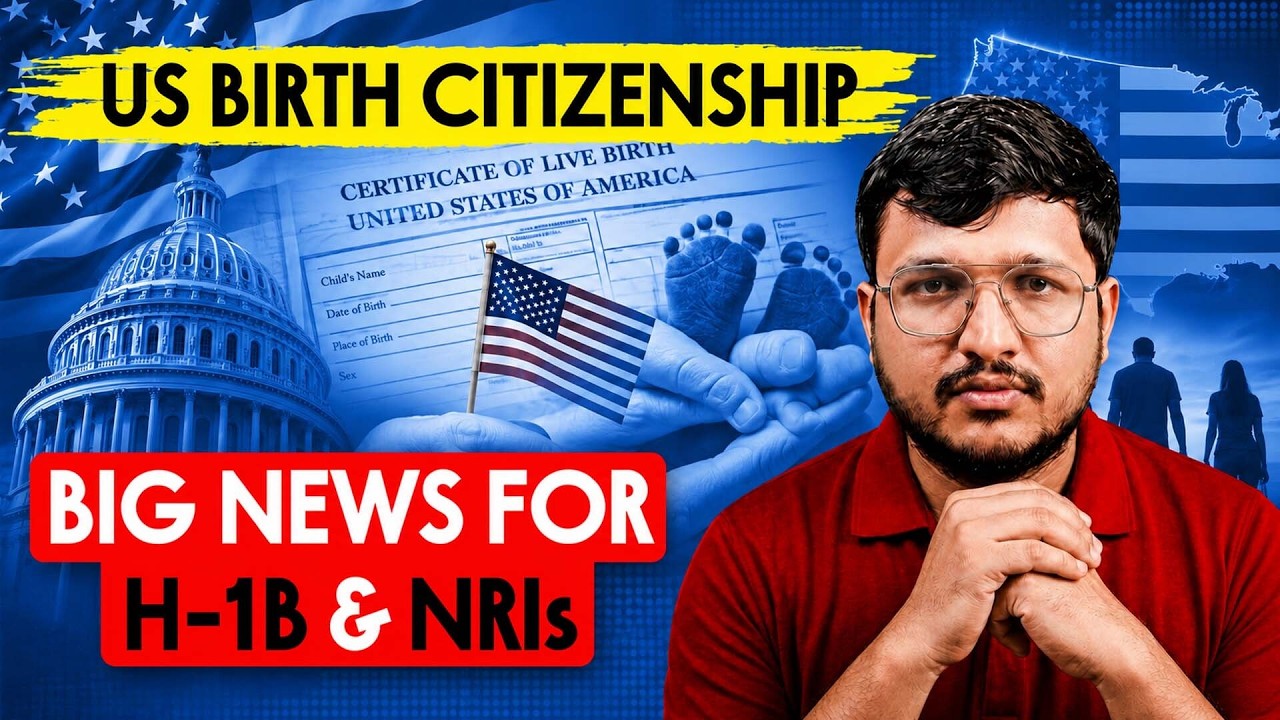
This content was created by Pratibha Sharma. This content was uploaded by Pratibha Sharma. This is a YouTube explainer video titled "Born in USA = US Citizen? Supreme Court's BIG Decision Explained (2026)" (created 2026-07-10). A single presenter (transcribed as SPEAKER A) addresses primarily Indian/NRI audiences and explains the U.S. Supreme Court’s June 30, 2026 decision (Trump v. ... ) reaffirming birthright citizenship under the 14th Amendment, what the ruling means for parents on H‑1B, F‑1, B‑1/B‑2, green cards, NRIs/OCIs, and clarifies that a child’s U.S. citizenship does not automatically change parents’ immigration status; the video also covers enforcement against birth-tourism and debunks three common myths.
Chapters
If you are planning to have a baby in the U.S., or you know someone who is, this video is extremely important for you. Just a few days ago, on June 30th, 2026, the Supreme Court of the U.S., delivering one of the biggest immigration rulings in decades. The question was simple: Does a baby born on America soil automatically become an American citizen, or has that rule finally ended? There's been a lot of confusion, especially in the Indian community, about what this means for H-1B holders, students. Visitors and NRI families. So in this video, I'm going to break down exactly what happened, what the Supreme Court said, and what it means for you. Stay till the end because I am also going to bust 3 myths that are spreading like wildfire right now. So first, let's understand the basics. Birthright citizenship means that if a child is born on US soil, that child is automatically a US citizen. It doesn't matter what passport the parents hold. It doesn't matter what visa they are on. Born in the US, US citizen, simple. This isn't some new policy. This right comes from the 14th Amendment to the US Constitution, which was ratified way back in 1868 after the Civil War. The purpose was to guarantee citizenship to formerly invaded people and their children. And for over 150 years, this rule has applied to virtually everyone born on American soil. The Supreme Court confirmed this interpretation in 1898 is a landmark case under U.S. v. Wong Kim Ark, where a child born to Chinese immigration parents was declared a U.S. citizen by birth. The precedent stood for more than 105 years until President Trump's executive order sparked a new constitutional challenge that brought the issue back before the Supreme Court. On January 20, 2025, his very first day back in office, President Donald Trump signed Executive Order 14160. The order attempted to redefine who qualifies as a US citizen at birth. Specifically, the order said that babies born in the US would not receive automatic citizenship if: 1, the mother was in the country without legal status and the father was not a citizen or green card holder, or 2, the mother was on a temporary visa like a tourist visa, student visa, or work visa, and the father was not a citizen or permanent resident. This was unprecedented. No president had ever tried to change the meaning of the 14th Amendment through an executive order. Multiple federal courts immediately blocked the order. One judge called it, and I am paraphrasing, blatantly unconstitutional. The order never actually went into effect, but the legal fight continued and eventually reached the Supreme Court. The case was called Trump v. Barbara. Oral arguments were heard on April 1st, 2026, the Supreme Court delivering its decision on June 30th, 2026. Bringing this landmark legal battle to an end. On June 30th, the U.S. Supreme Court ruled 6-3 that President Trump's executive order violated the 14th Amendment and could not take effect, reaffirming birthright citizenship under the Constitution. Chief Justice John Roberts wrote the majority opinion. He was very clear. He said, and I am paraphrasing, citizenship was the right to have rights to freely participate in a political community. The framers of the 14th Amendment Extended that promise to every free-born person in this land. We keep that promise today. The court held the children born in the U.S. to parents who are unlawfully or temporarily present are subject to the jurisdiction of the U.S. and are citizens at birth. Under the 14th Amendment, Chief Justice dissented Justice Thomas, Alito, and Gorsuch. Justice Kavanaugh agreed with the reserve that on different legal grounds. He said the execution order violated a Federal statute, the Immigration and Nationality Act. Bottom line, birth citizenship remains fully intact. Now the part you have been waiting for. If you are an Indian family in the US, whether you are on H-1B work visa, an F-1 student visa, a B-1/B-2 visitor visa, a green card, or you are an NRI or OCI card holder and your child is born in the US, your child is a US citizen, period. The law has not changed under the Supreme Court June 30th 2026 ruling. Children born in the US are generally recognized as US citizens at birth, even if their parents are in the country on temporary visas or without lawful immigration status. Parents must still maintain their own lawful immigration status separately. A child's US citizenship does not automatically change the parent's visa, work authorization, or immigration status. But, and this is critical, your child's US citizenship does not automatically give you an immigration benefit. Your baby being a US citizen does not give you a green It does not protect you from deportation. It does not change your visa status in any way. You still have to qualify for your own immigration pathway independently. Can a U.S. citizen child eventually sponsor their parents? Technically, yes, but only after the child turns 21, and even then, it's a separate legal process with its own requirements and wait times. This is not an automatic ticket to a green card. One more thing you should know: even though birthright citizenship is unchanged, the U.S. government is cracking down hard on organized organize bird tourism. ICE launched a dedicated bird tourism initiative in April 2026. The State Department has revoked over 600 visas connected to bird tourism networks. And on the same day as the Supreme Court ruling, the Department of Justice directed all U.S. attorneys to prioritize the prosecution of bird tourism schemes. Traveling to the U.S. while pregnant is not by itself illegal. However, intentionally misrepresenting the purpose of a trip or committing visa fraud can lead to visa denial, revocation, Removal or future immigration consequences. Let me quickly bust 3 myths. Myth number 1: Birthright citizenship has ended. False. The Supreme Court reaffirmed birthright citizenship in its June 30th, 2026 decision. Myth number 2: If your baby is born in the US, you automatically get a green card. False. The child's citizenship is completely separate from the parent's immigration status. Myth number 3: Trump permanently changed the Constitution. False. An executive order cannot amend the Constitution. The Supreme Court made that very clear. So the biggest takeaway is simple: despite all the noise, all the legal battles, and all the political debate, birthright citizenship remains the law of the land after the US Supreme Court's landmark June 30th, 2026 ruling in Trump v. Barron. If you have questions about your family status, or if you are an NRI navigating the US system, always rely on current law in qualified legal advice. If you find this video helpful, comment citizen below. Share it within your family and friend circle who need to hear this. Subscribe to the channel for more NRI tax and immigration update. I will see you in the next one.