Pratibha Sharma compares Indian tourist visas and e-visas against OCI cards across seven criteria: validity, stay duration, work rights, property rights, processing time, cost, and hassle. She walks through a three-question test to help you choose, and flags common mistakes like thinking OCI is dual citizenship.
Chapters
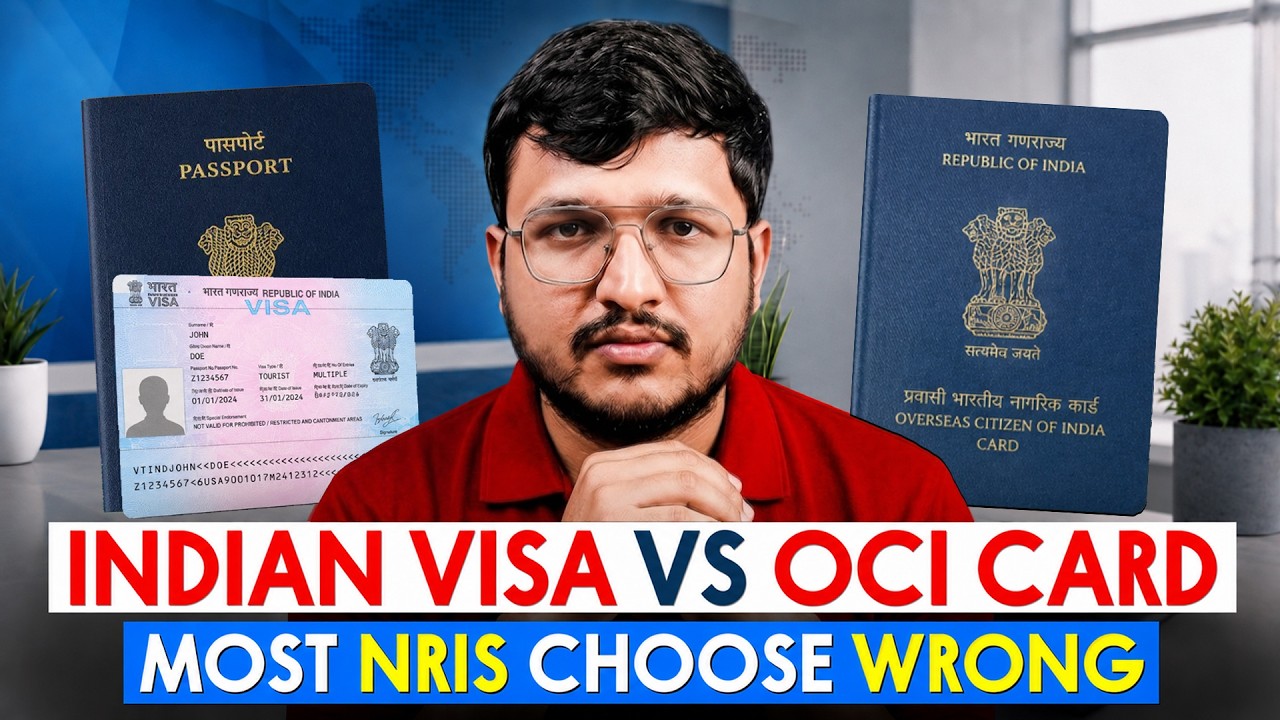
Every year, thousands of NRI waste money, waste time, and miss family events just because they pick the wrong travel document. Some of you are renewing tourist visas every single year. Some of you are sitting at the embassy for the third time this decade, and some of you didn't even know there was a better option. Today, we are setting this once and for all: Indian visa versus OCI card. Which one should you actually get? Stay till the end. I will give you a simple three-question test that tells you exactly which one to pick. So let's start with the basics. Indian visa is a temporary travel permit. You apply, you get it stamped, you visit India, and when it expires, you do it all over again. There are different types: tourist visa, business visa, employment visa, medical visa. But most NRIs end up on a tourist visa or an e-visa. A tourist visa gives you anywhere from 6 months to 10 years of validity depending on your passport country. But here's the catch. Even with a 10-year visa, most tourist visas have restrictions how long you can stay in India during a single visit depending on your nationality and visa type. And you cannot work, you cannot run a business, and your property rights are limited. Now, the OCI card. Overseas Citizens of India. This is not a visa. Think of it as a lifetime entry pass. Once you have it, you never need to apply for an Indian visa again. You can stay in India as long as you want. You can work, you can study, you can buy property, except agriculture land. OCI cards generally remain valid for life. However, OCI card holders should keep their OCI records updated whenever a new passport is issued in situations prescribed by the Government of India. Now let's compare them on the 7 things that actually matter to you. Number 1, Number one, validity. A tourist visa lasts six months to ten years. An OCI card, lifetime. That alone should tell you something. Number two, stay duration. With a visa, your stay per visit is limited and varies based on your nationality and visa type. Some visa types even need you to register at the FRRO if you stay beyond 180 days. With OCI, there is no cap. Stay one week, stay one year, completely your choice. And here's something most people don't realize: many OCI cardholders save more in avoided visa fees and paperwork than the actual OCI application costs itself. Number 3, can you work in India? On a tourist visa, absolutely no. You cannot take up employment, you cannot freelance, nothing. On an OCI card, yes, you can work freely. You can take up jobs, start a business concern. The only exceptions are certain government and restricted sector positions. Number 4, property rights. On a visa, you have very limited rights to buy property in India. With OCI, you can buy resident and commercial property in accordance with FEMA regulations. The only restriction is agricultural land and plantation property. That's not allowed for a foreign citizen or OCI holder. Number 5, Processing time. An e-visa can come through in as little as 3 to 5 days. A regular visa takes up to 1 to 2 weeks. OCI takes longer, typically 4 to 8 weeks. So if your trip is next week, OCI isn't going to help you right now. But once you have it, you never go through this process again. Number 6, cost over time. A single e-visa costs roughly $10 to $25 depending on duration. Sounds cheap, right? But if you are visiting India every year for 10 years, that's $100 to $250 plus the hassle each time. And OCI has one-time fee of about $275. You pay once and you are done for life. Number 7, the hassle factor. Every visa application means paperwork processing, waiting, something sometimes as embassy visit. With OCA, you don't do it once. After that, you just book your flight and go. No applications, no approvals, no anxiety about whether your visa will come through before your trip. Now, I would be doing a disservice if I said OCA is always the right answer. There are situations where a visa is the smart choice. If you are visiting India for the first and possibly only time, maybe a friend's wedding, maybe a short vacation, A tourist visa or e-visa is quicker, cheaper, and perfectly fine. If you are not of Indian origin, OCI is only available to people of Indian origin or spouse of Indian citizen or OCI holders. If you don't qualify, a visa is your only option. If your trip is urgent, you need to be in India within a week, an e-visa is your fastest path. OCI processing simply takes too long for last-minute plans. All right, here's the simple test I promised. Answer these 3 questions honestly. Question 1, do you visit India at least once a year? या और प्लान टू? If yes, OCI. Question two: Are you of Indian origin or is your spouse of an Indian citizen or OCI holder? If yes, you qualify for OCI. Question three: Do you ever plan to work, invest, or buy property in India? If yes, OCI. Because a visa simply doesn't give you those rights. If you answered yes to even two of these three, OCI is the obvious. If you answered no to all three, a visa is just fine. So before you go, 3 quick mistakes I see NRIs make all the time. First, applying for OCI on the wrong passport. Your OCI must match your current valid passport. If you have renewed your passport, your OCI records need to be reissued on the new one before your travel. Second, thinking OCI means dual citizenship. It does not. India doesn't allow dual citizenship. OCI gives you visa-free entry and most resident rights, but you cannot vote, you cannot hold a government job, and you cannot buy agriculture land. Third, waiting too long. OCI processing takes 4 to 8 weeks. I have seen people starting the process 1 month before their flight and then panic. Start at the start now. So if you decided OCI is right for you, or even if you are still not sure, we handle the entire process for you at VisaMentor. From documentation to submission to tracking, you don't have to figure it out alone. Link is in description. You can also book a free consultation call. Now, if this video saved you time or helped you decide, hit that subscribe button. We make videos like this every week, helping NRIs navigate the stuff that nobody explains clearly. I will see you in the next one.