I Dissected 213 Sales Pages. These 3 things will fix yours.
James Allen breaks down 213 sales pages to reveal three conversion drivers: attention-grabbing headlines that stop scrolls, clear body copy that speaks like a person and focuses on benefits, and abundant social proof like testimonials and reviews. He covers frameworks like PAS and AIDA, practical tips like making copy skimmable and using stories, and tools like testimonial.to for gathering proof.
Chapters
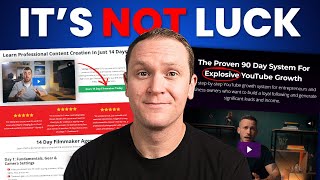
In the last 3 years, I've dissected over 200 successful sales pages to uncover what makes their creators earn millions of dollars. In this video, I'm giving you the top 3 secrets that we can learn from these sales pages so that you can skyrocket your income, impact, and time freedom. But first, what is a sales page? A sales page is a standalone page created to convince someone to buy your product or service. On a sales page, you usually find the description of a product, its benefits, and how the product will help you solve your problems. Sales pages also include CTAs or calls to action, promotional offers, and discounts to further persuade customers and prospects to make a purchase. Now, there are two types of sales pages that we need to think about. The first one is short-form sales pages. These are precise and contain only the essential information about a product or service. They're very straightforward and include details that are necessary for customers and prospects to make a purchase. These are really good for free opt-ins or products under $50. The other type of sales page is a long-form sales page. A long-form sales page, on the other hand, provides an elaborate description of your product. These are commonly known as sales letters. They give all of the information that may be required for someone to complete a purchase. These also are really good at debunking the limiting beliefs that the prospective customer might have related to the product. But what exactly makes these sales pages so effective at converting casual visitors into paying customers? Well, that leads us to secret number 1 that all these pages have in common, and that is a catchy headline. One of the most important aspects of marketing is capturing attention, which is harder than ever considering the average attention span is about that of a gnat these days. Literally, studies show that we have about 15 seconds to capture the average reader's attention. A great headline is going to capture your reader's interest and make them want to read more about what you have to offer. So when you're writing a really good headline, it's important to be attention-grabbing and interesting because if you can't get your reader's interest in that first line, they're gone. And quite frankly, they're not going to come back. It may sound simple, but creating a really good headline is the thing that most copywriters and these experts you see spend the most amount of time on. It can and should take a lot of work from us as the creators to create something that would really appeal to your target audience. Right in the beginning of the page. We want our reader to think, how can I do that? Just by reading our headline. The key is to not just state what you do or what you're offering, but instead to make a bold promise about a result that is very appealing to your audience. So a great example is Russell Brunson. When you land on his page, Expert Secrets, which has generated him a ridiculous amount of money and continues to, to this day, right at the top it says, want to share your message with hundreds, even thousands of people? How to get paid for your expertise and increase your reach, impact, and influence. It is the biggest block block of text that he has on his page, and it's right at the top. If you read that and you are interested in that, chances are you're probably going to want to either watch his video or continue on down the page to learn more. Another example is Ed Lawrence from Film Booth. The top of his sales page, which has generated well over $1 million, says, the proven 90-day system for explosive YouTube growth, the step-by-step YouTube growth system for entrepreneurs and business owners who want to build a loyal following and generate significant leads and income. If you read that and you're interested in that, chances are you're going to watch his video and want to read more about his page. Now, another really big piece to writing good headlines is not just the big headline at the top. It's also writing really good scroll stoppers, as I like to call these. Here's an example from my sales page. If we're scrolling down my page, you will see these subheadlines. And if this one catches your eye, the secret to getting coaching clients consistently, because you'd love to learn how to do that, then you're going to want to read the rest of the body copy. But a really good one that I'm proud of is down here where it says how I made $12,000 my first month of podcasting. If you're scrolling and you see that, you're going to think, whoa, how did he do that? And that's going to pull you in to read the rest of the copy. The key is to keep these short, catchy, interesting, and straightforward. But crafting a captivating headline is just the beginning. What if I told you that even the most compelling headlines can fall flat without this next piece? Because this is where the real magic happens, and it's essential to keep your audience engaged from start to finish. And that's secret number 2, which is clear and persuasive body copy. When it comes to writing compelling copy, you have to join the conversation that's already going on in your reader's head. Your headline must be compelling, and the body copy needs to focus on the benefits of your product instead of just the features. The best way to get started with writing good, compelling body copy is to follow a proven formula like either PAS, which is Problem, Agitate, Solve, or AIDA, which stands for Attention, Interest, Desire, Action. I'm not going to go into a ton of detail on either one of these, but knowing what they are will at least point you in the direction so that you can go watch some more videos or read some blog posts to learn more about how they work. Well, there's a lot that goes into writing good copy. Here are my top 6 tips. Whether you use PAS, AIDA, or any other copywriting formula, the first one is to keep it skimmable because people skim online. So you want to give your page some breathing room with bigger fonts and short paragraphs, typically between 1 to 3 sentences. Now I know this can be incredibly challenging, especially if you are an academic of any kind, or if you're used to writing long essays and papers because you're completely changing up your entire format when it comes to writing. Copywriting is salesmanship in print. It is persuasive writing. Writing an academic paper with a huge wall of text that looks like an essay isn't gonna be compelling for anybody. Therefore, they're not gonna read and get persuaded to buy your product. So make sure your content is skimmable. Next, keep it simple. Write as if you were talking to a 5th grader so that they can easily understand by using simpler words and phrases. They don't actually have to talk to them like they're a 5th grader, but the key is just to focus on the simple words and phrases. Now, if you're having any trouble articulating what you're trying to say in a simple and straightforward way, you can always go over to ChatGPT and say, rewrite this using simple words and phrases, and then paste in your text. And that'll at least give you a good idea on some other ways that you can word it. My next tip is to write like you speak. Read what you wrote out loud and make sure that it actually sounds like you. When you can add your personality into the mix and make it genuinely sound like you, you will write way better copy because it's going to sound like a human, not some corporate company. Next, focus on emotion. As you write, pause and ask yourself, how is this making me feel? For example, if you're really trying to target pain and frustration in your writing, as you read it out loud, think, am I feeling this pain and frustration? Because if you're not even feeling it, your audience isn't going to feel it. Tip number 5 is to review and edit. Always write a second draft. Typically when you're writing, the first draft is the worst and it's also the hardest just to start writing. So just know that your first draft is going to suck and that you're going to have to go through and edit it and rewrite it. Most likely there's always room to improve, words to cut out, and ways to make more sense with your writing. Just remember that every word must earn its way onto the page. My last tip when it comes to writing good copy is to use metaphors, examples, and stories. These quickly put your concepts and ideas ideas into perspective so people better understand what you're saying. And on top of that, they also showcase that you really know what you're talking about when you can speak from experience and make sure that your ideas do make sense in a very simple way. Even great copy can fall short without this next piece, but with it, you can instantly take your sales page from being decent to absolutely irresistible. And that's secret number 3, which is undeniable social proof. Now more than ever, people want to know that they can trust the products they're interested in buying. 9 times out of 10, when you're considering buying something on Amazon, you want to know what other are saying about that product. So you go over to the reviews, especially when it's something expensive. Some of the sales pages that I've researched over the years that generate millions of dollars in sales are mostly just social proof, and they actually have very little copy. That's how important this stuff is. Take Justin Welsh, for example. If you look at any one of his sales pages, right at the top he's going to show 5-star reviews from 25,000+ students. As you scroll down, he's got a little bit of copy, but most of the page is just Social proof, more social proof, and then what? Oh, even more social proof. And he has a little description of what's inside of the program. But then again, more social proof, a call to action to sign up for it. And then again, even more social proof, FAQ, and finishes it off with even more social proof. There's barely any writing on this page. So if you want the fastest way to make your sales page convert like crazy, it's by adding as much social proof as you can. But what if you don't have a lot of social proof? I'm going to challenge you on that because you probably have more than you realize. If you have a ton of raving reviews and kind words from social media posts, YouTube comments, Amazon book reviews, or even podcast reviews, that can be your social proof, at least to get started. Ideally, every testimonial on your sales page should be backing up the big promise that you're making and be related to the product that you're selling. But as long as people are praising you, the creator, for the work that you've done, that's good enough to get started. The more results you get for yourself and other people, the more you can capture and add to your sales page. Page. So when your audience and clients praise you for your work or tell you that they got this huge result, take a screenshot of it and invite them to share a video talking about their experience with you. Use tools like testimonial.to or senja.io to easily collect and distribute your testimonials. And if you have a sales page but it hasn't been converting, or as much as you want, consider how much social proof you have, because this could be the biggest reason that you're not making sales. All this being said, you should still prioritize leveling up your copywriting skills because you can always get better. Watch this video next and I'll give you 20 of best copywriting tips in just 6 minutes. In the end, a sales page is created with the aim of increasing sales by enticing people to purchase your product or service. A good sales page is precise, straightforward, and has all the relevant information needed to see the value of your product all in one place. Take what you learned here, get out there, make something happen, and I'll see you in the next one.










