Online Courses Have Changed Forever (and nobody even realizes)
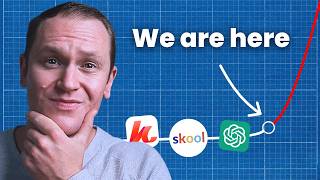
James Allen has sold online courses since 2019 and watched the market shift. ChatGPT made information free and abundant in 2022, killing the information-only course. Now the value is in helping people actually use what they learn, which is why he bundles courses with weekly group coaching, community access, and accountability.
Chapters
I've been selling online courses since 2019, and they've helped me build a 6-figure online business with a small audience and without even running ads. And I can tell you with complete certainty that online courses have changed in 2026, and most creators have no idea what's happening, and they're still trying to sell courses like it's the good old days. Today I want to share what's happening with the online course industry, why they feel harder than ever to sell, and explain what we need to do now if we want to stay ahead of these changes. So before anything, we need to talk about the old online course model. Why did online courses feel so easy to sell a few years ago but feel way harder Well, before COVID or BC as I like to say, online courses were already growing. They were a hot commodity. But when the pandemic hit, it was like pouring gasoline on the fire. Millions of people suddenly found themselves stuck at home with more time on their hands than ever before, more screen time than ever before, a bunch of money from stimulus checks or working from home, and a desire to just do something. So people went all in on learning new skills, starting side hustles, learning how to garden, play guitar,, start a business, start investing in themselves, all at a massive scale. So if you had knowledge and could package it into a course or a digital product of some time, pretty much anybody would buy it because access to the information felt valuable. Owning a course felt like progress, even if people didn't do anything with it. It was kind of like in the pandemic where people would just buy workout equipment during the lockdown, even if they didn't do anything with it. It just felt productive to just have the equipment. So basically, if you were selling a course of any kind in 2020, you made money. It was like the gold rush of online courses. And the course boom wasn't just about courses. It was about people searching for opportunity, for certainty, for self-improvement during a really uncertain time in history. And the old model of selling online courses worked because information was hard to find. It was hard to organize. People didn't know if they were doing things the right way and to actually apply into their lives. But then came the big shift. So if courses worked so well back then, Then what changed? Well, pre-2020, if you wanted to learn something, you had to find the right book. You had to search and dig for the right blog post, find a good YouTube channel, a coach, a mentor, a course, a digital product, something like that. And experts acted as the bridge between you and the information you needed so that you could get whatever result you wanted. But then ChatGPT went mainstream in 2022, and suddenly anybody could get answers, ideas, plans, frameworks, outlines, step-by-step instructions on virtually any topic that they wanted in seconds. The barrier to accessing information literally disappeared overnight, and what used to take hours of research can now happen in seconds. I mean, think about it. If somebody wants to learn copywriting for their business, they want to start a business, they want to lose weight, they want to improve their marketing or write a sales page, they can get a pretty decent answer instantly without ever having to buy a course now. And that's why so many creators started to feel like courses got harder to sell because they did. Courses became a commodity virtually overnight because the thing that people were selling became easier to access somewhere else. But here's where most people get it wrong. AI, I believe, didn't make online courses obsolete by any means. I do not think that online courses are obsolete. I was literally selling courses this week. But saying that online courses are obsolete is like saying that books are obsolete, that people don't buy books anymore. But that's just not true. AI didn't make online courses any more obsolete than Google made books feel obsolete, or YouTube made coaching feel obsolete. Sure, you can watch a good YouTube video and feel like you're getting coached, but that's never going to take over the actual coaching experience of working with a real person one-on-one or in a group setting. What AI did was make information less scarce. So information used to be the product. If you didn't know how to do something, you could go dig through a bunch of blog posts to try and find that information, or you could buy my course that puts all the information you need from someone that you probably trust in some way into a step-by-step system that you would follow and then get whatever information information you needed so that you could execute. And yeah, you could get extra templates, you know, resources, different things like that to help you actually execute on the thing instead of just information. But for the most part, people just didn't know how to do stuff. So that's why you find someone who knows it, buy their course, and then you would learn how to do it. But now information is the starting point in the coaching relationship. The internet used to reward people who had valuable information, and it still does to a sense, because Google, for example, really is cracking down on AI-generated content. So they do want credible experts putting out content, people who actually know their stuff instead of just constantly using ChatGPT to replicate expertise in some way. But today, the real value that people are getting is the application of information, because how many times have you bought a course and then it sits down on the shelf and you never really use it or even learn from it? Or maybe you learn from it, but you don't actually apply the information into your own life or business. So your job as the coach or the expert is to help people apply the information, but they still need to learn things. So that's why I feel that courses are a really helpful tool that we can use as coaches and experts, but it's not the one thing. And the creators who understand this shift are the ones that are going to thrive. But the creators who keep selling information are going to constantly be struggling and watching their income just get lower every single year. So let's talk about what your online course should do. If information isn't enough anymore,, then what role should an online course play? A few years ago, I thought that the course was the product because that's how I was putting it out there and portraying it. My course sales started to really slow down around 2022 in this big boom with ChatGPT, but my coaching clients kept getting good results because I actually was working with them every single week. And what I noticed in my coaching is that I was answering a lot of the same questions over and over again, questions that I already answered inside of my courses. So what I did was I started giving clients access to all of my courses and using our coaching calls the implementation, the feedback, the problem solving, actually getting our hands dirty. And then when they had specific questions, I could answer it real quick, but I would point them to specific lessons within my courses that they could work on. And this is when everything really clicked for me. The course wasn't replacing my coaching, it was enhancing my coaching. Course provided the roadmap and the structure and gave them enough to make progress when we weren't on the call. Which I believe actually empowers them instead of always having to wait for the next call to get my permission or anything like that. I don't think that that's what makes good coaching, but the coaching helped them actually follow it by having a regular meeting every single week where they could show up, ask questions from the course, and they go hand in hand instead of being two separate things. People need help putting the puzzle pieces together. They don't want more puzzle pieces or just a bigger puzzle unless you're a puzzle fanatic. It's our job as the coach to lay out whatever it is that they're working on, like it is a puzzle, and then build it together. The creators who win moving forward aren't the ones who are just selling information. They are combining education, implementation, accountability, and support all into one cohesive package. So what that looks like for me right now is that I work with people in a group setting every single week. They get access to all my courses that are à la carte style courses. I have one all about how to use YouTube to generate leads and sales. I have one about how to create and sell digital products because they are still a big piece of my business. I have another one one on how to get a VA, another one on how to turn casual conversations into high-paying coaching clients and create your offer. All these kind of things. And wherever somebody is at, I can just direct them to one of the courses and say, that's the one course that I want you to focus on right now. And then on our calls and in our paid community, you can ask questions and I'll be there for support in between our calls. So you don't have to just do one-on-one coaching and give people your course, though I think that's a really good place to start if you do have courses. And you're doing coaching, but you could also make it more scalable by having a group program or a paid community of some kind. Because if you find yourself always answering the same exact questions constantly, it's kind of getting mundane and a little annoying. That's why you have a course. So you can tell people all this is answered inside of the course and you can go through that, direct them to specific lessons that solve whatever problem they're dealing with right now. And then if they need more support, they can reach out to you or hop on to your weekly call or biweekly call whatever it is that you're doing. Following this model has allowed me to create a very powerful ecosystem for people to constantly be learning from me because they can interact with me in my community. They have me every single week on calls, and then they also are listening to me in my course content every single day. So what I hear from my clients is that they listen to me every single day. They're learning from me every single day, whether it's on the call, in the community, or from one of my courses. This has helped people actually finish and consume my course content. But also get way better results inside of my programs. So I still believe that online courses are still valuable, but I really do believe that most people build them the wrong way. Watch this video next and I'll show you what to do before you even build an online course. And if you've already built one, still check it out because you'll learn something. So I want to hear your thoughts. Have you been selling online courses and how's it been going? Have you noticed any of these changes? Let me know down in a comment below. If this video is helpful, please like it, share with someone that you think would benefit from it. And as always, take what you learned here, get out there, make something happen. I'll see you in the next one.










