How Rahul Vohra Founder of Superhuman raised $110M to compete with Gmail
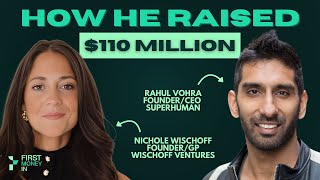
This content was created by Rahul Vohra. This content was uploaded by Rahul Vohra. This is a YouTube interview (title: "How Rahul Vohra Founder of Superhuman raised $110M to compete with Gmail") published January 7, 2025. It is a hosted conversation between Nicole Wishoff (host) and Rahul Vohra (founder & CEO of Superhuman). The discussion covers Superhuman’s founding and fundraising journey (early angel/pre‑seed rounds, seed, Series A/B/C and notable investors like First Round, a16z/Andreessen, IVP and Tiger), fundraising strategy (finding “true believers,” SAFEs/valuation progression), deliberate waitlist/onboarding approach, go‑to‑market and retention metrics, product lessons for replacement vs. new products, and Rahul’s transition into angel/venture investing and running funds.
Chapters
Find the true believers. Either they truly believe in you because you're awesome and you have a track record, or they truly believe in the idea. Ideally, it's a combination of both. The first $2.6 million that I raised for Superhuman was exactly that. If it's genuinely a new thing, you can probably get away with it being half baked and not quite working perfectly for the vast majority of your users early on. Because what else are they going to use? There's nothing to go back to, right? This idea, which by the way seemed absolutely absurd, that we would build an email experience, that we would compete with Gmail and that it would cost money. No one believed, except for my pre existing investors from my last company, which is why I started there.
Hello and welcome to First Money in a show focused on now extraordinary founders and their very first time ever raising venture capital. My name is Nicole Wishoff and I am thrilled to bring you our latest episode. Today we welcome Rahul Vora, founder and CEO of Superhuman. Superhuman is the most productive email app that some say has ever been made. Since launch in 2014, Superhuman has raised nearly $110 million from very notable investors, Andreessen Horowitz, First Round Capital and Tiger Global. Join us as we learn more about the founding story of Superhuman, the power of a wait list and why you should be building an AI company. Raul, thank you so much for joining us today. I had the pleasure of spending a few hours digging into all things you and Superhuman and super excited to hear your story. So give us the scoop. In 2014 you had the idea and went out to start building Superhuman, but you were actually a founder of prior to that and sold the company to LinkedIn, is that correct?
That's right. I'd started a company called Rapportive, which was the first Gmail plugin to scale to millions of users. And I did end up selling that to LinkedIn.
Did you bootstrap that or did you raise venture capital?
I don't know if you would call it venture capital, but we did raise $1 million of capital for that company. We were in fact part of YC Summer 2010. So showing my age here a bit, most of it was angel money. There was a small amount of institutional money from Charles River Ventures in there as well.
Wonderful. So when you went out to build Superhuman, it looks like you were initially by yourself and that you had done the rounds, meeting with different partners, getting a bunch of feedback. You took a non traditional path in that you stitched together up to two and a half million dollars. Is that Right. Versus a traditional seed round.
Yes. And these distinctions are kind of blurry because we started with a pre seed round that ended up growing into a seed round, and I was raising consecutive notes or safes over a period of time. So 2.5 sounds big to me as an investor for a pre seed, but it started off as a pre seed that became a seed, and then first round capital topped it off with 1.5. So that in total was the 4.1, I think 2.6 plus 1.5. That in total was the seed round.
I see. And what was the idea going out and raising for more than just one lead firm that early?
Well, I think this is an interesting sequence because the quote unquote lead firm was actually the last investor to get involved in the seed round. I'd raised 2.5 million primarily from angel investors and investors in my last company, Reportive, as well as a few other pre seed firms. So famously, the first check in Superhuman was bellstarch Ventures. You may know Ed and Elliot, they're amazing people. They actually wrote the first three checks into Superhuman because they wanted to invest $750,000. And I said, no, I have no idea as a single founder who doesn't have any employees yet what I'm going to do with that, but I'll take $250,000 and I'll get going on that. And then I made a bunch of progress and I came back and I'm like, cool, I'm ready for the next 250. And then I did that for the next 250. And alongside that, I was also raising from my previous investors in reported my previous angels, who, depending on when they had invested in the company, made anywhere between 3 and 15x. Actually, there was one investor that made 22x the capital on the last company. So it was only after I'd raised the 2.5 that I think somehow First Round Capital had gotten wind of what was going on. They had a look, and me and one of the partners there, Bill Trenchard, we really got along. We saw eye to eye on what great productivity software is, and that's how that round happened.
Was it that you were specifically competing with Gmail, which seems nearly too audacious, because I feel like someone that had a strong acquisition from a notable company like LinkedIn would have kind of a walk in the park experience, or was it just different times in 2014? Like, were folks more apprehensive to take big swings with what you were building?
I think it would have been very difficult. Even as an Exited founder with a notable acquisition to a notable acquirer. To have raised a large amount of institutional funding for this kind of an idea, I think I would have possibly been able to pull off a $5 million Series A or a 6 or a 7. But I also didn't want to waste time trying to do that. You have to really refine your pitch. You have to probably pitch 5, 10, 15 different firms. Find a true believer very, very early. And by the way, if you have that true believer, go for it. We almost got there with Balaji when he was at a 16Z, which is kind fun story. I can share that if you're interested, but for various reasons that didn't happen. And if you don't have that true believer, instead of being married to the size and the shape of a round, for example, it has to be at least 5 million and it has to absolutely be institutional investors. I was married to the idea that the investors had to truly believe. So I went back to all of the reports of investors, all of whom had made money and were like, hey, give me that money back and then some and this time round will deliver you an even better return.
Were those on safes and did you set the post money valuation for those?
Yes and yes. The initial valuation, the bolt stop valuation was 8 I think I asked them to do their second check at 10 and then maybe the third check at 12. And as we were making progress over the course of this, I think it was a year that we were raising the $2.5 million over maybe a bit longer. I was increasing the price of the company also in 2014, you may remember, prices were just increasing radically fast. 2013 to 2014 was when I saw why Combinator valuations move from around 10:15 to 15, 2025. So I was also just keeping pace with market.
Okay, I see. I do want to hear the story about a 16Z early on at least, because I read something about that and it's super interesting. But before that, at what point did you end up finding other co founders or your first few hires because you went to market by yourself. Correct. At least initially.
So the A16Z conversation was as early as February 2014, which is weird. I didn't actually start working full time on the company until November ish of 2014. But I was dabbling with the idea over the course of that year and I was having conversations but like turning up in an office grinding on the company not until November 2014. And I was solo founder from that point until I believe it was either May or June of 2015. So I'd say for about half a year. Going on a full year, I was solo founder here.
Oh, okay, wonderful. So you had met with Abology early on, and from what I read, correct me if I'm wrong, it's an interesting story because he, he didn't end up investing at the time, but Andreessen did much later on a much higher price.
Yeah, that's right. So a few weeks before I was leaving LinkedIn, A16Z actually reached out to me and I think it was Balaji who did the outreach, saying, hey, we've heard you're leaving LinkedIn and you're about to start a new email startup. We'd really like to be the first check in that company. How about you swing by Soundhill Road and we'll hang out And I'd love to find out what you're doing. Which I thought was amazing because I hadn't really told anybody externally about this and the fact that they were so tapped into who's doing and which founders are leaving. And maybe they were tracking my vesting schedule, I'm not entirely sure. But they knew to reach out to me at just the right time a few weeks before I was leaving, so kudos to them. And I hadn't met Balaji before. So I go over to Sandhill Road, the A600C offices. It's probably the second or the third time I've been there. And it's a really interesting setting. It's 10pm, it's really late at night, and we're having this late night steak dinner from the Rosewood Hotel. So it's a lovely steak dinner, but we're eating it out of the little cardboard containers in Balaji's office. So perfect juxtaposition of everything. But I loved it. I thought it was really charming. And he's such a great guy. He's one of the smartest people I know. And we just got straight down to it. He's like, so listen, I've heard you're about to start a email company. Tell me about it. Like, what's your vision? What do you have in mind? And this was really the first time I was ever telling my idea of what became superhuman to anybody externally to LinkedIn, obviously. I told the report of team that I was still working with. This was the first time I was telling the story externally. And it was in that meeting, which lasted for several hours, where I outlined the first few core ideas that it would blazingly fast, that it would be driven by keyboard shortcuts. That it would have integrations to CRMs and your other systems of record that matter to you. I didn't call all the things I didn't know, for example, that it would be multiplayer. I didn't know at that time that we would be charging money for it. I thought, like many founders at the time, that freemium would be the way to go. But I did have most of the vision all the way back in February of 2014. And towards the end of that meeting, he said, well, this is all great. What are you going to call the company? I said, I don't know. But I know how I want our users to feel. I want you to feel like you have superpowers and why don't we call it Superhuman? And so he pulls over his laptop and he types in superhuman.com and shockingly, it seemed available, meaning it was owned but squatted. It wasn't used for any other company. And I was like, wow, maybe this name actually does have legs. And what's really fun is I have the papers. We were taking paper notes at that from that time. I still have the paper notes, which is really cool. So 10 years later, I'm still able to look back, actually more ten and a half years later, I'm able to look back and see that initial conception of Superhuman.
Wow. So let's fast forward to the Series A, because even with I think it was 10 customers, you were preempted for what, a $10 million round? Was that Andreessen or not yet? Was that another firm?
Andreessen did the Series B. The Series A was actually relatively unusual for us because we raised it not from angels, not from operators, not even from traditional venture institutional money. We actually raised it from a family of office. But this isn't just any old family office. This is one of the most sophisticated family offices there Is. They are LPs in most of the best venture funds in the Valley and then some. And very occasionally they also do direct deals. If they believe that direct deal could potentially move the needle on their overall portfolio. They probably don't want me sizing the portfolio on a podcast. But needless to say, it's very, very, very large. So they only do the deals when there is world changing potential. And they and I came to this mutual belief together as to how it came about. I ment were LPs in some of the best venture funds in the world. They're also LPs in Boldstart Ventures. And so of course when you would know this now as a GP, but when we're writing our LP updates and we're pinging our LPs. The ones who are interested in leaning in and doing direct will ping you and they'll say, hey, Superhuman looks really exciting. We're believers. We thematically want to do that kind of company. I'd love to chat to the founder ahead of them going out to raise a Series A properly. And so the GP pinged me, Ed pinged me and was like, hey, listen, these folks seem really interested in chatting to you. Would you like to have that conversation? I was like, sure, absolutely, why not? I have very little downside here. We ended up meeting actually just down the road. I'm in San Francisco today at Four Seasons Market Bar. Had a really long conversation, two or three hour long conversation. I showed them the demo slash product. It was just starting to work. You said we had 10 customers, but no one was paying for us. We had 10 users at the time, zero revenue. And it was enough. It was enough where they understood where we were going, how this would change the world, and more importantly than all of that, how big of a market email truly is. I mean, it's absolutely ginormous. People don't really realize this, but there's a billion professionals in the world that's widely known. And on average, we spend three hours a day reading and writing email. So that's 3 billion hours every single day, or north of a trillion hours every single year that go into reading and writing email. Even a teeny tiny fraction of that monetized is a ginormous company. And we had that conversation and that's how that deal came about.
That's interesting. We will get here. But you are unique in that you also invest. Are they an LP of yours for your fund?
Yes, they are.
Wonderful.
Great.
So that worked out super well. So you're kicking things off. I guess we can jump to 2019. You ended up raising a $33 million round from Andreessen. So they're finally in. And that valuation was obviously much more expensive. It looks like it was around 260 million post money. How did that all transpire? And were they kicking themselves or for missing out early on?
I don't know if they were kicking themselves. Look, that would have been infinitely cheaper for them to buy Superhuman with. I think we were contemplating a two or three million dollars round which would have bought them roughly the same amount as a 33 million DOL. But you and I both know it's the absolute returns that matter. So things are trending well. We will see how that goes. And I Think they're super excited to be part of the company. This is a very special company and I'm excited to work with them and they're excited to work with us. How did it come about? That is a great question. This is so long ago. 20, 19, five years ago in founder years. Feels like 15 years ago. I remember I had gone to a conference, Lobby Enterprise. So this is a conference put on by David Hornick, now at Lobby Capital. Previously at August Capital. An amazing conference. Relatively few people, 100, 200 people, mostly founders. Founders. Some VCs are there. And it takes place in Hawaii. Keeps changing island. I forget which particular island this was on. This may sound irrelevant, but it's actually important because one of the things I like to do, and I advise most founders do this, if you have the luxury of being able to do it, is when you go to these conferences, you're going to spend time socializing and networking and getting smart. That's the main benefit, is staying really sharp and smart with what all of these other sharp and smart people are thinking. But there's another thing that you should do, which is once it's done, take a day or two, just go sit on the beach, reflect, think about the company, think about your life, think about where things are going. I always find that a. The decompression is physically necessary, right? You're out on an island, you're partying with these people. You just need to relax. But also, that's when these interesting thoughts start to happen. After that conference, in that year, this would have been early 2019, it occurred to me to start slicing and dicing our cohort data in a very particular way. And I was able to show and convince myself and then my company and then eventually investors that we'd actually kind of reached the holy grail. We'd reach the point where, if you look at the cohorts, they're stacking up, the revenue curve was starting to tilt up, growth was starting to become exponential, and the cohorts themselves were starting to grow. If you're a SaaS founder, you know that that's the moment where you can go big, where you can say, listen, I have cohorts, they're getting bigger and the old ones are growing. That's the fundamental basis of really any software as a service company. And it came from really just taking a moment to breathe. I think so many founders need to do this little bit more. Don't go silly. Don't spend like several weeks trying to figure stuff out. Even just a day or two is Enough to. To have that insight. So I had that insight and actually at that very conference happened to be David Ulovich, who was the GP at a 16z who ended up leading the round. We did not hit it off at the conference and we barely spoke to one another. And I was in my world and he was in his world and it's fine. But there was enough of a connection that when I got back into San Francisco, I called up Ed, speaking of both start benches, and I said, hey, listen, I think things are looking good. I. I think we can raise. And we just started to put up very gentle feelers. Actually, I don't even think it was me. I had Ed do it. I had Ed call David Ulovich and a few of the folks and say, hey, listen, we've got this company. By which point we were sort of hypey in the Valley. So he was like, you absolutely know about them, the superhuman. Everyone's going crazy over this company. And I think the founder is potentially interested in raising. Would you like me to ask Rahul if you want to spend time with him? So I had Ed do the back channel and find five or six interested parties and then we took it from there.
Interesting. From a go to market perspective, you had quite a sizable wait list. And I think for a long time. Was that really intentional to not have a full public launch where folks can start scheduling their 30 minute onboarding calls and get moving or what was the thought process around that?
It was super intentional. Actually. People misread the reason why we did this. A lot of folks see that and assume we did it to generate FOMO or to create kind of the nightclub effect. Oh, there's this really cool, mysterious app and I don't have it, but all these smart people do. It must be amazing. And we definitely got that value out of the process. But that was in no way the reason why we did it. The reason why we did it is because we were so laser focused on being able to actually deliver value to those early customers. And I see this go wrong for so many companies, especially in productivity or collaboration or any space where the product surface area is really, really high, which is you can build an email app, let's say, and you can launch that email app. But guess what? It is easy to get the first few tens of thousands of signups these days. You'll find a way to go viral or you'll find some influencer to talk about it, or whatever it is that you do. But it is so, so hard to retain those users because what will happen is they'll all sign up, they'll all kick the tires and they'll all find a variety of bugs and each one of them will find a different bug. And so you've got your tens of thousands of users who might find thousands of bugs. Well, how many bugs can a small, tiny startup realistically fix per week? 10, 20, 30? Not a lot. It's hard. And so I wanted to avoid that. The way that we avoided that was by onboarding 5, 10, 15 customers per week. And I would go and do this actually physically in person. I would take a bottle of wine or a bottle of whiskey or something else with me as a gift and I'd sit down and watch people do their email. I'd spot all the bugs, which they usually wouldn't see. Users are not very good at seeing bugs, but I certainly am and our team is, and I would take those bugs back to the company. I would say we have to fix these and if we don't, we're not onboarding the next round of users. And that is the only way, even to this day, I believe it. That is the only way you can reach a high quality product and get through the grind. So you actually start hearing things from your users that otherwise they wouldn't have told you. You've got to get through the obvious stuff to get to the non obvious stuff. So that was in the early days. Then we looked at the metrics of those users and we were like, this is insane. The retention is through the roof, the virality is through the roof, everything. Net promoter score, our own product, market fit score, all through the roof. Maybe there's something to this onboarding. And so we tested it and initially I was like, maybe it's the founder effect and that there's a little bit of. Well, Rahul himself came to see me. I'm at least going to give this a go. So we had somebody else in my company do it. The metrics held. Then we started to build an onboarding team and the metrics held. And famously we built a big onboarding team and we did that for a while. All during that time, we kept the waitlist going. And it was because there were still large chunks of people that we couldn't serve until recently. Anyone who was on Office365, anyone who was on Android, anyone who absolutely needed a HubSpot or a Salesforce integration to do their work. I'll give you four reasons off the top of my head, and there were others as well. So we maintained this wait list until maybe two years ago, 2ish, three years ago. I don't remember exactly when we turned off, which is funny because it was such a big feature of the company to begin with and the day we turned it off was just a non event day. Like at some point we ran out of reasons why we wouldn't onboard people and now of course anyone can just.
Sign up for founders listening. And I'm sure you get asked for feedback all the time. Do you think this is a good strategy for a lot of consumer products? Do you think it's super specific? Because email is complicated and it's every day and it's all the time.
There's that. There's also because it's not a greenfield market, it is a replacement product and it's a replacement product for something that is free. Everybody has an email client, whether it's Gmail or whether it's Outlook. And so for founders who are listening, wondering if they should do this, I would ask is it genuinely a new thing? Because if it's genuinely a new thing, you can probably get away with it being half baked and not quite working perfectly for the vast majority of your users early on because what else are they going to use? There's nothing to go back to. If it's not genuinely a new thing, then I think you have to be a lot more strategic and methodical about how you capture increasingly larger amounts of the market.
That's super helpful. So let's jump to 2021. You ended up raising around from super great funds like Tiger. This was two years later. Right. So this is your Series C. It sounds like you had figured out go to market. Things were structured and standardized from that point on. So what had changed, I guess. And would you call this sort of a peak 2021 raise, if you will, or were you already planning to go out to market? The metrics were there and you guys are ready for another round of capital.
Yeah. So Target did participate, but the round was actually led by ivp. It was Ajay Vashif from ivp. Wonderful guy, brilliant investor and we're so thrilled to be able to work with him. For folks that don't know, he was one of the youngest CFOs of a public company ever. He was actually the CFO that took Dropbox public and so we also understood our space very well, productivity and collaboration and to this day that's remained a huge asset for the company. Was it a peak 2021 raise? I was always planning to raise money during that time and it was, you know, the metrics Were there trying to remember the revenue numbers when we raised the series B with a 16Z, I think we were doing like one $1.5 million of revenue at this point we were at about 7, so we'd sort of 6 to 7 X'd the previous raise 7 million of ARR. And so yeah, like it was a high valuation. I think it was 100x present day and obviously less on 12 month forward. But it was by no means out of range for what was marketed in 2021, right?
Yes. Even as you're essentially breaking out and proving that this thing is working and you're competing with the Gmails of the world, were there still investors that that just weren't interested in the business? I think founders think that these companies that raise these notable rounds always win and always hear yes. And are always over subscribed for sure.
Yeah. In both of those raises I didn't do a full court press. I spoke probably to 5, 6, 7 funds for both of them. But it wasn't that all of those funds got to term sheets. I would say 60 or 70% of them did, but there were definitely funds where they were just like, sorry, we don't believe and here are the reasons or it's outside of thesis and here are the reasons at that point. I don't even remember I so quickly disengage when I hear that. I'm just like cool bite piece. Because there's no point continuing the conversation. But yeah, there was definitely one or two funds that weren't immediate believers.
Before we jump to your VC investing, which I do want to speak to a tiny bit if you're open to it, any advice for founders on their own journey in terms of raising capital and maybe things to optimize for early on that maybe you didn't, or maybe you did and you're happy that you did.
Gosh, that is probably the best phrased version of that question I've ever been asked. And now you've inspired me to want to spend two days on a beach and really think about it and write it all down. I don't even know where to begin on that one. I'm going to turn it back around to you and ask for some constraints. So why don't you constrain the question in some way and I'll try and come up with something helpful.
Yeah, maybe this market because it seems so much more like the haves and the have nots. Right. Like you're building an AI company and you're raising 5 on 30 or far beyond that and then there's everyone else who just thinks that, like whatever they're doing, no one believes in it and they're trying to scrap together a million dollars. You took this sort of in between approach where you're like, I'm going to take in the folks that believe in me and do this and I'm not going to chase like a lot of this noise. Maybe you learn that with the first company, but I think a lot of founders get lost in the headlines and the nonsense. You seem like you had a straight head on where you just said, look like one thing you mentioned earlier is I'm super focused on people that actually believe in this versus knowing that a bunch of other folks are excited like Boldster and are just trying to put in a million dollars.
Yeah. Okay, so two things. Yes, this is an AI market and it's an AI market for good reason. AI is definitely taking over the world. And so if you're a founder wishing you had an AI company and you're that early, well, then maybe you should have an AI company. Maybe you should be asking, what role are we building the copilot for? What role are we building the agent for? What pools of work or labor can we potentially automate and even maybe one day replace to some degree? What dislocation can we create in the way that people work? How can we go from software as a service to service as software? Can you do that in your space? And it can be hard, especially if you didn't want to start an AI company. One approach is to stop grumbling about it and become an AI company. And I think that's pretty sane approach. If you really don't want to do that, then that's also fine. Maybe it's a deep tech thing and we just invested in a deep tech company recently. Maybe it's something else every now and then. We do consumer social. We're in Loyal, which is a biotech company that is doing phenomenally well. And we're really excited for potential for Loyal to extend the health span and lifespan of dogs for companies like those. What I've noticed is the founders executed the same strategy I did, which is find the true believers. Either they truly believe in you because you're awesome and you have a track record, or they truly believe in the idea. And ideally, it's a combination of both. The first $2.6 million that I raised for Superhuman was exactly that 2014 was. It wasn't hard, but it wasn't a walk in the park. And again, instead of wasting my Time trying to explain to institutional investors. Actually, now that I'm talking it through, I did actually do a little bit of this. I spoke to some of them and most of them were just like, yeah, this is crazy. We don't believe it. Instead of wasting my time on that, I went back to the people I'd already made money for, the true believers in me and the space, and said, hey, listen, trust me, this one's really going to be big.
Yeah, I love that. I was not expecting you to say they should all just go build AI companies, but I love it. I don't necessarily disagree. So last thing here, last couple of minutes. You are also an investor. So have you been doing that from the start? Are you writing small checks? And you do have funds with LPs? So how did that all start?
Yeah, it started angel investing. So I sold my last company reportative to LinkedIn. Like I mentioned, that was back in 2012 and my vesting schedule at LinkedIn lasted about 30 months. I was there for about 20. And in order to stay sharp and smart, I wanted to be right adjacent to the best founders. And so I put it out there that I was going to do angel investing and just started to hang out with smart founders. And for me it was social, it was fun, and again, it was staying smart in doing so. As you know, you start to meet people with simpatico taste, you start to meet people who regularly recur in the same deals, other angel investors, and you start to figure out who your co investors tend to be. And for me, one of those folks was Todd Goldberg, with whom I do the venture fund. And we were just solo angel investing for four or five years and had a lot of success together picking a lot of great companies where we were individual angels on those captives tables. And then he came to me at one point, I think this was maybe 2019, and he said, hey, listen, I've been thinking about whether do I start my next company or do I go raise a venture fund? And I'd like to go raise a venture fund and I'd like you, Rahul, to be an lp. And I said, well cool. Whatever you do, I'm in. What size fund are you thinking of raising? And he said, three or four million. I was like, that's ridiculous. That's tiny. No, let's double that. And I'll be a GP with you and I'll pull in Mark Andreessen, I'll pull in my entire board. They're all investors and I'll just pull in a whole bunch of People, we can easily go raise twice the size of fund. And he was like, yeah, that sounds great, let's go do that. So we went and did that. And hence the Todd and Rahul angel fund. And that's gone really, really well. Fund one is trending excellently. The follow on fund which came after that, is doing fantastically. Fund two, which is weirdly enough, our third fund is also doing great and will shortly be going out to raise the next fund as well.
That is amazing. Okay, last and final question. Is it it easier or harder to raise money for a venture fund than it is a startup?
So this is my observation of all the founders I know who are raising and all the gps who I know are raising. It is much easier for a founder to create scarcity in a company's cap table than it is for a GP to create scarcity in a fund. Because founders have, at least in the early stages they have mechanics like safes where they can literally just close money today, tomorrow, the day after. And you can do that as a gp, but then you start your IRR clock ticking. And of course there are ways around that, but you generally don't want to literally call the capital on the day that you closed it. You have to line everybody up and say, this is the date. Boom. Here we're going to go. Some of those folks will require an anchor tenant investor. Whereas for the most part, again at the early stages, founders can just go collect angel checks or pre seed fund checks or seed fund checks pretty easily. I also think that in terms of supply demand, there's a bit more demand for investing startup dollars than there is for investing fund dollars. But in both cases, if you are a founder or a company that is sought after, or you are a GP with a track record, and maybe it's from operating or maybe it's from your last fund, in both cases you'll be able to raise in this market. That's what I'm seeing.
Interesting. Super helpful. Well, this has been wonderful. It is a great, great story and thank you so much, Raul.
Absolutely. Thank you for having me.
More from Rahul

How We Captured Silicon Valley in just 4 months | Crush-it Conference, Rahul Vohra


How To Apply Game Design to Business Software / Rahul Vohra, Superhuman (Design Driven NYC)
E993 Superhuman CEO Rahul Vohra on building a Product Market Fit Engine + Future of Angel Investing