“$50k credit card debt. Will he ask for a divorce?”
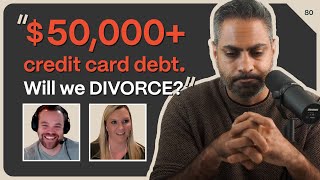
This is a transcript of a Ramit Sethi YouTube episode featuring a coaching conversation with Kevin (42) and Sarah (38), a married couple with three children who previously accumulated roughly $200,000 of debt. Six months after selling their house (sale ~ $1,050,000) and using proceeds (about $375k net) to pay off $130,000 in credit-card debt, they re-accumulated approximately $50,000 in credit-card debt within six months. Ramit unpacks both numeric drivers (large categories of recent spending including a prepaid cruise, business expenses, eating out, surgery-related costs, travel and coaching — Ramit calculates roughly $72,500 in spending over six months from the items they list) and emotional/communication drivers (different money languages: Kevin = numbers, Sarah = emotions; generational baggage; lack of a shared plan). The couple’s goals include building a house, better communication around money, and creating a positive, forward-looking money conversation.
Questions this video answers
Kevin is 42; Sarah is 38.
14 years.
Approximately $200,000.
Sale ~ $1,050,000; walked away with about $375,000 net.
They paid off $130,000 of credit-card debt; six months later they had about $50,000 of credit-card debt.
Chapters
I'm speechless.
Yeah.
You paid off $130,000 of credit card debt six months ago, and now you have $50,000 of credit card debt just six months later.
Yeah.
Whoa.
We need something that works because nothing's working like working through how not to repeat past mistakes. Because we throw out a plan, but we always seem to get back to where we were. We both have the goal. Like, we're committed to wanting to build this house and wanting to travel, and it was just our rich life, but we don't have a common plan to get there. This is a generational issue, I think, on both sides. And now as a mom and as a wife, I'm breaking that.
Meet Kevin and Sarah. He's 42, she's 38. They have accumulated $200,000 of debt. Then they sold their house to pay it off, and now they're finding that those old habits are coming right back. I went back to their application when they initially wrote into me, and I found a line that I'd like to share with you. Sarah wrote, kevin recently told me that if I kept adding debt to my credit card, he would ask for a divorce. My parents got divorced over money, so I'm desperate to figure this out. We're going to talk to Kevin and Sarah today. But one of the biggest lessons of this podcast is that our money decisions are rarely only our own. A lot of us like to imagine that we're rational, logical people. We're pushing our shopping cart down the aisle and we're making a careful cost benefit analysis before we buy those Ritz crackers.
Reality.
Our parents bought those crackers and they subconsciously taught us that love means buying this exact brand. We learn how to talk about money from the people around us. We learn how to invest it, or if investing is even for people like us. And of course, we learn how to spend from the people around us. And it is very, very hard to shake those generational money lessons away. I would encourage you to listen to this episode and I would invite you to watch it on YouTube. The body language and the facial expressions you'll see add a whole layer of understanding. You can find this episode on YouTube by searching for Ramit Sethi. And be sure to follow my channel there. Now, let's begin. I'm Ramit Sethi and this is I will teach you to be rich.
We did Dave Ramsey's thing. We tried that. Spreadsheets, our own made up throwing spaghetti against the wall. I don't know, what am I missing? I mean, we've probably. It's out there. We've probably tried it.
And so coming on this show to talk to me for you, what does it represent?
I'm an emotional person, so there might be tears. Hope is what I hear in all of your podcasts. And so.
Hope to do what?
Figure it out. We have very different backgrounds when it comes to money. And we want. I want commonality and tools and a way to speak to each other where we can actually hear each other when it comes to money. We tried to talk about money and like, and I was like researching your site and you're listening to your podcast. I kind of. I'm an all in kind of person. And we started having conversation about money. Just trying to communicate because you'll find that that's where we struggle deeply and we just lost it on each other.
So talk me through that conversation. Do you remember where you both were?
Gosh, there have been so many. I think, I think we were actually probably like, I was sitting here and he was in the living room and it was something. I don't remember exactly what it was because like I said, there have been so many, but it was, it was basically, screw this, like I'm. Something's gotta change. Probably what it was was him getting mad at me about what was spent.
On credit cards, what you spent on credit cards, or what was spent.
What. What I spent because it's my card.
I'd like to hear from you, Kevin. I'd like to hear about that same conversation that the two of you had where you both became really frustrated. What do you remember about that conversation?
I think. I think I know what she's referring to. And this comes with accumulations of things that it's a built up of. You know, throughout our marriage, I get short fused. And so in that particular moment, there were the expectation in my head, hey, we should be at this ceiling. And when we spoke, the ceiling was higher. And therefore I was like, oh, that means that there's more debt that we have to.
Sorry, what does ceiling mean? What are you referring to?
Just in the sense of. I thought that the debt was at that level and it turns out to be at a higher level. Right now we're probably at $50,000 in debt of credit card debt. Five, zero, five zero.
Okay.
I want the clean slate every month. So like you've talked about in your book, like utilizing credit cards as an account versus because you can use them for certain things that are very beneficial. And so I think you do it that way. But if you don't have a plan in place of what you're putting on the cards, then it can get out of control.
And so is it out of control for you now? Yeah.
I mean, the amount. Yes, it is.
Okay. Anything else that is or is not out of control?
Lots of things I feel like right now.
But tell me.
Yes, I mean, just. We sold our house. Gosh. We sold our house. What? In May. And moved into a rental house with the goal of building. It's been. That's been a lifelong dream of mine of building our own house. We had to switch. Gosh, why is this? Sorry. We had to. We've had a really tough year and so we had to switch our girls school because they went through a lot of stuff there in private school and they went through a lot of stuff at their old private schools, so we had to switch schools for them. So I think that out of control is just level of stress and not being. We're very outside of our comfort zones right now and my business is maintaining and so. But I lost a pretty big account in October and that dropped my income in half. Almost. Yeah, almost in half. And, and. And then my. My income for my business has kind of steadily gone down. Not much, but a little bit. So it's just. There's just been a lot of stress and so. And I don't. I really struggle when I can't control things.
So how do you react when you have more and more stress like this? What do you do?
It depends on the level. But I tend to get depressed and I start withdrawing or I blow up. And it's usually blowing up. A Kevin.
And this has bluntly put, this has caused an issue in our marriage is where professionally I has been so heads down that there are moments, more than moments that in our marital lives where I didn't see her going through these times until she blew up or until it was verbally told to me. And in the meantime, I'm thinking, oh my gosh, this is. If this is happening, then that means I need to double down and buckle in into my work so that we can come out on the better end together. But she's suffering because of that, because she's not getting the support emotionally. So this is full transparency here.
I really appreciate it. Really helps me understand the dynamic here. A few things to note. There's a lot of emotion in their description of money, a lot of history, and I'm going to spend time trying to unravel it. Along the way, I suspect that Kevin and Sarah will get a better understanding of what's really going on. Because when something like money is covered in emotion, it's easy to lose sight of the real issues. It's like a bad relationship. Everything feels existential. You'll also notice that there are some clues. Something about their girls. Something about Sarah's dream of building a house. Something about Kevin having the best year of his career last year. We're going to get into all that and we'll get into all the numbers. But I think it's important for you to know that Kevin and Sarah are high earners. Keep that in mind as we continue on this conversation.
I think that money is a foundational struggle for us because we can't sit down and have a non emotional conversation or it's very rarely that we can do that.
Is that the dream? To have a non emotional conversation about money?
Yeah.
Okay. And if you were to have a non emotional conversation about money, what would that look like?
Just sitting, just sitting down together over wine or dinner or out to eat or just in the living room and.
Talk.
Talking about the spending and the things that we've done without criticism or feeling put down.
Who feels put down?
I do.
Okay. Okay. So you'd have conversations without you feeling put down. What else?
Feeling as an equal in the conversation. And, and having a common goal. And, and we do. Maybe it's more like a common plan. Maybe that's a better way of putting it because we have, we both have a. The goal. Like we're, we're committed to wanting to build this house and wanting to travel in, in our rich life, but we don't have a common plan to get there.
What has stopped you from making a common plan towards an already common goal?
We don't speak the same language.
Ah, what language do you speak?
Well, we did. We don't. He actually does completely speak a different language, but we, I. He speaks numbers and like it's just very. This is how it is. I mean a perfect example is he was like, can't you just transfer the money over to the credit card? And it, I don't know why that is very hard for me to do. He's like, it's just a button. Click a button. And I'm like, it's not that easy. There's a lot of emotion behind it.
So he speaks the language of numbers. And what language do you speak?
Emotions. My childhood was very much all emotions when it came to finances. My parents divorced over finances. Like there's a lot of baggage.
Want to talk about how you were raised? I find it very interesting that you speak the language of emotions.
Yeah.
You were raised with emotions, but you told me that your number one goal is to have a non emotional conversation about money.
Because. Yeah, because I don't want to cry through every conversation or avoid or yell at each other. I want a maybe. It's not emotional, it's positive emotion.
Ah, that's different, right? Yeah, because can I just say, I don't think there's anything wrong with having emotions about money. Everybody does. Even Kevin, who's Mr. Numbers. I bet you he has emotions. Give me five minutes, I'll find him. Everybody has him. And I think sometimes we're raised with this idea that deep down emotions are weakness, but they're not. They're just human. So can we reshape your goal? You said first that you want to have a non emotional conversation about money. I think that would be really boring. What would you like to do instead?
I want to have a conversation that is positive and is forward thinking and is exciting to sit down and talk. Look what our money's doing and we're going. And look what we're gonna be able to do. This is so exciting.
All right, I can get behind that. Kevin, are you. Are you down for that?
I'm writing it down.
Okay. Okay. Love it. Okay, good. Okay. And when you two got married, how long ago was that?
Yeah, we just celebrated 14 years.
Oh, congratulations.
Thank you.
Appreciate it. That's awesome. 14 years. Amazing. Okay, 14 years, three kids. Fantastic.
All right.
A lot of you listening right now. Beat yourselves up for things that are deeply held parts of your personality. Sarah basically started crying in the first two minutes of our conversation. But four minutes later, she tells me she wants to have a non emotional conversation about money. That's not going to happen. That would be like me going to a French restaurant and saying, ooh, I'd really love to spend $89 on some poulet that's seasoned with three particles of salt.
It.
It's not going to happen. I want some fucking spice on my chicken. I'm not going to a French restaurant. And Sarah is not going to have a non emotional conversation. A better approach is what she finally said. She wants to have a conversation with positive emotions. Maybe she will later say that she wants to become comfortable talking about numbers. I can help with that. But I'm glad we caught this now, because if you truly determine test something about yourself, if you believe you need to fully extinguish it, it's going to be very hard to actually change. Sarah, will you tell me about how you were raised with money. What do you remember about growing up with your parents?
What I do remember is there was a lot of turmoil between my parents and my. And especially with finances. My parents were raised very differently. And when it came to money and in general and I. One of the biggest things I was thinking about it earlier today was my sitting at dinner, had gone out to eat. My dad ordered a steak. And so there's four of us. I'm one of four. And my siblings and I were like, oh, we want steaks too. And my mom would either order nothing or soup. And we would find out as I got older. The reason we did that was we couldn't afford it. And instead of arguing with my dad there in the restaurant, she would just let it happen. And there were lots of times my dad bought a car without consulting her. And there were six of us, and it was a five seater and it was like. And then he'd go and buy TVs and just different things. And it was always, we can't afford it, we can't afford it. And who said that? My mom.
Okay.
And my dad. My dad worked hard, but we grew up on the poor side. He grew up very poor, and my mom grew up wealthy. And so it was very. Two different sides of the track.
Can you think of any examples where that difference really manifested itself?
I can. I know of that. Some that my mom told me about and that it like, we would be. They would not be able to pay the light bill, and my dad would say, just go ask your parents for it.
Oh, wow.
And your mom told you that story, not your dad?
My mom told me that story, yes.
And did they separate your parents?
When I was 16.
Why then?
Money and other things.
I see. And who was the one who initiated the separation?
I think my mom.
Okay, okay. Looking back now as an adult, as a mother, looking back on how you were raised as it relates to money, what are the things that you take away?
That my mom was just trying to survive was a big one. That. There. That I know my dad had a lot of struggles as a child as well, that he was never able to work through. And it really was a problem. This is a generational issue, I think, on both sides. And now as a mom and as a wife, and I'm done. I'm not. I'm breaking that. And I don't want my children, and we have three girls, and so I don't want them to. To grow up in their life and not know what I didn't know. I don't want them to be in these same positions, to risk their marriages because they can't budget well or whatever. I. I don't want to end up like that, and I don't want us to end up like that.
Do you think you are destined to end up like that?
If we keep going the way we're going, yes.
That helps me understand a lot. Thank you. Kevin, what about you? How were you raised with money?
My dad worked a lot. My last band that I seen, he managed the money. My. My mom stayed at home. Once my dad's career really took off, she didn't need to be a teacher anymore, and so she stayed at home. So that's what I remember for most of my life.
What did you learn about money? When. Now that you look back as an adult, what are your takeaways?
Well, this is where it gets a little through. Throughout my life, I. I've never been educated about money. I saw it, I was around it, but wasn't educated about it. So I didn't grow up in this country. I grew up abroad.
And.
With that, there's some culture differences. Differences. Right. But I didn't have an indication about money. I just knew my dad to carry.
Sarah, you reached out because of a series of conversations. Describe it for me. What is the situation? It sounds like you have together $50,000 worth of debt. What would you say in a sentence or two seems to be the problem that keeps coming up for both of you.
Lack of communication and connection. I think that we have to find even more commonality in what we want for our money. We've got to come together on that roadmap.
And let me ask you a question about yourself. You specifically. What behaviors do you think you need to change in order to break that generational?
I think, well, one of the big ones is impulse. I. Impulse purchase. And usually out of emotion or feeling like I deserve it. I think some of the things that I tell myself about money, And I think probably just. Yeah, I would say a lot of it's the impulses, the. And the. The way I speak about it, the way I talk about it, and the way I think about it. Mm.
Be sure to watch her facial expressions on that last exchange. They are very revealing. This $50,000 of credit card debt, whose credit card is that on?
Mostly mine.
All right, so you have a joint checking. Joint investment. Is that joint?
It is.
Okay.
And then we each have. He has a 401k and I have a Roth.
Great. All right. You have separate credit cards.
Yeah.
So I'm just curious about, like, the bills, the day to day bills, getting paid, for example, your rent, eating out. Like, how does that decision get made about who pays for what.
The rent, the. Like to live our life under our roof. Rent, utilities, all that kind of stuff. I set it up, I put it on my card. Except for the rent. It went. It has to come out of the checking account. So it's on the joint checking account.
Okay.
But anything that was going on could go on a card. I just put it on the credit card.
Your credit card. Okay.
And then when it's eating out, it is. I mean, a lot of us, for eating out is convenience because we're pretty busy. And so it's. If we're all together, typically it's on his card. If it's me with the kids, it's fine. If I'm ordering, it's fine. If it's through an app, it's probably mine.
So it's just like whoever is basically doing the thing is pulling out their credit card. Okay. Does this cause any problems for you?
Quite a bit.
Oh, it's. I was like, this is kind of a weird setup. But you both seem very calm about it. I'm like, is there any issue here? And then I go, is this a problem? And both of you are nodding furiously. Okay, so what's the problem? Break it down. What happened the last time y' all argued about this?
So if, if I think one way.
To.
To, to add to the context is when we sold our house, we were able to be debt free. This, we sold the house, we're like, x debt, credit card, no more. That's it. Blah, blah, blah. And then we reintroduced it. And there goes again bad behaviors where there's no plan set where we actually could get back to zero. And for, for a minute we did it. But then there are some things that occur. Pull the trigger here, pull the trigger there, and next thing you know, it's the snowball and here you are reaccumulating debt.
Okay, let me ask a few questions about the, the pattern that you seem to be in. How much did you sell your house for?
A million fifty.
Okay. And how much did you take home after the sale?
Was like three. Was it 369 or 396?
Yeah. So somewhere around there. All right, I have 375 in my.
Head, but let's say 375. And did that include all fees that you had to pay? Transaction fees, all that? What about taxes?
Yeah, that's what we walked away with.
Okay.
Walked away.
Including paying taxes, etc on anything that you owed?
Yeah. Minus 500 bucks that we had to pay for HOA.
Okay, great. So 375. And how much credit card debt did you have at that time?
130,000. Credit card debt? Yeah.
Okay.
Was it. It was. Yep.
130. And was there any other type of debt at that time?
Student loans, Cars, Cars?
Multiple.
Yes.
Okay. And student loans. Whose student loans?
Mine.
Okay. All right. So you had. How much was it? 130. All right, so you were able to pay all that off, and you still had a couple hundred thousand bucks?
Yes.
Awesome. All right, great. So did you. Was it kind of like a big thing in your household? Like, all right, we're paying off this debt?
Huge.
Yeah.
Okay. What'd that feel like?
Amazing.
Yeah, it did.
That's cool. Was it the first time that you were debt free in your marriage?
Credit card debt, mostly. Yes. Yes. I think it was completely. I don't know if we've ever been completely. We haven't been completely debt free.
Did you take the money from the house and pay off all the student loans as well?
No, because we were. The. The goal was to take the additional. We. We sat down and we decided we were going to pay off the credit card debt, and then the additional amount that we had left over, we were gonna invest some of it, save some of it to have cash available for whatever reason, and then utilize that for a down payment on land. Okay, so we didn't pay everything off? No.
Okay. That student loan that you had, which you did not pay off, how much was it at the time?
Right. Around 30,000.
Okay. What was the interest rate? Do you remember?
It's nothing, right?
I mean, it's low.
It's zero. Zero right now. I mean. Okay, but back then, this was six months ago.
Oh.
What?
Yeah.
Hold on. Let me get this straight. What the hell? I didn't know about these timelines.
Yeah.
Hold on. Oh, I'm speechless.
Yeah.
You paid off $130,000 of credit card debt six months ago, and now you have $50,000 of credit card debt just six months later.
Yeah.
Whoa.
So what happened?
Life.
Wait. Okay. This isn't. This is like. If this was five years, I would be like, all right, yeah, life happens. But six months? We could figure this out in, like, 25 seconds. Let's just do it right now. Okay. Life happens. All right? Life, not that much life happens in six months. So let's break it down. What vacations did you take in the last six months?
Well, we paid for a cruise that we have Coming up.
How much is that ballpark?
7,000, I think.
What do you think? What number do you think I would pick to write down here? How much is your cruise going to cost? Your. You said 7,000. What do I think the real number is?
Eight. No, 8,500.
Higher. Kevin?
11. 1150.
Okay, so let's say 11,000. What else you spend money on the last six months?
Business stuff. This is that credit card debt is including the business cards.
Okay, how much did you spend on the business?
I think it's 15.
Okay, 15 on business. You spent that on a credit card?
Mm.
Okay. What else? Eating out.
You mentioned eating out. That's a big one.
How much?
Three to four thousand a month.
Let's say four thousand a month. What else did you spend money on the last six months?
Yeah, I had surgery in July.
Okay.
And so a big cost was post care.
Okay. How much was that?
I was spending. Spending. I think almost a thousand dollars a month for six months till for five per five.
Okay. And are you doing all right? Okay, good to hear. Okay, anything else?
Christmas.
How much?
I don't know.
Like 110,000. What are we talking about?
4,000.
All right.
Anything else? Clothes you mentioned, Sarah. Clothes.
This is actually the first time we've had to buy, like, a large amount of clothes because our girls were in uniforms before and the school had, like a hand me down thing. So in August we spent, I don't know, maybe 2,000 on clothes for all three of the girls.
Okay.
I'm trying to think what other. I've had some trips with my business. The one in September was about 2000. Cabo was my flight, which I spent quite a bit on my flight.
How much?
3,500.
Okay, what else?
And what else? August, September, October. Just little coaching. Oh, yeah, business coaching.
How much was that?
It was 1700amonth for six months. And then now it's 900amonth for six months.
Let's just say a thousand a month just for easy math. So that would be 6,000. Would that be fair to say?
Yeah.
All right. All right. So if we add up all those numbers, what do you think we get?
A lot.
Any idea? Just take a guess.
30. Okay, 35.
30. Well, which one is it?
30. Okay, 35. Since we're going with the larger numbers.
Let me Finish calculating these. $72,500 in the last six months. What do you think about that number?
Wow, that's unexpected.
All right, I need to lay down the fucking law here for a few different items. Can you see that? Affirmations board behind Sarah. They just spent $72,000 in six months putting them back into credit card debt. But she has these Etsy affirmations behind her, these posters. Here's what they say. This year will be different. I have genius inside of me. I have something the world needs. It's like affirmations are nice, but sometimes you need to look at the fucking numbers. Notice the details. Remember how I always say the best predictor of your future behavior is your current behavior? And people get mad at me. Oh Ramit, that's not true. I can change. Everybody can change. Well maybe, but it's hard. You'll also notice that Sarah is using the innocent Doe technique to evade actually acknowledging what they're spending on. You don't know what the innocent Doe technique is? Let me explain. Imagine a wide eyed Bambi me, little old me. I have no idea what's going on with our money. I don't know. That's the innocent dough technique. And I can tell you because if it was five years of spending, okay, we could figure it out. It would take a while. They ran up 50k of credit card debt in six months. It it took us three minutes to figure this out. Some of you have been procrastinating on some money question for 13 years. That would take us 15 seconds to find the answer to. You could join my money coaching program. Let's solve it right now. You'll also notice another click.









