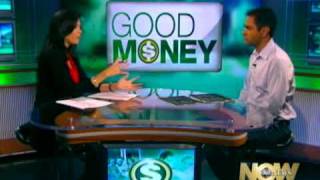
Ramit Sethi explains phantom costs: the hidden expenses that make purchases far more expensive than their sticker price. A $350/month car payment actually costs around $1,000/month once you add insurance, gas, and parking. A $290,000 house costs over a million dollars over 30 years when you factor in interest, taxes, and insurance.
Questions this video answers
"Phantom costs" (also referred to via the acronym TCO, "Total cost of ownership").
Example payment: $350/month; effective net monthly cost claimed: about $1,000/month (after insurance, gas, parking, registration, tickets, etc.).
About 40–50% (example: a $1,000 mortgage could become $1,400–$1,500/month).
He claims it is "over a million dollars" over 30 years after principal, interest, taxes, and insurance.
At least 15% down.
Chapters
Hello, everyone. Welcome to Good Money, your trusted source for personal finance advice. I'm Meg Oliver in New York. Have you ever walked into a store, looked at the price tag and thought, sure, I can afford that. Then a few months later you're scratching your head thinking maybe that wasn't such a good idea. That's because you didn't consider those phantom costs. According to my next guest, Ramit Sethi, ABC's personal finance contributor and author of I will teach you to be rich says you need to consider those costs before telling the salesperson to put it in the bag. And Ramit is here. Thanks so much for joining us today.
Thank you.
Alright, so break it down. What are these phantom costs?
For us, phantom costs are the costs behind the sticker price. These are the invisible costs that we don't consider when we're making a purchase, especially a large purchase. And they're expensive, they're expensive, they add up. And the worst part, the most insidious part, is that we never think about them until it's too late.
Alright, so give me an example. Let's start with a car. Tell me about your car. How much do you pay?
Okay, so I have a car. The car payment is $350 a month. Any idea on how much I actually pay? Net net? Any idea?
No, no.
Thousand dollars a month?
Really?
Yeah, you would think that's crazy. You're paying $350 for the sticker price. But no, you have to factor in things that you don't think of when you're buying that car. You have to factor in your insurance, your parking, your registration, any tickets, gas. These things all add up in a huge way, taking it to almost triple the price of what you thought.
All right, so this basically changes the way you go in to purchase a car, right?
Yep. Most people, you know, it's funny, most people, when they go in to buy a car, they look at the price on the window and they say, oh, I think I can afford that. But the actual way is to say, how much can I afford total? And based on that, knowing what the phantom cost will be, how much car can I afford? So let me just give you an example. If you can afford $500 a month for a car, reasonable amount, you can't afford a $500 car. No, no, you can afford about a $200 car. $250 maybe. Because you got to factor in your gas, your parking, your. All that stuff, you. And that means that the car you can actually afford is about $12,000.
Really?
Pretty sobering. Most of us think, oh, I can, I can get that car. It looks good, it's beautiful. No, you have to factor in all the phantom costs, which can add up being a tremendous amount.
Ramit, are you seeing even more of these phantom costs in this economy where, you know, it's hard to go out and sell a car these days?
Yep. Those costs, I mean, some of the costs you can make back when you try to sell something back. But these days, since there's so much supply and so little demand, you're gonna have to basically eat those costs yourself.
Okay, let's talk about housing, because I can only imagine how many phantom costs are involved there. It comes down to the closing costs, right?
There's more than that, actually. The bigger the purchase, the more phantom costs there are. So closing costs are one. But when we go to buy a house, we tend to think like this. We say, you know what, my monthly rent for my apartment is $1,000 and this house is $1,000. Mortgage, might as well build some equity. But you're forgetting that you have to add on with all the phantom cost for housing. Get this 40 to 50%. So that thousand dollar mortgage is actually going to be about 14 or 1500amonth.
So, so what are you suggesting to people that are looking, they're trying to get into their first home instead of renting? Because everybody says, hey, you know, instead of wasting your money, you should be buying.
Well, first of all, you're not wasting your money on rent. You have to run the numbers. But you want to factor in things like your down payment, you want to factor in your interest, you want to factor in maintenance. When you're renting and your toilet breaks, that's a call to the landlord. But when it's you, that's $500 out of your pocket.
All right, let's use the example of a $290,000 house. How much does that cost over 30 years?
Okay, so you wouldn't believe it again, taking my car, you know, it seemed like very simple, but a 290,000 DOL is a fairly typical house in America. Across America, you're going to have your principal, you have your interest, you have taxes and insurance. Net it all out. It's over a million dollars for that house.
What?
Yep.
Are you kidding?
Nope. You have to add all these costs up. And let me tell you again, the worst part is that we never think about it. Tax time will come once a year or we have to pay our roof cost for $25,000. But you have to amortize that out over your entire lifetime.
Okay, so now that you've got everybody's attention about their car and the house and everything, you have them a little scared. What do you do? How do you make this work for you?
Three letters, tco, Total cost of ownership. What that means is you don't want to just look at the sticker price because companies and marketers are very good at saying, oh, here's just an introductory price you want to think about. You know, what if I'm moving into a nicer neighborhood, Can I factor in how much those more expensive groceries are going to cost? And I'm not saying don't buy a nice car or don't buy a nice house. Buy it if you have the money, but make sure that you know what tco or total cost of ownership is for that purchase.
So what would you advise somebody? Would you just advise them to stay and rent right now and wait until they have enough money to cover these phantom costs?
Yeah. I mean, there are some simple guidelines you can use to know if you're ready to pay. First of all, you want to be able to have at least 15% down.
Okay.
Second of all, you want to run the numbers and see does it indeed make mathematical sense for me, like, for example, in places like New York or San Francisco, it almost never makes sense to buy. And then once you do that, you want to say, you know what, how much will it actually cost me on a month to month basis? Not just with the mortgage cost, but, but everything. Factor in that roof, factor in that toilet, factor in your taxes, and then you can say, you know what, do I have the money? If so, do it. And if not, I'll just wait.
And then how about cars in terms of appreciation? A lot of people want to go out and they want to get a new car or something. The same principles apply here as well.
Same principles. Don't just think about what the sticker price is. Make sure you factor in everything, even traffic tickets. So I tend to get, you know, one or maybe two traffic tickets a year. Guess what? I got to add that on to my monthly payment.
Okay. Now, does it help at all if you are trying to buy a car late in the season? Because, you know, car dealers are trying to get rid of those late models cars. Any of those phantom costs go down?
No. Phantom costs are going to stay roughly the same, but your sticker price is going to go down. So that's a good thing.
All right. We've been hearing some bad news in the economy over the last 24 hours, especially with housing prices. So what does this mean for the average American out there right now?
It means that you should redouble your efforts to really understand how much something actually costs. Don't. Even if that house you love last week fell 5%, don't just go by the sticker price. Look at how much it totally costs. That's what's going to help you get ahead.
All right, and before we go, any other hidden purchases or any other hidden costs. Excuse me. When it comes to different purchases.
Well, I mean, I have an example, so I'll give you an example. You have any clothes that you have to that are pretty nice? Like you have a nicer shirt, I imagine. Right when I've bought a nicer shirt. What I didn't realize when I first started buying a little bit of nicer clothes was, guess what? These are dry clean clothes. Clean. And at a certain point, you actually spend more on the maintenance than the cost of the shirt itself. So there's these phantom costs in everything you do.
Yeah, you really have to factor into everything but good organization. Looking at your finances, I'm sure it definitely helps.