ABC Money Matters - Buying a new car?
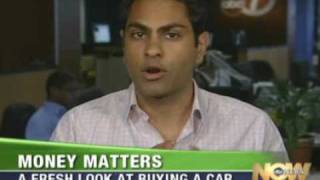
TV interview (ABC Money Matters) with Ramit Sethi giving practical advice on buying a car. He emphasizes the single most important factor is how long you keep a car, outlines four steps—budgeting (including phantom costs), picking the right car, negotiating (using online reports and multiple dealers), and maintaining service records—and gives concrete examples (his payment amounts and a negotiation that saved $2,000).
Questions this video answers
July 27, 2009.
$350 per month.
About $1,000 per month.
$2,000 under invoice.
Chapters
Buying a car can seem like a daunting task for some. First, you go into the dealership with all the excitement in the world, only to be discouraged when you can't get your dream car at the price you expected. But with sluggish auto sales, this could be the best time to try your hand at haggling for the best price possible. Here to share with us some tips on how to save thousands of dollars when purchasing a car is our trusty savings guru. Lookit, you have a new title. Ramit Sethi, author of I will teach you to be rich. Ramit, it's good to see you again. Do you like your new title?
Hey, Jackie. I. I like it. Thank you very much for it. It's an honor.
Okay. Well, before we get into how to save thousands, there is a single most important decision associated with buying a car. What is that?
Well, when you buy a car, it's not the brand, it's not the mileage, it's not the rims. In fact, if you think rims are a good investment, please jump off a bridge. Okay. When it comes to buying a car, the most important thing is actually the length of time you keep your car before selling it. So you could get the best deal on buying a car, but if you sell that in three years, you're going to lose thousand because of tons of transaction costs. What you want to do is understand how much you can afford. Pick the right car, maintain it. Right. And then hold it for the long term. That's the way that you save thousands on a good car.
How long have you had your car? And be honest.
I'll be honest. I've had my car about four years. And as I always tell my friends, I can't wait to give that car to my kids in about 20 years. Okay. I'm planning to keep that for a long time. Okay.
I hope it's a nice car that your kids will be getting.
Yes.
Okay. You say there are four steps to buying a car, and I want to start with the first one. And of course, that one is budgeting.
Yeah. So most people go into a dealership, they pick the car they like, and then they try to figure out how they can afford it. And who do they turn to to help figure that out? Often it's the salespeople who help them finance it, which ends up putting tons of dollars in the salesperson's pocket. What you want to do is plan how much you can afford to spend beforehand. Now, so let's talk about this specifically. Maybe you say, hey, I can afford to spend $300 a month total. Okay. Now you might say, oh, great, a used Toyota Corolla is perfect for me. I'm going to take the extra money I have left over and invest it. Or you might say, I really love cars. I want a BMW and I can afford it. Once you figure that financial numbers out, it's guilt free spending. You shouldn't feel bad about buying a nice car if you can afford it. But I want to ask you something, Jackie. My car payment, to get specific, my car payment itself is $350 a month. How much do you think I spend total every month? If you factor in taxes, gas, all that stuff together, $350 is just a car payment.
All right, I would say about five. Well, you live in San Francisco, right? Could be more than five then if you're, you're including insurance and everything in this, right?
Everything. Yep.
Yeah, I'd say about 5, 550.
Okay, so 350 on this, on the sticker price every month. And what I'm actually paying is about $1,000.
Yikes.
Now this is shocking to people. You got to factor it in. These are what I call phantom costs. People look at the monthly price and they think, oh, great, I can afford it. You got to factor in the phantom cost. These are gas, insurance, taxes, parking, tons of other things that you wouldn't think to add in, but you want to add those in. Go online, go to iwillteachytoberich.com or go search online for, you know, car payment and all different kinds of search terms. And you'll find out that there are lots of things you're not thinking about. Those are the phantom costs that you want to factor in as well.
All right, talk to me a little bit more about picking a car. How do you pick the best car for you?
Okay, so you've gone through step one, which is picking your budget. So you've now limited the universe from a million cars. You could choose down to approximately four or five. Okay. You know these four or five cars that you can afford once you factor in how much you can afford on the monthly side and all the phantom costs. Okay, so you know, four or five cars, you can look at Consumer Reports, they're great. Go in and test drive them, of course, but make sure you have those numbers right, because you don't want to be have the budget of a Toyota Corolla. You and go in and test drive a Porsche. Okay, so that's, you want to make sure you narrow it down before you ever Step foot in the dealer.
Alright. And once you've picked a car, you have to negotiate, right? You can't just take the price they're offering.
Of course not. Now I have never seen people make such bad financial decisions as when they go in to buy a car. It's totally ridiculous. If you know that you're not a cutthroat negotiator, take someone who is. Let me tell you about me. When I went in to buy a car, my parents actually taught me they, for them, buying a car is not a one day process. My dad took five days to buy a car. Okay. I think we ate breakfast in the dealership on multiple days. So you want to make sure that you take someone who's cutthroat. Now I'm also going to share with you the way that I negotiated, which is I would say the 21st century way of negotiating like an Indian and negotiating kind of from the comfort of your own home.
Okay, show me how you negotiate.
All right. So I used a tool called Fighting Chance. You can find it@fightingchance.com A lot of people don't know about this site because it's run by a, a nice man who doesn't really publicize himself too much. What he does is for about 40 bucks, I think, he gives you a customized report for the car that you want. So you tell him what car you want and he'll tell you exactly how much the dealers are paying for it, including things that no one else knows, like dealer withholding. You can then take that report and it comes along with strategy, tells you exactly how to negotiate. And I used that to get my car when I went to buy it a few years ago.
Oh, I like it. Were they shocked when you showed up with this report? Were they impressed?
Well, let me tell you. Oh, they were. No, they were not impressed. They didn't like me very much. But let me tell you, I didn't even show up with the deal. Here's the thing, you can do it from your house. So let me tell you what I did. I sat down and of course you want to do it around the end of the year because dealers are salivating at the chance to hit their quotas. So I did at the end of the year, around early December, and I said, look, this is the car I want. I know this is exactly how much it costs you. I'm looking for the best price and I'm ready to buy within the next week, so give me your best price. So I faxed it to one dealer. Now he Wrote me back and said, this is the best price I can give you. I took that, faxed it to the next dealer. Next dealer. So about three days later, I'm sitting in my room eating a Taco Bell burrito. I have 17 dealers bidding against each other. Okay. And I end up with one winner. I got the car for $2,000 under invoice, and that was the first time I stepped foot into the dealership. I just went there, signed the papers, and I was on my way.
Fantastic. We're learning a lot from you today. Okay. The last step to buying a car now, of course, is maintain. And it's not cheap, is it?
No. I do believe in paying for maintenance. And this is, again, you shouldn't be making the decision when it comes time to go into the dealer and get your maintenance done. You should have factored this in early on. So spend a lot of time before you buy the car understanding how much maintenance costs. For example, maintenance on a Mercedes is much more expensive than maintenance on a Honda. So you want to factor that in when it comes to it, what I do is I just have a little envelope in my glove compartment. Every time I get anything done, oil change, checkup, whatever, write the details down on the receipt, put it in the envelope. When it comes time for me to sell my car, let's say 18 years from now, I'm going to pull that envelope out. Okay? It's going to look like a petrified forest, but I'm going to pull it out and I'm going to say to the person who's going to buy the car, here's every single receipt and every single service I've ever had done to the car. Now, somebody like me, if I go to buy a car and they don't have maintenance records, I'm going to. Somebody like me is going to say, well, you know, it's a nice car, but you really don't have the records. If you knock off two grand, maybe I'll consider it.
Okay.
You don't want someone like me coming around to negotiate you down. Get your maintenance records, make a bulletproof system so that when you sell that car, you will save thousands just by maintaining your car. Right. And plus one last bonus. It'll actually last a lot longer.
Good to know. And what do you have to say to people who want those flashy cars?
Well, remember, I'm not the kind of guy who says no, no, no. Right. Personal finance, and I will teach you to be rich, is about spending on the things you love extravagantly, but cutting costs on the things you don't. So if you really want a Mercedes and you can afford it, then great, you should get it guilt free. But if you can and if you haven't taken the time to figure out all the phantom costs, then you have no business going in to buy a car. Okay? So you want to think about this stuff before you ever set foot in a dealership. Alright?
Some great information. Ramit Sethi, as always, thank you very much for your financial insights.
You bet.









