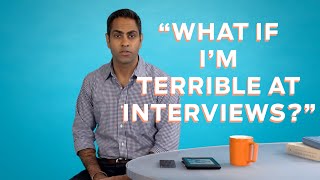
This content was created by Ramit Sethi. This content was uploaded by Ramit Sethi. This is a YouTube video titled "Ask Ramit: What if I'm terrible at interviews?" created on November 12, 2015, featuring Ramit Sethi addressing questions from Catherine C. about coping with interview anxiety and assessing one's skills for a dream job. Ramit provides advice on practicing interview skills and calibrating one's abilities against the market.
Chapters
Okay, this is a fairly long two questions, but I want to engage in them because they're really, really good. These are from Catherine C. How does someone who is terrible at interviews cope? My IQ drops 100 points the moment I step into an interview. The only way I can overcome sounding like a blithering idiot is to manipulate the meeting into a mini consulting session. I light up and come alive when I talk about marketing, but can't manage to remember a single species. When someone asks what kind of a tree I would be, I can't think of any answers to. Tell me about yourself that don't sound stupid or pompous, especially when I'm dying to find out what interesting marketing problems the job presents when it's a job I really, really want. This problem amplifies proportionally. Okay, this is a great question. So a lot of us are, like, super conversationally fluent. You know, they're like people you would hang out with. They're fun at coffee shops. They're fun at bars. They're, like, fun people get into an interview and they suddenly start talking like this. Well, yes. I have engaged in several different marketing endeavors, and I have routinely found great success. And you're like, what just happened? Like, this person was so friendly and cool, and then we closed the door and she became, like, a super weirdo. Or this guy became a super weirdo. Not what you want to happen. The best answer to your question, Kathryn, is practice. Now, did you want me to give you some magical technique that you could just use off the bat? I'm sure you did. No. Practicing this not just by yourself, but with a very skilled interviewer. So I have people that. They're friends of mine, and they'll be like, hey, Ramit, I'm going in for an interview tomorrow. Can you give me some help? First of all, I'm like, really? Like, you wait until the last minute to call me to ask for help. Don't you think it would have been better to ask earlier? But that's just me getting mad, so I'll. You know, I've done a lot of interviews, and I've also been interviewed a lot of times. And I'll ask them questions, and we'll go over it again and again until they feel totally comfortable and natural. What did the Navy seals say? They say the more you bleed in practice, the less you'll bleed in battle. The same thing is true of interviews. If you go into an interview and you've never answered these questions, you've just read it in a book, you think that's going to work. It's like some of these guys I know, they have these rehearsed lines. They've read it on an Internet forum for picking up women, and then they go out to a bar and they use it and they're like, well, the thing is, have you. Did you see that fight outside with those two girls? Super awkward. It takes practice. Now, there's two kinds of practice. One is behind closed doors with your friends, supportive people giving you feedback. The other kind of practice is actually doing many, many interviews. Both of these things come in very handy or over time. I'm going to show you some of my techniques that I use to dominate these interviews, including the toolbox technique, where I have a toolbox full of different options to deftly answer and parry any interview question that comes in. I'll show you how to do that. But in general, to start, start practicing, you know the types of questions you're getting. So let's do that. By the way, the mini consulting thing is a really interesting psychological comment on yourself. So you said, I turned it into a mini consulting session. Now, that can be great, but if I'm sitting here as the hiring manager and I have a list of questions, you better answer them. Don't try to redirect too many things to what you want to talk about. Yeah, you can do that sparingly, but you better answer my questions. Tell me about yourself. That's an easy question to win or lose an interview on because most people never prepare and they just start rambling. Whereas a top performer will have a tight narrative that she wants to message. And so when I say tell you, tell me about yourself, that's like a layup. So please, please practice and get these interview questions like, perfect, because you owe yourself nothing less. Now, another question that Kathryn says is, when do you know that your skills are good enough for your dream job? Colleagues tell me I'm one of the best marketing people they've ever worked with, but I always have a list of additional skills I'm working on, and I fear that what I already have to offer won't be good enough. When do you know that you're good enough to even try for a dream job? That's a nice question. One way to do it is to calibrate your skills against the market. So your friends may tell you that you're the best market in the world, but the market may not think so at all. You may actually not be that good at all. I'm not saying it's true. I'm sure you're great. How do you find this out? Go out to the market, interview over and over, and if you start getting offer after offer after offer, it probably means that the position you're in is not good enough for you right now. However, if you get rejected time and time again, it either means your skills are not as good as you think or your interviewing skills are not as good as you think. So keep both of these in mind, and then disentangle each of them. Work on your interviewing skills, and if you get really good at those, but you still get keep getting rejected, you'll be able to find out that, hey, maybe you actually need to improve your skills a little bit more. Thanks for the great questions. Kathryn.