Boomers Lost Their Minds Over My Money Advice
Ramit Sethi reads New York Times comments on his money advice, mostly from boomers calling him a grifter. He defends his approach to guilt-free spending and automation while acknowledging real problems like housing costs and financial literacy gaps.
Chapters
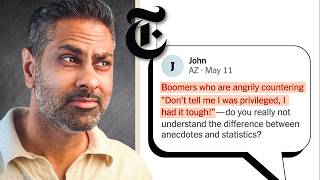
The New York Times recently ran a profile of my work, and I have to tell you, the comments were amazing. In fact, somehow the comments turned into a full-blown generational war. In the comments, some people said my work changed their lives, and there are unhinged nuts who call me a grifter. Many boomers said young people are lazy. You all just need to pull yourself up by your bootstraps. So today, I decided let's have a little fun and go through the comments together. The angry ones, the thoughtful ones, and the unhinged ones. Let's take a look. Mike from San Francisco. In other words, another grifter trying to sell themselves as some sort of oracle and looking to make a buck. Where's the critique here? Is the only critique that I'm a grifter? And if I'm a grifter, how come 98% of my material is for free? I want everybody to understand that you can have a business for 21 years. You can have your book in every public library and actually actively direct people to get it for free. You can have a TV show. You can have multiple bestselling books. But somewhere online, there will be a guy named Mike calling you a grifter. And it is important that you realize you actually don't have to listen to Mike. If you think I'm a grifter, that's fine. I actually think if I was wearing a shirt that didn't really fit me and it had a bunch of wrinkles and I kind of spoke, you know, with a lot of ums and ahs, that it would actually get less comments about being a grifter. Sarah from Seattle says, I don't find financial influencers like Ramit Sethi helpful. He constantly beats the drum about buying a house being a terrible decision because he personally has zero home improvement skills. And would rather travel, consume, apparently can't even use a screwdriver. Yet many of us take great pride in building and fixing things. Okay, that's actually true. I do have zero home improvement skills. The only tools I have in my house are imported pens from Japan and these beautiful Tokyo-based scissors. So you kind of got me dead to rights. I don't have a toolbox. I never want to own a screwdriver. Where I think I might offer a little bit of critique is I don't think buying a house is a terrible decision per se. I never say that it is a mistake for everybody, but that is what Americans hear me saying because in America, our number one religion is home ownership. And when anyone dares to even question the idea that perhaps buying a house might not be the right decision for everyone, and you should just run the numbers on the biggest purchase of your life. What people hear is he hates buying a house and he can't pick up a screwdriver, so he's a loser. I mean, I can't pick up a screwdriver. If I'm a loser, that's up to you to decide. But I will say, if you like doing home improvement, that's awesome. You should factor that into your non-financial considerations when it comes to buying a house. And Sarah, if you would like to come and do some home repair for me, I would welcome that. Thank you very much for the comment. Okay. What did this next person say? Laura from Kansas City says, seeing Ramit Sethi featured in the New York Times is such a treat. His podcast has allowed me to create a plan to live my rich life, and I feel peace and positive pressure despite making big changes that may not make sense from the outside. Learning new ways to think and talk about money has already changed my life in the last 6 months. Honestly, thank you so much, Laura. It makes me so happy, especially to hear you say that you are making big changes that might not make sense from the outside. I think that the more and more you refine your vision of a rich life, the more and more confusing it actually becomes to the outside world, even bewildering. So when I talk about the things that I love to spend money on, people are like, that sounds really weird. Sometimes they think it's totally stupid. I love that. It means that I am turning the dial so my rich life fits me like a handmade glove. And I want all of you to do that. It may turn out that your rich life is quite conventional. Perhaps you want to have a big house. Perhaps you want to have 2 SUVs. That's fine, as long as you can afford it. But what I find is that my rich life is more and more fun the more and more uniquely I craft it. Reading these comments, you start realizing that some people truly believe the economy works the same today like it did in 1987. Why don't these young people just save more? Uh, buddy, daycare costs more than your mortgage payment did back then. I believe we should take personal responsibility for our money, and we should look around at what's going on and acknowledge it. One of the things when it comes to taking personal responsibility is protecting ourselves in case something happens to you. That's where today's sponsor Fabric by Gerber Life can help. Fabric by Gerber Life is term life insurance you can get done today. It's made for busy parents like you, all online, on your schedule, right from your couch. You could be covered in under 10 minutes with no health exam required. And the best part, Fabric has flexible, high-quality policies that fit your family, like $1 million in coverage for less than $1 a day. Even if you have life insurance through your employer, it may not offer enough protection for your family and it can disappear the moment you leave your job. Fabric follows you wherever you go. There's no risk. There's a 30-day money-back guarantee, and you can cancel at any time so you can make the decision confidently. If you've got kids, especially if you are young and healthy, locking in low rates now is one of the smartest moves you can make for your future. So join the thousands of parents who trust Fabric to help protect their family. Apply today in just minutes at meetfabric.com. Meetfabric.com/ramitsethi. That's meetfabric.com/ramitsethi. And use my link so they know I sent you. This is what I mean by controlling what you can control with your money. Okay, now let's get back to the generational chaos in these comments. SBB says Sethi has no degrees or training in finance, investing, or getting rich in old speak. Yet he sells millions simply with his smooth and fluent appearance. Thank you so much. I appreciate the compliment. Diana from California says anyone under the age of 70 asking the baby boomers to, quote, listen to your children with compassion and an open mind and consider the impact of your political decisions on your children's welfare equals Instant screeching. You are right, Diana. What is up with this? Notice that in the interview, all I said was, look, if you're gonna give them money when you die, you might as well give them a little bit of money now. And all your kids really want is to hear you ask them a few questions, get curious, and acknowledge, hey, that sounds really tough. I know it was tough for us back then, but it seems really tough now. That's it. Is it that hard for you to stop focusing on yourself for 10 minutes and to actually acknowledge that your kids have it tough? Is it that hard? Or do you have to go back and resort to saying, when I was 23, interest rates were 17%? Look how many people in the comments are doing this. You're actually proving my point that you are so me-focused that your children who are struggling with a series of policies created largely by wealthy and people in power to keep basic necessities unaffordable, like housing. But as far as you're concerned, you made it happen so your kids can figure it out themselves. I just can't imagine being a parent in their 70s, 80s, and looking at kids struggling and just saying, "Fuck you." That's effectively what you're doing by not even acknowledging how difficult their life is. It costs you nothing. All I'm asking is for a little compassion. And I think that actually might be part of your rich life. You just don't know it yet. I think I have a mental defect because whenever people criticize me, but with really stupid criticism, I love it. Like, I can't get enough. Like, some people get angry. They're like, "I deeply feel the need to be understood." I love it like going in a spa. Some of you get a massage for fun. I read comments of people who don't know what they're talking about. And that seems to be what's happened here with a few of the commenters, because my team did an analysis and they found that I spoke about boomers roughly 10% or so of the interview, maybe less. But there are tons of comments from angry boomers who do not like the mere suggestion that they should be compassionate to their own children. Like, in what world are we existing? Oh, it's America. Who knew? Let's go through some of the comments. Mark So from Jacksonville, Florida says, quit worrying about what the boomers did. It has no bearing on your current problems. Oh, is that right? Are we not aware that the bulk of these benefits is going towards boomers, not young parents, not poor children, but boomers? We're not aware of that. We're just going to ignore that data. Oh, I already know what your next reaction is going to be. Well, we worked hard. And now it's your time to figure it out yourself. You worked hard, and as soon as you bought a house, you pulled up the drawbridge around you and didn't let anybody else buy a house. You're a NIMBY, and that has caused your own children to not be able to live in the same neighborhood they grew up in. But you don't care. Instead, you say things like, "Quit worrying about what the boomers did." I can't imagine having you as a dad. Somebody who says, "Don't worry about us, just focus on yourself." no compassion, no empathy. And I would argue probably no intellectual capacity to understand structural effects. You just look at people, it's black and white, simple, almost childlike. These are not the kind of people I want in my community. If you want to learn how to talk about money without this outdated old person telling you all the things you should never spend money on, hit subscribe because you are welcome on this channel. On this channel, it's okay to spend on the things you love, as long as you are hitting the rest of your numbers. Simon Harding from Portland says, I worked and— already I'm going to stop right there. I already know what the rest of this comment— I haven't even read it, but it's going to be a boomer saying how hard they worked and how they restricted themselves and now they're fine and you need to do the same thing, you poor loser. Let's take a look. Simon Harding from Portland says, I worked and scrimped, didn't eat out and still pack lunch, never buy coffee out, lived on ramen and fried egg sandwiches in grad school. Saved, struggled with house payments and the childcare realities of the '90s and early 2000s. Sold my large house when the kids were gone and moved into a small house with my partner. Don't blame me or my generation. Blame policy. Okay, this is actually more nuanced than I thought. First of all, I appreciate that somebody cooked food at home and didn't eat out a lot. I think that if you are on a limited income, that's actually really smart. I do also agree that we should blame policy. I do think that policy has an outsized effect here. I do want to point one thing out, Simon. People who are older disproportionately vote, and those people who vote tend to vote for things like NIMBYism. They are the ones who have voted local city councils and governments in who have prevented housing from being built. And in places like Florida, as recently as just a few months ago, older people are now floating the idea that they should not have to pay property taxes anymore. Do you realize what that actually means? It means that now younger people who already struggle with housing costs, education costs, food costs will now be paying more for local government funding instead of older people who are disproportionately wealthy. So Simon and I actually might agree on a lot because he says blame billionaires and the venal corrupt GOP. Agreed. There are also liberals who are nimbys as well. Nimbys cuts across all political lines. But I do agree that the GOP in general has totally fucked over young people, people of color, etc. Don't blame me or my generation. Blame policy. Well, policy is made up of people who vote, and the people who vote tend to be older people. And the older generation tends to create policies that disproportionately favor themselves at the expense of younger people. So yeah, I want younger people to vote. What do you think I'm doing? Why am I donating six figures to get people to the polls? I want them to vote. But I also think in addition to blaming policy, we need to point the finger at the people who create that policy. Post Slug from Cambridge says, using a platform to create generational divide is destructive. Every time I talk about racism or politics and money, I get some cuckoo coming out of the woodwork saying, you're just being divisive. And you know my answer? Good. I like to be divisive against extremists. Ramit, you're mean. Good. It's actually good to be mean to extremists. Shame them. Banish them. Let them know they are bad people. It is not destructive to talk about policy. It is not destructive to describe what is happening. When I describe the basic facts of money, for example, housing is historically expensive, primarily because of nimbyism. That is not destructive. You think it's destructive because it makes you feel uncomfortable. And if there's one thing we know in America, people do not like to be uncomfortable. The minute they feel discomfort, They start using all kinds of strategies to avoid that. Why are you always making it about race? This is destructive. You're being divisive. Fine. You can say what you want, but we are going to deal with the facts here. And the facts are that young people are not simply irresponsible and spending too much on avocado toast, that there are policies that have caused housing, education, healthcare to be disproportionately expensive, especially for young people and people of color. And if you think that's destructive to talk about, then you need to take a look in the mirror. One thing I noticed reading through these comments is how many people still believe that being good with money means saying no to spending it. Don't spend, don't travel, don't enjoy anything until some magical date when you finally feel secure enough. Oh, and by the way, that date happens to be at least 45 years in the future. That is what keeps people ultra frugal and focused on just numbers instead of actually living a rich life today and a richer life tomorrow. And this is how people burn out from restriction, or they make good money and then they still feel guilty every time they spend it. This is not what a healthy relationship with money looks like. I want you to have a deeply healthy relationship with money. Look at my face. Get tight on this. Do I look like I'm worried about money? Hold on. This is me actually smiling. You can't see it, but in my head I am smiling. I'm feeling extreme joy right now. Look, I'm not worried about money because I have a system. I know what I can afford. I feel totally confident in the decisions I make. And that is what I want to show you how to do step by step. Inside my money coaching program, we help you build a system so you can save, invest, and enjoy your life right now. In the program, we help people figure out what their rich life actually is. How to spend intentionally without feeling guilty, and how to automate the important parts of your finances so you're not constantly stressed out about money anymore. The goal is to become calm, confident, and competent with money so that your money supports your rich life instead of controlling it. If you are ready to build this system and start becoming good with money, scan the QR code on screen or click the link below to join money coaching today. Okay, let's check this one out. John from Arizona says, "Boomers who are angrily countering, 'Don't tell me I was privileged. I had it tough.' Do you really not understand the difference between anecdotes and statistics?" Thank you, John. I love you. And the answer to your question is no, they don't understand. They don't understand statistics. I have had thousands of conversations with people in my DMs, and they will often say something about, you know, immigration or whatever. And I'll say, okay, show me the data. And they refuse to. So then I do it. And if you're wondering, like, how do you have all this time? Aren't you a CEO? I have unlimited time to talk to dumb people in my DMs. Unlimited. Let me just tell you right now, I can tell you that over 1,000 conversations, not one of them will even read a chart. That I paste in front of them. I'm not joking. Not, not 10, not 5, not 1 out of 1,000 will even read a graphic. I'll say, what does that chart tell you? And they simply will not read it. Guys, you need to understand we have a serious literacy crisis in America. There's data showing that a lot of Americans read at basically a 6th grade level. But I have higher standards and I expect more from you. That's why my readers are smart. And that's why so many of the people leaving comments in here are telling me about their experience buying pickles. For the 5 people left watching this, let's continue. Scott from Steamboat Springs, Colorado says the absolute best financial advice I've heard is to cook with nice ingredients at home and eat out less. Scott, that's the best financial advice you've heard? Like, really, of everything out there? For everybody watching, I am begging you to take money more seriously. This comment is actually a great example of somebody who very likely benefited from tons of structures around them without any knowledge of them. And they are now turning around and giving this seemingly helpful advice. Hey, everybody, you gotta cook with nice ingredients. We're talking about things like the cost of childcare. We're talking about things like how much it costs for college and student loan policy. Which is not dischargeable in bankruptcy. We're talking about things like how much 1% AUM actually costs, which can be hundreds of thousands of dollars over your lifetime. I don't think somebody telling me that once a month I should go to the farmer's market and get artisanal pickles is really going to change the numbers here. Have you ever gotten advice like this from some parent? And they're just like, you know what you need to do? You need to go around to every business on the block and hand them your resume. And you're just like, I don't think you know what's going on today. I think Scott probably has good intentions, and I think it is nice to have nice ingredients if you can afford them, but I don't think that really has anything to do with how money works in today's society. So we can smile, we can say thank you, but I don't think bell peppers are going to change my financial future. Jim from Hackensack says Ramit Sethi plays the part of the contrarian to to sell books and tickets to his workshop, but at the end of the day, personal finance talking heads are operating in a commodity-filled space. The only way to achieve a high net worth is to live below your means and save and invest consistently, period. And yes, make coffee at home, skip the Starbucks, and live in an apartment if you have to. No one is entitled to a rich life. I kind of love the idea of folks like Jim, who just look at younger people and they basically are like, "Go fuck yourself. I had it hard. You need to have it hard as well." And they simply do not operate in any kind of world where empathy plays a role. Like, "Hey, I graduated with crippling student loans. Maybe we could make it better." Have you seen the meme going around? Like, "My grandmother had cancer, so you should get cancer too." What? None of us. If somebody said that, we'd be like, "What the fuck is wrong with you?" But basically, a lot of people say the same thing when it comes to money. Why do you think that no one is entitled to a rich life? I think they are. I think we all are entitled to a rich life. And a rich life might be as simple as being able to take your kid to a local park and play with them because we all pay our taxes and we are thankful to have government services like a local park. Or it could be as extravagant as going on a 14-day safari if you can afford it and you saved for it. But the idea that no one is entitled to it, and you can tell this person almost takes joy in it. Fuck you. No one is entitled. Grind it. Work it. This person is one car accident away from being homeless. But the way they talk is to almost align themselves with billionaires. I Will Teach You to Be Rich is not simply about how to maximize your credit card points. If you want that, go find somebody else. I'm trying to bring class consciousness to you. One way or another, I'm going to make you understand that in this country, you are one accident away or one mishap away from being homeless. You are one step away from a steep downward climb socioeconomically. You don't realize it yet, but a lot of the people who are homeless in your own city have a job. They just can't afford housing. And that is a policy decision. So Jim may call me a contrarian and accuse me of wanting to sell books. Yeah, I want to sell my books 'cause I think it's really good, or you can get it from the library. But what I can't stand is somebody who had a relatively easy way of building a high net worth and now turns around and looks at other people and basically curses at them. Not in my community. Don from California says, "Before paying even $1," for any of your courses or books. My income increased exponentially, times 15, as I interviewed for and got the jobs that paid me my worth. Thank you so much, Don, and congratulations. I love this for you. The highest praise that any author or creator can get is that somebody used their material to improve their lives. This makes me so happy. And another thing is that I was struck reading the comments on the New York Times profile. That there were some people who were just so cynical. This doesn't work. You're a commodity. Everybody needs to just cut back on coffee and none of this will work. And then over and over and over again, I see comments like Dawn's. I changed my life. My kids now have a 529. We can take a vacation without worrying about the price. And I was just struck that you can take these two types of comments and put 'em right next to each other. And you choose, you choose what kind of life you want to lead? Is it the one where you cross your arms and you're cynical and you go, "This doesn't work. No one wants to help me and nobody should help you either." Or you go, "Hey, I'm willing to put the work in. I want to understand how social structures affect my finances, but I also want to focus on the things I can control. And by the way, look at what happened. My income went up 15 times." Dawn, this is life-changing for the trajectory of you and for your family. I'm so happy I could play a small part in it. Thank you. Ed from Washington, D.C. says, "I've been following Ramit Sethi for 20 years. His stuff is great. Very glad to see this piece." Ed, thank you so much. That takes me all the way back 20 years to my college dorm room. I started I Will Teach You to Be Rich in my dorm room as a blog because I had spent a year and a half trying to convince people to come to my free events about money and nobody came. They would complain about overdrafts, but they would not show up. Back then, I was a little arrogant and I said, you know, I have something the world needs to hear. But I am so thankful that I took a hard look in the mirror and I said, this is not working. I've been trying to get people to get a free class for a year and a half. They're not coming. So I got to switch it up. And I did. I started a blog and I wrote like you and I would be having a drink. It's like, let me tell you something dumb I did. Let me call you out if you did something dumb with your money. And then let me show you how easy it is to get this all set up. Fast forward, and maybe Ed followed my blog, maybe Ed was on my newsletter, maybe Ed saw me on Netflix or got one of my books. The fact that Ed took the time and effort to log on to the New York Times and leave this comment is incredibly gratifying to me. I want you to know how much I appreciate every single one of you who reads my material, watches my videos, and tells the world about it. It's been 20+ years. This never gets old. Ed, big thanks. Seth from Brooklyn says, "I've talked about him so much that someone literally brought it up during a wedding speech." Amazing, Seth. Thank you so much. Seth has been following me since 2013. That is a huge, huge compliment. I have always loved finding somebody that I admire and trust and then following what they say. And sometimes we evolve. Sometimes we grow out of the teachers that we follow. But the fact that Seth has been following me for that long while his life has clearly changed and so has mine means that what I am doing is working. Because I always said, as I get older, as I become more successful, I want to bring everybody with me and I want to talk about different topics. I want to go deeper. I want to show you how to apply this. To whatever part of your rich life you are in. And the fact that, Seth, you've come along for that long means a lot to me. Congratulations on the wedding, and I thank you so much for the comment. Marina from Ukraine says, "I've realized that my rich life is to buy the cheese I love, not the cheaper one, to use the detergent I love, not the cheapest one. What did it give me? It gave me the state of dignity." That I deserve what I love. Wow. Marina uses the word dignity, and I think that is a profound word to use with money because I want you to respect money. I want you to take it seriously. Respecting money means you spend the time to understand your key numbers. It means you show up to your monthly meeting, whether it's solo or with a partner. It means that when you spend on the things you love, you take a second and you appreciate it. You show gratitude to yourself for creating a system that allows you to spend guilt-free. And when you respect money, you earn dignity. Dignity can be going on an extravagant vacation, and dignity can be as simple as having a safe housing situation for your family. But we get dignity by respecting money. And these are two words I want to talk more about. I'm so glad that Marina brought them up. Congratulations, Marina. The comments are very revealing and frankly, a lot of fun. I like a little messy comment here and there. I don't mind it. So I was having fun reading them myself. What is clear to me is that there is a massive generational divide when it comes to money. Some people feel like the younger generations are complaining too much. Other people feel like the rules have changed and nobody's really talking about them. There are, in my opinion, much bigger structural problems today that need to change. Housing is number one. Education, the cost of daily necessities. But you still need to know how to build wealth in the economy that exists right now, not the one from 1980. If you want to know how to actually build wealth today, even if you are starting from zero, I put together my complete playbook in this next video.









