Give me 23 Minutes, and I'll Improve Your Finances by 82%
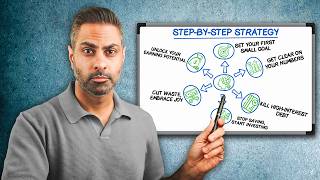
Ramit Sethi walks through eight concrete steps to fix your finances fast: build a $1,000 emergency fund, list all your accounts and debt, attack high-interest credit cards, audit your spending line by line, then max your 401(k) match and Roth IRA ($7,000 limit), automate everything, and push for raises or side income.
Chapters
Lets get real. Most people say they want financial freedom. They want to stop stressing about money. But when it comes to taking action, they freeze. For 20 years, I've watched people too paralyzed by uncertainty to even take the first steps to fix the money issues, causing them constant anxiety and sometimes fear. If that is you, it ends here. Sit back and I guarantee you I can improve your finances by at least 80%. Let's go. Step one, set your first small goal. Maybe your financial life has always been a mess, or maybe you slid into bad habits in the last few years. Either way, here's the truth. You need to prove to yourself that you can make a positive change, starting with setting a small achievable goal. The first of many. I've coached thousands of people on how to take control of their finances. And the best place to start is by building a small emergency fund. Let's say you put $100 every month, or maybe $200 a month into a high yield savings account until you have a thousand bucks tucked away. Now that doesn't seem like a lot, but number one, it stops the next emergency, whether it's a car bill, medical bill, losing a couple shifts at work from sending you straight into debt. And it proves to you that you can actually save money, that you can make a plan and stick to it. And that last point is huge because once you see that you're capable of saving $1,000, you start to ask yourself, what else can I do? And that's when you take control of your money instead of letting your money control you. So let's flex those muscles of making the right decisions and take it up a notch. Step two, get clear on your numbers. Yes, all of them. Now listen, if you ask me how my car works, I have no clue. I get in there, it works. I go somewhere, I come home. I don't care. I really don't care. The problem is you can't take the same approach with your money. So many people have no idea where their money is going. In fact, 50% of people I talk to don't even know their household income. It's very possible for people to not know the difference between a 401k and an index fund. It's really common for people to hear words about compound interest, but not really understand how it works. And when I ask people about things like how much debt do they owe? Panic attack. Now if you don't know your basic numbers, you're flying blind. It's a lot of vibes. It's a lot of feelings. The Truth is, nobody trips and falls into a rich life. You have to know your basic numbers. So let's fix that. Let's do it right now. Number one, list every account in your name. Checking account, savings account, credit cards, loans, investments. Yes, that includes your 401k, all of it. Number two, write down your debt. That's your current balance and your interest rate on your credit cards, student loans, car loans, mortgage, any type of debt that you have. Don't be afraid. And if you're not sure what the numbers are, call your lender. They will tell you. Number three, calculate your income. That is your gross income and then your net, how much you bring in every month after taxes and deduction. Number four, write down your fixed expenses. Those are the numbers you need to keep the lights on, including your rent or mortgage, utilities, insurance, groceries, anything non negotiable. Now listen, no judgment, no guilt. We're treating this like a science experiment. We're just getting it all out on the table. Suddenly you're going to see where your money's coming from, where it's going and most importantly, what needs to change. Now if you are like most people, one number on your list that's going to freak you out is your total debt. Good. That is often the wake up call. You needed to see that number in black and white. You can't rationalize out of it, you can't excuse it, you can't brush it under the table. Oh, where'd it go? I never saw that. You saw it, you saw that number. And now we're going to come up with a strategy to pay it off fast. Step three, kill high interest debt fast. Now listen up. Credit card companies love when you ignore your debt. That's why they make it so easy for you to pay the minimum. Let me show you the actual numbers. Let's say you have $5,000 in credit card debt. Let's conservatively say you have a 25% interest rate. Now if you only make the minimum payments, which is usually interest plus let's say 1% of the balance, it would take you 24 years to pay it off. Now what do you want to look like in 24 years? Waking up depressed? All this debt, where did it come from? The economy or. I took responsibility. I took a look in the mirror. 24 years ago, I made a big fat change and now I'm in control of my money. Here's the lesson. If you paid a minimum on your high interest debt, you are lighting money on fire every single month. Forget about the price of coffee. And freaking red onions. You're lighting tons of money on fire overtime. You want to know how to fix it? Let's do it. Number one, list your debts from highest to lowest interest rate. Number two, pay the minimums on everything except for the highest interest rate. Number three, take every extra dollar you have and put it towards the debt with the highest interest rate. And finally, once it's paid off, move to the next one. Now, this is called the debt avalanche method. And it will save you the most money on interest because you're plugging the biggest holes in your boat first. Now, I know a lot of people saying, ramit, I don't have extra money. After I buy my essentials, how do I pay off debt? What extra money are you talking about? Perfect. That means I get to score an easy win with you. Because 99% of the time when people say this, they are shocked when they discover how much money they actually have extra left over. This. That brings us to step four. Cut waste. Embrace joy. Now, I know it doesn't look like a guy who looks like me is going to have a lot to talk about when it comes to joy, but trust me, I do basically do what I say, not what I do. Okay? This is my face when I'm joyful. Look at me. That's joy. I don't know what to tell you. Here's an exercise I want you to do. Number one, pull up your last three months of transactions. Literally log into your credit card account. It's right there. You can download it. Number two, go line by line. Don't skip it. This one doesn't count because it was a full moon and it was January. I don't care. Look at every line. Number three, highlight anything that you forgot you were paying for, such as subscriptions or memberships. Next, write down anything that you bought impulsively. Oh, it was 1:30 and I was at 7:11 and I needed $74 of beef jerky. No. And also, anytime you were tired. Oh, why did I buy this delivery from Chipotle. Which one bowl cost me $37? Because I was tired. Write that down. Wait, hold on. This is the section on joy. Oh, yeah, we're joyful. Please write that down so we can all feel joy. And also write down anything you thought was small but it added up. Like Amazon purchases. $20 Venmo charges. Any parents here I know. Oh, these floaties only cost $7.95, but I bought 30 of them. Write it down. Now, I do this with people all the time, and the results are Quite hilarious. I. I have to tell you, I have a personal sense of joy when I discover people lying. I love it. I don't know about you. When somebody lies to my face, I love it. Especially when I can show them the lie. People tell me we only buy essentials. We're living paycheck to paycheck. And then we Discover they're paying 14.99 for a streaming service they haven't used in seven months. They paid $87 for a clothing sale that they couldn't pass up. The tags are still on the freaking jeans. They paid a $150 in random Amazon orders. We needed that. We need this cake cutter because our son turns 211 months from now. That's 300, 400, sometimes $800 a month of costs that they would barely notice cutting. Trust me when I say you don't need seven spatulas. Think of it as spring cleaning for your financial life. So what I want you to do is embrace the joy of simplifying your financial life by removing the things you don't truly care about. You're actually going to have more money to live your rich life. You're going to have security and peace of mind that's going to let you pay off debt, build up your emergency fund, contribute to your retirement. You're also going to get to do more fun stuff like create automatic savings for travel, beautiful clothes, eating out whatever you love. No guilt, no suffering, no budgeting, just mercilessly cutting costs on the things you don't care about. I love this exercise because it helps you get serious about what matters to you. You're literally putting your money where your mouth is Now. I don't really spend my money on organic food or the latest tech product because those aren't really things that I care about now. Maybe you do. Fantastic. Your rich life is yours. But you know something? That I happily spend money on protecting my online privacy. Right now, your personal information. Your name, email addresses, phone numbers, even the addresses of your family members, they're being harvested and sold to data brokers for profit. And those data brokers can't be trusted to keep your personal information safe? No. They make money from selling that information. I think this is a massive violation of privacy. And. And it's not okay. And it's hard to fix on your own. Thankfully, our partners at Deleteme are here to help. Deleteme is a subscription service that will remove your personal information that's being sold online by data brokers. Here's how it works. You sign up and submit your information for removal. Deleteme Experts search for and start removing your personal information now. Within seven days you'll receive a detailed detail Deleteme report with what they've found so far. And look at this. It even shows you what data each broker has of you like your name, past addresses, relative's name, court records. Then Delete Me continues to scan and remove your personal information regularly all year long. This is a service I personally use and I even bought a subscription for my parents. So if you want to get your personal information removed or from search results on the web, go to joindeleteme.com ramit for 20% off a plan for you or your entire family. You can also click the link in the description below. Now let's talk about the real way to build wealth Investing Step five Stop Saving Start Investing. Every day I wake up, I take a sip of coffee, I look online at comments and then I want to jump off a bridge within seven minutes. Why? Because people talk about saving and investing in completely the wrong ways. Investing feels like gambling. How am I supposed to invest? I don't have any money. The way you get money is by investing. That's how wealth is created. Then when it comes to saving, they go, oh well, I'm trying to save. I don't try to save. Do I try to brush my teeth? No. Do I try to give my loved ones a hug? No. I do it. And saving money is actually easier because it's automatic. Listen up. Wealth is not built by trying to save. It's not even built by saving. If you save money, give yourself a pat on the back. And then, like an Indian son, hear this message. That's not good enough. Saving is not enough. If you want your money to grow, you need to put it to work. So how do you do that? Well, let me break it down for you in a simple step by step playbook. It's going to work for you right now. First, top up your 401k match. Now, money can flow to this retirement account from your salary pre tax. That means you get to invest money without being taxed on it. That's a big deal. An even bigger deal is that if you have an employer match, they're going to match what you put in. Let me give you an example. With real numbers. Let's say you make $40,000 a year. Let's say your company matches 50% of your 401k contributions up to 6% of your salary. You contribute 2,400 bucks, which is 6% of your salary your employer adds another $1,200. That's free money. An instant, risk free 50% return that you will not find anywhere else. Take advantage of it. Here's how you do it. You open up another tab. You go to your 401k portal. You, you set your 401k contribution to get the full match from your employer. So if your employer matches 3% of your salary, set your contributions to 3%. You won't miss the money. I promise you. When it's gone, you will learn to live with less and you'll be accumulating money for the long term. Next up, open up a Roth ira. This is an amazing account where your money grows tax free. In a Roth ira, you take money that you've paid taxes on, but when you withdraw it in retirement, you pay zero taxes on the gains. Imagine if you have money growing in a Roth IRA for 20, 30, 40 years. That money grows tax free and that is huge. Especially because a lot of you will probably be in a higher tax bracket later on in life. Let's do some quick math. If you invest $7,000 a year in a Roth IRA for 35 years and it grows at 7%, you'll have over a million dollars waiting for you. And because it's in a Roth, you keep every dollar. Here's what I want you to do right now. If you are eligible for a Roth, just search Roth IRA contribution limits. Max it out every year. The current limit is $7,000 for those under 50 years old. Future. You will look back at this single decision while you were sitting here stuffing your face with a bagel and casually watching this YouTube video. And you're going to go, wow, I was so smart. I'm so glad I did that 25 years ago. So do it right now. Next, people going, ramit, what do I invest in? I always have this question in my comments, but what do I invest in? As if I'm trying to gatekeep some secret. I wrote about this 15 years ago in a book. It's at every public library. Read it. But if you can't read, let me just tell you right now. Investing does not have to be that complicated, okay? You don't have to pick stocks. You don't have to be looking at PE ratios. One of the best investment options that I talk about with my family and loved ones is low cost target date funds. Now, I love these funds. I have target date funds myself. Why do I love them? Number one, they're convenient and simple. You choose a target date fund based on the year you plan to retire. So if you're going to retire, let's say 2060, there's a 2060 fund. This means you don't have to do a ton of research. You don't have to pick individual investments. You don't even have to really monitor your portfolio on a day to day or even month to month basis. It's hands off and it's simple. The next reason I love target date funds is they are automatically diversified. They include a wide mix of stocks and bonds. And the third reason I love them, and this is really important, is that target date funds automatically rebalance. That means that as you become older, they automatically become more conservative. For example, you don't want to have 100% stocks when you are 70 years old. It's really risky. And if the stock market drops 20%, you will freak out. Now remember, your 401k and Roth IRA are just accounts where your money goes. But once they are there, they're just sitting there in cash. You need to invest by buying some type of investment. It could be an individual stock, which I don't recommend. It could be a target date fund, it could be an index fund, it could be whatever you want. It's very important that you do this. Otherwise you're sending thousands and thousands of dollars just sitting there in cash doing nothing for you. Now, even if you can only invest a little bit right now, like even 50 or $100 a month, do it. That's because you need to adopt this principle. Always keep the factory running. Now, I know what a lot of you are thinking, Ramit, logging into my account every single month to buy these target date funds savings. Sounds annoying. Yeah, that's horrible. You don't have to do that. You think I sit around Ramit Sethi logging into accounts? Oh, I think I'd like to buy 13 shares of this. No. That's why step six is all about automate your financial life. Now, some of you show love through praise. Some of you show love through physical affection. Some of you show love by letting your little dog bring its dirty little feet onto your bed and sit there putting mud and filth everywhere. Whatever your love is, I support it. I love love. But I show love through automation. So I don't care if you make $40,000 or $400,000. There's lots of love to go around when it comes to automating your investments. Here's how you automate your money so you automatically save, invest and even spend on the things you love every single month. First, before Money ever comes to your checking account, you take part of it out and send it to your 401k. Perfect. You've already invested without even doing anything else. Next, that money hits your checking account, and now it's available to be used. So what do you do with it? Well, part of it, of course, you need to pay your rent or your mortgage. You need to pay your fixed costs. But part of it is also automatically going to your Roth ira. In other words, to your investment accounts. This is called paying yourself first. So before you're going out to eat a nice dinner, you're paying yourself first by your retirement and even your savings account. How do you do that? You set up automatic transfers to your high yield savings accounts. That could be an emergency fund or a down payment for a house or even a vacation. Now, you can check in every few months. Not every day. People always telling me, oh, I log into my accounts every day. Listen, now, we all had a blankie when we were kids, okay? Indians call them kapra. It's like comfort. Okay, fine, but you're an adult. You're watching a freaking YouTube video on investing. We don't need the security blanket of logging into our account every day and going, hurrah, hurrah, oh, there's still money in there. You have money. The money is flowing where it needs to go. What I want you to do is not log in every day. You can check every few months. But zoom out and start to focus on the more important parts of your rich life. And by the way, subscribing to this channel is another important part of your rich life. Do it once it pays off. Forever. It's free. Your move. Click subscribe. STEP 7. Unlock your earning potential. Look, you can only cut expenses so much. You think I'm going to sit around here tell you, hey, everybody, have you ever considered going through the landfill to find old coffee beans? They taste just as good once you scrub them with a sponge. You can cancel your Netflix. You can stop eating out. You can track every single dollar, but at some point, you hit a wall. But I know that you can increase your income. Maybe you can increase it by $5,000 a year. Maybe 10,000, maybe $100,000 a year. And yet, I talk to so many people who have never considered increasing their income. They stay in the same job for years. They never negotiate their salaries. They tell themselves, maybe someday my boss will notice my hard work. Or that doesn't work for people like me. Guess what? If that's what you believe, then it will be true. Meanwhile, I have tons of other people out there who are making an extra 5k, 10k, 50k or more because they decided to learn the skill of increasing their income. So my challenge to you is to pick one way to increase your income this month. Not someday, not when I feel ready this month. You can negotiate a raise. If you've been at your job for a long time, you haven't had a serious conversation about your pay, you are leaving money on the table. Here's my full guide to having that negotiation conversation. You can make money on the side. Writing, design, coaching, personal organizing, Excel. Whatever you're good at, you can turn that into a side income. Here are actual ideas that people have turned into money. Here are the actual numbers to show you how much money you can make. Now, will it be a little awkward at first? Yes. Should you do it anyway? Also yes. I'll show you how in my earn 1k program. Now, even with the perfect strategy, here's one thing that might hold you back. Your own mindset. Step 8 Stop fighting yourself over the years, I've realized that some of the biggest money problems are not solved by me shrieking about automation. Roth, ira. I know, it's I'm a little slow. It took me about 25 years to learn this. For a lot of us, money is not just about the numbers. It's a psychological battle. We're often stuck in old habits, old beliefs, old fears. And until we deal with that, no investment strategy or automation framework is going to fix it. It's like two of us could be looking at the same numbers. And because one of us grew up feeling scarce about money, we look at that and we go it's never going to be enough. So if you feel like you are constantly sabotaging your own financial progress, I want to give you two ideas that will help you address your money mindset. First, replace scarcity with abundance. Maybe you grew up hearing we can't afford that money doesn't grow on trees. Maybe you've been burned by bad financial decisions and you're worried because it always feels like one step forward, two steps back. Your relationship with money might be fear based. And here's the truth. Your past does not define your financial future. You can make more money. You can save and invest without feeling deprived. And yes, you can live a rich life where money is a source of joy, not stress. So take a deep breath with me and say this out loud. I can improve my financial life. And I will. I don't care if it feels cheesy. Say it anyway. Because sometimes the best way to change the way we feel is to change the way that we talk about money. I can improve my financial life, and I will second accept that. Improving your money mindset is a process. I see it all the time. Somebody reads about investing, they put in a few hundred bucks, they check their account every day, and then they get discouraged because it's too slow. Oh, everybody else getting rich? How come I'm not? That only made $0.03. It actually went down $4.00. That's not how this works. If you were to talk to somebody just starting out, riding a bike, doing karate, whatever, you would intuitively understand that it takes time to become successful, and it's a lifetime to become a master. Real financial success happens through small, boring wins that compound over time. The first time you negotiate a raise, maybe you get $2,000 more. The first time you invest, maybe it's 50 bucks. The first time you create a side income, maybe $100. But those small steps compound, and the wins start getting bigger. You can build serious wealth with consistent, intentional action. Because once every dollar serves your rich life vision, that is when you have truly fixed your finances. Make sure you hit that subscribe button and then check out this video next.









