“He wasn’t supposed to have student loans. Now he has $157k”
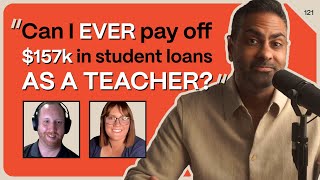
Sam, a 36-year-old math teacher, carries $157,000 in private student loans at rates up to 18% because his grandmother's medical bills consumed tuition money he was supposed to inherit. He and his wife Elena earn $120,000 combined but have a negative net worth of $179,000. Ramit shows them how to cut fixed costs and add side income to move from drowning to breathing room.
Questions this video answers
$157,000
Debt line read as $205,000 (net worth reported as -$179,000)
Approximately $130,000 of it is interest (as stated in transcript)
Multiple rates; highest reported around 12.5%–18%
About $120,000 per year combined
Chapters
My decisions aren't always based in reality. Sometimes they're based in anxiety. Things that discuss finances really, really, really stress me out.
Is that the word you associate with money?
Yeah. Yep.
Stress.
Yep. I shut down, but I was on the phone with my student loan provider today and I got stressed. And Elena can vouch I was sort of just dejected and almost disassociated for the rest night. I usually avoid, avoid, avoid.
It's just the number's so big.
You're just like, ugh. It's pretty insurmountable. So it's. It's very overwhelming. For sure.
It's tripled since it was originally taken out. There's 130,000 of it is just interest alone. He would have to pay a little over $2,000 a month to go on any sort of downward trajectory of that loan.
I hate this.
For a public school teacher, what would.
You do if you had a cloud of debt hanging over you? And what if that debt felt completely unfair? Today I'd like you to meet Elena and Sam. She's a 37 year old hairdresser. He's a 36 year old high school teacher. And they are facing a huge student.
Loan that's left them paralyzed.
As you listen, notice the dynamics around their living situation, their children, but most of all, how this debt came about. You know, money is never just a series of numbers on a page. Money has context. Money has meaning. Money even has politics. That's what we will explore today.
I loved the Netflix show. I felt like it was really relatable. It was about people that I didn't think were represented very often on financial things. I got some help out of it. I felt empowered to, like, talk about our finances and do something. But I also knew that this show is something Sam couldn't watch, and I found that intriguing.
Sam, is that true? You couldn't watch the show?
Yeah. Things that discuss finances really, really, really stress me out. So, I mean, there's been time I had to shut off the movie the Big Short even, because it totally unrelated to me, but it was stressing me out too much watching these stockbrokers take advantage of the subprime housing market.
So what, money is stressful to you? Is that the word you associate with money?
Yeah. Yep.
Stress.
Yep.
And when I say stress, what comes to mind for you?
I shut down. But I was on the phone with my student loan provider today and I got stressed. And Elena can vouch I was sort of just dejected and almost disassociated for the rest of the night up until, like, dinner time, because I was just like, ugh.
That was today?
Yeah, it was today. Yeah. Yeah.
Oh, my gosh.
If he knows he has to call, it's a whole day stress affair. No, he talks about it all day, and he has to work himself up.
Last of the month, I had to talk to him.
How often do you talk to your.
Student loan company lately? Once a week. But we're working on trying to come up with a settlement, so it's been more frequent. It's usually not that frequent. I usually avoid, avoid, avoid.
How do you feel right now talking about money?
Okay. Okay. Yeah.
If it gets uncomfortable today, tell me. Take a break.
I'm okay. Yeah. I'm okay with being uncomfortable.
Okay, that's good to hear. I like that.
Yeah.
All right, wait a second. So you decided to invite both of you onto here where millions of people watch? What?
I was trying to find the text where she told me about it, but it was like, please don't kill me. I'm sorry. Something along those lines, yeah.
Okay, well, I'm glad you're here. Both of you.
Cool. Me, too.
So, Sam, tell me in a sentence or two. When it comes to money in your relationship, what is the primary challenge?
I think we probably overspend a lot.
That's the primary challenge.
Well, aside from we're not paying my student loans right now, so, like, how.
Much are those student loans, Sam?
$157,000.
Sam, that seems like the primary issue.
Yeah, yeah, it is. It is. But when I, you know, I put it on the back burner, and that's not good.
Okay, so. So you have $157,000 of loans. You put it on the back burner, means you avoid talking about it.
Sure.
And then what's the overspending part?
Too much takeout.
Too much takeout.
I think too much takeout in comparison to the $157,000 is pro on the totem pole.
It is quite interesting that when I ask, like, what's the primary challenge? You said we overspent. Think it's kind of interesting.
Yeah, I think there's. There might even be some projection there, I think, because I know that I have this huge, I don't know, camel on my back. What's the phrase? I don't know. There's a phrase.
Rocks in your backpack.
Yeah.
Yeah, I like that one.
Is that the student loan?
Yeah. Okay.
How does this student loan debt affect your relationship?
In most of the ways, I think he had a hard time marrying me because he was Nervous about me taking that on as a partnership. It's informed the amount of children we have. That was really hard for him to have two, and I would have picked three, so.
And how about day to day?
Yeah. Like, conversation wise, I have to choose how to. You know, we have to choose how to have our conversations. I remember having a conversation with him about the rental car. Like, how. How expensive that was. I felt like I was sort of slow rolling him when at the end of the day, I should have felt justified, I guess.
Slow rolling him means what?
Like, trying not to be as direct about how much it was right out of the gate.
Do you do that a lot? Yeah.
I have a hard time being honest with how much things cost because I don't want to get in an argument about it. If I feel like it's needed for the family, then I will do it.
Okay. Does it work?
No. No. I'll end up with, like, you know, tomorrow. Elena has a bigger issue. That vacation we just went on was really hard to visually plan out and mentally plan out because I felt like I had to do it all on my own.
Because if you asked Sam for his input, what would happen?
It would just make him anxious, stress him out, remind them of that loan.
Okay.
I love you.
And, Sam, how about for you? How does the debt affect your relationship?
I would say mostly in my mood. I don't think it affects us a lot. But on the days that it does affect me, it affects me a lot. Just in the sense that today I could. I was not super talkative because I didn't even really. I was sort of, you know, despondent because I had gotten off the phone with them and it didn't go great. It didn't go bad. But I was just so emotionally exhausted from working myself up to that that I wasn't maybe the most available partner for the rest of the day.
Yeah.
It's just the numbers so big.
You're just like. It's pretty insurmountable. So it's very overwhelming, for sure.
Why do you think, Elena, that you're the one who filled out the application and not Sam?
I guess I see a future in that. Like, I'm optimistic.
Okay.
Hopeful.
All right.
I think I'm the opposite. So that probably has something to do with it. I'm pretty pessimistic about it.
One of the things I find so.
Fascinating about people is we will do the same thing every day for 50 years, and we will openly admit it doesn't work, and we'll just keep doing it. Notice I said we because I do this too. We all do it. We avoid things, we pick fights, we talk around issues, we make up stories about why something won't work for us. And again, we openly admit that our approach does not work for us because sometimes the alternative is too scary to contemplate. I found that most of us would rather keep doing what is failing than change our approach and possibly risk failure. This, to me, is one of the most fascinating peculiarities of human behavior that there is.
We'll be right back.
Today's episode is sponsored by Element, a very tasty electrolyte drink mix, and I want to read you a response that I got from one of our readers who started using Element recently. His name D. He wrote, you convinced me to try Element and I'm pleasantly surprised by how much I enjoy it. The magnesium is really helpful for managing headaches and getting quality sleep, but it tastes so much better than I was expecting given the salt factor. This will be my new go to for workout recovery and the blistering Florida summer heat. Well, first off, I love hearing about your experiences with our sponsors on the podcast. I want to pick the very best sponsors for you, so keep your feedback coming and thank you. Element can help prevent and eliminate headaches, muscle cramps, fatigue, sleeplessness and other common symptoms of electrolyte deficiency. If you're sweating or feel dehydrated and you want to replace your electrolytes, consider Element. They have eight great flavors like citrus salt, watermelon salt, raspberry salt, and even lemon habanero. Right now Element is offering eight single serving packets, free with any Element order. This is a great way to try all eight flavors. Get yours@drinkelement.com Ramit Try it totally risk free and if you don't like it, they'll give you your money back. No questions asked. You have nothing to lose. This deal is only available through my link. Let me give it to you again. Drinklmnt.com R A M I T that's drinklmnt.com Ramit.
You know I believe in spending time.
On the things that matter when it.
Comes to your money. I don't want to sit here and track the price of ice cream for the rest of my Life.
That's a $3 question, but I do.
Want to make sure that I'm automatically.
Investing every single month, which is a 30,000 or even $300,000 question.
Now I recently posted that you really do not need to be logging into your accounts every single day and I.
Got a ton of ferocious feedback a Lot of people said, I do that because I want to make sure there's not fraud on my account.
I was like, first of all, the bank is better at that than you. And second, what? There's not fraud happening every single day on your account.
This is a tiny detail compared to setting up a system where you do not need to track it and log in every single day.
A better use of your time.
Make sure your investments are set up automatically.
Make sure your family is protected.
Today's episode is brought to you by Fabric by Gerber Life Fabric was designed by parents for parents to help you get a high quality, surprisingly affordable term life insurance policy in less than 10 minutes. You could go from start to covered in less than 10 minutes with no health exam required. Get your personalized quote in just minutes, then apply when it's convenient for you.
It's all online. It's all on your schedule.
So join the thousands of parents who trust Fabric to protect their family. Apply today in just minutes@meetfabric.com ramit that's meetfabric.com ramit me et fabric.com/ramit R A.
M I T. Policies issued by Western Southern Life Assurance Company not available in certain states.
Prices subject to underwriting and health questions. Now back to the episode.
Well, I want to know about this debt. First of all, how did you get into this debt? What degree was it for? Walk me through it.
All right. So when I was in high school, my basic, like, family and guidance counselors or school counselors were like, you go to whatever the best school you get into, and we'll figure it out after the fact. You will figure it out how to pay for it. So I got into a pretty expensive school.
Which one?
Northeastern. Okay. But my grandmother at the time was also in a financial position where she was like, don't worry about it. Go. It's all set. It'll be taken care of. And then I would say my third year is when my grandmother got Alzheimer's. And so we had a couple options. She could go into, like, a care facility, or she could do hospice at my mom's house. And so we decided to have her live here, but that included building a huge addition to my mom's house. And that's where a lot of my money or not my money, a lot of her money, some of which was allocated for my student loan debt or my student or college costs.
You missed the part where she didn't tell you that.
Oh, I didn't know that, Oliver. Money was basically disappearing. Yeah, that was not something that was made aware to me. So I dropped out of Northeastern at that time when my grandmother moved in with my mom to reassess what I wanted to do. I was a psych major at the time at Northeastern, and I took a few years off and then went to UNH and graduated from there two years later.
How much did you have in the end, in debt?
I don't remember, if I'm being honest.
When did you realize at what age, how large this private loan was?
26.
26 years old. What'd you do when you realized. How did you realize it, and what did you do?
I shut down. I asked my mom what we were going to do or if there was a plan. And basically the answer was, well, when I sell the house, we can pay it off. I felt a little brushed aside, but it sounded like a good option. But the house is still not sold, and we're. We're here at the house.
That's the house you're living in right now?
Yeah. Yeah, yeah.
Okay. So does your mom live there as well?
Yeah.
Ah. And. Okay, now I'm starting to understand.
So we moved in with our investment.
Right.
Why didn't she sell the house?
It's a good question. Well, her spouse died. How long ago? Elena? Four years.
Right before the pandemic, like a few months before.
So this house is her security? Is that.
Yeah, I think toggles back and forth on wanting to keep it and leave it to us when she passes versus selling it and doing something with it. I think she gets overwhelmed.
Just out of curiosity, what would you prefer?
I don't think we know for sure.
I get the challenge. In a dream world, I love the multigenerational living, but without the. Without the thing over our head. I feel like it sort of turned our relationship conditional because we're just keeping, you know, minding our P's and Q's, making sure that that deal is, you know, goes through. But it's not a good relationship I want with a loved one.
It's kind of morbid, too.
Yeah, it gets. Yeah. Yeah. Yep.
I mean, I love a good morbid joke, but I feel like this is beyond any ramit joke, so we can.
All imagine it in our heads. Thank you.
Thank you, Sam, for not making me joke around. So. So can I ask, does your mom have an income? Y. Oh, she works.
Yeah. Yeah.
Oh, okay. Is she avoidant with money?
You can answer. Go ahead.
I think I would say yes, Sam.
Yeah. I mean, just even this, the specific situation, when we talk about it, it's usually like, oh, we'll figure it out.
Yeah.
Who else did you hear that from in your family? Your guidance counselor.
Oh, right. Yeah, yeah.
They told you, we'll figure it out. Anybody else in your family tell you that phrase, we'll figure it out?
Your Grandma Elena? Sometimes.
I do do that.
You do? But no, my grandmother never said that. She was always just like. Well, I guess she never said, we'll figure it out, but she just said, you'll be fine. It'll be fine.
That's the same thing.
Yeah, I suppose.
And, Sam, are you fine?
No. Yeah. And 12 years ago, it was probably about half of what it is now would be my guess. I know you. You asked, and I don't know the exact number.
It's tripled since it was originally taken out. There's $130,000 of it is just interest alone. He would have to pay a little over $2,000 a month to go on any sort of downward trajectory of that loan for a public school teacher.
Yeah. I hate that this is what students go through in America. I hate it. I don't mind that. You know, some people take out debt, Okay? I don't mind that they have to pay their debt back, okay? But to have it increasing at these rates, to not be dischargeable in bankruptcy, to compound faster than you could get in the stock market, Insane. Sam, what's the interest rate on your loan?
It's a few different ones, but the highest one is like 12.5 18.
I can't even get 12% returns in my investment. Wow. Okay. You're a public school teacher, Sam.
Yeah.
What do you teach?
High school? Math. There's a joke there, too, I'm sure.
But let me summarize.
Sam's family and guidance counselor told him to go to the best college he could get into, and they would figure out the money. When he got into an expensive college, his grandmother said she would pay for it. Halfway through, she got sick. She needed expensive care. Those expenses drained his tuition money without his knowledge. Expenses which were then poured into his mom's house, which is where they live now, under a new promise that one day she will sell the house and.
Pay off the loans.
Ask yourself, if you were in this situation, how would you feel? Personally, I would feel betrayed. I would feel hopeless. I would feel like life isn't fair. And I can completely understand why Sam would decide to avoid debt or even money altogether.
Did you make payments on your loan?
For a little while, yeah.
Okay. And then what happened?
I couldn't keep up with it. So, like, say, you know, I was paying it out of my savings. I wasn't paying it out of money that I actually was making. So I just couldn't keep up with it. I think I went on forbearance for, like, a year, which my servicer actually got in trouble with. They let too many people go on forbearance without telling them what the. You know, you're still accruing interest, you're still. All that bad stuff is still happening. And then for a while, I would go off and on reduced interest programs, okay, which were great, but they, you know, they would let me max out at six months. And then I went back to having to pay $1,700 a month or something like that, which was not sustainable for me at all.
And then after the. After this cycle of paying and pausing and paying and pausing, what happened? After several years of this, I got.
Married and I had a family. I realized that that unsustainability was actually unsustainable because I'm thinking about my children's future. You know, when you're in your 20s or mid-20s, whatever. I wasn't necessarily thinking about my future. So then when I met Elena, got married, started a family, then I started thinking about my future and realized that this was no way to make my future better and make my family's future better.
What made you switch from ignoring it and this sort of passive cycle to saying, like, I'm going to call them and try to figure something out?
Elena talked to a lot of people about it. She did the legwork for me, and it sounded like it made sense.
Okay, Elena, what was that like for you?
I was going through a really tough time because of it. Moving in with his mom was, like, all part of that. Albeit, you know, I had my dream. I definitely have my dreams of, like, that intergenerational living. And it is a nice house. But that is why we moved in, was to get the ball rolling on things and then at a really hard time, mentally living around that conditional situation. Every time we'd have an argument, I felt like I had to, you know, suck it up, because it's $150,000. It's your whole life. Like, don't value your mental health. It's. This is more important.
This is a very complex situation. As a reminder, this is not a therapy session, and I'm not a therapist. Fortunately, I checked with Elena and Sam. They are going to a couple's counselor to help them through these complicated family dynamics. So let's zoom in on their finances.
How often does money come up for the two of you?
Like.
Four times a week. One of us will question the other one about a debit purchase occasionally, or we'll talk about a bill coming through. Or like, maybe some of the things that we manage manually, like when to pay. What.
Okay, first of all, do you use a debit card or do you use a credit card?
Debit card, mostly.
You have credit card debt?
Yes. Okay.
Yeah. Who's the one in charge of the bills?
You are.
Okay. Yeah, there's some that you're in charge of, but, yeah, mostly. Mostly I am.
Okay, got it. What else? What was this thing about taking vacation? Do you ever talk about, like, how are we going to pay for this? Or like, this thing's coming up?
Every once in a while we'll have a. This thing's coming up and we have a thousand dollars in our bank in our checking account. So do we want to pull from savings? Can we pull from savings? What are we going to do? But we never hit zero. But once I hit $1000 in my checking account, I go into, like, panic mode. And usually it's the beginning of the month when all of our bills come out and I haven't gotten paid yet or something like that. But that does put me into panic mode.
What do you do when you're in panic mode?
Text Elena. OMG. We have $1,000 in our banking or checking account. Don't spend any money because all of our bills are about to come out.
How do you deal with an upcoming purchase? Like one that maybe you didn't expect? Maybe it's a holiday, Maybe it's braces or whatever it may be, you know? How would you have that conversation?
I'd probably text you first to prepare you on your own before we talk about it in person. And then I'll, like, undersell it or oversell the importance of it. Like, I kind of have to think about what sort of energy I want to come into the room with. Like, more commanding or more emotional?
Like, who's making the decision?
I give Sam. I don't know. I think I give Sam more decision. Like, in chargeness.
Yeah. Because it seems like you've taken on the role of trying to convince him.
Yeah.
Let me put on a presentation for Sam.
I definitely grew up in, like, that patriarchal side that I fall back to.
Yeah.
I don't agree with, but I fall back on a lot.
Okay. And I don't think it's her trying to convince me on a personal level. Right. Like, it's more From a unrealistic financial level, from my perspective, what does that mean? So, like, let's say Elena is like, hey, we need to go on this family vacation, and the rental car is going to cost $2,000. I would immediately say no to that. But that's not because we couldn't get access to $2,000 to pay for a rental car if we absolutely needed to. It's more trying to talk me off of that ledge than it is like, yeah, of course we'll need a rental car, but where are we going to find the money? Crazy. Where it doesn't exist. But it does exist, and we can find it, and we did.
So your instinctive reaction, Sam, is to say no to expenses.
Yes.
Elena, your instinctive reaction is to undersell how much something is really going to cost. So you can, quote, convince Sam to say yes. Am I getting this right?
Yes.
Yeah.
Is this dynamic healthy?
Probably not.
I don't think it is. Can you imagine a different dynamic? How do you think other couples talk about money decisions as a team?
I would hope.
Yeah, but, like, how?
I don't know. They probably just say something like, hey, we need to rent a car for this vacation. Right. What do you think we. What should we value? I don't know.
I'm laughing.
I just want to say that sounded so unrealistic. Like, even halfway through, all of us, every single one of us on this call were like, this is. There's no way.
I have no idea how they would do that.
That's actually quite interesting, don't you think? Alath it, like, yeah, we're speaking totally hypothetically, and you're, you're really struggling to.
Find out how another couple might talk.
About something like this.
Yeah.
Sam, how do you think other couples talk about decisions like this?
I, I, I don't, I don't know. I don't know.
Y' all ever heard a healthy conversation about money?
I, I, maybe I haven't.
Have you ever listened to the I will teach you to be rich podcast?
You know, I haven'.
I feel like there's just a lot of anxious avoidance that we both do. Like, we're just trying to avoid it. So then we're not making positive or healthy decisions or understanding how to make them.
Okay, I'm having a little fun with them, but this is actually serious.
Let me tell you what I'm noticing first. It's actually really important to keep things light, especially as I'm getting to know a couple. So these jokes, these random asides, all of that stuff is absolutely critical. To connecting with my guests. It's not an accident. I had someone on YouTube recently ask Ramit. Have you ever considered releasing a version of the podcast without all the fluff?
I just wrote back no, and they deleted their comment.
People who think that small talk is merely fluff miss the entire point of money. That money is not just a series of spreadsheets, but it's deeply psychological. And you can see how this plays out with Sam and Elena. They admit they've never had a healthy conversation about money. They can't even pretend in the hypothetical that I gave them. Most of us are problem oriented. We know that we have a problem. We love to talk about our problems. But very few of us move to the next step, which is being solution oriented. This is why you had that friend in your 20s who was always stuck in horrible relationships. You'd try to give them advice and they would just start repeating what that guy or that girl did. And can you believe it? They're such an People with problems love to talk about their problems.
In fact, if you rewind just a.
Few seconds I joked about listening to the IWT podcast, but it wasn't really a joke. I wanted to see how they responded. And true to form, Elena went right back into talking about her problems. What this shows you is that until someone is ready for a solution, I can't really help them. Nobody can. Before we get back to the episode, you know I'm always out there buying a bunch of tools and gadgets so I can make my life more convenient. Here's one of them. I'm going to share three of my favorite little gadgets that make my life easier and more convenient this Saturday on the podcast newsletter. You don't have to spend a bunch of money trying all these things out. I'll just tell you the best. Get it@iwt.com podcastnewsletter Again, find out my three favorite tools, each under $25, @iwt.com podcast newsletter.
My decisions aren't always based in reality. Sometimes they're based in anxiety.
You think it's possible for you to feel good about money?
I do.
Tell me.
I think these decisions would be a lot easier. I'm looking at the next four weeks or five weeks. What's coming out? What's happening, how much money is in the checking account? So I think the decision making process would be a lot easier if we were more healthy financially. Because I could say, hey, look, no, we don't have enough for this. Or hey, we definitely do. Or hey, we don't Quite have enough for this. Maybe we can dial it back on some other things to make this car. I'm saying car rental, but make this whatever happen.
Sam, it's interesting that when I asked you what would it look like and feel like if you felt good about money, you gave me a series of like, tactical processes. Now listen, I love a good tactic. I love it. But you know, you. You're actually quite adept at describing how you feel about things. Can you just try to connect on the positive side for a minute? Think about something that you feel really positive about and connect that to money. Even hypothetically, what would it look like and feel like if you felt good about money?
I would feel like such a weight was off my shoulders. I would feel so much less stressed out. It's my main source of stress. I would be able to be more present in my family and my children's lives.
When you feel stressed about money, where do you feel it?
Like in my gut. Yeah.
Like the acid in your stomach?
Yeah. That just starts. Yep. Okay. Yeah.
So that wouldn't be there. And when you feel really good, like when you're watching your four year old and your two year old play and they're giving each other a hug, you know those moments, where do you feel that indescribable?
Everywhere.
Everywhere.
All over my body, my head, my face, my heart. All those places.
I would love for you to be able to feel that way even once with money. When talking to Elena.
Same.
Yeah. Okay.
Yeah.
Well, I believe you can do that. I. I believe that and I believe you can even do that. Even while having this debt that currently sits on your shoulders. I don't think you have to wait 20, whatever years to pay it off and then feel good. That's not my philosophy. I don't want anyone to wait some indeterminate day in the future to finally live their life. I want you to start living a rich life today and a richer life tomorrow. Even if you have a ton of debt. Okay. But that is my goal. For you to have a plan and for you, Sam, to feel good about money.
Okay. Great.
Elena, hearing that anything surprise you when you heard Sam's answers to my questions?
It sounded worse coming from his own lips. That was kind of hard to hear. Makes me sad.
Why does it make you sad?
I don't want him to feel that way. I don't think our life is like that. So for him to feel like that, it is like that for him. In his head.
I'm good at hiding it a lot of the time.
You're good at it means you don't show it to other people.
Right. I'm not saying that's a positive thing.
I'm just. Hey, listen, listen. As a guy, I completely understand that. I get it. And I also get that that might not always be the healthiest thing. I think what we should do is we should look at the numbers, and then. I have many more questions. But until we look at the numbers, it just sounds like a big, scary amount of debt. But I don't understand things like the cash flows and the investments and things like that. So would you mind if we take a look at that?
Not at all.
Yeah.
All right, let's pop it up here. Sam, read me off the word in bold. So assets. And then read me the number next to it.
Assets is $22,000. Okay. Next, investments is $2,000. Savings is also $2,000, and debt is $205,000.
All right.
Total net worth, negative $179,000.
All right. What do you think of that?
Scary. It's overwhelming.
All right, let's go on to the income section this time. Elena, I'd love it if you could read off your the bold and then.
The number on the right side, 10,074. Right.
So combined, YouTube make $120,000 a year. Did you know that? No.
I don't look at gross too frequently, so, yeah, no, I didn't know that.
Elena, does it surprise you to learn that you and Sam make $120,000?
Yeah. I thought we made $80,000. We should be able to afford a life worth living.
Let's take a close look at their numbers to paint an even more detailed picture. Their rent is $450. Daycare, $1,600. Groceries, $650. Clothes, $200, and phones, $260. Do any numbers stand out to you?
Here?
For me, it's the rent. Paying only $450 is absolutely amazing. But then this happened.
But right now, how much are you paying towards debt?
I think it's like five or six hundred dollars. Yeah. So I pay those down when I think I've made a little. Like when I've had busier weeks, I try to pay more.
We're not going to do this anymore.
Yeah, I have no idea how to do that. I have no idea how to talk to Sam about when. How to pay those off when we're holding balances.
Alaina, you never read my book, right?
No, but a client recommended it.
And, Sam, I know you haven't read my book, right Nope.
Okay. All right.
I'm keeping a nearly a 100 record of people who come on this show and never read my book.
All right. Oh, no.
How long until this credit card debt is paid off?
I don't know.
What the hell? How much is on the credit card?
I don't know.
What did you guys do?
I don't know exactly. Eight, probably.
8,000 on the credit card?
Yeah, it's like a couple different cards right now, but yeah.
What'd you spend on to get $8,000 of credit card debt?
Little things here and there, mostly. Grocery store at Target runs a couple big things like the flights for our vacation. And then honestly, it's like, literally a couple. A few thousand dollars just from not knowing how to talk about, like, I. Like, it's one conversation to use the credit card and then another conversation to pay the bill. And the pay the bill conversation is, like, way harder to have for some.
Reason, because you know it's going to make him uncomfortable, and then you want to undersell it, et cetera.
Yeah. And then I feel really crappy that I've added to our debt because I can't figure out how to talk to my husband. It doesn't feel great.
What is the minimum payment, by the way?
I have to ask Elena.
Elena?
Oh, I don't know. We never pay that low.
So my new rule for Elena and Sam is you have to know the details of your debt, because what is the one thing that's dragging you down right now?
That's your debt.
And there's only really two things you have to know about your debt. It's the balance and the interest rate that tells you everything.
I already know.
The interest rate for your credit card is probably like 24.99 to 26%. It's high. Really high. I don't know the balance. What you say it was 6k? 10k? Something like that?
Eight. She said 8k?
Yes.
You want me to just show you how to calculate this right now? Sure. All right, check it out. So we got a balance of 8,000, correct?
Yeah.
6%. And your monthly payment is 600. It's going to take you 17 months to pay it off.
That's pretty fun.
What do you think about that?
That I can see that.
Yeah. 17 months.
That's cool.
Actually, want me to show you something even cooler?
I thought this was going to stress me out.
No, listen, it stressed me out a little.
I have to tell you, there's a.
Massive light at the end of the tunnel. Even when people see, oh, my God, I have to pay this debt off for 28 years. Even then they go, ha. At least I know. So this number here, your fixed cost number, Elena, what number do you see here?
76.
Yeah, that's 76% of your take home pay. Do you know what that number should be?
No.
Okay. Sam, do you know, I thought it.
Was anywhere from like 60 to 70.
50 to 60. Okay, 50 to 60. So at 76, it's well above my recommended range. What do you think that means? That it's 76 instead of say 55.
Daycare's expensive and we need to make more money.
Okay, but what does it mean for you currently on a day to day.
Basis that money's tight?
What it means is because you have so much spend in your fixed costs, that's why you feel so stressed out over target purchases. And it's not, you know, you think, oh, like am I a bad person because I bought these tomatoes and actually has nothing to do with the tomatoes at all. It has to do with the amount of, of infrastructure that you are spending on for fixed costs with your current salaries. What do you think about it?
Sounds like sticky. Like I can either. I don't, I don't know exactly. It just sounds like a little like you're stuck in a rut.
I don't know.
It doesn't feel good.
Okay, that's a fair assessment. Yeah. Sam, what about you?
I was, I was going to say the exact same thing. And if you couldn't describe sticky, I was going to explain how it also made me feel sticky and what that meant. Yeah, no, it makes me feel stuck.
For sure they feel stuck, but they don't really understand why. And this is really common with money. You have to remember that most people do not break all their expenses down into four tidy categories and then calculate a debt payoff plan. Most of the people who come on the show don't even read my book. No wonder they feel this overwhelming sense of dread about their finances. Finances, it's just one big ball of bad. One of the things that the conscious spending plan lets you do is break down your expenses into manageable categories. Use it and you will suddenly be able to see where something is going wrong and how to fix it. You can get the CSP for free from my website. I'll throw in a link in the show notes as well.
We'll be right back. One of my money dials is convenience. And when I think about the convenience options we have today, we live better.
Today than kings and Queens lived 100 or 200 years ago. Think about it. I have an iPhone charger in every room. I work with a personal trainer who helps me show up and plan my workouts. And I have things automatically sent to me like contact lenses, deodorant, things I don't even have to think about.
You don't have to have a personal assistant to make this happen.
You can actually use today's sponsor, DoorDash. With DoorDash, you'll enjoy convenience with delivery within the hour. Grocery and convenience stores are on the app so you can get everything you need. Look, plug in my zip code. I see CVS, Walgreens, Starbucks, Sephora, Petco, pizza places. Everything delivered in one hour.
Shop DoorDash to get everything you need.
Delivered right to your door. And you can use promo code Ramit to get 50% off up to a ten dollar value when you spend 15 or more at convenience, grocery or retail.
Stores on DoorDash, that's 50% off up.
To 10 value when you spend 15 or more. Promo code RAMIT. Don't forget that's code RAMIT. R A M I T for 50% off your next order.
Terms apply. This episode is sponsored by BetterHelp. A few years ago, my business went.
Through a really tough time. Our revenues dropped by a huge amount and nothing we did seemed to change it.
And at that same time, I started having trouble sleeping.
I went to see an ENT doctor because I was waking up every night and I was choking for air. And they looked around, they said, everything looks physiologically fine. Are you under any stress? And I laughed because I was under huge amounts of stress. But to me, I had always been the kind of person who stress didn't really affect. And it was only at that moment.
That I realized, wow, just like everybody.
Else, stress affects me. It just takes a little bit more.
To really affect my body.
Looking back, I wish that I had actually talked to a therapist at the time and been able to share what.
I was going through.
I'm sharing this with you because a lot of us, especially high achievers, don't make that connection. I know I didn't. So if you're thinking of starting therapy, if you're having trouble going to sleep, if there's something on your mind or you just want to talk, give BetterHelp a try. It's entirely online. You can fill out a brief questionnaire, get matched with a licensed therapist, and of course you can switch therapists at any time for no additional charge. So get a break from your thoughts with BetterHelp. Visit betterhelp.com ramit today to get 10%.
Off your first month.
That's BetterHelp. H E L p.com/ramit now back to the episode.
Let's play a little hypothetical game. Is there anything that we can dramatically cut under fixed costs? What would it be?
Close.
Okay, What. What's the number now?
I could cut that in half.
All right.
Easily.
Okay, watch the numbers. So I'm going to cut $100 off your clothes. All right. What just happened?
One down, 1%.
Yeah, it went from 76 to 75. Well, directionally, we're in the right direction. Let's take the win. All right, Round of applause. We're going in the right direction.
All right.
What else you want to do?
I mean, there's nothing else we can do.
Nothing. Really? You gave up after one category?
Are you kidding me?
Are there any other easy wins you can pick up? Let's get a little momentum here.
I think. Groceries.
I mean, we definitely do the. You know, we don't always buy, like, we buy marinated meats and stuff, which tend to.
What? Yeah. You buy marinated meat?
Oh, my gosh. Yes.
They're so expensive.
Are you guys kidding me right now?
Let me get off.
Hold on. Let me just. You know, I'm not really a stickler for groceries. You know, I'm not like, Mr. Grocery Man. I had a national news organization, and they were like, ramit, we want to put you on air this, like, big feature. And I was like, oh, okay, let's get on the phone.
And then they were like, we want.
You to give us tips on how to save at the grocery store. I was like, what the hell do I know about saving money at the grocery store? Well, I know one thing. My immigrant mom and dad never, ever, ever in our life bought us marinated meats. All right, I'm just. If you're telling me that, then you're telling me you have a bunch of other expenses that could be cut from the grocery store fair.
Yeah.
So we went from 6:52 to, like, 426. Does that work?
Yeah.
Yeah.
Wow.
Okay, great, great, great. Look at the number at the top. What does that number say?
Getting closer.
71%. Nice job. Take the win. All right, what else you got?
So Elena's not going to like this one. In theory, we could cut $400 from daycare.
How?
One of our kids goes an extra day. So Elena's still home watching the one kid. So it is for her mental health. So she gets one day with only one child.
Okay, here's how I want you to think about this. You've clearly discussed the mental health part of it, and I think that's awesome. You absolutely should. You cannot only make decisions based on some random number. But I guarantee the two of you have never looked at the effect of making this change on your money. So would you be willing to entertain just me playing with the numbers for a second? And that way you understand both the mental health portion and the numerical part. Can we look at that?
Yeah. All right.
This is how we make big decisions.
Okay.
We write down how we feel about it. Awesome. And we also want to look at the numerical ramifications. All right. Daycare, instead of 1636, you're saying take away 400 bucks a month. Is that correct?
Yeah.
All right. Wow. What do you just see? What just changed? Oh, it went to 65, 65%. We're within striking distance. I'm not asking you to make a commitment to this right now. Right. I just want you to think about.
It, and neither am I. Just to be clear. Like, I'm not going to be like Ramit said. Sorry.
So now you see why I am in such a rush to get you.
To make big changes.
Like, with a machete, even a hundred or $200 a month can often make a massive change. So you see, you know, I think it's really important to acknowledge the mental health aspect, but I also want to show you, like, gosh, 2, 3, 400 bucks a month towards debt would be game changing. What do you think?
So I have two thoughts.
All right.
Love it. Tell me.
We could probably change the cell phone bill a little bit. I agree, but that was probably about a hundred. We have his mom on the plan. You know, I imagine there's probably about $100 we could finagle through.
Amazing.
Also, talk to her about what we give her in rent and utilities.
You could give her less if.
I mean, if. If she's open to it. I initially think that sounds terrifying. Yeah.
Here, let me just tell you how I would say it. I love what you just said. That's just great. I'm gonna give you a couple tools you can use. You could say, look, you know that we appreciate living here. We know that you're charging us less rent that we would pay somewhere else. That means so much to us. It allows us to raise our family here and to have a stable house. That means so much to us. We have been taking our finances really seriously, and we've made it a mission. We want to pay off our debt because we want to have a healthier relationship with money. And we want to show our kids how to have a healthy relationship with money. We have a question to ask you. If you say no, we totally understand. We currently pay $450 a month. If we were able to pay $200 a month in rent, that would allow us to shave off X months from our credit card debt and be credit card debt free by blank month of blank year. Would you be open to letting us change the rent that we pay from 450 to 200amonth?
Oh, and then you'll go back to 450 when we're done. Or maybe I'll sell the house.
Yeah, you're like. And then maybe you'll sell the house and give us a fat stack of cash like was promised to us 18 years ago. No, don't say that. That's for another day.
Elena definitely shouldn't say that. I might be able to get away with it.
I think she'd be open to it. Sam.
My thought isn't she'll immediately say no. So that sounds better than anything promising.
Listen, great work even thinking about this. And when you have this conversation, practice it. Record it. Because all that stuff I said at the beginning, that's the kind of stuff that you want to connect. You know that stuff about your kids. Drop that in there.
Yeah.
Get those kids in. Put a little cute little picture of your kids. Have them dress up and do a little dance or something.
Whatever they do, do that.
Okay. It's important. This is serious stuff. Right? 200amonth or 250amonth is a huge deal for you right now. And you're also respectful enough to say, look, if you decide not to do this, we totally understand. You're giving her an out. She's already giving you, you know, a very nice deal.
So.
No. That's how you go.
All right.
Great find, Elena. Great suggestion. Should we assume that it's going to happen? Should we model it?
Let's model it.
All right. Love it. Damn. Are we at 59%?
Yeah.
That's a round of applause. Great job. Those suggestions came from you. That was lovely. Whoa. Remember, when you. When you speak to your mom, it's all about how you're getting financially healthy. It's not. I want you to pay for your cell phone and you to take less rent. It's not that. It's about how you're building a healthy financial future for your family. Okay, great. Yeah.
That got me excited. And I felt like we had just discussed at dinner whether we should add the other kid to three days a week and pay even more daycare, but then have Tuesday where I can start working more.
Okay.
And I feel like that is that. Like, I know how to have that conversation now because I know what I'm weighing. So if I can add a day at work, probably looking at $300 more a week.
Okay, so 1200amonth. Okay, great. That's amazing. Okay, watch the number change. 4567. Oh, my God. I'm excited. Are you guys excited? Yeah, I'm excited. Okay, watch this number. It currently says 59%. Okay. We're increasing your income. One, two. Oh, I messed it up. Hold on. Oh, God. 4,000, 567. All right, 45, 67. One, two, three. Whoa.
Whoa.
Holy. Do you see this?
Daycare goes up by 400, though.
Okay, let's fix it. Let's fix it. 818. Adjust it over here. I'm raising your daycare. Look at that number.
Yeah, it's great, you guys.
This is amazing.
Cool.
Okay, high fives all around.
That was like. I seriously did not expect to get to that.
I didn't. I definitely didn't.
This is a very, very healthy number. 55% right down the middle. Okay, first of all, how do you both feel just looking at that number?
Great.
Yeah.
This may be the first time Elena and Sam have felt good about money in years.
Years.
Now, of course, this isn't the whole story. There are a lot of changes to be made, even down to the level of meat that they buy at the grocery store. But what I'm showing them here is hope. And this is real hope backed by real numbers. This kind of positive vision is something that tens of millions of Americans lack when it comes to money. We've been taught to save, to hoard, to worry about money, never to actually enjoy it. If you notice, with Sam and Elena, they have debt. They have a lot of debt, and they can still take control of their money. This is the power of feeling good about your finances. You have to remember, we're not robots. If we feel bad about something, we're not going to want to keep coming back and keep improving. It's going to be really hard to want to make changes. But on the other hand, if we feel good, if we feel even a small sense of control, you will find people coming back, wanting to make changes, sticking with it, and being more creative and resourceful than you ever thought possible.
Now, I want to make sure that I'm honest about these numbers, because there's a Bit of, like, shrouding that we've done, and I want to make sure you know it. Okay, so first off, the reason that you. You're able to do 55% is that you're basically paying nothing in rent.
Yeah.
If you were on the open market, your numbers, it would not work. Yeah. You'd be way above that. So let's just acknowledge that. Obviously, if you can pay 2, 3, 400 bucks a month in rent, you take it. All right, fine.
I think we're very grateful.
The next thing, which is like, the thing is row 24, the student loan payment, which you are currently not paying. Now, once that kicks in, which is going to kick in fairly soon, that becomes an issue. Correct.
Yep. All right.
So, Sam, what's the latest with this company? What's going to happen with your conversations?
So, as of today, they offered me a 60% settlement.
That's good to know. Hey, 60%. So just so everybody knows, the reason that they're doing that is they want to recover what they can. And they know that you are so burdened that right now they're like, look, we got to take what we can get. You know, even though they could milk it for the next 50 years.
Yeah.
If they can get 60% now, that works for them.
Yep. All right. We're also thinking about making a counter offer. We've been going back and forth, so I've been considering.
We're hoping to get 75.
Okay. All right, fine. It's worth you negotiating. That's great.
Yeah.
It's just a business to them. That's it. But one way or another, payments are going to start at some point, correct?
Yeah.
Yeah.
All right, so while I think it's awesome that you're going to pay off your credit card debt in approximately a year, once that's paid off, that's $600 a month. That's going to suddenly free up for the two of you to redirect towards student loans, which will be fantastic. But those student loans are still going to be 1400 or so dollars. Maybe a little less, depending on what you settle on, but still a lot of money, right?
Yeah.
So how do you want to deal with that?
Sam's consulting work.
How much are you making from that, Sam?
Well, so I just started it. It's like a little side hustle.
Love it.
So I am making a hundred dollars an hour right now, my man.
And they're loving his work.
I have a question. So I hope, first of all, I think it's amazing you're doing this that's awesome. That's extra money. Math teachers are in demand. People hire math teachers as tutors, like, all the time, and they pay very well. Have you ever considered it?
I've tutored.
How much do you charge?
A hundred dollars an hour.
Could you do it again?
Yeah.
Okay. Can you just do it? I don't care how you make $100 an hour. Can you just do it?
Yeah. Yeah.
Okay. Thank you. Thank you. I'm going to show you why. I don't know. What should I put here for the net increase?
$400 a week.
Okay. So 1600amonth. Great. And that net that out to what, like 1200?
Yes. All right.
8771. Watch the numbers, please. We're at 48%. That's amazing.
I think we have a hard time believing it.
I'm not changing. I'm not doing any magic. It's just math. It's literally your numbers.
Feels like.
It's not that we don't believe you. It's that we've been so financially just so down on ourselves that it's like. Just seeing it is, like, shocking.
Basically, the entire world you've been living in is about feeling horrible with money.
Yeah.
Every time you talk about money, it's bad. And I'm like, yeah, okay, you have a lot of debt. That's messed up. But we can also do a lot of stuff to go on offense with that debt. It's kind of different because for the first time, you're going to have to find a way to start feeling hopeful about money and maybe eventually even feel good about money.
That'd be nice.
I know you can get there. I know. I see it. Look at this. I'm just going to show you one more time. The numbers don't lie. These are the numbers you gave me. You told me you can negotiate your rent down some amount. Hopefully 200 bucks to 200 bucks. Okay, great. You told me that you're going to pay a little bit more towards your debt payments. Shave that off in approximately a year. Fantastic. And after that, that's $600 a month in cash flow. That can go right towards debt, savings, et cetera. You're tightening up your groceries, your clothes. You're going to get a little tighter on your phone, and then you're going to earn more. Both of you are going to earn more. Now, here's the thing. What are you both going to get.
Our lives back? I guess.
Be specific.
We can live and plan for now.
Okay. But each of you go back and forth Ask each other. I don't think you actually know the answer to this question.
Oh, okay.
What do we get if we make all these changes which actually are going to require you to think differently, talk differently, behave differently about money?
What do we get?
This should be a primary question you're asking. Ask each other.
I don't even know what to ask.
What do we get?
What do we get?
Freedom.
Freedom. Accuracy in our relationships with our family members. I want to be able to have a good relationship with your mom that isn't based on that hurdle. I'm looking forward to not having to think about it. When we think about family and emotions.
I 100% agree.
Give me the positive word. A sense of. When I think about family and I think about our new vision for money, I feel a sense of hope for the future. Home and. What was that, Elena?
I said pride.
Pride. I love this. Now we're getting somewhere. We feel pride. We feel hopeful. What else do we get?
We get.
Get.
Things. I'm gonna put things on the walls. I'm gonna have a house that was worth decorating.
Wow. We get to surround ourselves with a little beauty. Yeah, I love that. Very inspiring. Something. Every day you wake up and you look at, you say, that's beautiful. I love that. Okay, Sam, I want to hear from you. What do we get?
I get to enjoy time with my kids without having to think about all the negative things in my brain.
Love it. Love it. Get to be present. You said that earlier. Four year olds are smart. Six year olds are even smarter. They really pick up on dynamics. If you were to continue the way that you had been going by the time your oldest got a little older, what do you think they would have intuited about the way that the two of you handle money? Yeah.
They hate money. They don't talk about money.
Yes. Mommy and daddy hate money. Yes. They're always tiptoeing around. Boy learns that daddy doesn't talk about money. And mommy is the one who has to bring up money when there's something to be discussed. And then daddy usually says no. And what do you think happens in his future relationships?
The exact same thing.
Yes. And then as for your younger, the girl, what does she learn?
She learns that it's her job to ask men for money.
Oh, wow.
She has to validate herself even being in that room. What are you thinking, Elena?
A lot like I'm just doing the opposite of everything I stand for and want for my daughter. I want her to do whatever she wants herself and not. Not feel like she needs to ask a man for money.
Yes. And when she thinks about money, when she gets a little older, she starts earning a little bit of money. How do you want her to feel about money?
Empowered.
Yeah.
Informed?
Yes. Keep going.
Like a means to her life. Like what she wants in her life. Like it's a tool.
Love it. How about for your son?
Same. Yeah. I want him to feel empowered and not feel like there's that.
It means angry that you have to tiptoe around.
Yeah. That he can be chatty about it.
Yeah. It's actually fun. Can I point something out? That is what you get.
Kids model their parents relationships with money. Whether you give them an allowance is irrelevant. Whether you send them to this camp or buy them that phone, irrelevant. They watch how mommy and daddy talk about money for the first 18 years of their lives. Are they stressed? Do they say, we can't afford that? Do they get in fights behind closed doors? Or do they say, don't tell daddy we bought that or don't tell mommy we bought that? By building a healthy relationship with money, you naturally teach your kids that you don't even have to create artificial constructs like an allowance. Although if you want to, you can. You simply live as you would. Talking about money regularly, discussing trade offs in front of the children, and even asking them to get involved as part of the family. For Sam and Alaina, I'm excited that they are feeling good about money for the first time in a long time. Let's listen to their follow ups. Hi, Ramit.
Hey, Ramit.
So your questions were. What surprised you about our conversation? What surprised you?
The fact that. Oh, I actually we can increase our income a lot more. I think we've been scared of.









