How I’d Invest $1K, $10K, and $1M in 2026
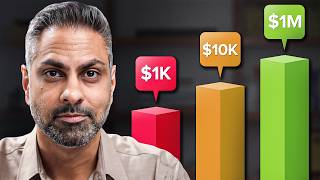
Ramit Sethi breaks down investing at three levels: with $1K, split $500 into emergency savings and $500 into a Roth IRA with automatic $50/month contributions. At $10K, prioritize your employer 401(k) match and max out your Roth. At $1M, build a core index fund portfolio, allocate 5% to alternative investments, and use tax strategies like backdoor Roth and tax-loss harvesting.
Chapters
Imagine this. You finally save up $10,000, and instead of growing it, it just sits there. Maybe you leave it in cash while inflation quietly chips away at it. Or you take a friend's hot stock tip and watch your money bounce around for years with really nothing to show for it. This happens all the time. Not because people are stupid, but because no one ever teaches us how to actually invest the right way at each stage. So. So today I'll show you exactly how I would invest $1,000, $10,000, and even a million dollars. And more importantly, how to avoid the mistakes that quietly cost people tens of thousands of dollars over time. Something you need to know. The strategy might change as you grow. I know because I've invested over a million dollars in a single year. You want to know where it went? Let me show you. This isn't a theory. This is literally what I've done. And what thousands of my readers have done as well. So wherever you are, a recent grad with 1000 dol entrepreneur trying to figure out what to do with a million bucks, you're going to leave today with a plan. Let's get started. Hey, $1,000 is a lot of money. I started investing with less than that and it completely changed my life. You can start with a thousand dollars and over time turn it into a lot more. The point is not where you start, it's that you actually start. So here's what I would do if I were beginning again today. Number one, emergency buffer. Take 500 bucks, park it in a high yield savings account and that is an emergency buffer. And that is helpful when your car breaks down or when you get hit by a surprise bill. That little buffer can keep you from going into credit card debt at 27.99% interest. Number two, Roth IRA or 401K. With the other 500 bucks, I would open up an investment account. I would pick a low cost index fund that tracks the S&P 500 or my favorite, a target date fund fund. To choose the right target date fund, you just pick the year that you are going to retire. So if you plan to retire in say 2070, you look for the target date fund called Vanguard 2070, Fidelity 2070. Number three, Automate. Set up an automatic transfer. Even if it is just $50 a month, this habit is worth more than almost anything you will ever do. When your money grows automatically, you can stop worrying about every market headline and just live your life. And let me just tell all you something for a second. Stop hunting for the magic stock. Your best buddy who barely got a GED telling you what you should buy today because it's a hot stock tip. Penny stocks, crypto. You don't need the perfect stock. You need a system that's going to keep working for 30 years automatically while you are living your rich life. So at the 1k level, don't obsess over optimization. Focus on getting started. Can I just ask you, how long have you been watching videos and thinking about improving your money situation? Some people are going to watch this video and make an immediate plan to change their finances right now. If that's you, I love it. But if you have been watching videos and listening to podcasts and even reading books, but you haven't actually taken action, then I want you to join my money coaching program. You're going to get access to my new AI tool. You could dump everything you've got right in that tool in it's going to create an instant plan for you. You're going to get access to a community. I'm going to be in there answering questions directly. And you can get unstuck right now using my money coaching program. Click the link below. Now let's move on to the next tier. Now, that's real money. If you've saved up $10,000, you are already ahead of a lot of people. You've proven that you can save, you've built a system and now you are ready to make it work for you. In my opinion, this is where you go from playing defense to playing offense. Here's what I would do. Number one, max out your 401k match. If you have a 401k through work and your company offers a match, take it. Contribute enough to get the full employer match, because that is free money. Free. If you don't do this, you're basically saying, no, thank you, I don't like free money. Instead, I'm going to argue over the price of raisin bread instead of actually taking thousands of dollars of free money. What? I'm not even getting into it. I'm already mad right now just recording this video because some of you don't take your 401k match. So to keep it simple, if you make 100k and your company matches up to 3%, contribute 3%, that's $3,000 automatically doubled to $6,000. Let's move on. Number two, max out your Roth IRA. Here is the current maximum you can contribute every year. Put as much of your $10,000 into it as you can and and invest it in something like a target date fund. Or a low cost index fund. Automate it, set it, forget it, and done. Number three, redirect. Once those accounts are running and being funded, don't stop at 10k. You can use your conscious spending plan to automatically redirect any extra money into investments. That is how you go from occasional saving to constant wealth building. You know, a lot of people think that they can only invest up to the max in their 401k and Roth IRA guys. That's not true. Do you know that wealthy people, they can invest $100,000 a month, a million dollars a month. There's literally no limit to how much you can invest. So what does that mean for you if you're not sitting on a million extra dollars a month? It means that you create rules for your money. One of my favorite rules is what do I do with unexpected money? That could be a tax refund, it could be a side income that I made, whatever. And a rule might be something like 75% of that money goes to investments. These rules are part of your system. Do you see that? It is less about picking some random stock and more about building a powerful system. We are operating at the strategy level. We are not concerned with what's on TV today. So at this stage, your money isn't just growing. You're learning to build that systematic approach. You're managing multiple accounts, you're setting up automation and you are ignoring the noise. This is not complicated, it's actually boring. And boring is what makes you rich. If you can master this at 10k, you are laying the groundwork for 100k, 500k and beyond. That is exactly what I did. Now, everything we just covered at the $10,000 level is foundational. You've built real momentum and you are managing multiple accounts. You're starting to see how your money can actually work for you. But once you start crossing, crossing, 50k, 100k and more, those questions are going to change. You're no longer going to ask, how do I get started? You're going to ask different questions, like am I on track for retirement? Can I afford to buy a house or even take a sabbatical? How do I balance investing with my family, with lifestyle? What is the smartest next move for my specific situation? This is where having the right guidance can make a big difference. And it's why I want to tell you about Facet. Facet offers dynamic financial planning that adapts as your life and money evolve. You get monthly check ins, accountability and a dedicated CFP professional who can help you make confident decisions. About investing, taxes, retirement and big life goals. All Facet planners are fiduciaries supported by specialists who help align your financial life with what you want, not just with what some advisor wants to sell you. And and unlike traditional advisors who charge a percentage of your assets, that's a big no no that can quietly cost you tens or hundreds of thousands of dollars over your lifetime. Facet charges an affordable flat membership fee for financial planning. I've worked with Facet before to help many couples on my podcast understand exact scenarios for their own goals, whether that's retiring early or paying for their kids college or just feeling more in control of their money. So if you've ever wanted a team that you trust to help you make these big financial decisions, check them out and see if financial planning is a fit for you. Head to facet.com ramit or click the link in the description below. That's facet.com ramit all right, let's talk about the $1 million range. Now I know a lot of people are not at this range yet, but I want you to listen closely because I think it's important to shine a light on how wealthy people treat their money. I always wanted to know since I was young, how do wealthy people afford to sit in first class? How do they afford to stay at that hotel or eat at that restaurant? It didn't make me mad. It didn't make me resentful. I wanted to know how they did it because I wanted to learn myself. That's why I'm going to share how to invest these larger dollar amounts regardless of how much you have in your account today. Now, I've had years where I invested millions of dollars and here's where it went. First, my core portfolio. Personally, the vast majority of my money goes into the same boring index funds that every single person has access to. The only major difference? Bigger numbers. So if you think that wealthy people have access to these secret investments that get them 10 times the returns, you're wrong. Yes, wealthy people have access to different investments, but most of those investments are dog. They're larded up with fees. They they're horribly illiquid. They're terrible. The best investments that wealthy people have access to are almost always simple low cost index funds. Number two alternative investments with a small slice, maybe 5%. I would use it for what I call fun money. And this would be something I would invest. Typically angel investing, somebody startup that I happen to know and have access to. I would put some money in there. Here's the key I didn't expect a return. And if you do these alternative investments like your friends freaking Greenpoint bar, you're probably not going to get a return either. In fact, I lost money on most of my angel investments and I've basically said I'm not doing that anymore. I'd rather just put the S&P 500. It's a way more profitable and way more boring, which I love. Number three Tax Optimization. Now, when you are at a higher level with a larger portfolio, you do want to consider certain tax optimization strategies. You you've probably heard of something called tax loss harvesting maybe. I personally find it a little bit overblown. There's backdoor Roth, there's estate planning. This is stuff that with a very large portfolio can save you quite a bit. In fact, there are often some advantages to simply choosing different types of index funds rather than a target date fund. Because wealthy people are primarily investing in a taxable account, some of this can seem a little bit confusing because most people do not need to be thinking about these minor tax optimizations. In these cases, it's often good to work with an accountant and occasionally a financial planner, of course, one who charges an hourly or flat rate, never a percentage of your assets. Next, philanthropy. Once you are at a million dollars, money stops being just about you. In fact, at the highest level of a rich life, it is always about other people. You've already won the game of personal finance. So now the question is, who can I surprise? Who can I delight? Who can I? Who can I bring with me on this amazing journey of living a rich life? Now it's about how you can use that money to shape the world around you. It can be donating. It can be funding projects that you care about. It can be thinking about legacy. And that's the part that a lot of people miss. Giving is a skill, just like earning and investing. The more intentional you are, the bigger your impact. Maybe that means starting a scholarship for kids from your hometown. Maybe it means quietly covering a friend's medical bills, or buying art from a local artist, or funding a clean water project that you believe in. At this level, the question is not how much can I make? You've already done that. You check the box and won the game. The question is, what do I want my money to say for the people around me? By the way, if you've been watching this whole time and you have not yet subscribed, you basically just took my million dollar playbook for free and I want to give you more. So hit subscribe so I can make sure that I send you even more material on what to do at every level of personal finance. Now, here's what you'll notice about each investment level. The mindset shifts. At $1,000, you're getting started. You're starting simple. You're building the habit. It's like going to the gym for the first 10, 20 times. You just need to get there and doing that is a success. At $10,000, you're cementing the habits. You're learning the difference between strength training and cardio and doing all this stuff and you're actually adapting it to your needs. At this level, you're looking to diversify and add automate even more. At a million dollars, you know what you're doing. At a million dollars, you are starting to manage risk. You are starting to think about legacy and who you can help. Now your goals will change. That's okay. Different stages require different strategies to some extent. You do not need to optimize every single dollar. You do not need to be tracking the price of pickles. Hey everybody. Corn nuts went up 6%. It's so outrageous. What you need to do is level up and build a system. Too many of you are playing small for your entire lives when it comes to money. Can I tell you one of the best parts about having a lot of money? It means that I don't need to look at the prices when I go to a restaurant. Immensely freeing. And that happened through practice. That means that I systematically elevated myself from looking at the price of chicken to moving up and saying, what is my investment portfolio? That's what I want for you. Whether it's restaurants or travel or kids activities. I want a system that works when you're asleep, when you're on vacation, when you're eating at a restaurant, living your rich life. So let me know in the comments. Which tier are you in right now? And what is your next financial move? And then watch this video to go deeper on how to invest for any income level.









