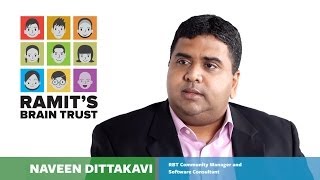
This is a transcript of a Ramit Sethi interview with Naveen Dittakavi about building recurring revenue and using strategic questioning to get actionable advice. Naveen describes preparing detailed, non-ambiguous questions for an RBT meetup to elicit specific systems and a ‘‘blessing’’ to prioritize recurring revenue, and Ramit emphasizes deliberate preparation and tradeoffs (e.g., taking one fewer client to free time). The conversation also highlights mentorship, community (RBT), and how giving back reinforces growth.
Questions this video answers
RBT Community manager
A software development company
He built recurring revenue so he can work on his own projects (recurring revenue became a significant part of his business).
"Form a question that cannot be answered with a question."
"Maybe you take one less client per month next year"
Chapters
Hi, I'm Naveen Didakavi. I'm the RBT Community manager and I run a software development company. And I can now work on my own projects because I build recurring revenue.
Welcome. Thanks for coming.
Thank you for having me.
Ramit, this is an unusual interview because I think it was just a few days ago I said, can you fly out from Atlanta to our San Francisco studio? I've been wanting to interview you for a long time, but it's unusual. I've never interviewed an RBT student before, so I think today's gonna be a lot of fun.
I'm looking forward to it.
Let's talk about the recurring revenue because I think a lot of people are fascinated with this. You had clients, you joined rbt. You came to meet me in Los Angeles when I did an early RBT meetup. Talk to everyone about that experience. What happened at the RBT meetup where you brought all these note cards and your beautiful.
Well, yeah, exactly, my beautiful. Thank you. So what essentially I did is I prepared for that conversation based on a strategic advice I wanted to receive from you. Also based on expected conversation flow.
Okay, wait, wait. Stop right there. That's already a ton of stuff. So most people, if they're gonna meet someone, which most people don't, but if they're gonna go meet someone they admire or they wanna learn from, they just go and say, I'm gonna soak up what he has to teach me. I'm just gonna listen a lot. But you took a very different approach. Right?
Can you talk to us about that? Yeah. So I knew that I had these questions that I wanted to ask, but I also knew that these were not. These questions were not specific enough.
Example.
The example would be like, how did you decide to start your second product? That's not what I really wanted to know.
What would I say if you asked me something like that? What's the expected response?
The expected answer would be extremely vague. You would say that, oh, you had some things in place, and da, da, da, da, da. I wanted to know, what did you have in place? And I disqualified certain answers that I already knew. So I said, besides having a team or besides this or that, what did you have in place in order for you to do a second flagship project after earn 1k?
So what is the framework you're using there? Because you're essentially playing out the conversation in your head. What is that framework you're using?
The framework is this. And I think it was Kirsten from Atlanta who taught me it. And she said that if you Form a question that cannot be answered with a question. That question is a good question because basically it is specific enough, it provides context, and all you need to do is answer the question. You don't say, what do you mean by that? Right.
I like that. I use a similar related framework, which is I will write down the questions I want to have answered when I'm going to meet someone and then I pretend that I'm them and I answer them. And if their answers are really vague or pointless to me, then it's a bad question. If the person's going to answer it in a way that is novel or surprising or useful to me, then I keep it on. In other words, the question has to earn its way onto the page. Whereas most people, they come in and say, what inspired you to do this? That, to me is a low competence trigger right there. It shows you haven't really thought of a great question. And what am I going to answer? I'm going to give you platitudes. I'm going to say, you know, I love to help people and I just want to have the influence of so many people. And then you walk away. It's like you had a cookie. You feel great for five seconds, oh, Ramit is such a nice guy. And. And then you realize I didn't learn anything from that. Right. So you came in, you had a list of questions. You'd already run through it in your mind, which I really admired. And what happened at that meeting?
That meeting I received very specific, actionable feedback from you on what systems you had put into place. And I basically quickly sat down after that meeting and wrote it all down and got the basic framework down. And then I started to add color to it and actually created this massive document on RBT talking about our meeting. But more importantly, I got the questions answered. But the other thing that I did during this meeting is I got a blessing from you. I came to you with a specific question that I already knew the answer to. Ramit, I really want to make recurring revenue a big part of my business. It's currently a really small part of my business. And I know that if I do this, then someday I can work on my own stuff. And you basically gave me the answer that was a platitude, but I needed to hear it from someone I respected.
What did I say?
You basically said, naveen, you had to choose to do this. And you gave me an example saying, maybe you take one less client per month next year and you make time to do this. And this kind of really Goes back to what your parents tell you. A year from now you're going to be a year older. What are you going to do? That really clicked at that point, because a year from then I knew I was going to be engaged. I knew that I was going to be getting ready for this wedding. And I knew that I didn't want to be in the same place that I was at that point, even though I was successful. And I wanted to change what, how my financial makeup was.
This right here is the crux of it. This is really insight into the mind of a top performer. You're already doing well, you can coast on what you're doing, but you're taking the time. You're flying across the country for brunch. You're coming with 30 hours of preparation to say, look, a year from now, I want to be in a different place and I want to seize the opportunity. I want to make it happen myself instead of letting something rain down from the sky by chance.
You know, it's very interesting. I have very successful friends. I mean, I'm staying with my buddy here who's at UCSF for radiology, one of the top programs in the country, probably the top program in the country. And these people are very successful. They're physicians, they're lawyers, they're engineers, management consultants. But the issue is that they're not kind of like me. I'm the only entrepreneur in this group of friends that I have. I can't really go anywhere with, with my questions, my concerns, my anxieties. So when I do talk to other people and I'm able to relate to them in this context, I'm able to get my questions heard, provide feedback to people in a like minded way, you know, understand how to manage my own energy levels and motivation and get more things done. So I think that the more you give, the better it is for you. So that means mentorship, that means giving back on rbt, that means volunteering anywhere else. So, so that's, it's, it's very interesting on how it all actually at the end of the day benefits you.