How to build a powerful network even if you hate networking -- with Ramit Sethi and Jayson Gaignard
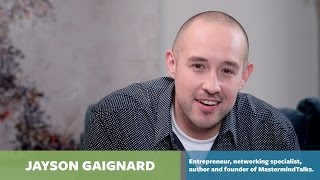
Jayson Gaignard, founder of Mastermind Talks, started invite-only dinners while $84,000 in debt and built a high-value network by investing in relationships, keeping his word, and asking for advice instead of favors. The core principle: make yourself interesting and approach people with respect.
Chapters
Hey everybody, Ramit Sethi here. Very excited to talk to my friend Jason Gaignard. He's the founder of Mastermind Talks. He has an annual event where every year he brings some of the most interesting entrepreneurs to speak about business life and relationships. And the way he created it is one of the most interesting stories you're ever going to hear.
My name is Jason Gaignard. I help facilitate connections amongst amazing people. And I do that through an annual invite only event for entrepreneurs called Mastermind Talks. Given where I was in my personal life, I was, I was seriously considering bankruptcy. And I thought to myself, you know, they could take my car, they could take whatever measly assets I had left, but they couldn't take my relationships.
Okay, amazing. So you start these Mastermind dinners and you're making no money. In fact, I assume you're spending money on these dinners still in 330 plus thousand dollars of debt. Okay, we're gonna talk about how to do these dinner events, by the way, in a minute. But what starts to happen after that?
So I continued on with these dinners. And then one morning I woke up and saw that Tim, who's a mutual friend of ours, posted to his blog that he was doing this, I guess, land rush campaign for his book, Four Hour Chef. As you may remember, his book was banned from all retail distribution like two, three weeks prior. And Tim is one of the smartest book marketers I know. So he created these bundles where if you bought five books, you get these additional things. If you bought 50 books, maybe he'd do a webinar. He had this Hail Mary package that he thought nobody would buy that if you bought 4,000 books. He'd do two speaking engagements. And at the time I thought of actually a friend of mine who's in the event space, like, this is a great opportunity for him. So I sent him an email that morning and the minute I click send, I said, you know what? This is a great opportunity for anybody.
Because 4,000 books equals how much money?
$84,000 U.S. okay. Which is like $120,000 Canadian right now.
So what'd you do?
So I ended up, I sent the email to my friend, but I'm like, you know what, this is a great opportunity. So I, I emailed Tim directly and Tim was still awake. It was like four in the morning Eastern time. So he goes to bed late and he's like, all right, we'll talk in the morning. So I had to. The only pitfall to that $84,000 was I had to raise that money in my last business I built or all my businesses I built purely on credit cards and was always kind of ingrained as a child to never ask for handouts or any ask for favors or anything like that. So I had to overcome that limiting belief in a very short period of time. And reached out to three friends that morning. The first one said he'd love to talk about it, want to see the numbers. And I'm like, unfortunately I'm a quick start kind of guy. I don't have time to talk about numbers, I need the money. The second person wanted to start a business together and I'm like, that's totally cool, we can talk about it. And the third person I reached out to just said come pick up a check at my office tomorrow morning. Did like nothing on paper, didn't need to know the details of the business. So about three months later I asked him, you know, why he decided to lend me the money. Because it was on paper, one of the worst investments you could possibly make. And he said, I wasn't investing in the business, I was investing in you. And at that point, two things became very clear. One is you never know the value of your network until you really need it. And the second thing is when you hit rock bottom in life, you'll be left with two things. One is your word and the integrity of your word. And the second thing is your network. So never tarnish your word and always invest in your network.
Your relationships are the thing that take you from transactional to something completely, completely different. When you have great relationships, you can make a phone call and get $120,000 check. You can invite people to your birthday party and they come to me. That's like the money, it's such a different game. Sure. You know, and that's what you've shown. Another quote from your book, I want to ask you, this one really hit home for me. You said, would you be friends with you? What does this mean?
Well, I kind of, I got that from the dating space, which is, you know, if you want to pick up a 10 or something like that. Are you yourself a 10 on some level?
Very provocative concept. I think it makes perfect sense.
Sure, perfect.
How are you going to expect to get a high caliber person, man or woman if you're not the same level?
Exactly.
So instead people complain. Oh my. And they're always doing on their keyboard, oh my God, this world is so unfair. Oh my God. It's like, dude, why would someone who's high caliber look at you? Have you done the work. Do you look great? Do you have a good attitude? Are you serious? Secure in who you are? Otherwise, why should they?
Yeah. So, I mean, in the case of. If you want to be connected to a millionaire, what would make you fascinating to that millionaire? And it's not apples to apples. Like, it's not if he's a millionaire. You have to be a millionaire as well to be in that club. But, you know, I know I have a friend of mine who's been to 110 countries. He's a pretty fascinating dude. Right. So I'm always looking at my. Myself personally on what are some things I can do to make myself interesting.
What is the answer to that? Why would a millionaire want to be friends with you?
In my case?
Yeah.
Well, I mean, one of the reasons now is the network I've been able to build. So I'm kind of, I guess, the linchpin to just a great community of people. I don't know. I think it's very contextual. Right? Yeah.
So look, for someone watching, one of the biggest questions they have is like, why would he want to talk to me, whoever he may be? He or she could be a millionaire, could be a successful entrepreneur or a VP at some bank. I don't have anything to offer.
I'm not at that level.
I don't have the network you have. So why would that successful person want to talk to me? Yeah, how do you give advice around that?
I mean, one of the things that. So I've been blessed to have many great mentors in my life, and I'm now in a position where I mentor a lot as well.
And.
And again, for me, being able to spot talent, somebody who has potential and who is coachable, I don't think of how successful somebody is. I really don't care if I can see huge potential. I want to invest my time in them.
Okay.
And I brought this up. I spoke at an event, and this actually was my opening part of the keynote at the end of the event, when everybody else was taking selfies with Gary Vaynerchuk and all these guys. And I told them, I'm like, if you actually want to build a genuine relationship with people, if you ask for a photo, you wouldn't do that in a normal environment where what it says is that you're lesser on some level, and you'll never build a relationship with somebody if you come across as somebody who's lesser to some degree. And the funny thing about that scenario with that event was that I was sitting at the back in this VIP section and Gary Vaynerchuk, who. We've crossed paths before, but part of me, I was sitting next to somebody, she's like, oh, I want to take a selfie. And I had a gut feeling. I'm like, I'd love to take a selfie too, but I'm like, I gotta stick to my guns. And so he came up and I smiled at him, he smiled at me. And after like 30 seconds, he turned to me and he's like, hi, I'm Gary. And I was like, that's exactly why you don't do selfie photos.
So that's interesting. I don't think you're saying never take a selfie.
Not at all.
In fact, I'm happy to take photos. I love taking photos with IWT readers. But I like what you said. It's not a natural thing to first go up to someone and first thing, put yourself in a subordinate position to ask for a photo. Much better. If you're at an event, ask for some advice. Tell them you really liked something they wrote about a month ago.
Absolutely.
That's. That's, you know, that's real.









