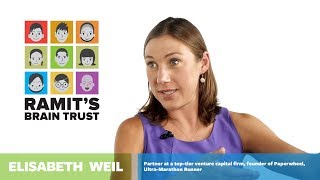
Ramit Sethi talks with Elizabeth Weil about mentorship, gender dynamics in the workplace, and how women navigate career choices in business. Weil discusses the real obstacles women face and what actually helps when you're trying to move up.
Chapters
You mentioned your mentors. Are your mentors male, female, Both. Both. And have you learned anything? Like do your female mentors give you specific advice relative to being a woman or what they've gone through?
So it's, it's interesting. In the venture capital industry, most of the partnerships are made up entirely of men. And I know that's something that people have been cognizant to try to change, but it hasn't been changing very quickly, at least in the firms that I see. My mentors have come from different industries, different areas, and I think male and female is important just to give the perspective. But I think some of those more similar in life are, are they married with kids? Have they been on both the startup side and have they dabbled in venture? Have they had a side project before? And when I, I never chose the people that are my true mentors because of that. But when I look back and pattern match now, each of them have the makeup that I really admire and that is me.
Interesting. Okay, interesting. What about positioning yourself? Now I'm talking on a more day to day basis. So have you had to position yourself differently as a woman? Have you had to change any behavior? Is it perhaps thinking carefully about the clothes you wear, which guys, especially in tech, don't think about at all? They're wearing their free Google shirt from 2006. You know, is it where you sit in a meeting or who raises their hand? Do you have to think about these things or did you in the past?
I think with a lot that has been brought up now, I'm probably more cognizant of it than I ever was. And almost it's now, now that people are talking about it, I don't know if I feel more awkward about it or less awkward because if I didn't sit at the table, does it mean I haven't read Lean in yet? And sometimes there's just natural conventions that if there's a certain number of chairs and I'm not one of the main people that needed to be there, should I be taking that? So it's hard. This is, I think will forever be something I struggle with on the clothes side. First of all, I think everyone's parent has probably said dress a little bit nicer than you think you need to be dressed. I tried to follow that. I think it makes you both look a little bit older, received a little bit more professionally. But I think also just adjusting to the types of people you're working with, meeting with. On days that I know I'm meeting with an Executive team that has a lot more polish. Maybe a larger company, maybe one of the Fortune 500, maybe I dress up a little nicer. And the days that I get to go and spend time with our small consumer portfolio companies, I can be in my jeans and my flats and I love that too. So I think just being knowledgeable about what you're doing and factoring that in is important. So as far as the raising hand, getting where your seat is, I've also had some people say never offer to get the client or guest a drink from the fridge because then you're put in this administrative role. And I think part of it is being a good host too. So I think as long as you are you and you are compensating, they know you're a valuable place player in that meeting. You are leading a discussion. You are showing that you're credible too. Why would you want to leave somebody at the table thirsty?
Not everyone has the opportunity to kind of slide into investment banking or consulting. You would have if you wanted to. You could have easily gotten those jobs. I mean, you remember how easy it was for us to get. I mean we show up to an interview. It's like you get a guaranteed interview with these firms and I mean you're great at interviewing and you would have been able to knock that job down. You would have gotten a very high paying job. Whether it is consulting banking or a lot of the people watching here, maybe it's not banking consulting for them, but they have a set default career that they can go to something safe, something that is predictable. And you decided to not do that. You actually went the opposite ultra risky route of a startup which is almost.
A guaranteed failure and which is very not my personality.
Yeah, so talk to us about that.
My mom is the most practical, down to earth person you will ever meet.
She still runs too, right?
Still runs too. I will sell her and say that she's 70 years old and still running marathons so that you can continue to do. But she is just so. She's still living in the same house I grew up in. And with the taking a risky route, I really didn't even view it like that though now it seems like it would have been. But it really is the only time in your life that you have so few other distractions that are, you know, kids related. Owning a home, I had to make sure I paid my rent and you know, I had my vehicle and those things. But you really do have the opportunity to go play and try doing different things when there's a lot less on the line. And I think if you use those years and look at them as a way to grow and guide what you will ultimately love and do for the rest of your life or as you get older, that it's definitely worth taking a little riskier route for sure.