“I got into a PhD program! But he’s only worrying about the cost”
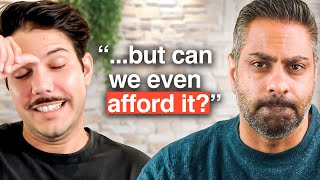
Katie got into a USFP PhD program with a fellowship, but David immediately worried about the cost and timeline. They had different money approaches rooted in their childhoods, and resolved it when David showed her a savings plan and she accepted the fellowship.
Questions this video answers
March
$13,645
$16,000
$80,000 to $145,000
She accepted the fellowship/scholarship and decided to attend.
Chapters
Today we meet David and Katie.
Money conversations just make me uncomfortable.
I don't want to be the technician or the leader. I want to be a partner.
Katie admits she avoids money and she likes that David will take care of it for her.
David handles all the finances, David takes care of all of it. And I just sit back and let it.
David worries about money. He wants to know where it's coming from, how much it's going to cost. He thinks logistics first.
It was all about, like becoming the provider, having a good career to make enough money to support a family.
They're recently married and sometimes it's hard for partners to shift thinking as a single person to a joint way of thinking.
For me, it was a lot of like, come on, let's go. And for Katie, she was like, I'm not sure, I don't know.
When we merged, it was very hard for me to kind of get over that hurdle of my money is your money. Your money is my money.
This is just one example over a deep disconnect that they have around money.
Hey, I got accepted to the USFP PhD program. It was my choice to go back to school. And so there was still that little bit of this is mine.
Once I started asking for details about, like, what does that mean for career? What does that mean for cost? Right now? She just didn't have a lot of answers.
Katie wanted to do something and David met her news with a bunch of dream crushing questions.
All of the questions that David was asking me was overwhelming me. I just shut it down.
David, were you frustrated by the responses?
Yeah. Yes, I sent her a loom.
No, you did not.
Yes, he did. He absolutely did.
Let's meet Katie and David.
I found out in March, hey, I got accepted to the USFP PhD program and I think I'm going to do it. We'll figure out how to pay for it, but I really want to do it. I'm really excited about it.
What did David say?
You were like, how are we going to pay for it?
Well, I think you mentioned right away there was a scholarship. I was curious about that. I was like, wow, that's really cool. They give you a fellowship or there was a scholarship on the table. What does that mean? What are you going to do with the degree? What's the dream? What's the name of the degree? What can you do with a PhD? Where are we going? What does that mean for, like, career opportunities? Yeah, what does it cost for the university? Like, you know, how do we, how do we plan for this? How long Is it going to take?
How long did it go for?
I don't really recall it being very long because all of the questions that David was asking me was overwhelming me and I think and I kind of just shut it down.
How did you respond when he asked.
You those questions over?
I just was like, well, we're going to figure it out. I'm going to figure it out. Just really kind of like mentally shut down because there were just all these questions, why that? Like, how? Why what? And I was like, just be excited for a minute. But they were all these like follow up questions. I don't think I had really thought through or had thought through, but like, in that moment didn't really have like the mental capacity to answer.
I wanted to focus on what was the dream, what was the vision, why go back to grad school? I mean, it's a lot of work. And yeah, I do think she was pretty overwhelmed by all those questions. I also think that the timeline was pretty quick. You had to give a decision in a week or two. And I think as that deadline approached, I felt more anxious about what that commitment was going to be. I mean, Katie's a full time counselor at the high school. She also is the head coach of junior varsity cheer program that is very successful, which takes up a lot of time. And then we had just sort of set up our budget or conscious spending. We were focusing on saving quite a bit for vacation. We were saving some for like an emergency fund. And, you know, every dollar was accounted for. So I was just more focused. Well, how much is it going to cost to save? Not cost, but how much are we going to have to save? What are we going to have to reallocate? You know, we just finished that and I thought we got to a good place, but now we got to pivot. Which dollars are we taking away from? Where? The mechanics of how we were going to do that. Which is why I think I wanted to focus on the dream. Because at least in my personality, when I know why I want to do something, the obstacles or the process to get there, you know, is justified or makes sense or the, you know, in terms of the brass tacks of it.
What was your reaction after the first conversation? You had a few days to make a decision. What'd you do?
Well, I did my research. I looked at how much it was going to cost for the whole program with the scholarship money and without the scholarship money. I made the decision. I mean, truthfully, I made the decision to accept this scholarship money without talking to David first. With that came a lot of questions. And David was very much like, well, if you're going to do this, then I need you to explain X, Y and Z. And gave me basically a list of questions that I had to answer. And I wrote it in an email. I wrote it in a very detailed email of this is how much it's going to cost. This is how much I'm getting from the school. This is how much time it's going to take.
Can I, can I pause you, Can I see that email?
Sure. The questions that I was asked was a lot for me to process all at once because each one of the questions involved such detailed responses and like were conversations in and of themselves.
So you made a decision before this email?
No, no, no, no, no.
You didn't make a decision without talking to me first.
We talked about it, but telling the school that I was going to accept the fellowship money. I did it and I did it and then I told you afterwards, which is when that email was sent.
Let's take a look at the email that Katie sent. So David asks, approximately how much will the total program cost to us? Parentheses. We already know the answer to this. 16k. And then Katie writes, I hate to sound dumb, but I'm confused by this question. The answer is $13,645 after the waived classes and 10k fellowship money. So a little bit of disagreement on cost. What are your future job opportunities and their projected salary ranges by the time you finish your degree? You mentioned wanting to contribute more. Give me the vision of that with numbers and titles if you can. Katie writes back, I could work at the college level with a salary ranging anywhere from 80 to 145k depending on job and location. Okay, that was actually very helpful to see. David, you're laughing.
Yeah, because it was, it was worded, it was worded like it was to a client. It was like I was trying to get information. I think it was on the heels of like not having a concise in person conversation. So I put on my producer hat.
I'm taking it at face value. I'm just giving him facts.
Is that good or bad?
To me is, it's good. But I know he wants more. He wants to see my dream in the future in my answers. I was frustrated that I was even writing that email in the first place. Yes. And by the end I was kind of over it. So I didn't give the specifics of exactly what the question was asking.
What was the question actually asking?
What can you do with your PhD? What can you do. And I, and I didn't really answer. Yeah, what can I do?
Yeah, I just humbled by that awareness. I think in my mind it's one thing and out of my mouth it's another.
Well, it's a phrase I like to say a lot, especially with business owners I teach in my earnable program. I say, put your hand out and ask yourself, what do I get? If I'm devoting all this time and learning all this stuff and speaking to customers, what do I get? I better get paid more or have a flexible life. I better get something out of this. What I see is David trying to push for specificity. And Katie, I see you trying to squirrel away, evade. It's a chase, avoid. You know, I don't think David necessarily worded it like this. Doesn't strike me as dreaming at all to say, what are your future job opportunities and their projected salary ranges. But this is also not a good answer, Katie. I could work at the college level with our salary range of 80 to 145k. Okay. I could be a professional boxer or a professional skydiver.
I mean, I understand my answer was not good, like at all.
And David, were you frustrated by the responses?
Yeah. Yes.
So what happened after this email exchange? I just love that you're all deciding like a life changing decision via email. This is like, I love it. So what happened after this email?
There were, there was a follow up.
I mean, I went to work.
She, I went to work. She's like, I clicked send and then I rolled out. What else? Okay, what happened next, Katie?
I sent her a loom. I sent her a video message.
Yeah, yeah.
No, you did not.
Yes, he did. He absolutely did.
A F loom. You all think it's nerdy for people to use my journal, talk about money together or to use my agenda or a csp? No. David created a loom video for Katie. And yes, I did ask to see the video.
I just want to lay this out for you. So first of all, we're going to have to increase our savings rate. You were saying to not have any personal spending. I mean, I think that's pretty unrealistic, to be honest with you. You can't just like forego living your own personal life for, for, you know, five years because you have to take six credit hours, assuming all the classes are three credit hours, just for easy math. Six credit hours? Two. You said two classes a semester. Six credit hours times 450 is $2,700 a semester, $5,400 a year. This Is, of course, assuming that you don't do anything in the summer, which I think you have to consider, because I want to be able to travel with you, and we're also going to be saving for travel. And in parallel with this, that's important to me, and I want to be able to do that with you. So I'm trying to figure out how to do this, you know, with the resources that we have. I think the conclusion from this is you can go ahead and get started. Financially, it's going to work, and you have quite a few years. If we're able to just do this savings rate starting now to, like, make this happen, and then we can figure out some other stuff here. I wonder if there's other scholarships that you can look for or just ways to find extra cash. But, yeah, this lays it out for me in a way that makes sense and says that it's doable.
David, you did the model. And, Katie, what was your response to that model?
Surprised that put all that effort into making it work.
Why?
Because at first I wasn't convinced by his reaction that he was excited for me or happy for me. I. All I heard were like, how is this going to work? What is this going to cost? Money, money, money, money. Where? Then when I saw him make the video of how it was actually going to work, I was like, okay, so he actually does care that this is important and we're going to make it work.
And you left a timestamp comment. You're like, at two oh, nine. I think you really got this calculation wrong. So we're going to definitely have to discuss that. We'll be right back. Now back to Katie and David. What did you end up deciding?
I took the fellowship, I took the scholarship money.
It's pretty impressive to get into a PhD program. Obviously, we know it takes a lot of time. Did you think it was a big deal worth spending time on the financial discussions and the relational discussions?
Not in the moment, no.
Why is that?
Because I was really focused on me. It's my education. It was my choice to go back to school. And so, yes, David is my husband, but there was still that little bit of but this is mine, which is. That stopped me from involving him as.
Much as I should have after the spreadsheet. And we were like, okay, this'll work. We can make this work. It allowed for that. I'm so proud of you. This is awesome. This is so cool. A PhD. Like, let's talk about it. But I think that obstacle or that step forward for me was really important, because it wasn't just about the PhD. It was about us working together. I think shortly after this is when I maybe applied to the podcast, because hearing stories of others on the podcast, I did not want to step into a role. I did not want to create a dynamic. Katie and I just got married a little over six months ago, and so I was like, this is all fresh, this is all new. Maybe I have my strengths and she has her strengths, but we're ultimately, I want to work together as a team. That's what I said about being connected earlier.
Hold on, hold on. So what kind of dynamic were you afraid that you might be creating?
David handles all the finances. David takes care of all of it, and I just sit back and let him. And I'm not involved in any of it. I'm hands off. Right.
Yeah.
I don't want to be the technician or the leader. I want to be a partner.
Katie, were you concerned about the dynamic at all?
Yes and no. I mean, honestly, money has always been a very, like, taboo conversation for me in general. The converse money conversations just make me uncomfortable in general, whether it's personal or in the. In my profession, having to have some sort of responsibility freaked me out a little bit.
On one hand, I can see that they approached this decision differently. Katie wanted David to be excited, to approve, to encourage. David wanted to know the details, affordability, timeline, outcomes, and then he could get excited. But on a deeper level, Katie is not being a partner in this massive decision. See, they're recently married, and sometimes it's hard for partners to shift from thinking as a single person to a unified joint way of thinking. But interestingly, I noticed this more in men than in women. In fact, I experienced this myself before I was married. I made all my financial decisions on my own. So for me, it took a lot of recalibration to get married and to communicate and collaborate about money. It felt restrictive sometimes, especially early on. But it was also an important recalibration so that my wife and I could grow a healthy relationship with money together. I didn't hear that from Katie. She got in, she decided to go to the PhD program, and she doesn't want to hear anything else. Sure, David should have replied in a different way, but being a good partner means collaborating on major financial decisions. I wanted to ask Katie about how she grew up with money.
Now, we didn't really talk about money. My parents made a great living. My father had a. Has a wonderful job that. That allowed my mom to stay home and raise three kids and Then when we grew up, she went back to work. My father was like, the provider for the family. My father was very good with money.
How do you know?
Because he was able to provide all of the things that we needed. I won't say we were spoiled, but I have two siblings, so we all three went to private school, K through 12. We all went through college.
Would you call yourself wealthy?
Upper middle class wealthy?
All right.
But I don't really ever remember sitting down and having financial conversations with my parents about, like, my finances.
What phrases did your parents say about money around the house?
You do need to get an education and you do need to get a job because you need to be able to take care of yourself. Because God forbid, if something were to happen to whoever you were with, you need to be able to take care of yourself. That is something I vividly remember.
Hello. How did this just come out right now?
As you just asked? I don't know.
Do you think maybe that phrase has anything to do with the PhD? The rush?
Of course it does.
How does that phrase relate to the decision you made probably 20 years later? Make the connection for me. Before we hear her answer, I need a quick favor from you. Hit that subscribe button. Because it really helps my team and me.
I'm going to continue my education so that I can eventually make more money. Because if something happens to David, I'm able to take care of myself financially.
By the way, was it your mom or your dad who passed that chestnut down to you?
My mom.
Would you say that maybe your decision making about the PhD was related to what you heard back 20 years ago?
Oh, 100%, yes. I don't ever want anything to happen to David. And so I still think as much as I try and push it back, I still need to be able to take care of myself financially. I can't rely on him if he's not here.
Wouldn't that imply that you would become highly knowledgeable about money and build the skills to invest and all that stuff?
Yes. You would think. Yeah, I avoid it.
Yeah. How do you reconcile those two?
It's. It's very. It's very opposite thinking, but it's. It's very nice to have someone like David who does take charge and initiative doing those things. Because in my head, and this is very, like, gender role, but, like, he's taking care of the family financially in that capacity. And it is my responsibility as well, because it's a partnership. But David can take care of it.
Just like your dad took care of.
It, just like my dad took care of it. Yeah.
Boy, I'm really glad I'm talking to you now and not 20 years from now.
Oh, me too.
David, let's talk about you growing up with money. What do you remember your parents saying or your family saying about money?
A penny saved is a penny earned. My mom was not very proud of where we lived. My dad had his own business, and he did pretty well for it, for the era. We were pretty middle, middle class. I had, like, private tennis lessons, private violin lessons. Those are, like, you know, not things that someone would do with the narratives I heard growing up, which I'm embarrassed that we live here or I wish we could move here. That was. My mom was talking about that a lot. I think my dad was relatively content with where we were.
Hold on. Violin and private lessons for violin. What else did you have? That's middle, middle class. What else did you do? He goes, private equestrian lessons. That's middle class. What's the problem? What the hell?
Homeschooled.
I was homeschooled. I was on the swim team. I did private tennis lessons, and I did private violin lessons. Music was the thing that kind of stuck. I kind of deviated from sports in my early teens. I was very academically focused growing up. Education was huge, and my mom is Cuban.
So education was big for both of your families and for both of you. I assume that that came up early when you were dating. That's like, a core value. I can totally understand that.
It was all about, like, becoming the provider, having a good career to make enough money to support a family so that my wife didn't have to work and could raise the. That was the. You know, that was the household in which I grew up. And that was the model.
It's quite traditional.
Yeah, it was. Yeah. Very, very conservative, you know, like traditional roles in that sense.
So you guys both grew up in traditional households. You both have naturally adopted a traditional outlook where David takes care of the money and Katie is. She'll ask once in a while. That's the sort of more traditional perspective. Not saying it's right or wrong. It's just more traditional. But yet you're both here.
Why break the cycle?
I don't want that. Yeah.
Why not, though? Both your parents seem to have worked for them.
Well.
Well, in conversations, when money was brought up, growing up, it was always. There was a. A looming sense, and it caused me to feel uncomfortable. And so as an adult, I don't want that in my marriage. I don't want that for our kids. Later on down the road. Traditions are one thing. And yes, I mean, growing up with that, and yes, my dad took care of it, so David should take care of it. Like that's, that's absolutely, like that's cookie cutter generational. But we don't necessarily want all of it.
And it's not as fun. We don't get to dream together. We don't get to like, you know, there's also that traditional role thing that happens where, oh, you spent too much. I manage the money. You don't know. Like, you know, how can you entrust somebody with like, financial resource if they don't know what's going on? They go to the store, they don't know how much they have to spend. You know, for both parties, it's like the choices are all about being very aware and in touch and like tapped in. Not like, how much money did you spend going out? You know, or dynamic is. It's not a fun one to have.
Well, I have to say I really respect both of you for having this vision. Both of you. It would be really easy for you to just model what each of your parents did. They did it the way they did. It was sort of similar traditional pattern. You could replicate it. I think that the path you're choosing is a little bit harder up front. And we're seeing this right with these conversations, trying to break old patterns, and you find yourself behaving in peculiar ways, sometimes a little harder up front. But once you get the right model, once you start seeing the benefits of like, oh my gosh, I have transparency, I have control. We both have control. We're in this not because I'm trying to tell you to spend less or control you, but because we both get to make our vision a reality. It's extremely fascinating that they both grew up in these traditional households. Both of them want to change it, but they're still finding it so difficult to make that change. That is how influential our culture is. Look, I'll show you what I mean. Let's say your middle school kid came home from school, they got an A plus on their math test. What would you do to celebrate? I would say 90% of Americans will probably say, I'd take her to ice cream. Now imagine a culture where you don't use food as a reward. There are lots of cultures like that, but we would struggle to even imagine that from an American perspective. So here we see David and Katie both wanting a non traditional relationship. But then Katie admits she avoids money and she likes that David will take care of it for Her. Let's go into an example because I want to know a little bit more about how you think. So I understand that you recently took a trip to Japan or there was some trip planning involved. Whoa.
And we want. We wanted to go.
We didn't make it to Japan. We wanted to.
Whoa. Look at Katie's reaction. What happened?
Cost. It was like. It was a half baked idea. Truthfully. It was a conversation half baked. I looked online, found the tickets, said, this is how much they're going to be. And he was like, oh, my God, we're not doing that. I'm not spending that much money on flights. And I was like, all right, fine, we're just not going to do this anymore.
Now back to the show.
So we had. Okay, we got married legally, like in December of last year, and then we had a wedding reception party in February. There was, like, not some clear communication about what was going to be gifted or not. So we just assumed the whole thing wasn't going to be gifted. And in the end, there were gifts. And I was like, well, is that our honeymoon money? Is that our emergency savings money? Like, what do we do? And flights were like 80% of the budget we had to Japan. I was like, how are we going to do anything in Japan? I just don't think we can do that right now. I think we've got to save a little bit more and plan for that so that we can go and enjoy a really nice time and do what we want, like, exactly what we want. So then Katie's reaction was like, okay, well, then we're not going.
It's.
It's a. It's a reallocation of resources for what you can use to kind of get the thing that you want for what's available to you. Now, that's kind of how I see it.
I just said, all right, fine, then we won't go. And I just totally fawned and backed out and was like, do it.
Wait a minute, hold on. You said, let's take the $8,000 and go to Japan. David's like, no way, we can't afford it. And then you said, fine, we're not going to Japan.
Yeah, I did, essentially because I was like, I'm not having this conversation with you because this just. It's not worth the energy. This isn't worth it.
Notice the two different approaches to this money. Katie's like, we have money in the bank. Let's go to Japan. Even though, financially speaking, it makes no sense, Right? Those tickets are too expensive. You can't only go to Japan with $2,000 for 11 days on a honeymoon. Like, none of. And you already have debt. It makes no sense. So then David, like, starts raising all these things, like, hey, what about this? And David's approach is like talk, using words like reallocation of resources. Okay. When you're talking to someone who goes, I see money in our bank, I want to spend it. And then David goes, reallocation, resources. And Katie goes, I'm taking my ball and I'm going home. Like, it's as simple as that. You two are speaking two different languages. Look, I don't know if I'm reading too much into this or not. What I see is how even at the beginning of their marriage, Katie wanted to use their money and David became the person who had to run the numbers. Or to put it another way, he became the dream crusher. Now, fast forward 30 years and you have a very typical traditional relationship where the wife wants to take a trip to Disneyland and the dad is grumpy. He spends his entire time crossing his arms and saying, oh, my God, how much is this going to cost us?
Oh, my God.
We've heard this exact scenario specifically around Disneyland many times on this podcast. This Japan trip also provides more context for how that PhD conversation unfolded. Katie wanted to do something because after all, her mom told her, be sure you can provide for yourself in case something happens to your spouse. And David met her news with a bunch of dream crushing questions. No wonder she ignored them. But also no wonder he got frustrated at her lack of answers to his increasingly specific and increasingly frantic questions. Do you all combine your finances?
We do, yes.
Yeah, that's.
Wow.
Yeah, I think that's part of what in the earliness of having done that resulted in that earnestness to ask those questions. Because it was so your earnest mind. Yes. Yeah. Yeah. Because we were venmoing money back and forth or zelling money back and forth. I was like.









