“I make $40k… but I own 100+ suits”
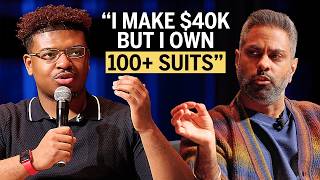
This content was created by Ramit Sethi. This content was uploaded by Ramit Sethi. This is a YouTube video titled "I make $40k… but I own 100+ suits" created on March 25, 2025. It features a live event hosted by Ramit Sethi in New York City, part of his book tour. The event includes conversations with two couples, Antonio and Devonte, and Pam and Nick, discussing their financial situations, goals, and challenges. The focus is on financial planning, wealth levels in New York, and personal spending habits, particularly Devonte's collection of over 100 suits despite a $40k income as a student.
Chapters
What's up, New York?
Whoa.
As a student, you make 40k a year.
What the hell?
So it's kind of hard. We moved from the apartment to a house. All these bills just keep coming in.
Hold on, hold on.
I gotta do it.
Are you telling me that when you buy a house, there are certain costs.
You did not account for? How many suits do you have?
Probably about 100.
What?
I'm like, tagging along in this relationship. I'm like, well, that's really nice. We get to do cool things because Pam said we could.
You want me to just tell you the answer?
Yeah.
No, that's not how it works. We are living in La La land right now.
On today's episode, you'll get to join me on the third stop of my live book tour in a city that.
Is very special to me, New York City.
I loved being on the road for this tour and experiencing Boston and Chicago was unbelievable. But there is something special about coming home and having the opportunity to get on stage in my own backyard. Today I will speak with two couples and at completely different ends of the socioeconomic spectrum. And that is one of my favorite things about New York. We have a huge melting pot of all different backgrounds, culturally, financially, and we get to explore it today. Now let's get to the show.
Yes.
Whoa.
What's up, New York?
Whoa.
Love to see it. Welcome, welcome, welcome. Oh, my God. All right. Welcome, everybody. And it feels great to be back in New York. I lived here a long time. I met my wife here. And living here, you realize money here is different than money in other cities, right? How many of us have been scrolling on social media? We're just scrolling, having a nice time.
And then you see some who posts, hey, who wants to live in New.
York in a one bedroom apartments?
Ugh.
If you lived in my city, you could buy a house like this. And then they show you the ugliest.
House you've ever seen in your life.
I go, who wants to live in a field surrounded by wheat and a Wells Fargo?
I hate Wells Fargo. See, what people don't understand is that New York is like a cosmic vortex of finance, right? You wake up, you go outside, you go to work, you come home, you.
Kick off your shoes, and then you just realize, I spent $375. I don't know why it's New York. They will never understand it. But we do. Like in another city, you walk into.
A breakfast place, you know, you sit.
Down, you have your meal, you go, yummy. I'm so full. And you give them a $10 bill and you get change back. Here. I saw somebody this morning order a bagel at Apollo's Bagels. That bagel was 15 doll. They won't get it, but we do. Don't even bother trying to explain it to them.
It's hopeless.
What they don't understand is that real.
Wealth in New York is not just about the clothes that you're wearing.
It's not about the bag that you're carrying.
It's none of that. Y' all want to hear the real levels of wealth in New York? Let me tell you. Level one, you have an elevator in your building.
Let me hear you.
If this is you. Is this you? Wow, wow, wow, wow. If this is you, you have officially made. You are not climbing up a fifth floor. Walk up in August in Flatbush. Well done, well done, well done. Level two, wealth in New York.
You have a dishwasher in your apartment. Let me hear it.
If this is.
Wow, wow, wow, wow. Every night you finish putting stuff in.
The dishwasher, you close it, you wipe.
Your hands, and you just stare at.
That dishwasher and you say a prayer.
Thank you, Lord. I don't have to scrub off my skin for the next 15 minutes and then use 20 paper towels to clean off my counter because I have no space to store these dishes. Thank you. Hallelujah. That's level two. Level three, wealth in New York.
Laundry in your unit.
Wow.
Yes. Yes.
Ladies and gentlemen, if you have laundry in your unit, you are ballin'. Okay? You definitely work at a job where you make so much you can't contribute to your Roth ira. Okay.
Now level four, wealth in New York, which they will never understand. But we do central air conditioning.
Exactly. You know what I'm talking about? You know what I'm talking about. Central air. You just turn on switch. It cools the whole place down. Not that rattly old box that's three months away from falling out of your window and killing someone. If you have central air in your.
Apartment, you are worth at least $10 million.
And now for the ultimate level of.
Wealth in New York.
This is level 5 wealth. Can you guess what it is? No. It's not a car.
It's not owning a Birkin. It's not even a summer house in the Hamptons.
If you live in New York and you have an in sync garbage disposal, you are rich. Like Richie Rich. Yes. Like use my house in Aspen because I'm never there.
Rich.
That's rich.
Okay, now I'm telling you. I'm telling you, they will never understand, but we do. Now, I love New York because I.
Love the levels of wealth.
I love talking about money. And I've had some of my best.
Conversations about money in New York. People open up and they tell you things that you can't believe they're saying.
And you never know what to expect.
Like tonight, we get to explore one of the most fascinating and under explored relationships in our lives. And that is our relationship with money. So I want your help to welcome our guests who are coming out. Please get on your feet and give.
A huge welcome to Antonio and Devonte. Hello. How you doing? Welcome, welcome, welcome. How's it going?
It's good, Pretty good. How y' all feeling?
Look nervous.
Nervous. All right, is this crowd here for them?
They are here for you. Thank you so much for being here. Now, who applied to come up here?
I did.
You did?
Okay.
Is that normal in your relationship when it comes to money? Are you the more assertive one with money?
Pretty much, yeah.
Okay. All right. Now I understand that you are both young and you both recently bought a house and you're getting married this year.
Is that right?
Yeah.
All right, so you told us that you feel like you're not able to get ahead with your savings goals. Now, before we get into all that, I just want to say I talk to a lot of different folks, different incomes, different locations, different situations. One of my favorite things in the world to do is to talk to young people because the fact that you are up here asking the right questions early on is amazing. And you have the time to set your life up the way you want to.
So can we give it up for them? Young, asking these questions? Oh, my God. You're 23 years old.
Yeah.
Amazing how many people here wish they started optimizing their money at 23.
Damn.
Look at that. Look at that. That's got to feel good, seeing that.
Yeah, you're doing it right. Okay, great. So I want to know a little bit about your financial dynamic income wise. You both earn similar or different incomes.
Different.
Different.
Okay, break it down for me.
So I'm a registered nurse, so I earn like 65, so 65k a year.
65. Okay.
And I'm a full time college student and I work part time and I have a residential cleaning business.
Okay, how much do you make from that?
For my cleaning business this year I made $20,000. And for my part time income, I make around $20,000 off like 40k a year.
As, as a student, you make 40k year? What the hell? I Feel like this is going to be very easy for me. All right, 23 year old making good money. Great.
Now this was. This was a role reversal because you all switched incomes recently. Explain that a little bit.
So basically last year me and Antonio was in apartment and he was going to school full time in his accelerated program. And I was working part time, but I was also doing my cleaning business. So, like, financially we're in a better position. We didn't have the house, so we didn't have like this much debt. I was basically covering majority of everything because the bills weren't that much. Like, our granny was helping us financially with the rent. So we just had to cover like the utilities and then like eating, you know, everyday expenses, which wasn't that much. So I was basically like the sole provider while he was going to school and he was an accelerated program working one day a week.
All right.
So I was basically flipped now. Yeah.
Yeah.
All right. So how do you feel about that, Antonio?
So I'm not used to, like, per se being like the breadwinner or like, provider role. So it's kind of hard because, like, we move from the apartment to a house and then it's like all these bills just keep coming in.
What do you mean? Hold on, hold on. I got to do this. Are you telling me that when you buy a house, there are certain costs you did not account for?
Well, we did, but I didn't think.
It was going to get like that.
Thank you so much.
Thank you.
Feels so good right now. All right.
There's a lot of phantom costs in owning, that's for sure.
Okay.
You mentioned something. You said I'm not used to being the provider. That's interesting. How would you characterize each other of your financial roles in the relationship?
So he usually, like, in the past, will handle more of, like the bills and stuff. Like, I know they're coming, but I wouldn't see them.
True.
And so, like, you knew they were coming, like, spiritually?
Yeah, like, you know, I know, like first month, the rent. Okay. I knew how much the rent cost, but I just knew, like, it was handled or I don't know, like. Or I'll know, like the water bill or something like that. Okay.
I mean, what about for you?
For me, I more so handled like saving our money or like just planning it out and.
Okay, what do you say?
Like, basically what he was saying, like, I would take care of all the bills. I'm kind of like a splurger. So I would kind of like buy us things, like take us out to eat and stuff like that.
What do you splurge on suits? What?
Yeah.
What?
Like, how many suits you have?
So usually, like, I travel a lot and I do, like, a lot of events because I'm a business major. So usually when it's like an event or anything like that, I will always buy a brand new suit to go to the event.
Notice how he did not answer my question. How many suits?
Probably about 100. What?
Are you serious? You have 100 suits?
Yeah.
Oh, my God. What? I did not know that. What am I supposed to do with this information?
Like, how do you have enough closet space for that?
Yeah, there's closet space. So I make closet space, and then I have, like, a wardrobe full of the suits.
Okay.
And, like, the ones I can't fit anymore, I just give away.
Do you think that it's normal to.
Have 100 suits legit?
No.
What do you think would be like, a average amount of suits for a man?
Probably 20. Yeah, I think that's a good number.
We are living in La La Land right now.
All right.
Okay. I was gonna ask if you all were aligned on savings goals, but I feel like the answer is no.
We're aligned with, like, the mission of, like, we both want financial freedom. Okay. And our definition of that, like, per se. Like, we just want to not have to worry about, like, money or. And have, like, the luxury of traveling, because that's our passion. So we are aligned in essence.
Hold on.
So financial freedom for you is not worrying about money and traveling. Okay. Do you think you'll be able to.
Achieve that down the line?
Yeah, I think definitely we'll be able to achieve it. So, like, buying this house was, like, our first, like, financial investment. The financial freedom. Because, like, real estate, I believe real estate is the. The way to get into, like, to start financial freedom. So that was why the decisions for buying the house. So we want to retire before 50. So that's our goal.
Okay, got it.
That's helpful.
Yeah, I like that specificity. Okay, great. So, Antonio, you're more frugal with saving.
Yeah.
How many suits do you have?
I have, like, probably like five. Five.
All right. So, like, what do you say when he comes home with another suit?
So, yeah, he likes. Every event or conference, he'll go out like, oh, I gotta get a new suit. I'm like, well, no, you got. You got suits in the closet. And so I. I kind of just tell him to, like, restyle it. But he doesn't want to restyle it. He wants a new one. So I be telling him every time it's not needed.
Did you buy a new suit for this trip?
No, I didn't.
Okay.
All right, that's interesting. So right now, it's like. It's kind of funny. What happens if you keep that pattern up for the next 10 years where you're buying a suit and. And then you're like, do you really need a suit? Why are you buying a suit? What happens as the numbers get bigger and the stakes get higher?
I feel like there does be, like, kind of some tension when it comes to, like, his splurging, in a sense, because, like, sometimes I feel like it's unnecessary, and I feel like if it keeps going on, it's like we're going further and further from, like, our goals.
Yeah.
We'll get back to Antonio and Davante after a quick break to support our sponsors. This episode is sponsored by Leesa, and I use this product myself. Now I'm going to give Americans an unpopular opinion. You know why you have back pain? Well, part of the reason is your soft mattress. Sinking in the middle, legs up akimbo. Every other culture knows that you sleep on a very solid mattress. When my wife and I went to Asia, we're in all different Asian countries. We're in India.
Look at this coffee mug.
You can put this coffee mug on one part of the mattress and go like this. It won't even move. That is a good mattress. Now, why am I so angry as I'm reading this ad? It's because I'm angry at you. You, for falling prey to the worst marketing I've ever seen from soft mattresses. If you want great sleep, why don't you just get the mattress that I use? I tried a bunch of them. The mattress I use is from Leesa, and it's the sponsor of this week's episode. Now, Leesa mattresses have tons of different models to choose from based on your sleep position and your preferences. But if your preference is soft, you. You're wrong. Do what I say. You're going to have better sleep. There's a mattress for every budget, including the fact that when I talk to people on this podcast who have $5,000 mattresses, I'm always like, why is your mattress more expensive than mine? I don't think you have to pay a tremendous amount of money to have great sleep. Now, with high quality materials, Leesa meticulously designs and assembles their mattresses in America for exceptional comfort and support, plus free delivery. You can return it if you want, and you Have a hundred nights to try out your mattress in the comfort of your home. Give it three nights. Your first night you're going to be like, why am I sleeping on concrete? The second night you're going to be cursing me in your sleep. The third night you're going to be like, wait a second. All those Asian people were right. That's how I actually have a better back. Go to Lisa.com for 20% off site wide plus an extra $50 off with promo code RAMIT. That's exclusive for my listeners. That's L E-E-S A.com promo code RAMIT for 20% off site wide plus An Extra $50 off Lisa.com promo code RAMIT. Remember, no matter who you are, no matter how many delusional marketing messages you've fallen for over the last 45 years, there's a Lisa just for you.
As part of my rich life, I have 10 money rules. And one of those rules is I can spend guilt free on anything relating to my health. That means healthier foods, working with a personal trainer and buying books or courses on improving health and wellness. But it also means that I stay on top of regular health checkups. And finding a good doctor in network is incredibly difficult. That's why if I were looking for a new doctor or a specialist, I would use the sponsor of this week's episode, zocdoc. Zocdoc is a free app and website where you can search and compare high quality in network doctors and click to instantly book an appointment. Book in network appointments with more than 100,000 doctors across every specialty including mental health, dental health, primary care, urgent care and more. And you can use the app filter for doctors who take your insurance and are located nearby. Appointments made through Zocdoc also happen fast, typically within 24 to 72 hours of booking. Sometimes they even offer same day appointments. If I needed to find a doctor today, this is what I would use. So stop putting off those doctor's appointments. Go to zocdoc.com ramit to find and instantly book a top rated doctor today. That's z o c d o c.com ramit zocdoc.com ramit now back to the show.
If you had $10,000 extra, what would you do?
I wouldn't buy no more suits. I think I have enough suits. I would probably say buy another house or invest into another like real estate, property or something like that.
Okay, so if that's the case then if you have like 500 bucks, sounds like you go and buy Another suit. So what's the difference?
So the difference is, like, I guess because I have way more money. So I feel like if I have that, if I look at it at that number, then I'm like, okay, I have to do something big. I have to invest this money and not, you know, utilize that 500 to buy another suit. So I think because I like, I see like the three, 400, I'm like, okay, I can extra that I have. So I'm like, I can just take this and buy another suit or something like that.
Whatever I see, it gets spent. Yeah, if there was a big chunk, I might invest it.
Yeah, definitely.
Antonio, when you think about the hundred suits, et cetera, how does it make you feel?
I would get annoyed for that reason.
Like, for me, like, 15 suits is annoying. Like, 40 is a different word and 100 is a different word.
Yeah.
What do you think? That's me. You tell me.
Well, yeah, I feel like it gets kind of, like, excessive in a sense, because it doesn't need to be splurged like that.
That's why I'm trying to understand this idea, because you describe yourself sometimes as a splurger. Devonte. And then you tell me of 100 suits. That's what you splurge on. You know, sometimes I ask people, what would you spend more money on? And if they like to eat out, they will go, oh, I would eat out four times a week. I think the. In your case, it's, I like suits. I would buy a hundred suits. And sometimes I ask them, what if you ate at a nicer restaurant? What if you got a custom meal, a custom suit made? Have you ever thought about that?
No, I haven't really.
Tell me more.
I haven't really thought about, like, that. I don't know. Like, I just. For each event that I, like, want to attend, I just want to look nice and want to, you know, stand out. So that's why, you know, buy another.
Suit is the idea that, deep down is the belief more is better.
I would say kinda, because growing up, like, both of my parents were on Social Security, so they, you know, they have five kids, so they didn't have, like, there was no money, like, for any for us or anything like that. And then I didn't have the money to, like, go get new clothes and, like, I want to or just dress nice and look nice. So I think as I got older and I got access to this money and I'm going to these different events and I'm seeing these, like, industry leaders looking Nice. I kind of want to resemble that or, you know, like, embody that. So that's why I go out and make sure I look nice. And, like, first impressions is key for me.
I get all that. I don't get the hundred. But, like, what I'm trying to get at is I don't mind nice things. I like them too. But when I hear that the two of you have a vision of retiring before 50, and I hear 10, 20, 50, 100 suits, I start to go. Right now you're earning what you're earning as a student. Soon you're going to earn a lot more. That's a lot more money.
Right.
I suspect you'd probably be tempted to.
Get a lot more suits.
I would.
If I bought 100 suits, I'd want. It's like eating tortilla chips. I eat 10 chips, I want 20 more.
Right, right.
So what I'm trying to really get at here is what's the vision, individually and together? I hear the together vision, which is retire before 50. Financial freedom. I love it. I don't hear how the individual vision contributes to that.
I believe, like, once I get older, I won't. Or once I make more money, I won't buy any more suits. I think that's kind of just like a now thing.
Hold on.
How many people in this room cheer.
If you believe that? Dude, nobody buys less of things they love. When they make more money, they buy more.
Right.
There's no problem. I'm not. Trust me, I'm not the guy who tells you, don't spend money on suits or lattes. That's not me. What I'm trying to get at is what's the vision? If I want to look great, one way to do it is to have dozens of suits. Another way is to have a certain number of suits and to restyle them. And maybe the suit quality goes up or maybe it's the same, But I have 20 different shirts. And I want you to really think about it because the decisions you make today carry through for the next 20, 30 years. Okay, how do you all set your accounts up?
So we have a joint checking account where, like, all of our bills come out of, like, the fixed costs. We have high yield savings account together, and then we have personal high yield savings accounts.
Great.
Okay, great. Amazing. And are you planning a wedding right now?
So I don't want a wedding because of the cost. So we decided to, like, just elope and do something private with both of us.
Cool.
Yeah, I love that. Yeah, I love that. You know, What I love to me.
Big wedding, small wedding, it's all good. What I love is that the two of you talked about it and you decided this is for us. So that's beautiful. Let's take a quick look at the numbers here. All right, so what we see here is assets of 157k, investments 5,000, debt is 185, total net worth of about 20k, gross annual income of 100k, approximately fixed cost at 61% and investments at 9. I mean, how do you all feel about these numbers?
I feel okay, a little bit. I mean, I'm proud of like where I came from, from like where I started. I just more so feel like the debt component, like it gives me like anxiety.
Yeah, yeah, same. I feel the same way. I feel like our numbers are pretty good, but I feel like they could be better and I just want us to like work on paying down the debt. I don't like to see that that high of the number with for debt.
Okay. I think your CSP is pretty good. Honestly, for 23 years old, I think it's really good.
And you got a student, like, you're.
Not even earning your full time income.
Correct, Correct. So this is solid and it's really.
Important when we talk about money, it's like a window into our soul. It tells you how people feel. So did you notice how the two of you answered a question? It was very similar. I said, how do you feel about those numbers? What was your answer?
Good. But anxious about the debt.
Yes.
Good. But don't like to see that high of a number with debt.
Exactly.
You guys were like, it's good, but anyway, I feel really horrible about it.
We got to fix this and that. Like, you glided over the good so quickly.
Yeah.
And I wonder what would it look and feel like if you actually spent more time on the good? I once had a performance review for one of my teammates coming up. And I have this group of CEOs I'm in a group with and they were like, are you ready for the performance review? And I always find them challenging. And they said, how good is this employee? I said, oh, he's really good. They said like on a percentage 1 to 100, how good is he? I said, he's 90% like, great. They said, in your performance review, which is going to be an hour, how much time are you planning to be positive versus constructive? And it just immediately hit me because I was going to say a couple of nice things and then spend the rest of the time focusing on all the Things that he could do better. And they taught me to flip it if something's good. Spend a lot of time on the good. Yes. We can fix the stuff that needs to be fixed, like the debt. But sometimes it really helps to really lean into that feeling of good. You guys think you can do that?
Yeah, definitely. Focus more on that.
Yeah.
All right.
Celebrate. 23. You got these numbers, quick calculations, very simple calculations. If on one income, if you just continue, you'll have $1.6 million at retirement.
That's great.
Okay, that's good.
Yeah.
If you have two incomes, that's $3.1 million.
Oh, wow.
Okay.
And y', all, we didn't add in any increases in incomes. None of it. So you know that if you were like, we want to make. We want to have 4 million or 5 million, you could do that because you're 23 years old. And tiny little changes now echo 25 years down the road, 30 years. So now I'm going to ask you again, how do you feel about those numbers?
We're in a great position.
Yes. Look at that smile. That's what I'm talking about.
Feeling good, really leaning into that. Celebrating with each other.
We did it.
Look how far we came. Look how we grew up. Look where we are now, and look where we get to go together. That, to me, is really powerful. How do you think that that will change the dynamic of your money conversations going forward?
I feel like we have money conversations, like, almost like weekly.
But wait, what do you talk about weekly?
We'll just reflect over kind of like where we're at, like, financial wise, like, what we have to pay and things like that. Right now. It was like a lot of worry conversation. Like worried about, like, paying.
Surprising.
Yeah.
Because, like, I'm a perfectionist. So I kind of like in like a tense about, like, paying off certain things that we have. So I kind of go overboard.
Oh, wow.
So out of a 30 minute conversation, it's not 30, is it? How long is the conversation?
Sometimes they're 30, but if we get like really deep into it, maybe like an hour.
Okay. Out of an hour, how much of it is positive versus negative?
I'd like, percentage wise, we're probably 75%, like negative, then 25% positive.
Okay.
Yeah.
That's honest.
That's.
That's actually how most money conversations, like, 90 plus percent negative. Because really the only time people talk about money is when they're fighting.
Yeah.
And then they go, let's go to sleep and pretend this didn't happen. And let's wait for another six weeks until it comes up again. So the fact that you're actually proactive about it is amazing. I think a week is kind of aggressive.
Yeah.
Like gosh, that's like what do we need to talk about every week if we've set things up to flow smoothly? If each person owns a couple of numbers, probably a week, you may not need to do it. But I'll leave that to you. Typically I say every month. Some people do it every week or bi weekly, that's up to you. But I would really just, you know some of the stuff in the book is how to have these money conversations. Be positive. We always start with a compliment. We always give each other a hug, a high five at the end really recharacterize them. One thing that I would really remind myself of if I were in your situation is we're on a single income for right now, but that's a temporary situation. When do you start a full time job?
So potentially fall of 2026.
Do you know how much you'll make when you start that?
Yes. So starting salary is about 75 to 85k.
Damn.
All right, so that's a lot.
I mean that's going to be great.
Yeah.
So have you all talked about what where the money is going to flow when you make that much?
Yeah, I believe we talked about it. Did we?
Yeah. Like right now kind of thinking on the same plan of like I kind of. We kind of want to switch to like living off of one income and then using the other income such as save or invest like how we want to. So I feel like that's kind of where we want to stick to.
But where's the suit suit money going to come from? No kidding.
Really?
Where is it?
So it's going to probably come from my portion. So I'm probably going to be paying all the bills and we're going to be living off my income. I'm make sure I have a little bit for probably my suits.
Like how much?
Probably a year probably I want to say like 5,000.
5,000 a year off 100k.
Yep.
Okay.
It's not my money. It's not my position to say. I think that if the two of you set your accounts up right, which my suggestion would be shared joint account and then you each have, you have some joint guilt free money, things like eating out trips, all that stuff that's important to you and then you each have some individual guilt free money. Then that note that guilt free money, that's individual is no questions Asked if you want to buy another suit, it's your money, no questions. But it's got to come from there. Can't come from the joint money because that suit doesn't make sense for the joint. So that's why I really love setting this money up, so that each of us has individual, no questions asked money. And within that, it's yours to play with. Your partner knows about your account. They don't even have access to the account, though it's yours and you have your own as well. Each of you do what you want. If you set that up and you two come up with a vision as teammates, this is how much we're going to have. Our incomes are about to go up significantly because we're going to combine them. We're going to have another income, and we have this vision of maybe buying another property, retiring at 50, traveling. I think you'd be very, very successful.
All right, let's give it up for Antonio and Davante. Thank you very much. Well done.
You know, I have to say it's rare that I get a chance to speak with such a young couple, and I have to applaud them for thinking about their finances at 23 years old. And hearing our story is a great reminder that how we talk about money influences the way we feel about money. And in order to feel better about money, we could probably benefit from spending a little bit of time celebrating how far we've come as opposed to just dwelling on what we don't yet have. Wait until you hear their follow ups at the end of this episode. I am blown away by the progress they've made in a really short time. I think you will be, too. We'll get back to the show after a quick break to support our sponsors. You know, I've been in business for over 20 years and I work with a lot of business owners. And one of the misconceptions when you start out is that you have to do everything yourself. You have to write the emails, design the web pages, add the landing pages, edit the social posts, all the graphics. No. Over time, you learn you can hire that out. And you can't grow your business if you're tinkering in canva all day long. So how are you supposed to find somebody who can help you grow your business? Well, there are lots of amazing freelancers out there, and one great place to find them is Upwork, one of the sponsors of this week's episode. Here's a list of projects my team and I have hired for on Upwork over Just the last few months. Graphic designers for PDFs, TikTok, video editor, content editor for an email campaign, and web design for a new sales page. And we just post the job on. Upwork doesn't cost anything to join. You can register, browse profiles, get help drafting a job post, and you can book a consultation. From there, you connect with freelancers, you can look at their portfolio and you can hire them to get started on projects right away. Upwork makes the entire process easier and more affordable. And with upwork, you can access top talent across tons of different industries, including IT, web dev, AI, design, admin support, and marketing. Visit Upwork.com right now and post your job for free. That's Upwork.com to post your job for free and connect with top talent ready to help your business grow. That's up w o r k.com upwork.com now let's get back to the show and meet our second couple, Pam and Nick.
Please get on your feet and welcome.
Pam and Nick, welcome.
Hello. How you doing?
Welcome.
Please. Hi.
All right.
Hello.
How you doing?
Good.
How you feeling?
Nervous.
Nervous.
Okay.
Can we give it up?
We have the best community in the world. We're all here for you. By the way, I asked you to send a photo and you sent these great photos and. And my team selected one of the photos you sent. Can we take a look here?
I do love the photo. I don't think I need many comments here. Now, Pam, I want to just jump.
Right into what you wrote in your application for today. You said biggest challenge, trying to figure out whether my partner Nick can stop working given my high income. We both come from low income backgrounds and a lot of financial insecurity during our childhood. We both used to be avoiders and we're now trying to be in charge of our money. First of all, I gotta say I really admire the fact that the two of you were avoiders, grew up in a low income environment, and you are here right now in New York talking about this in front of tons of people. To me, that's very inspiring. Thank you. What did you feel about money when you were growing up?
Never enough. There were times where we didn't have a home to live in. And so it was something that we just didn't have and thus was sort of the crux of insecurity, lack of safety.
How did money work in your family? Did you have a dwindling bank account or a stack of cash in the house? What was it like?
I don't even know if my mom had A bank account. My mom was on welfare for most of my growing up. I remember very clearly a wad of cash that would. She would keep in her dresser drawer in her bedroom. And I would just see through the month, that roll getting smaller. And when it was out, we're like, okay, well, now we just have to make it through until the next cat comes in the mail.
Wow. Okay.
Thank you for sharing that. What about for you? How did you feel about money?
It was definitely. There was always a culture of working as hard as possible, like grinding to earn enough. I immigrated with my family when I was 10 years old. So there was also the switch to moving to the US and leaving everything behind and starting from zero and learning a new language. So it was just a lot of. Yeah, a lot of having to figure out how to earn money.
Wow.
I don't think that many people can understand what it's like to move to a different country or to see a stack of cash getting smaller and smaller. And you know, that that is it. I think we all have some feeling where, oh my God, is there going to be enough? And you're here today. You're here today because your financial situation has changed considerably. But there's some other issues, some other psychological and communication challenges I think still remain. Pam, how did you get into your current industry?
Tech?
Yeah, I got my master's degree in Italian. And then when I graduated with that, I basically applied to like 200 jobs anywhere in the country that needed that skillset.
Okay.
And then I got hired by a tech startup that was working on teaching foreign languages.
Okay. A big one that probably people in this room have heard of.
Yeah, it's called Duolingo.
Okay. Okay.
And then what were you doing there?
So I was working as a language expert, helping to create course content. So, like all the weird sentences. And then while I was there, I was working with a lot of bright software engineers, a lot of bright product designers, and I learned technical skills through that.
Okay, and take me forward to today. Where are you now? What do you do?
So now I work in software engineering. I do like large scale program management.
So you said I had no business in tech, but I kept learning and getting promoted. Pretty amazing. Pretty amazing. Can we just take a look at the numbers? Okay, pop them up. Let's take a look. Gross monthly income, if I just net it out for you, is $633,000 a year.
That's what I love. That's what I love. You know, sometimes I have couples, they.
Have all different incomes that come on stage Sometimes they're in huge debt, sometimes they have huge incomes. And it's a little touchy to talk about a huge income, but on the occasions where I've brought couples up here who have a very high income, the crowd always cheers. And I really love you for that because we can support people who are in debt. We can support people who have huge incomes. The whole point of my work is that the way you feel about money is highly uncorrelated to how much you have in the bank. And so I really appreciate you sharing that. You have $0 in assets, so that means you rent. Great. Your investments are $865,000. Fantastic savings. $69,000 debt. $228,000.
That's all my student loans.
Ah, okay. We'll get to that. And I mean, the rest of this is like fixed costs are 38%.
Yeah.
That's what happens when you have a super high income. How do you feel about the numbers?
Amazing.
Great. Wow. Thank God I don't have to talk to another high earning couple that goes, oh, I don't know, 630, is it enough? Great. I love that answer.
I feel amazing.
Great.
How about you? How do you feel about the numbers?
I feel like I'm really fortunate. My contribution is significantly less in terms of the totals. And. And I also come along with that debt component. I feel fortunate to be where we are together. Maybe a little bit of guilt in my portion.
Right. Okay, so to clarify, you're not married. Are your finances combined or not?
We just moved in together in August and our goal is to merge finances to figure out what that looks like.
And Nick, what is your income?
My income?
Yeah.
153.
That's pretty good. It sounds like you say it like you're a little bit embarrassed. That's a very good income.
Right.
Well, I worked really hard to get there and then I made it and I met everyone that you know by comparison. I was like, oh, wait, I guess maybe I didn't do as well as I thought I was doing.
So, like, when we talk about comparing ourselves to the Joneses, it's literally this. Except it's income and not material things. Okay, well, we all think your income is great and combined.
I do too. Great and combined.
It's outstanding.
So.
All right, let's talk about that. Nick, you have debt. What is the debt from?
It's all school.
Okay.
How do you feel about it?
I wish I could have a conversation now with the person who decided to sign those loans.
What would you have said?
You can get this degree at a less expensive school.
What was the degree?
I'm a nurse practitioner.
So you got 228 or so thousand dollars of debt. Do you feel proud of the schooling that you went through?
Yeah, I worked really tremendously hard, so I am proud of that.
Cool.
Do you feel ashamed of having the debt?
Yes, 100%.
How do you reconcile those two?
Just the idea that I could have done it differently.
Okay.
Looking back, if I had changed this, I would be in a different place.
Okay.
How does that feeling of shame or regret, how does that affect your relationship?









