“I make $450,000 on YouTube. My husband is ashamed he can’t match my success”
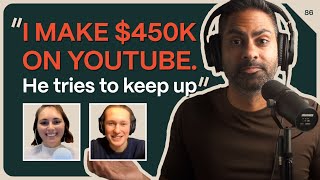
Kirsty makes £450k a year on YouTube while her husband Darby's channel earns nothing, leaving him ashamed. They argue about spending, money scripts, and whether his unpaid work at home counts. Ramit helps them build a plan that doesn't hinge on her income staying massive forever.
Questions this video answers
Kirsty is 25; Darby is 27.
She described yearly income progression roughly as £20,000 → £100,000 → £250,000 → £450,000 (current), expecting possible doubling.
About £1,000 per month before taxes.
£100,000 by age 35.
Currently earning nothing.
Chapters
I started my channel eight years ago, but really the money started coming in the last two, three years it's been big jump. I remember like my first sort of year it was like 20,000 for the year and then it jumped to 100 and it jumped to like 250 and then to 450, which was sort of at now. And I'm imagining it might double this.
Year at the moment I haven't achieved anything, so.
You haven't achieved anything. Can you finish the end of that sentence for me?
Success wise, career wise.
Career wise, yeah. There's other things in life besides career, right? You have achieved other things.
There is. I am a very proud person. I'm very ambitious. That's not my life. I'm not going to be a house husband all my life. I'm not just going to, you know, kind of be, be that person. I want to live a successful life, you know, I, I.
Successful means what.
I'm not, I'm not sure.
Meet Darby and Kirsty. Darby's 27, Kirsty's 25. And they're YouTubers with one of the most drastic differences in income of any couple we've seen here on this podcast. Now what's fascinating is that they did not really grow up with a lot of money, but now that she is making it, there seems to be a lot of disagreements about how to handle it. Darby feels like he's not contributing. Kirstie is paralyzed into over saving and worrying that it all might end soon. As you listen to this podcast, I want you to think about how the numbers can change in your financial life, but your money psychology does not automatically change as well. And of course I'd like to invite you to go to YouTube search for Ramit Sethi so that you can watch this full episode. Make sure you hit follow or subscribe there because I'd love to keep sending you more and more of our future episodes. I'm Ramit Sethi and this is I Will Teach youh to Be Rich.
A couple weeks ago. Okay, I was just looking it up. We were thinking about having a weekend away, our first weekend away from the kids. And I was just looking for a nice spa break. I thought it'd be nice for us to have a bit of time just to relax because the kids have been stressful. We've got a one and two year old and it's been chaos. And so I found a nice place just for a couple of nights. And yeah, I, I got my phone, I went to show it and it's like, he wasn't really interested in looking at the phone. And it was.
What did you say? What was your first few words that you said to him?
I think it was like, oh, I found somewhere really nice for us to. To go for a weekend or something like that. Or. I'm really excited. I found this place that I think looks great.
And when was the moment where you realized he was not reacting the way you thought he would?
Probably just after I said that.
Okay. Immediately.
Yeah.
How much does this spa cost?
It was for like two or three nights. It was about two, three thousand altogether.
So what did you do? You just keep going with the pitch?
I kind of read the room and I. I suppose I just, I got a bit sad and we stopped talking about it right then and sort of brought it up later in the evening.
Okay.
And I was like, why? Like, you know, I was like, I was really excited about it and, you know, you made me feel like I wanted. I thought you would be excited about it, and I was sort of bummed out that you weren't, and I felt like it was just like a no go area.
Wow, that's. Are you two in therapy together? I mean, it's very impressive. You know, you read the room, you paused, then you came back later, you expressed how you had felt and you asked a question. I mean, this is like a plus. It's. It's amazing. Okay, so what happened then?
Darby explained to me why he felt that way and explained that it was because where he's at with his business, not making any money and not seeing any growth on YouTube, he feels like going to a spa and just sitting and doing nothing for a weekend. He feels like, what has he done to earn that or deserve that? And I think for Darby, it's more. Because it seems to be around, like, taking holidays. I think it's more I can't take the time off or I don't deserve to, like, relax or have a break because what have I done to, like, deserve that?
Okay, so what did you do? Once he explained that.
I listened more. I mean, I. I said, it doesn't have to be this place. We can go somewhere you feel a bit more comfortable with, do something else. And yeah, I suppose I tried to see. Because he then said, I don't think you really understand how I feel. And, like, the shame he feels about not earning. And I just tried to listen to how he was feeling and I sort of saw it in a new way. I hadn't really thought about how he felt in that sort of way. Until then. And I kind of. I got it a bit more. And so I didn't, like, push it because I knew he was feeling uncomfortable about going to these really, like, fancy places. He didn't feel like he would fit in or. Yeah, earned that sort of right to be in those places yet.
Okay. And are you going to go to the spa, Darby, I want to hear your perspective. So she came to you. She's got her phone in her hand. What do you remember about that conversation?
Yeah, so, yeah, she came into the room. She was super excited, I think. I think Kirsty knew that I was going to say no. She was trying to. She was trying to say it in a way. It was like, please don't say no, but. Because she deserves that trip. But it's just like, well. Well, I don't. And I think the. The difference is if it was a spa that's, like, down the road, then I'd be. I'd be cool with that. But the fact that she's found one of the best European spas, like, like possible, is, like, one of the best ones around the world. And it's in Switzerland and it's. And it's going to be lovely and perfect and it's just like, well, I'm earning no money. Does someone who earns no money go to the best spa in Europe? No, they don't.
Hold on, hold on. Is that true?
Which part?
The part that does someone who earns no money go to the best spa in Europe?
Well, I don't know, but in my case, I don't deserve to go on that trip. I haven't earned that trip. I wouldn't feel as lovely as it was, as it would be. And obviously I would enjoy it because I. I enjoy going to spas with Kirsty. I. I couldn't sit there and fully relax and enjoy it because it's like, what am I relaxing about? Of. You know, if I'm. If I'm there in a lovely sauna in the Swiss Alps, it's like, why am I doing. Why am I sweating it out in the Swiss Alps? Like, why. Why am I here? I've got better things to do. I've. You know, I don't. I'm not comfortable with my current situation. I don't wake up. I'm not. I'm not fulfilled. So why am I. How can I sit and relax and, you know, like, as far as to. It's like a reward. It's like you're cooling down your. It's like a. Yeah. So It's a reward after you've done something, so. And I haven't done anything, so I shouldn't be there.
I disagree a bit because even though you may feel like you don't deserve it, in terms of work, for the last two and a bit years, we've had a very stressful, full on life with two kids. And you've done a great job at being an amazing dad. And like there's been a lot of workload associated with looking after the two children. So I feel like you deserve those few days of a rest from a stressful life of looking after the kids.
Yeah, but everyone does that. You know, there's. There's always people, you know, people always do that. That's.
So let me try to understand the rules here because seems like there's a lot of invisible rules here. I like to just get them out on paper. So in order to go to a spa, it's okay if it's down the road. It's not okay if it's in Switzerland. In order to go to a nice spa, you have to be able to have earned the money to go there. Yeah, parenting doesn't really matter because every parent does that. Any other rules that are implicit?
Bring up another thing that I thought.
Oh, yes, you can, but just let's get the rules out on the table. Darby, you seem to be the rule keeper. What else?
I just, I just, I just want to feel like I've deserved it.
What about your partner? What does she deserve?
Yeah, Kirsty deserves it.
So should she go alone?
Well, if she wanted to go alone, she could go alone. But she did, obviously. You know, why would she want to, you know, as far as for partners. And I know she'd want to take me, but that's, that's, that's. I guess that's one of the reasons why we're here, because we're in two very different places and yeah, I guess we don't know how to navigate situations like that.
This spa scenario gives us a very rich example of their money dynamic. I love Darby's examples because most of us have money beliefs that fall apart upon the simplest of inspection. He believes you have to earn lots of money to go to a nice spa, but I bet you half of the people at that nice spot don't even have a job. So think about what deep, invisible script you have about money and give yourself the chance to interrogate them.
Hey, I believe all rich people are evil. Why?
Why do I believe that? Where did I learn that? Who told me these Are, of course, exercises that I cover in my journal. If you need a little help. Let's keep listening in. And I should note again that they are in their 20s, which is very.
Helpful to remember as we go on.
I was going down another path, but decided to sort of quit uni and pursue YouTube. And it grew so, so fast. And since launching courses and building my email list, it's just like doubled each year. And it's got to a point where I. I don't know how to manage it. And I've got no one around me that's in this situation, so I feel a bit lost.
Your YouTube has grown. Are you the primary earner in the relationship?
Yes.
Solana Sole earner. Okay. And is that all coming from YouTube?
It's mainly coming from core sales.
Core sales. Okay, got it, got it. All right, well, congratulations. How fast did that happen?
I was tutoring for a little bit at my old school, so that's the only real job that I had. And that was just at my old school, so it didn't really count.
Counts to me. How much were you making.
The tax about? Well, before tax, about a thousand a month.
Whoa.
How did you survive?
I was living at home.
Ah.
I was only 18 at that point. I started my channel eight years ago, but really the money started coming in the last two, three years. It's been big jump.
Got it, got it, got it. Okay. And then you doing this YouTube thing and then it started to blow up and you started to just. You went from a thousand a month to 35,000amonth. Yeah, that's a big difference.
Yeah. And yeah, that's sort of average. It's weird because some months are like 21 month was like 170.
Wow.
That was a long a launch month. Yeah, I remember like my first sort of year, it was like 20,000 for the year and then it jumped to 100 and then it jumped to like 250 and then to 450, which was sort of at now. And I'm imagining it might double this year. I've been doing double engine growth, so I've got a new strategy.
Oh, good, good. Yeah, that's one of our advanced programs. That's awesome. So congratulations. You've done amazingly well.
Kirsty's a member of my double engine growth program, which. Which helps you grow your existing business. I'll throw a link in the show notes for any business owners who want to take their business to the next level.
So you're making all this money. Kirsty, you're the sole Earner in the relationship. Darby, you have a YouTube channel as well. How big is the channel? How much is it making?
At the moment? It's earning nothing. And it may be an excuse, but a lot of that has just been because we've moved house two or three times and we've had two kids in between them between, between those years and because we've, we've decided because Kirsty's doing so well and because she's the sole learner with any, any, any situation where I can help her, support her in the pregnancy, support with the kids. You know, if she's got a busy few months coming up getting courses out, I'll, I'll, you know, take the extra load with the kids and get everything sorted to allow her to, to continue with the business. I've done that.
Got it. Okay. That helps me understand. How do you feel about supporting Kirsty in her business?
Yeah, I, I, that gives me, that gives me fulfillment. I love, I love being able to support her and with the kids because it's, you know, it's the, it's the, not only is it the right thing to do, but yeah, it's just, it's what, it's what I want to do. But I am a very proud person. I'm very ambitious. As much as I'm happy to do that, that's not my life. You know, I'm not, I'm not, I'm not going to be a house husband all my life. I'm not just gonna, you know, kind of be, be that person. I want to have my own business. I want, I want what Kirsty has. And you know, she's a big inspiration to me and we support each other, we work with each other all of the time, every single day, because we work, we work at home. She wants that for me, I want that for myself. And yeah, I'm very committed to that. I want to be proud of myself. I want to be proud of myself. I want to, I want to live a successful life, you know, I.
Successful means what.
I'm not, I'm not sure. I want to exceed expectations of me expectations. Maybe families, probably what I would imagine, you know, I guess what I imagine old school friends would think, or should.
I just get the truth? Kirstie's over here with the most evocative facial expressions I've ever seen. Look at that. She's taken a sip of water. She's gearing up to just spill it. Go ahead, tell us, Kirsty, whose approval is he looking for families Parents.
I think it's more because he feels like as a child, everything was either done for him or he didn't have to try very hard for anything. So now he wants to show that he can do it on his own and that. Yeah. And that he doesn't need anyone else to help him. He can. He can do it. Because I think he feels like he lived quite an entitled life, even though his family wasn't, like, rich or anything, he was very comfortable. And now he wants to prove that he can do it himself, that he doesn't need that. And also I think he feels that because he's been doing it for three years and his family will ask, how's the channel going? And it's like, is it bringing it. Does that video, you know, those views, does that bring in money? And he'll say, no, I think he wants to show that, you know, I can. I can do this. You know, he wants to go to them one day and say, yeah, that is. It is getting some money. And, yeah, I've been speaking to this person and, you know, get their pride, I suppose.
Darby, you agree?
Yes, completely. Right, yeah, that's. That's.
Kirsty, what about you? How do you feel about the way that the financial arrangement is working in.
Your relationship, apart from the fact that you see it as my money? Like, I don't mind being the sole provider. It doesn't. Like, it doesn't bother me paying for everything. I'm not type of person that's expecting Darby as the man to provide. I don't care about any of that. I just want him to feel happy and fulfilled in himself, and I want him to start earning some money because I know that that will bring some fulfillment to him and he'll feel like. Like he's part of it and that he's doing something for himself.
Darby, do you agree with that?
Absolutely, yeah. It became very, very clear to both of us that my. My own. My own fulfillment with. With work is. Is a big factor. My happiness is. Seems to be quite tied to that. And maybe that's a bad thing, maybe it's not. I'm not sure. But at the end of the day, I'm. I'm only going to succeed if I make good videos, you know, Like, I'm. Only if people enjoy. If I make people. If I make videos that people want to watch.
Yeah.
Then, you know, people on YouTube succeed because they deserve to succeed.
So hold on. First of all, I feel very out of my element debating YouTube. You're the ultimate YouTube couple.
These fucking kids, they just record themselves playing some video game. It gets like 25 million views. I'm like, I'm going to kill this.
Nine year old kid right now. I spent so long creating this conversation. So how do you explain that?
No, I completely. I mean, I feel. You're paid because I feel like my videos deserve more love, too.
Both of us are so bitter right now and we're just looking at Kirsty. We're like, fuck you. How did you do it? We'll get to that. Look, I understand that you've done it before, and I understand that you're on this path now. I think you should keep doing your YouTube if it makes you happy. Fantastic. But that's actually not directly leading to your goal. And as Kirsty pointed out, even if you achieve that goal, it's highly questionable if you're actually going to feel the way you think you're going to feel. You know how many millionaires I talk to on this show where they're like.
Oh, when I finally have $1 million.
$2 million, I'll feel safe? And then I go, you're never going to feel fucking safe. Then I bring on some with $10 million and they're like scrounging in a garbage can to find blueberries. I go, oh, God. Have you ever heard those conversations?
Yeah, yeah, but you're different. We've seen those, we've seen those podcasts.
Is anything striking you here, Darby? As I talk about this.
It'S, yeah, it, like, it hurts, it hurts to hear. However, You know, I'm not, I'm not going to quit. You know, I'm not, I'm not going to quit because it's.
Why not?
Because it's because I, I. Because I believe in myself and I want it. So this is what this is. This is the path that I've, I've picked myself. This is how. Yeah, this is, this is what I want to do. This is what I want to do with my life. And I believe, I believe I can do it. If in the next five, 10 years I do start seeing success, and we spoke about it, even just, I don't know if I start to earn, let's say, 50 grand a year in the next five, 10 years, I think that. I believe that will make all the difference because I'll see a lot of fulfillment in earning that amount of money. Because I don't compare myself to you. I'm not, I'm not comparing, you know, I don't need to earn as much as you to Be. To be fulfilled. I just need to earn a little bit. Enough. I've got a letter in this desk drawer. A letter to myself saying, saying that I'll open when I'm 35 years old. And that's, that's the goal. I'm working towards. 100K by 35.
When did you send that letter to yourself?
About two years ago.
Okay.
Yeah.
What would happen if you opened it at 35 and you achieved that?
I believe I'd be extremely fulfilled and happy and just, it'd be, it'd just be massive respect. I just give myself so much respect and love knowing that I've, I've. I've put my mind to something, I've worked hard and I've achieved it because at the moment I haven't achieved anything. So to.
You haven't achieved anything? Can you finish the end of that sentence for me?
Success wise, career wise.
Career wise.
Yeah.
There's other things in life besides career, right? You have achieved other things.
There is, there is, but like the.
Relationship that I'm looking at, I know, kids, the house again, not the car, but everything else. Okay. Career.
That's, that's amazing. That's amazing. I'm really, I'm, I'm so grateful for that. But you know, Kirsty and I have been together 11 years. We.
Wow. We.
We. Yeah, we got, we got together at school and everything. Outside, career wise. My life's just been so easy. Everything's just flat flowed so nicely. You know, I, I married the girl I was, I met at school and she so happened to become nearly a millionaire. You know, that's, that's, you know, I'm incredibly lucky.
You want to do something for you.
Yeah.
I got you. I hear a lot of my younger self in you. You know, the idea of driving myself, like pushing myself, of setting these internal goals, like when I do this, then I will get that. I hear that, you know, a lot of it rings true with me. It pushes you, it, it keeps you sharp. I will say the one difference is that when I created those rules for myself, I was single. I don't know how those rules would have stood up in a relationship, especially if there was a dichotomy in earnings. That's your situation. And that's one of the reasons that I'm really delighted to get a chance to talk to you because I want to see how these rules are stacking up in this relationship. It's not just one, it's two of you.
Many of us create these rules for ourselves, these goals These timelines. I want to live in New York in my 20s. I want to be married by 30. I want to have a million dollars by 35. Whatever the rules are, adapt them for your own life. You know what I'm talking about? I actually think these are great. I love any example where people are intentional with their lives. But I do think that as we change the season of our lives, our goals should change. That's normal. So I'd like to issue a challenge for you right now. What's a goal you used to have for your life that you are ready to put aside something you used to think, I need to do that. And now at this point in life, you realize that's actually not a goal of mine anymore. That's question one. Question two is, what can you replace that goal with that is more meaningful to you now?
It's not just, you know, 50k because you don't really care about the money. It's just. That's the number you think shows that you've gained some success at the YouTube thing.
Is that true, Darby?
Yeah, absolutely. It's not the money at all. It's what. I know what that 50k represents in terms of success on YouTube. And 50k was simply, you know, that's like kind of like at that mark of five, you know, that's not what I wanna. That's not. That's not what I believe my potential is. I. I wanna. You know, I have. I'm very ambitious. I want to go a lot, lot further.
Okay, what is the cost of that belief?
At the moment? I guess, yeah, it's. Cause. Yeah, at the moment, that belief is causing all the problems that we've just discussed.
What if you find out you've created all these rules for yourself and they are just totally the wrong rules to play the game of life by? The rules that you are telling me, they're rules you made up in your head and they don't necessarily make sense to me. These rules of I need to deserve to go somewhere like a spa, even though my spouse, who I support by taking care of our children, and I'm sure supported in many other ways, even though my spouse has done incredibly well financially and wants to take both of us, I don't yet deserve it. Then another rule you just said is, I need to earn roughly 50k, but it's gotta be in this extremely narrow, specific way, which, by the way, has not been working for the last three years.
I don't think this is the one thing in the whole world that will make you feel fulfilled. And I think if you. You just keep. I mean, it's important not to quit, but it's important to know when it's been enough time to, like, okay, this isn't working.
Yeah, I. I hear what you say. I hear what you're saying.
What I want to point out to you, Darby, is that the way you are approaching money is through a certain set of lenses that you think are totally normal, because you've been wearing those lenses for many years. But if you were to actually take those lenses off and put on a different pair, you might see things completely differently. I have a scenario I would like to throw out to the two of you. Let's say that I got married and I was making a lot of money, and my wife was not, and she stayed home with our two kids, and I can. I was the breadwinner, and she stayed home with the kids, and we had a great. You know, it was all good. And I said to her, I would really like to take this trip to go to Italy. What do you think her response would be in this scenario? Kirsty?
Okay, that's good.
Okay, Darby?
I'm sure she'd say yes.
Okay, I agree. Why is it different when Kirsty invites Darby to a spa? Can I answer this, please?
Can I. Can I. Can I flip it? Because.
What.
What. What I see is so imagine. Imagine I go, yeah, take me. In fact, let's go to an even more expensive one, and let's go for longer. Let's spend all your money on me. In fact, I love clothes. Start buying me designer clothes. I love that. And get the Tesla, that, that, you know, the. The thought of. Of me having that life where because my wife is successful, she's spoiling me, or I'm. I'm kind of reaping the rewards of her rich life. That doesn't sit right with me. I find that really uncomfortable. If I'm. If I'm directly. I mean, like, if I'm. If I'm directly, kind of. What's the word I'm looking for? Profiting is the wrong word. But if I'm like, if I'm being rewarded just because she's doing so well. I don't know. I don't. I don't like that. I want to. You know, I. Because I'm unfulfilled in what I'm. What I'm doing, I can't accept all those things.
That was a very impressive series of spinning. You know, what if we go to the nicer spa and the Tesla And. But that's not even on the table, is it? It was one spa, which in the scheme of your income, is quite modest.
Yeah, we don't do much.
You know, if I offered to take my hypothetical wife, mother of our hypothetical two children, I was the breadwinner and I said, let's go to Italy for five days, she would say yes. We wouldn't even be having this conversation.
In investing, there's a concept called inversion. Charlie Munger talks about inverting the way you think about a problem. For example, most people ask, how can I become rich? Charlie says, let's invert it. How do most people go poor? They gamble, they cheat, they don't invest, they have high expense ratios. And he just says, let's avoid that. So inversion is a really helpful tool, especially with gender dynamics. I find that to be the case on this show because you and I grew up in a culture where we intuitively see certain things as normal. For example, a dad working and a mom staying home with kids.
Or.
But if we flip that, as is the case with Darby and Kirstie, suddenly lots of peculiar dynamics emerge. And so by inverting their scenario, what I'm trying to do here is gently challenge Darby on his views about money and recognize that gender is at least one variable playing a role here.
I find it confusing because the spa's a no go, but he is completely happy and very excited about us getting a Tesla X, which he will happily drive everywhere.
What the. Oh, God. Let me guess.
I know, I know, it's weird.
What is it? Oh, the technical specs are so cool.
And it has lane assist.
And one day this crackpot is actually going to do full self driving. What is it, the features?
No, no, it's none. It's none of that at all. You know, we'll be taking the kids in it. It's like, it's. Obviously, it's a luxury. It's a very, very nice car, obviously. However, it's still. It's still just going to be going to the supermarket and back and go, taking the kids places and things. It's like a. With my, with my imposed rules when it comes into the family and what. Like, I guess when it comes with. When our kids are involved, I guess my rules change a bit. It's like I have this radar inside. I don't know, I don't fully understand how it works, but yeah, that makes that. That goes through.
So. So wait, hold on a second. You're just. To restate what you said, why are you covering your face? This is funny. Does it feel weird to say it out loud?
It's funny because I know it's. What's the word? It's a bit hypocritical. Yeah. I'm contradicting myself because a Tesla X is just as luxurious as a spa. However, I think because a spa is fully indulgent, as a Tesla is still a car at the end of the day, and we're still driving it to places we need to go, it's still a. A utility vehicle, you know? Still. Still. It's still be. We'll still be driving it for its, like, essential needs.
Why don't you just. What's the cheapest car where. That people drive where you live?
I don't know. Probably the car that we drive was a Ford Fiesta.
Oh, my God, there's so many Ford.
I hate Ford.
Why? So many people drive Ford on this show. All right, so why don't you just get another Ford? I mean, it's a utility vehicle, right?
Well, I'm. I'm happy to drive this car until it breaks. And if it. If it. You know, if it. If it was. I wouldn't. I wouldn't. I'm not asking to get the Tesla. I'm just saying I'm okay with it.
I'm okay getting an $80,000 car. Anybody? Anybody else?
I know, I know.
It's actually interesting to hear that your rules are situational.
They are situational.
Yeah. And I hear a lot of commonalities with other people I've spoken to where they have certain rules for themselves. Parents love to deprive themselves of stuff. In fact, the spa slash massage is a classic example. But if it's the kids, they will either do anything for the kids or.
They will create loopholes so they can.
Justify purchases for their kids. Like in all the reasoning for your Tesla. And by the way, if you want to get a Tesla and you can afford it, get a Tesla, whatever. But it's. Well, it's utility. Well, it's for the kids. Well, I don't really care. I could drive a Ford.
It feels like there's a lack of.
Coherence as to what you truly want and whether you deserve it.
I don't deserve the Tesla, and I'll happily drive the Ford, but Kirsty deserves the Tesla, and she can drive now. So if she, you know, if she wants a Tesla, she can have a Tesla.
What if she bought you a Tesla?
No, that was.
No, that wouldn't happen.
Really?
You'd refuse that?
Yeah.
Well, like, for example, his Phone broke, so he's now using a Nokia, like 10 pound Nokia.
That'S actually retro. That's cool.
Until I can afford to buy that phone myself, you know, I'll stick with the Nokia. If Kirsty was to buy me a new phone, well, you know, wouldn't be a problem. You know, you know, she could buy me a new phone every single day for an entire year. But yeah, it's just like. Well, it just, I just, I wouldn't appreciate it. I want to appreciate it. I want to be able to do, do something for myself.
Can I give another specific example? Because, you know, we were talking about like the test and everything and how like that's okay because the children are benefiting.
Yeah.
Well, there is another example where Darvi is directly benefiting, but he's okay with it, and that's restaurants. He's happy. If we was to go to like a Michelin star restaurant or a nice restaurant, you know, eating out, you're, you're fine with it. You don't mind, and that's something you're, you know, directly profiting from and enjoying it, but you're fine with that.
You know the difference, Darby, please tell.
Me, because I don't know what's the.
Difference between that nice spa and a restaurant?
To me, a, the spa is a lot more kind of self indulgent and relaxing as I know when we, when we're at a restaurant, you know, we're gonna have with, you know, we'll have nice conversations, we'll be sharing food and I, I know we'll be, it's like, it's like when we're at restaurants, we, you know, that's our time to, to connect and talk and have like, nice.
It's not what you do.
Yeah, but it's so much more relaxing. You know, let's just, you know, we're already doing the restaurant, so let's continue doing the restaurants.
Here's a question for you, Darby. When you grew up, did you eat out at restaurants?
Yes.
And did you ever go to a spa?
None. If you're going to spa down the road, I'm cool with that. But it's that, that big luxury spa that, that rich people go to.
You guys are rich, you know that, right?
Kirsty is.
Aren't you two married?
Yes.
Until you see your finances as a team, you will forever be drifting apart one degree at a time.
Okay, but Ramit, what, what I need help with is I, I don't know where that healthy balance is because like I said, that that alternative that I shared earlier about, you know, me just accepting everything and being like. And saying yes to everything, that would just make me feel really, like, dirty and horrible. And I can. I just. I can't appreciate. I'd feel. It just feels wrong.
What feels more important to you right now is it not feeling dirty by accepting the offers of your wife or the need to keep pursuing this YouTube channel?
Is that the ultimatum?
No, but it's the two things that are most at the surface for you. So tell me which one of those is most important?
Well, okay. Well, on. On the one hand, with. With me, with my. With my career, like, that's. That's my life.
Say what you want to say. You won't hurt my feelings.
But that's. That's, like. That's like, to me, that's ex. That's extremely important to me. Like, that's my fulfillment. That's my. That's my happiness. That's what I'm tying a lot, too, having that fulfillment. But then, like, us kind of like going to the spas and things. Like, I know that's not make or break. Is that make or break for you? I don't know. Is that. Is that as. Is those things as important to you as my career is to me?
Yeah, but it's not about. That is. It's about things adding up and, like, on one side, you know, it's not just one spot. You know, the 10th time you reject the spa, and then it's like, we're not going on vacations or on skiing trips. And. And then if you're not being successful as well, it's like, well, you'll get more depressed and. Or, like, more unfulfilled. And then you'll be even more resistant to anything I offer you because you'll feel even more unsatisfied with your. Yourself.
So would do you believe I should just accept everything?
I mean, I mean, you know me. It's not like I go and splurge on loads of things, or if I'm. I'm going to be, like, throwing cash at you, but one holiday or two holidays a year and stuff like that. It's. I'm not saying you can never say no, but why is the premise of.
Accepting as if you're the recipient? Why is that even the premise? I reject the premise. What's a good model? Because the one you have is, like, you're just this passive recipient. It feels very disempowering to me. Darby.
What do you mean by disempowering? As in like. Because I don't give myself any power. So what you're saying.
Correct. And so you see yourself as like, like this little baby bird with its mouth open. Ah. Oh, I don't want that spa because I didn't work for it.
Ah.
And I'm like, this is a weird ass metaphor. Two grown intimate partners who are also parents.
Yeah, I don't know. I find, I just find it extremely hard to. To accept things.
Notice what just happened? I asked him for another model of how they can be partners and his response was, I don't know. I just find this hard. That comment right there is typical of about 80% of the people I speak to. They will agonize over money. They will worry about it every day of their lives. They are what's called problem aware, meaning they realize they have a problem, but when I ask them for a solution, any solution, they fall back on that phrase. I don't know. I find this hard. Yes, it's hard. If it was easy, you would have solved it a long time ago. Part of making major changes in life is accepting that this is hard. And it's supposed to be hard. Now let's get on with it.
Okay. Are you scared of money?
Yeah.
No, I'm not. What do you mean, Kirsty? What do you mean?
Why am I scared?
Yeah, why are you scared of money?
You know, I'm always scared that I'm going to lose it at some point.
Scared of losing money.
I'm scared of the. Yeah.
Not having money.
Yeah, yeah.
Were you scared of money when you were making a thousand a month?
No, it's only since I've started earning more.
For a lot of people, they have this idea that if they start off a business and it eventually takes off, everything will be great. Is that the case for you?
No, I'm just constantly worried it'll end.
Oh, really?
Yeah. I suppose it's because I feel so young and it seems like I'm 25 and when I think about 20 years time, I'm like, well, this just seems too good to be true to like last forever. I'm worried about peaking, like really young.
And peaking would mean what?
I'm worried that I'll reach this high level of success and it'll end and I'll never feel like I can get back to that point. And so I'll always feel a little bit like athletes, I suppose, when they have this big football career and then it ends and maybe feeling dissatisfied and like, what am I going to do myself?
Okay, all right. You like to worry.
In other aspects. I don't think I worry a lot at all. I'm more the carefree one, I suppose. I don't know if you'd agree, Darby.
No.
Partner always knows best, Darby. Does she like to worry?
Yeah, yeah. It's in her blood. Her. Her mum is a massive worrier. And even though Kirsty, compared to her mum, is. Looks carefree, Kirsty still worries. Yeah.
What is the cost of worrying about money so much, Kirsty?
I think it gives me more stress than I need. And I also think it's. It's preventing me putting a financial sort of plan in place because I'm worried about doing the wrong thing and, and like losing it that way. So I've just sort of left it sitting there because at least I know it's there rather than making a wrong decision.
Our lifestyle hasn't adjusted much, especially in those first and then the last, like, three, four years. It has recently, as we've just recently bought a house. But yeah, we've. We have. Our lives haven't really changed. So Kirsty will say this too. Like, all this money that's been flooding in to her bank account, our lives haven't. Hasn't changed.
Is that good or bad?
I mean, we had. It was just coming in and it was just sitting in the bank, but if anyone looks at us, apart from the house, you wouldn't think that we earn anything different to anybody else. And I think early on in the first few years of earning it, I, I like that we. We saved. I should have invested it. That's a whole different issue. But I think we're at the stage now where it's like, okay, we should maybe should be spending some of it on doing something fun, because I'm seeing a trait in myself where I might be starting to feel a bit guilty. And I'm worried that if I earn even more, I'll get to the point where I struggle to spend it and it will always feel like, oh, that's a lot to spend on something.
Is that why you reached out now?
We reached out now because we. We started watching the podcast recently. And yeah, as soon as we saw that we could apply, we applied.
But why not? I mean, life is good, right? You have a. Looks like a nice place. You. You have a lot of money. I guess the one really truly depressing thing is you drive a Ford Fusion. That's atrocious. But aside from that, life is pretty good. So why now? This is, you know, liable to be a tough conversation. Why talk about this now?
I'd say because. Because our lives have moved, are still moving so, so fast. I guess it's hard to imagine it slowing down. I definitely imagine Kirsty's growth to continue. So I guess it's one of those things where it's like, you know, what do they say? The best time to plant the trees 20 years ago, second best time is today. Like, it's, that's the situation we're in. It's like we need to kind of sort this out now because it'll get.
Really bigger, a bigger problem. Yeah.
Yeah.
Okay, that's good. I'm glad to hear that. Forward thinking. It's a good sign. Yeah, that's one of the key differences among people who live rich lives and everybody else is the ability to think ahead and to plan ahead, even with bad things. It's like, hey, we disagree about this, we better sort this out. Now. Which of these two issues do you both think are more important? Creating a financial plan or sorting out the way that you talk about money and behave with money together?
The second one.
I just said the first one.
The second one just seemed like the right answer.
Well, would you like to discuss it?
Because I feel like if we have the second one, we can create the first one. If we know how to talk about money together, then we can talk together to come up with a financial plan because it starts with knowing your rich life. And you can't create a financial plan if you don't know that. And you can't create the financial plan if you don't know your rich life because you don't know what, what your goals are. And to create a rich life, you need to be able to communicate. That's my thought.
We, we have discussed, we have discussed all that, but our, our main issue is what we were talking about earlier with, you know, me not being fulfilled and earning no money and wanting to deserve things and, and you know, you being, you wanting to obviously reap the rewards of, you know, your success. So for me, I think with the second one, it's like I need to start earning money to be able to get over that problem as the financial plan. We can just, you know, like, we can start creating that straight away.
So what did we conclude just now?
Nothing.
Is this a common thing? You talk a lot, but no conclusion.
Sometimes. The thing is, we do, we do talk a lot though. We are always talking about, you know, like big. Yeah, like big important conversations.
Talking is good for sure. But also talking can get in the way sometimes of taking Action. It's like, all right, enough fucking talking. What's the answer? Yeah, which I'm still looking for, by the way. Is it one or two? Do you need a financial plan or is it that figuring out a way for the two of you to communicate about money. Which one's important?
The right answer is number two. Since watching your podcast, we've kind of binged a few episodes since, since we discovered it just over a month ago. And within that month we've been having a lot more of these type of discussions and, and you know, we've talked.
About not getting very far, are we?
No, maybe not.
We do a lot of talking, but no conclusions.
It feels like you are now operating with a 50 pound weight vest on your backs. Both of you, like you've accomplished this incredible thing, but you're not allowing yourselves to run as fast and as far as you actually can. Part of that I hear are these self created narratives of, you know, my dad was a provider. I need to deserve it, I need to feel fulfillment before we can go to the spa, et cetera, et cetera, et cetera. And I'm worried about losing money. We talk a lot. These are all narratives. Sometimes narratives are true, but sometimes they're just stories we tell ourselves. So I can help you get where you want to go. But do you both understand the cost of what you are currently doing? Do you understand the cost of wearing this weight vest around?
I think everything is just going to get harder, more stressful. I feel like we'll get further apart because what I'm worried about is if you don't start seeing fulfillment in the next five, 10 years and you're still waiting for something to validate you before you can enjoy things. I would. And if I carry on, you know, growing and wanting to do more fun stuff, I feel like we'll push further apart. And you know, I don't, I don't want something like money to push us apart because I feel like we're so strong in other areas and, you know, we love each other so much. Just having all of these invisible scripts that you're telling yourself is causing more damage.
It's interesting to hear Kirstie's perspective on money. The huge earnings, the, the feelings like she's going to peak and it's too good to be true. What I hear with both of them is that they have not adjusted to earning this kind of money. Not individually, certainly not jointly. A lot of people in this personal finance space have this phrase, live beneath your means. Okay. It's True, but I don't think the nuances are often explained. The idea is, if you get a $10,000 raise, I would argue most people in personal finance will tell you to take that money and invest 100% of it. They'll say, live like you didn't get that raise, and after 30 years, you really enjoy it. Honestly, I hate that idea. I'm much more a fan of creating a rule where you invest, let's say, 80% of that money, but you spend 20% on something absolutely amazing. In other words, live beneath your means. Yes, but remember that a rich life is lived today and tomorrow. This is why I say that it's a tragedy to live a smaller life.
Than you have to.
They're making $250,000 a year, but living like they're making 40,000, they're making this much money and they can't even enjoy a spa. When will that change?
How do you think my wife and I handle it? Because we have a difference in income. Do we have, like, she's just accepting or. I'm just accepting.
I'm assuming there's some sort of joint account or just communal.
Yeah, Darby.
Yeah, I'm sure there's. I, I. Yeah, I'm sure, I'm sure. I'm sure it's like a level playing field in terms of you both decide equally.
Yeah.
How we should spend.
And how about in a lot of relationships where one partner is staying at home, how do they do it? Is it. The non earning partner is just accepting everything? How do they do it? I'm.
I'm sure it's, it's joint also, and it's, it's a, you know, it's a discussion together.
All right. Can we put on those lenses for just a second and just pretend that that's how it is in your relationship?
Okay.
All right, so let's, like, physically take the lenses off of your face, like theatrically. Take. There you go. Very good. All right, now put, Put these. Tell me, tell me what those lenses looked like. Just so we all know, those accepting recipient lenses, what do they look like?
Gray.
That. That's very dark tint.
Very nice, Very nice. Okay. And what do the new lenses look like? Describe them for me.
Rose gold and thin frames.
Yes, yes, it. Light.
Light. Okay. Maybe they allow you to see things a little more clearly than the other ones. Okay, Darby, take the lead on this. Just for the next two minutes, we're gonna put these lenses on. Can you put them on for me so I can see?
Oh, sorry. Did I forget to do that.
Now talk to me about how you would decide on going to a spa.
Me? I would look? Yeah. Look at, look at our finances. Create. Look at our guilt free spending. We would discuss how we want to allocate that.
Can we just do it right now? So she comes to you, she goes, hey, I really love to go to this spa. It looks so cool. Take a look, respond to her, and then the two of you talk.
Okay. Yeah. Hypothetically, look at our guilt free spending budget. Is this something that we, we can afford? Is it, you know, do we have the money for it in our guilt free spending bucket? Is that, you know, are we happy with that? Are we happy to spend that? And yeah, if it fits and there's, you know, there's still room left for us to continue to spend, you know, spend money on other things that we want, then yeah, we go for it. If we've got the money for it, we go for it.
That sounded pretty cool to me.
I had those glasses. I remember.
Yeah. It's amazing what a fake pair of glasses can do. So what did it feel like to say that?
Very foreign.
Why?
Because. Because, I don't know, I made up. Well, first I'm making a decision about money that I haven't earned and I don't see as mine. So just making those decisions feels. It doesn't sit right with me.
You were not making the decision, were you? Who made the decision?
No, we were making it together, weren't we?
I'd love that.
Tell them.
Because that's what I've, you know, I've been wanting. I know we have the money. I know we have.









