“I struggle w/ cc debt but insisted on a Cartier wedding ring”
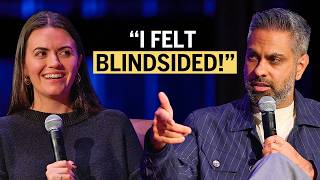
Ramit Sethi interviews two couples about money at a live event. One woman insisted on a Cartier ring while carrying credit card debt; her partner had paid $3,400 in interest alone that year. Another couple discovered $30k in hidden debt at a money-date and tied their payoff plan to their wedding.
Chapters
Yes. Welcome, Boston. How do you all feel in front of this crowd?
A lot of people.
Are you guys here to support them? You wrote that you lost $5,000 when you were house hunting. What happened?
We left with nothing. Hindsight biases. Such a.
What do you spend on food?
I like food. I cook a lot.
Hold on. No one can spend 74 on food.
You'd be surprised. Obviously, we get our knowledge through TikTok and Instagram these days. No, no, no.
Tell the truth. Tell the truth. Which TikTok scammers do you follow? Let me give you their initials. Is it K? Does it start with a K? Calculated year to date, you spent $3,400 in interest.
Damn crowd. Yeah, yeah. Can you see that?
Even the crowd was like, God damn, I don't even like mangoes.
We were in the P. F Changs at the Natick Mall.
This is something weird about this. Am I the only one? Do you think this is weird?
I don't know. I've never done this before.
Whoa.
Didn't have that on my note car. If you've ever thought I'd love to make extra money, but where am I supposed to start?
Listen up. A lot of people think that the only way to make more money is to get another job or to work more hours. Not true. Inside earn 1k. I teach you how to start earning $1,000 on the side in 30 days using the skills you already have. You don't need to quit your job. You don't need a new degree. You don't need a huge social media following. You need the right strategy to find your profitable idea, get paying clients and grow from there. I've helped thousands of people do this already. I want to help you, too. Enrollment is open right now, but not for long. Get all the details@iwt.com or click the link in the description below. Well, I recently spent several weeks on tour for my new book, Money for Couples, where I had the amazing opportunity to sit down with couples in person, on stage, in front of a live audience, totally unscripted. I love that energy in the room where you simply do not know what's going to happen. On today's episode, you're going to see me sit down with two couples live in Boston. Watch what happens. Let's get to the show.
Yes. Welcome, Boston. How you doing? Love to see everybody tonight. Welcome, Boston. This is a great crowd. Well, welcome. What a great way to kick off 2025. I posted the Cities that I'm Going to and I got a bunch of DMs from people. Some of them said, boston better be careful. I'm like, be careful. People really think it's still the Departed here. Meanwhile, you walk around Southie, 75% of people are drinking matcha. I'm like, what the hell? I really love Boston because every time I come here, I have the best conversations about money with couples. It takes a little bit of time. I got to open people up. But once I do, you really never know what to expect. And that is what we are going to see tonight from real couples who are going to do something, frankly, I would be terrified to do. They're going to come on stage, and they're going to talk about real numbers, real challenges, live on stage in front of all of us. That takes a ton of courage. That's why I would like for you to get on your feet and give me a warm round of applause for Giselle and Robert. Let's see him.
Thanks to me. Thank you.
All right.
Welcome. How you doing?
So good.
Good. How are you?
I'm doing great. How do you all feel in front of this crowd?
A lot of people looks a lot different.
Yeah.
I think the crowd is here for you. Are you guys here to support them? That's what I'm talking about. That is what I'm talking about. Okay, so I'm curious because in your application, Giselle, you wrote that you lost $5,000 when you were house hunting. Can you tell us what happened?
I was untruthful. It was $8,000 dollars.
Great.
Already starting with a lie. I love it. Keep it coming.
So we decided that we were going to try it out, get a townhome. We did not talk about what we were going to be doing or what that entailed.
So you didn't run the numbers?
I didn't know. Why would I do that? Right.
You're in good company with the rest of America.
Thanks. Yeah. So we didn't realize earnest money was a thing. We also didn't know that an appraisal and a inspection, it was. It was a lot. And then.
Yeah.
So you got the house or no?
Oh, no. So we actually didn't. We left with nothing.
Whoa.
Yeah.
Okay. So you started the process of buying a house, and then what happened to stop it?
I got a gut feeling that I'm like, this is probably not the best idea right now. We were doing too much work trying to get the house, and I feel like we're doing extra work that we shouldn't be doing.
I disagreed.
Yeah. It's.
I kept trying to, like, make it work. I kept trying to make the puzzle pieces work, and they just did not work.
So how did you talk about this?
We didn't.
Can we reenact a conversation that you had about the house?
Sure.
I really like this. I want this. This is mine. I think.
There was more than that.
Wait, is that for real?
Yes. I see a family in this house.
I do. I saw, like. I saw the wood paneling. I saw all the things. I was like, oh, so that's. The gag is. Is that she was a family friend, and I didn't realize that that was, like, a bad thing to do. So it was my best friend's mom, and I had no way of telling her, do you mind fighting for our earnest money a little bit? And she did not, so. And I'm super.
Yeah.
He was like, put up our money back. Like, we put this money down. I need to see something, like, in return, But. But, yeah, for me, it was a very different experience.
So let's continue that conversation. So, Giselle, you said, I want this house. I can see a family here. We can make it work. And then, Robert, what was your reaction?
I see a new deck needs to be done. I see a new roof needs to be done. A new basement needs to be done. She wants to change the master bedroom. She wants to take out all the carpet. So I'm like, if we're doing all this, like, we might as well pay for a house that has all the stuff already, and we're putting more money into the house. And so I didn't think it was.
A good idea, but the basement flooded on our last day of the due diligence. And I was like, but we can make it work. I know it wasn't the.
Okay, so what do you think about now that you're hearing yourselves talk about that?
I know.
What do you think hearing that conversation play back?
Yeah, it's embarrassing, but it. Hindsight bias is such a. I wish I listened the first time because we probably could have stopped at the $5,000 instead of keep trying to make things work. I think we ended up paying for the deck as well, so I wish we spoke about things sooner.
Okay.
For me, the biggest thing was I probably should have brought it up earlier in the whole conversation that we probably should be looking somewhere else or take some time to really figure out what we want to do with this.
What roles do you think you each played in this conversation? If you had to name the role that you each played, what would you name it?
I think I'm more of A dreamer. And I think that I'm. It's odd because I'm. I'm a dreamer. I'm like, oh, we can do this. But at the same time, I'm like, I'm scared to talk to him about anything when it comes to money because I just don't want to nag him. So my idea of doing that is just saying, let's just go for it. Let's go ahead and dive in.
Because being conscientious about your money equals.
Nagging, nagging and stress.
Got it. Okay.
I don't want to stress him out. I already stress him out so much, so don't want to stress him out more.
The thing is, she doesn't stress me out.
No, thanks.
I don't know if I just, like, I'm very easygoing, in my opinion. I think I'm an open book. If she wants to talk to me about it, she can. But I feel like for some reason. Well, I noticed now that she doesn't always come to me with the money problems that she might be thinking about or have questions about. So.
And what was your role if you had to name it, Robert, or the.
Getting the house that.
Conversations that you had about money. How would you name your role?
I'm a listener. I mean, I let her express what she feels. I give my two cents on it. And then we kind of try to make a decision from there, but I guess the conversation doesn't come up until she brings it up. And that's probably where part of the issue comes from.
Yeah, I think that's. That's probably accurate. Okay. That helps me understand what's going on. Shall we take a quick look at your numbers? Let's take a look here. So let's quickly look what we have here. Assets, 32k investment, 75. Savings 52. Debt 30. Net worth, 129,000. Nice. Gross monthly income, 25,000. Wow.
Good job.
Give it up. That's great. Nice work.
What the.
Your fixed costs are 26%. Is that for real?
I think so.
That's pretty low.
She knows more about this than I do, trust me. But that seems pretty much accurate.
26% is one of the lowest fixed costs I've seen. Just so everybody knows, typically the fixed costs are between 50 to 60% at least. That's a, in my opinion, a healthy number. 26, very low. In part because you have a very high income, but probably. Well, there's some other reasons.
Let's look.
Oh, investments are at zero. Okay. That explains part of it. Savings at zero. Okay. Guilt free spending at 74. What. What do you spend on food? How much food?
I like to cook. I cook a lot.
What kind of food you guys eating?
All right, we eat out a lot.
We do. Hey, hold on.
No one can spend 74% on food.
You'd be surprised.
I will say.
Now that's the kind of answer I like. What else? Travel.
We do travel.
We travel and then we eat when we travel. It adds up a lot.
Okay, well, it's interesting looking at these numbers. Does anything jump out to you?
We are very, very blessed to know that he had asked me to sell my car recently. So the. The asset was at a true 19,000. And that was really hard for me to do because logically I was like, oh, I can afford it. I'm good. I can have the company car and I can have my personal car. Stupid. So no payment on the transportation, which is good. But I would love to re. Put that into my student loan debt.
Yeah.
Because I'm kind of holding us back there. But his idea is some debt is good.
Oh, let's talk about that. Some debt is good. What kind of debt is good?
So I've always. Obviously we get our knowledge through TikTok and Instagram these days, so.
Oh, no, we don't.
No, no, no. Tell the truth. Tell the truth.
Come on.
Which TikTok scammers do you follow? Come on, tell me. Let me give you their initials. Is it K? Does it start with a K? Oh, I know. I already know this guy. So somebody told you that having debt is good?
I was always on the. Under the assumption that, you know, having your credit card bill being a certain percentage helps you build your credit.
Okay, hold on. I've always wanted to meet someone who believed this.
Yeah, I am that person.
Okay, now I get to ask some more questions. Okay, so having debt helps you build your credit. Credit score. And then. And then what? What, what do you get from that?
Assuming you can get more with your credit being higher, but you can get more.
What?
What? Yeah, you get more debt. Yeah.
So what's. So, like, what's the end goal? You have credit card debt. It builds your credit score. And then what?
Like you're talking about the 30, right? Yeah, he thinks that it's good to have. He's told me multiple times, like, no student. Like when we were getting the house, the mortgage person was like, oh, my God, that's great. Do you want to use your 401k to, to like add towards the. And of course, no.
And your broker who did this?
Yeah.
The realtor or the loan officer?
It was both. It was. It was both.
Okay. I got a couple of lessons. I need to lay down the law right now. First of all, never take financial advice from a loan officer or a realtor, ever.
Ever.
Now, I can't say that about TikTok as I am on TikTok. My account's not that good, but I'm working on that. Robert, do you. Do you have credit card debt?
Yes.
How much?
Probably like 15,000 total.
All right, so you all make a $300,000 income. Is that right?
That just sounds so much. Yeah, we do, I guess.
Have you ever. Wait, did you know that before you came here?
No, I didn't.
What did I tell you guys? 50% of the people I talk to do not know their household income. Here you go. All right. That's okay. It's very common.
Did not know.
No, that's because. Why explain for everybody? Because a lot of people, like, how can you not know your household income?
Yeah, it is hard to talk about. Like, even just bringing up his credit card statement before coming here, it was hard to ask him, can I. Can I get a look at that? Because I feel like there is a nagging sense.
Why do you have to ask him to get a look at it?
Because it's.
I feel like. I don't want to pry.
Why isn't he providing it instead of you asking?
Because.
Oh.
Oh.
That'S a good question.
Yeah, I mean, that's very true. I don't know. I think my. My personality has always been like, if.
You need something, let him answer.
Yeah, okay. Picking up what she's not saying, like, if you need something, let me know. Then we'll. Or get it figured out. But I guess I never go into the conversation first trying to provide the information she's looking for. But I can't read her mind, though, so I don't know what she wants all the time in terms of what she's looking for.
I don't know that I buy that. I mean, okay, you can't read her mind, but you're all talking about buying a house, Right. It would seem to me that talking about things like debt, credit card debt.
Would be first that should have been came up, probably.
Robert, do you know how much your credit card debt is costing you in interest alone?
Probably roughly, like 200 to $300 per. Per month.
Per month. Yeah. That's. All right, let's take a look before.
We hear how much Robert's credit card debt is costing him. Let's take a second to support our sponsors. You remember Yellow Pages? It's kind of wild to think that just recently there was a book with everyone's phone number and address dropped in front of your house. We don't have Yellow Pages really anymore, but people's personal information is still out there online. And that means you have to develop different ways to protect yourself. That is why I've partnered with Delete Me, the sponsor of this week's episode. I'm going to tell you what DeleteMe does, but I want you to know I personally pay for this service. I recommend it. Delete Me will remove your name, age, address, phone number, relatives, names, all of it. Here's how it works. You sign up, you submit your information for removal. Delete Me experts search for and start removing your personal information within seven days. You'll receive a detailed Delete Me report with what they found so far. And then they continue to scan and remove your personal information regularly and automatically. This is a service I personally use, and I recommend it to all my friends and family. So if you want to get your personal information removed from search results on the web, go to joindeleteme.com ramit for 20% off a plan for you or your entire family. Again, that's joindeleteme.com Ramit R A M I T. You know, I have some recent episodes where I speak to people who are about to become parents. And frankly, they're a little lackadaisical about what's about to happen. They're like, oh, we'll figure it out. I'm like, have you all ever heard of an sop? Standard operating procedure. It's time to document everything in your house. Like, lay it down. Where's the place that we're going to put our dirty shoes? Because we better figure this out right now before kids. Who owns what? Who's loading the dishwasher? What time? Who empties it? Let's not figure it out. Let's decide right now. Hey, when we travel, who carries the IDs? And if one of us gets hit by a bus, are our kids going to be taken care of? Too many people are just operating on vibes. Oh, I feel like okra today. No, a baguette. You're about to vibe your kids into being an orphan. You need to document how your business runs. I'm talking about the business of running a household. And when it comes to parents, one great option for this is term life insurance, which gives your kids financial support even if you aren't here Anymore. I'm using a euphemism. You're not here, you're gone. You better protect your dependents. Reduce your stress about your kids future by checking out Fabric by Gerber Life, the sponsor of this week's episode. Fabric by Gerber Life is term life insurance. You can get done right from your couch, all online and on your schedule. You could be covered in under 10 minutes with no health exam required. And even if you have life insurance through your employer, it might not offer enough protection for your family. Fabric has flexible, high quality policies that fit your family and your budget, like $1 million in coverage for less than $1 a day. With over 1800 five star reviews, they are rated as excellent on Trustpilot. Join the thousands of parents who trust fabric to protect their family. Apply today in just minutes@meatfabric.com Ramit that's meatfabric.com Ramit M E-E-T fabric.com Ramit Policies issued by Western Southern Life Insurance Company not available in certain states. Prices subject to underwriting and health questions. Now let's get back to Robert and his credit card balance.
2024, we calculated. In fact, I think you sent this over to us. Your year to date, from the full year, you spent $3,400 in interest.
Damn crowd.
Even the crowd was like, God damn.
I thought y' all were with me.
I like the chair.
So here's a couple lessons I take away. What do you take away from this, by the way?
Of course.
Don't have credit card debt with a $300,000 income. Makes no sense. Okay, that's number one. But there's, to me, a couple more deeper lessons right here. What do you notice?
Communication is a big part of it. And embracing that conversation might be uncomfortable, but trying to figure out a way to do it.
Yes. Love that. Meaning both of you. Yeah, right. And if you feel like I don't love the word nag because it's so gendered, you never heard a guy being like, I feel like a nag, you know, Never heard that.
Yeah.
So when. When you feel that there's a, like this nagging word, to me, that's actually a sign that let me step back and reexamine the dynamic. Let me take one step up.
Do I.
Am I asking questions like, why am I even asking this? Shouldn't he be coming with it? Okay, so there's that. And then the third lesson I learned is don't take financial advice from TikTok.
No wild.
Okay. Robert, you said you're pretty Easygoing, I think you describe yourself like that. Yes. You mentioned you travel. When you travel, who plans the travel?
The mixture of both of us depending on. Yeah. The type of trip. If it's probably more out of the country is more me. If it's more adventure, like activities, it's probably more her.
These conversations you have about money. You mentioned that you're an open book, and what was that phrase you used with her? I think you said something about ask me whatever you want.
Oh, yeah. I mean, I feel like she can ask me whatever she wanted to and I would give her the answer she's either looking for or wants to hear or. Okay, not the answer she wants to hear, but I'll give her my honest answer.
Let's try.
Let's try that right now. Robert, I'm here. We got plenty of time. Ask me anything.
Ask me anything.
No, no, literally, Robert, ask me.
Oh, I'm asking you anything.
Go ahead.
What do you have for breakfast today?
Oats and fruit. That's it? I mean, like, any money questions? Ask me anything.
Yeah.
Oh, my God.
I want a good question.
Let him do his thing. Let do his thing.
What would be your advice for why I should cancel all my credit card debt?
Right now you're paying 300. Over $300 or so per month. Nobody who has a $300,000 income with a 24% fixed cost should have credit card debt. The money is literally just being wasted. And more importantly, you're playing small.
Yo, my next today.
So I want to. I want to. You feel the energy kind of shift. When I said, like, ask me anything, what did that feel like to you?
You're not accepting anything. You're kind of just.
I'm just here like this.
Yeah.
All right.
What do you want? Let me know what you want. I'll tell you anything. Like. Yeah, it feels. It doesn't feel good to you?
Offensive kind of.
Yeah. Yeah. Anyone else feel that in the room?
Yeah.
And it's kind of like flippant. Whatever. Ask me. Yeah. And then I. I use these. Identity. I'm an open book just to say you did it.
Yeah.
Gotcha.
Yeah.
But what would be a better approach instead of me saying, ask me anything, what would it be?
I would like to talk about this or keep going.
I love that.
When you have a moment, let's discuss these things.
Yes. Amazing. You know, I have. I have a confession to make. I. I myself have struggled to connect with my feelings, especially as a young guy, Indian guy. We're not taught to talk about our feelings. If you had asked me at the age of 22, what do you feel about X? My response would have been, I think I literally could not answer. Words about feelings. Let's actually hear from the guys in the crowd. Any other guys have that? Let's hear it by a round of applause. Have any guys struggled to connect with your feelings ever? It's a tough thing. It's tough for all of us, but I think, especially for guys, I think we use a lot of techniques. Sometimes we say, like, ask me anything. I'm not holding back. But that's not connective. And I think sometimes that's why you get these reactions. Giselle saying, you know, like, babe, or like, I feel like a nag, but if I'm reading correctly, correct me if I'm wrong. I think what you're saying is, I'm not connecting with you. What do you think?
I think you're right.
Have you ever said that to him? I'm not connecting with you?
No. Oh, my gosh. I love him. No, I would never.
Wait, you could love him and not feel you're connected.
It's hard to, like, for me, at least. It's hard to critique him on because he's doing so well. Like, the money that he does bring in is so great, and so I don't know why I don't do that. Good question.
I don't think that asking questions is a bad thing of a partner.
All right.
I don't think giving honest, loving feedback is a bad thing. And most of all, what I hear is that the two of you right now are independent, like, you're in your own corners. I want this house. I don't want to do the deck. What would it look like if you had a different dynamic?
Probably come to a solution a lot faster.
Faster. Yes.
But would you.
Would it just do it independently and come up with it faster?
I think we'd be more accepting of it together.
Yeah. Maybe as a team.
Yeah.
What do you think?
How. How do you mean?
Okay, check it out. When you. When you went to get the house.
Yeah.
It was one person saying, I want this. And that person was kind of like. Like, this was their body language.
Yeah.
And then the other person was like this.
Yeah, that's.
That body language. That's. And then. And then you kind of just hashed it out.
Yeah.
Right. And you each got entrenched in your corner, like you were both pulling a knot, and it was just getting tighter. What would it look like if a team did that?
Okay.
I think we should get this House. I can see us doing this together.
Yeah.
You would be involved, Robert, you'd say, you know, hey, that sounds real. I love that you're thinking about. I love that you're so family oriented. You really have a vision for us. My concern is there's a lot of work to be done. I don't have a lot of free time. And. And it concerns me because I don't know about the money. I wonder if we could sit down together and talk about this and really look at some numbers together. Right? That's the beginning of a team. Now, I understand the two of you are going to get married soon. Is that right? Oh, congratulations. I love that.
I love them so much.
Congratulations. Okay, let's apply what we just talked about to your wedding. Do you have a number for the wedding?
I don't.
Okay, that answers my question.
That's fine.
Okay.
We were, I think 30, because we have savings, but.
Oh, that's the same number everyone comes up with. It's so funny.
It sounds good on paper.
Everybody.
So, like, so many couples, this is the. The common number, 25 to 30. Or if there's these common numbers that float around in personal finance, no one really quite knows why, but they are ubiquitous. You ask somebody, how much are you planning to spend on a vacation? Almost nobody plans a vacation number and they just go, 5,000. I was just going to say bingo. 5,000. It's like November 5th, 1955, from back to the Future. We don't know why, but, like, everything cosmic happens that day. It's the same thing for weddings. Okay, so you all make $300,000 a year. You're going to be debt free tomorrow because you're going to pay off that credit card debt. But it's funny that you picked a number that so many other people of all different incomes would pick. So before we get into the number, maybe we can talk about how you're gonna decide on the wedding right now. How do you feel when you think about planning a wedding? One word, accountable.
Tired.
Hey.
Okay, hold on. Does anyone resonate with those two comments?
Okay. Wow.
Lots of. All the married couples are like, ah, I got you, bro. When I proposed and we got engaged, I talked to a lot of friends, married friends, and I was like, what was it like to plan your wedding? And a lot of people said a lot of things. A lot of dudes kind of bond over, like, oh, my God, this is gonna be nuts. All this stuff. All I care about is the alcohol. And my brother in law, my brother in law actually said Something I never forgot. He said, that was the best year of our lives, and you're going to have a blast. And I remember that. And Cassandra and I, my wife, we talked about it, and we decided together, this is going to be the best year. So we made that intention, and that was just the beginning of us connecting over probably what's the biggest project together so far. So if you did that, if you did that for your wedding. One thing that we did, which I'd like to share with you is, is we had an infinite number of things we could have chosen from. You know, like, you're looking at venues and dates and flowers. It's overwhelming. Yeah. And so we created some core values for ourselves, things that would help us cut through. Just like money dials the things we love. But for our wedding, so for us, our first was relationships. And that meant that if we were deciding between nicer flowers or flying somebody from India, it was no question, like, that was a done deal. The decision was made for us because that's our number one value. And we discovered, you know, like, the people who came from out of town, we left little handwritten notes with pictures of all of us that was free, but it was really meaningful to us. So it helped us decide what we wanted to do and what we didn't. What would it be like for you? What would be a couple of core values for your wedding?
Family, I think, is a big part of it, right?
I'll say it. Money. I don't want to spend too much.
My thing has always been, this is the wedding for me, is more to see her happy and seeing our family bond and unite. But I never want to go into a wedding thinking that, all right, the day after, we just had a lot of money go down the drain now, because now it's all over.
Well, you are going to have a lot of money. Go away. Yeah, that's okay. Get a lot of money. Go away. After you bought those beautiful pants.
No problem.
They look great.
They are nice. I got them.
The question is, are we okay? The question is, is this important to us and can we afford it? Nobody's telling you to go into debt to have a wedding. Okay? What I'm at. And in fact, I never start with cost because it. It constricts you. It narrows your field. What's important to you? Family.
Family, yes.
Okay. And is there another one? Family. What else?
Experience. I don't. I don't want.
It's.
It's silly, right? I'm like, oh, I care about the money, but I'M also like, everyone drinks. Everyone has a great time. I don't want anyone to like too broad.
You got to narrow it down. Family is good because you can. You can be specific about that experience could be applied to literally anything.
Maybe venue.
Okay.
Yeah.
Okay, great.
And you.
So venue's important.
Yeah.
Okay.
Like when. When we got married because we spent more on family.
We had.
I remember we were talking to the chefs about the food and you know, Indians love mangoes.
Yeah. So they were like 5,000 on mangoes.
Yeah.
And well, you're. You see my reaction why I'm like so bitter about mangoes? Because my mom was like, we must have mangoes. And then I'm like, looking at the chef and the guy slides the price sheet over. The mangoes cost $3,000 for this wedding. I was like, I don't even mangoes. But that wasn't. That was an easy decision because family was important. Mangoes were not. So that's how we make that decision. Right. Same for you. If family and venue is important, that's how you make that decision. Do you feel that with two or three core values, you can make a good decision for your wedding?
Yes, I do. Okay.
Giselle. Nervous. Okay.
I don't know if that. I hope it does.
Okay.
You think you can do it together?
I think we could do anything together. Yeah.
I do.
I do.
I love that.
I do.
And do you think you can have fun doing it together?
Yeah, I do think so.
I love it.
Yes.
All right, well, I want to thank both of you for coming out. I'm wishing you the best of luck. Thank you so much. Keep me updated.
Thank you so much. Thank you.
Thank you. I appreciate it.
Thank you. Let's give it up.
Before we meet couple number two, let's take a quick break to hear from our sponsors. A few years ago, I was reading a book about back pain and posture and I realized that the author had a coaching program. I was thrilled. I booked a session immediately. She sent one of her coaches to my house. You can imagine the look on her face when she arrived. And she expected to see her typical client, probably 70 years old plus, instead, it was a 30 something year old guy who wanted to simply learn preventative maintenance and get better at posture. Part of my rich life is saying yes whenever it comes to learning something new. I can buy a book. I can buy an online course. I can get coaches to teach me and learn from the very best. That is why I love using Masterclass, the sponsor of today's episode. With Masterclass, you can learn from over 200 of the world's best for just $10 a month. An annual membership with Masterclass gets you unlimited access to every instructor. As you may know, I'm a huge fan of Disney. They had a masterclass with Disney CEO Bob Iger and anytime I get the chance to learn how Disney runs its operation, I learn. One of the lessons that I loved was something called taking giant swings. Basically, how do you play big when it comes to life and business? And that is something that I've adopted here in my own company. Plus, every new membership with Masterclass comes with a 30 day money back guarantee. Right now our listeners get an additional 15% off any annual membership@masterclass.com Ramit that's 15% off@masterclass.com Ramit masterclass.com Ramit I just got back from the gym where I work out with a trainer. They handle my training, nutrition, even when I travel. But notice one thing, they charge me a flat fee. Would I ever pay my trainer a percentage of my assets? No, that would make no sense. Would you ever pay your gardener a percentage of your assets? Of course not. You pay them a flat fee. So why do so many people pay their financial advisors 1% in fees? There is a better way. If you're looking for a financial advisor, use a flat fee. That's why I've partnered with Facet, a service that offers affordable, accessible financial planning. With Facet, you get flexible access to a team of financial planners and a team of professionals providing guidance across retirement planning, tax strategy, estate planning and more. And instead of taking a percentage of your portfolio, there's an affordable flat membership fee. But if you are getting closer to retirement or you have a complex portfolio or you just want a second set of eyes on your specific financial plan, then I highly recommend you check out FASST. You can book a free call@FASST.com Ramit, speak to them and decide if it makes sense for you. Check out their membership options@facet.com ramit Again, facet.com ramit F A C E T Sponsored by Facet, Facet Wealth, Inc. Facet is an SEC registered investment advisor headquartered in Baltimore, Maryland. This is not an offer to sell securities or investment financial, legal or tax advice. Past performance is not a guarantee of future performance. Terms and conditions apply. Now let's get back to the live show and meet our second couple.
You know, I've said, well, first of all, think about the courage it takes to come out here and share that kind of stuff. I don't Know what it is? There's something about money that when you say it out loud, sometimes you hear yourself, and you can feel silly and you can feel embarrassed. But to me, I heard them saying things, and I heard so many people out here saying, like, oh, yeah, that's like, we've done that. We've all done something like that. We've made big decisions. We didn't look at the numbers. We didn't talk about it in the way that you might. That's human nature. And now we are ready to welcome our second couple. Please get on your feet and give a huge round of applause to Sarah and Jay. Let's hear it. All right. Welcome, welcome, welcome. How you doing? Welcome.
All right.
How's it going?
It's going good.
We're good.
Feeling excited, Happy to be here.
Okay. This is a great crowd.
Yeah, we could tell.
We could hear you all who applied to be here.
Just so I know I filled out that application form, but I did ask Jay before filling it out, and he did say yes.
That was all Sarah's idea.
Oh, okay.
I actually have to give a quick shout out to my boss, who's somewhere in the crowd. I don't know where, but she was the one who got me into your podcast. And then also, like, screenshotted the Instagram story of we're looking for couples for live on stage and sent it to me, so.
All right, shout out to the boss. Thank you very much. Okay, I want to know, when was the moment where you both really decided to get serious about money?
We got engaged, and there was a big turning point where she had only known that I have, like, a lot of debt, but there wasn't really a number on it. She just knew it was probably more than 20. Less than, like, 20k, less than 100k, like, very.
Yeah, but we assume that.
Yeah, I did, but we.
One day we were. We really planned to, like, go out to lunch and do some back of the napkin math, and we had, like.
Now I have the terminology, thanks to you, Remy. Like, definitely it was a money date, but at the time, we just didn't know it was a money date. But it was okay.
And I kind of just showed my cards and told her how much I had in debt, and it was around 30k, I think, in mix of credit card debt and school loans.
Can we just recreate that conversation right now?
It was actually awesome.
Tell us what happened.
We were in the P. F Chang's at the Natick Mall, and we, like, planned. I don't know if we planned to go there specifically. But we planned to sit down over food, not at home, and talk about this. And we got there, and I was basically, literally with a napkin, like, okay, like, line it up. Let's see it. He took a few minutes, and then it was all out on the table, literally.
Yeah.
I shared my phone with Sarah, and we kind of went through all my apps, like the Discover app, the City app, Chase app, Sallie Mae, and I kind of just showed her the grand total. And.
And Sarah, what was your reaction?
I was really happy to hear it. I definitely am one of those people that, like, knowing this information was not anxiety inducing to me. Like, I said, like, I knew that he had debt before this conversation, but for me, it's like, if we're not doing anything about it, if we're just letting this sit here, that's what's causing the anxiety. So for me, knowing kind of what was ahead of us, and I forget if it was in that same conversation or maybe like, a few days later, Jay and I did, like, then sit down and we're like, okay, what are we gonna do? How are we gonna tackle this? What are our deadlines? When do we wanna get this done? What needs to come first? And that felt awesome. Like, it was really, really great.
I love that. Who drove that second conversation?
Sarah.
But I don't know a lot about, like, credit cards and debt, so I can also only drive that conversation so far, I feel like. So it's funny to hear you say that. I would have said you.
We needed to talk about it because we already started rolling the ball, and I knew, like, it was important to you too. But that day that we were at PF Chang's was a big turning point because I didn't. She didn't react the way I thought she would.
You thought she was gonna be really negative about it?
A little bit more negative than she was. But she was actually really, like, accepting and loving. And it didn't change how, like, I thought she felt about me versus my dad were separate things.
I was fired up. I was like, cool, thanks for telling me. Now we can get to work on this.
I'm like, right, what are we planning next vacation?
First of all, I love that reaction, and I love the way you describe it, Jay. Very accepting, very loving. I think that we all have a history, whatever it may be, relationally, financially, whatever. And there's a lot that, you know, people make mistakes. People do things with money. They make certain decisions and doesn't leave an indelible mark. We can change those Things. So I love this dynamic. Did you pay off the debt?
Most of it.
Yeah, most of it. So since that point, we made a game plan. And.
And it worked.
And it worked, and I'm down to, like, like, $3,500.
Oh, good job. Whoa. How'd you pay it off.
Jay definitely paid off most of it. But we did divide and conquer. Like, like I said, I forget if it was during that same conversation or shortly after. That conversation happened in July 2023, and we already knew that we were going to get married in June 2024. So a lot of our deadlines that we kind of created for ourselves were before the wedding or, like. Right. Literally, like the week before the wedding. We were like, we're gonna.
So how did you pay off the debt?
So that's kind of her to say that I took care of most of it, but it started with a big chunk of her savings to help me out.
Ah, you two were unmarried and you and what, engaged?
We were engaged.
Okay, you were engaged and so you found out he had debt. Your fiance has 30k of credit card debt. So then what was your reaction?
What comes first? What's good? What are we doing?
Meaning I, Sarah, am going to pay off how much of this debt?
Yeah, I think the way I saw it was, like, you know, we're. We've already made the decision to get married. We were those people who, like, decided to wait a year after being engaged to, like, be able to plan the wedding, but we could have walked into a courthouse that same day and just got married. The way I see it is, like, his debt is my debt. My savings is his savings, and vice versa, by the way. So I was just like.
But the actual math for it was we said, how much per month can we contribute from now till the wedding? And we added that up. And then she kind of gave me the difference. And I think you only. Not only you gave me, like, six grand, and we worked towards the rest of the other 20 something together. She, like, matched my savings pretty much.
Yeah. I basically matched it from there.
Okay.
All right. What do you all think of this? Wow.
Thanks.
Wait, there's a. There's, like, scattered support? Is that a fair description? Are there people who are like, this is something weird about this? Am I the only one? Do you think this is weird?
I don't know. I've never done this before.
Okay, so just so I understand. Okay. So P. F Chang's this memorable meeting. You then talk about it again. You make a plan. Whatever you're paying off, you're doubling or matching? Matching. Excuse me. And the debt goes from 30k down? Correct. Is that the direction it's gone the whole time? Down?
No. Oh, there's down and then flat line. Maybe up a little and then down again. But the overall trend. What's the up part?
Why does it go up?
We had some. Some trips and we had our wedding, which was this past year.
How much did the wedding cost?
About $40,000. But most of that my dad paid for, which was. We knew that going into it there.
Are still incurred expenses for like my tux and the bachelor party and his ring.
His ring. What was that? Like this ring?
Yeah, my wedding band.
Okay. Okay. All right, fine.
Designer wedding band, I guess.
Yeah, I'm like. My wedding band was like, not that expensive.
Neither was mine. Roommate.
Whoa.
Didn't have that on my note cards.
Wait, sorry to clarify.
Just tell us the numbers now. I have to know.
Bought our own wedding band, like with our own money. Mine was like 500 at Macy's.
Yeah, okay.
And I got a Cartier.
What the. Hold that thing up. You might as well show it off now. Beautiful. What is that? Let me see.
All right.
The love ring.
And how much does that cost?
Like a little over 2,000.
Whoa. So how do you decide? Like, I can afford a two thousand dollar ring for myself. When I have debt, I'll have the.
Money and then I'll pay it off. Like everything will be okay.
Keep going.
I don't go completely blind into it, but I try to do some rough numbers. And I know that if I purchase it on the credit card and I have like a thousand dollars cash, but I know I'll have the rest later on with the next paycheck or the paycheck after that.
And does it work?
Doesn't work 100%.
But say every like four times. It works.
It catches up.
This is like that Arrested Development cartoon. It's like, is it going to work? It never works, but it could work for us.
Yeah, it always catches up. And other things come along and I never have enough at the end of something that I thought I would. So Sarah has to come come along and save the day.
And Sarah, how do you feel about that?
It makes it hard. I think I trust jay with like 99% of everything, including with our finances. But this is the thing that's making it so that I don't feel like I can trust him 100%.
Yeah.
Because he. I'm so excited to talk to you, Remy. Like, I really. I feel like we talk. We do Talk a lot about money and our own backgrounds. We come from really different financial backgrounds and psychologies, and so we talk and talk and talk about it. And I still. Sometimes he's talking to me about his money, and I'm. I'm kind of looking at him like, how. How is that mathing up in your head? Like, I just don't understand. So it makes me feel confused, honestly.
Okay, confused. Can you tell me a couple other ways that the debt and not just having debt, but going back into debt. How does that make you feel? Confused. What else?
Confused. Counterproductive, or, like, if we're ever gonna for real get out of this, it's gonna be. It's gonna need to be my money.
What would you say? What's the feeling?
Nervous.
Nervous. Okay, that's it. Nervous. It's like a middle. Like, are you.
Are you sleep over this? I don't know.
Are you angry or.
No.
There have been times where I felt angry.
She's been angry.
There have been. I can literally remember them, like, two occasions where I was so angry.
You tell him?
Oh, yeah, I'm not. He knows everything.
Those conversations usually start with me being like, hey, I just want to let you know maybe, like, we can't go. We shouldn't go out to dinner this week or for the rest of the month, because I just. I don't have that much money this month.
And I'm like, how do you not have money this month? Like, you make money every month. Why would you not have any?
Yeah, and I'm more like, I kind of allocated already, like, to stuff I've already bought or to. To going out to drinks or something that I've already spent money on. So then the whole conversation would really come to fruition about, well, how much do you owe? Or this? And it'd be a few thousand here sometimes. And she'd be like, well, how did that Just. How did that build up? And I'm like, well, I just had my bachelor party and I spent a little more than I thought it would be.
So you mentioned. You mentioned that Sarah saves the day. What does that mean?
Well, whether you want to say now that we're married, our money is one a lot of.
And we do see it that way.
A lot of our net worth came together, really mostly from Sarah's side. So her savings are a lot more than I don't have. I really don't have that much savings.
Okay, do we have that CSP? Did we show that already? Let's take a look. Assets, 15 investments, 43 savings 33, debt 3.5. That's the debt. Credit card debt, net worth 87. Gross monthly income is 12k and fixed costs are 48%. That's really good. That's very low. That's good.
58 or mine and 38 hers.
Wow.
Okay, I understand. So these are blended numbers. Great. Investments at 17%. Who's investing more?
We actually, as of recently, both invest the same amount.
Excellent. All right, savings are at 7% and guilt free spending at 28%. What do you think of the numbers?
I think they're like an accurate reflection, I would say. Actually at the end of the month, I think our savings is usually higher than 7% because it's usually me who's contributing. Well, it is me who's contributing to savings, like 100% since his fixed costs are higher than mine. And then basically any money I have left over from guilt free that I haven't spent at the end of the month, which honestly I usually have, like nine times out of 10, I'll just dump it into savings. Yeah.
Okay. So what do you all notice from these numbers here? Just by a show, thumbs up, thumbs down, or thumbs to the side? Just based on your quick evaluation of these numbers. Let's just see what people put them up high so I can see it. We have a lot of thumb. Look at the, look at the crowd. A lot of thumbs up.
I agree.
The numbers themselves are pretty solid. Let me tell you why. This is just my rapid opinion, seeing these. Income is solid, but what's even more impressive is your fixed costs are low, your investments are really good. That's great. And savings are artificially low, but even if they were, that's fine. And your guilt free spending, it's probably artificially high, but even if it's not, that's still within parameters. So overall, I don't have any issue with the numbers. What do you think the issue is?
Need more guilt free.
That's the issue, but not in the way you think. Try it again. Sarah, what's the real issue here?
I can't speak for Jay entirely, but for me the issue is that we're both really open when it comes to having these money talks. I love when we have them. Making this CSP was really easy. But like I said before, I think sometimes Jay just talks about the way he manages his money. And I'm really sitting there. Like, I hear what you're saying, but I don't understand how you got there. Like, I really can't reconcile what you're saying right now. That's pretty much how it goes most of the time.
It's usually for me, the, my guilt free spending category. I, I don't really. I feel like I need to better manage that and, and categorize that into what I want to save for for our next trip and what I am okay with spending on coffee every day or to not go over what.
Jay, what did your parents teach you about money save?
Yeah, Growing up. They saved everything.
Did they have a lot or no?
Well, they had a lot of kids. I'm one of seven and my parents are immigrants and didn't come with too much to this country and they raised us and we never really went on vacation too much. We never really ate out. I related to you on that story about appetizers. I didn't really know what appetizers were until I was in my later teens. But yeah, they were really tight with me. They. And they were really disciplined. They paid off a 30 year mortgage in 13 years for their first house.
I feel like you're not giving them enough credit to like. Jay's parents came from Central America in the 80s and they didn't come here with not a lot. Like they came here with nothing and then they didn't speak the language and they had a lot of kids. Like the fact that they were able to do that is insane.
Let's give it up. Respect. Did they say no to you when you were a kid?
Yeah, all the time.
Okay.
Okay, they'll do. Where did the no go, Jay? Like in your spending?
I think when I started working, when I was like 16 and started having my own paycheck, I started to like buy my own things and feel like money. Like I was in control of money. But my mom would be like, save, save. Here, I'll help you open up a savings account. And I'd put some in there. Put some in there and then take some out and do. Do things with like friends and try to keep up with what other people are doing. And I think it just went on too long into my early 20s and I never got a good relationship with saving money like my parents did because I was really blessed.
Yeah.
What do you do for work?
I work in hotel management here in the city.
Okay, and does that affect the way that you see money?
Yes, I think so. I've been in luxury hotels actually since 2019 and I've seen a lot of the lifestyle people live. And I think it's not that I want to like copy them. I know I don't have a net worth nearly close to theirs, but the lifestyle that they are around, the nicer spirits that they're familiar with, the familiarity with all of it. I think I always wanted to keep up with that, even though it's not nothing to keep up with, but it made me feel. Feel good.
Yeah, I think. I think we all can understand seeing something that you grew up never having access to, and then you start to touch it and taste it and you go, I want to do that. And I think the truth is, if you wanted to try some nice drinks, you could. But I can see how part of the way you grew up with money affects the way that you treat money today. Sarah, any surprises in what you just heard?
No, I think I know all of that. I feel like you almost feel like kind of what I said about your parents too. Like, you almost downplay the situation. Like, it really is. It does make a lot of sense. Like, Jay also went from when Jay moved out of his parents house, he went directly to work in a luxury property in the Hamptons, and then from the Hamptons to Aspen. So he's seen, like, not just, oh, a little bit of wealth here and there, but like, he's been exposed to some.
It's like, yeah, you went from one end of that economic spectrum to the opposite end.
And like, I was living in those places too, and I was like, getting paid pretty good, and industry people, like, like to go out and have a good time. And I was just going out all the time, spending a lot of my paychecks in those destinations, kind of hanging out with or thinking I was hanging out with, with those crowds.
So what does this mean for your relationship when it comes to the finances? What do you think, Sarah?
This is like the first time this has ever occurred to me. So maybe we have different values in a way. Like we're kind of chasing different dreams in a certain way.
Describe them.
Yeah, like, it didn't even cross my mind to even look at Cartier bands. Like, and it never would have crossed it probably. I don't know how much money I'd have to have in the bank to feel comfortable doing that. But last year was not the time for me. So. Yeah, sometimes to hear Jay talk about these things. It happened today. He mentioned some clothing brand that I was like, I don't even know what you're saying.
Which brand? Just spit it out.
I was talking about Loro Piano.
Oh, just the most expensive Italian brand out there.
I didn't know what he was saying.
Okay, all right. So I think probably you do have different values on Money. Can you describe your values in a word or two? What might they be?
Security and freedom.
Great. And Jay, what does money mean to you?
Those are good words.
No, Maybe we do have the same ones. Maybe.
No, those are great words. Security I would 100% agree with. And the future? I'd say future.
I don't know if I believe that it's a word. I just don't believe it. It doesn't map to your spending at all. What does it actually mean to you? Not what you think you should say, but what does it actually mean to you? Loro Piana is not about future and it's not about security.
If I can help you out, I feel like it's also.
No, no, no. That's one of the challenges.
It means stability.
Okay, keep going.
Necessities.
Yeah. What's that on your finger?
Luxury goods.
I don't know. I think you like nice things.
Yeah, I like nice things. Nice, nice things.
How come everyone is suddenly nodding their head like yes? There's nothing wrong with liking nice things. I'm not here to tell anybody to stop buying anything. That's not my job. But do you think that the numbers that you have allow you to afford things like ultra luxury clothes, etc.
No. They should definitely limit them or find other nice things.
Yeah. Or work towards them in the future.
Or work towards them. Yeah.
And part of the reason that maybe you are able to spend on those things and spend that way is. Sarah, what do you think?
I think I provide maybe like a subconscious security blanket.
Yeah, keep going. It's not subconscious.
Okay, then maybe security blanket. And I think also I think I actually, what I do a lot is provide the voice of reason. Like almost play his conscious.
Yes.
Conscience. Like, I'm definitely the one being like, why would you do that? Tell me how you're going to do that. Do you have the money for that? And I'm not ever like, show me the numbers. If he says yes, my work is done. But he doesn't often say yes.
Can I make a suggestion? Perhaps the dynamic you're playing is entirely the wrong dynamic. Because sometimes in couples, we've seen it frequently, we have one who chases and one who avoids. And the more you chase, what does the other person do? More?
Avoid more.
Yeah. Again, it's like tying a knot. It could just get tighter and tighter. And sometimes we have a variation of that. We have this parent child variation where one person says, that's not a good idea. And the other person says, but I want to do it. And the solution is not to just both of you become more entrenched. It's actually to step out of that dynamic entirely. What do you think it would look like if you both stepped out of this dynamic that you are in today?
Today?
I think we've. Before coming tonight, we've already took a big step that. Into that direction. We keep talk. We talk about it. We have money dates, and we talk about it.
Did you make a plan?
No, we were waiting for this conversation.
Oh, all right. I understand that. Well, let's just do it right now. Okay. So we're going to make a plan to change this dynamic. So first off, the person in debt is responsible for paying off their debt and making the plan. Jay, what's the plan?
I think the plan is to pay off that 30 $500 by. By June. I believe that's included in my debt payment.
Okay, I like that. First of all, round of applause for anyone who knows their debt payoff date. That's very rare. Love that. And is that money coming from you?
Yeah, that's. That's my part of my fixed costs, personally.
Is there going to be any other unexpected expenses, like discretionary expenses, things like that that you're going to make?
No. Looking at her, the answer is no. But it's funny because there's a lot of potential for it, But I'm not going to let it happen.
This is where I need you to meet.
What do you.
Why are you talking like you're disembodied? There's potential for somebody to charge my credit card. What?
No, literally, like, that's sometimes the way Jay talks about it. And I'm kind of like, well, why would that happen? Like, it's like, what are you gonna buy?
Can I give you a suggestion?
So what.
What you're. When you're doing that, you are playing the voice of conscience, and that's the wrong approach. Because when you say that to him, what's his response?
Oh, I don't know. Like, this happens to me a lot. Sometimes I don't even realize it, and then it happens.
It's this blah, blah, blah, blah, blah. And it's not. I'm not. It's not. I'm not blaming you. It's just that you're both in an automatic pattern. You're both playing your roles, and these roles are not serving you. So maybe another suggestion is something like this. Jay, I noticed that when you're talking about spending over the next six months, you have this debt payoff plan. It's so impressive you have that. But you just said, who knows where my money may go? What do you mean? You're talking like it's not your money. Hold on, let Jay answer. Let Jay answer.
Jay, I think it's because there are things that I know we want to do together, such as travel and when sometimes I just don't have. We don't even have a figure or a number or a goal to save up for it. I'll. I'll kind of just think about it and not really plan it out and be like, yeah, I should probably be. I should probably be able to afford that by then.
Yeah, I understand that you. And that's part of what has got you in that amount of debt and has kept you kind of, you know, going like this instead of just straight down. It's this almost simplistic way of looking at money. I make X dollars. I'll take half of that and put it towards this. But you forget about all these other things like taxes and expenses and all these things that are already pre committed. I get it. That can work for a while when you're young, etc. But the two of you are now married, trying to build something together that actually doesn't work. To me, it's like, that doesn't work for me, especially not with the type of life that you're trying to create together. So if Jay says, Jay, if you say, you know, hey, who is to know where my money may flow? I might say, what do you mean by that? And then he might give you an answer, Jay, you might even come up with this. And I might say, you know, I appreciate that, but can I ask you that again? I really want to know. We have agreed that this is what we've committed to for the next six months. Are you feeling nervous? Are you feeling like you want to change the plan? What is going on with you, Jay? What would your answer be?
I would say, yeah, I got to buckle down. And I got to answer the two that where is it going to go? It's going to go like allocate every dollar. I got to be like, honest and upfront. And if I don't believe we can afford that or I can't really fund that, we should just not do it. I think is a big part of it or until save up until we can.
That's good. And Sarah, what role do you think you have in building a healthy relationship with money going forward?
Not playing the voice of reason.
Yes. What else? I love that.
Not coming to his rescue.
Yes. Amazing. And one of the ways we can do that is by setting boundaries.
Yeah.
Have you set a financial boundary ever in this relationship?
Well, yes. I don't know. Do you think so?
Not. No.
Okay. No, I have not.
We should set some.
I love that.
Okay, can we just do one right now?
All right.
What would it look like for you to set a boundary with Jay? Remember that boundaries can be loving, they can be compassionate, and they can also serve your shared vision of a rich life.
Yeah, a boundary. Maybe this isn't a boundary. You can tell me, Remy. But if we say that we're each going to save a certain amount from now until whenever, to then use it for our upcoming trip, my expectation is that you do that. Is that a boundary?
That's a good one.
Okay.
That's a good start. I like that.
Okay.
Can we. I like that. It's interesting that it was a discretionary expense, but I like that you're saving for it. How about the debt? Like, that's the burning fire right now.
I don't know. I feel actually so silly having said all this out loud tonight and heard from you in the crowd. I am not worried about Jay needing me for the rest of this debt I don't plan on. I almost feel like I don't need to set a boundary. I guess the boundary is, yeah, I'm not going to give him any more money to pay off debt, and I don't feel like that's going to happen. Wait.
Okay. Amazing. That's a boundary. Great. I like that you said it out loud. And another boundary would be when we talk about money every month in our monthly money meeting. I want you to come with your plan for where your money's going next month. I'm gonna do the same.
Cool. Yeah.
That's a loving boundary. Okay, great. How do you feel about that, Sarah?
That's exciting.
Okay. And Jay, how do you feel about that?
I really like that as well.
Okay. I like that. You know, I have a lot of confidence in both of you, and Jay especially. I understand. You know, your upbringing, your family, you working in Aspen. I get that it's affecting you. I have a lot of confidence in you being able to change the way that you relate to money. And I think it's really important as you sort of begin your financial relationship. I'm not the only one. Let's take a look.
Always say big chunk of your money, you don't need to be very happy. You don't need too many. I don't know how you say bluehost, but it's like a extra style, extravagant Stuff. No, happiness come from here. Doesn't come from. From. This is. This is all. This is temporary. But if you start to set up life. And I'd be so happy. When you get old, you're gonna sit and see, I did this. What's harder? I did this.
Thank you very much. Let's give him a round of applause. Sarah. Let's give it up. Sarah and Jay.
Whoa.
I loved hearing from Jay's mom what Jay's parents were able to do. Coming from Central America in the 80s with no money, kids, without speaking the language, to be able to be disciplined, to save and build an amazing life for their children is incredible. And as a child of immigrants myself, I especially appreciate that. I have to give a huge round of applause to both of these couples for having the courage to come out on stage in front of hundreds of people to share these intimate details about their financial lives. These are not actors. These are real people like you and me who came out to share their story and to ask for help. You can hear the energy in that room. The Boston crowd was amazing. Super supportive. You could hear the gasps, the laughing. The crowd wants these couples to succeed, and I do, too. I can't wait to share more of these live events with you. I am loving them.
I'm thinking about doing another tour.
What do you think? Would you like to be in the room next time I come to your city? If so, get on our waitlist iwt.com tourwaitlist and I will let you know the next time I'm in town. It's been over a month since I sat down with both of these couples. Let's see what they're up to now. First up, Gisele and Robert.
Our biggest surprise, I guess, for me was the debt conversation as well as the initiation. So, like, instead of me being so apprehensive and, I guess, nervous to talk to Robert about it, I could have just asked him maybe, why is he not leaning into the conversation? So just thank you for flipping that narrative that I had in my head that was interesting.
Basically, the feedback on not paying off a credit card bill in a full, thinking that having some credit card debt built in your name is going to allow you to build credit in a fast, positive way. But hearing how essentially owing no credit card debt is more of a positive than anything. So just kind of getting that feedback and figuring out how to now move forward from there.
Paying off the debt is the first thing that we should be doing. And so we did. I think it was like, three days after the Show Ramit really resonated with Robert and he was able to pay off $11,000 of his credit card bill. So it was his credit card bill on full. And each month, anytime I've used it or he's used it, he is paying off this statement in full now, which is great. I was able to pay off $10,800 of my student loan, my private student loan. So I still have my federal student loan to pay. That is the next step. And knowing that we can do that is, I guess, the biggest thing. So there are still questions, I guess, that we both have. I feel like you worded it perfectly.
Before knowing that my income is more of a seasonal thing as opposed to year round. So trying to figure out what actually is obtainable in terms of big purchases, knowing that at some points of the year, I do not have income at all. At other points, I do have a good income. But how should I be saving? How should I be putting money to the side? I think we have a few more questions in regards to that and hopefully it can be answered.
I'm still catastrophizing and I'm still like, I get excited about something in wedding plan. I'm like, oh, we can't afford it, so never mind. But the numbers, like, make sense, but they just don't make sense, if that makes sense.
So now let's hear from Sarah and Jay.
Sarah and I have had such a better relationship, not only with money, but with each other. We've been able to have a few money meetings here and there and discuss exactly where we're at and what we're saving for.
They've been really great. I feel like the whole mood has changed since we got to meet, and.
I've been able to behave a little bit better and not go spending on luxury goods here or there, but just stick to what I need.
The biggest surprise of the experience was probably how supportive the crowd was. Made it really easy to be there and to share and to like, be able to feel so open airing out our stuff.
Since the show, I've been lucky enough to have a unexpected bonus here at work, and I've taken the opportunity to actually pay off my debt sooner than expected.
We had said that his debt payoff date was sometime in June. I forget exactly the day, but actually it is all paid off now. So that is a great something great that's happened.
This gives me the opportunity to save more in these certain buckets that Sarah and I have for saving up for our future family fund or a future vacation fund. And it really has allowed me to allocate my income a bit better and contribute with Sarah towards our future.
I want to thank both of these.
Couples for joining me live in Boston and for speaking so openly with me in front of a live audience. I'm wishing you all the best. Without speaking the language, to be able to be disciplined, to save and build an amazing.









