“I’m almost 50 and have nothing to show for my life”
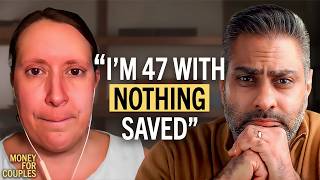
Christine and Thad have a combined income of $167,625 but a net worth of negative $199,000, mostly from $339,000 in student loan debt. Ramit Sethi pushes them to stop avoiding the numbers and communicate honestly about their spending habits, revealing that shame and avoidance are blocking them as much as the debt itself.
Chapters
I worry about our lack of retirement accounts, and I worry about our lack of savings. Since my savings account is at $101, we know I'm not saving.
I owe $125,000 to student loans on $17,000 principal. The rest is interest. We have been planning stuff or making a plan.
Dad, you don't have a plan.
I'm 57 years old. I'm only now on this point getting my finances and my stuff in order in life.
I ask him the same thing, why he gets cash out, and I think it's so he can hide his spending so that it can't be tracked.
Every dollar I have goes to this household except for the money that I wasted.
This is not fair. You're not even married.
I'm gonna be 50 years old in 3 years, and it feels like I have nothing to show for my whole life.
Is it too late? What if you didn't start saving or investing when you were in your 20s or 30s? Today we're about to get a look into this pressing question for tens of millions of Americans. In today's episode, I speak with Christine and Thad, She's 47, he's 57, and they do not have nearly enough money saved or invested to retire on time. Each have 6-figure loans, which creates a toxic mix of frustration and complacency and even hopelessness. They're also not married despite being together for over 6 years, largely because they're afraid marriage would impact their debt payments. Watch as we unpeel layers of psychological fascinations especially when we see how their psychology affects their numbers. I'm about to preview a few items from Christine and Thad's conscious spending plan, which breaks down their net worth, income, and where they spend their money. You can download and create your own conscious spending plan, or CSP, at iwt.com/csp. Assets: $0. Investments: $136,496. Savings $2,612. Debt $339,000 for a total net worth of negative $199,000. Their combined income is $167,625. Now, this CSP is going to reveal a lot more in the episode. But first, tell me in the comments, when did you start first managing your money in a serious way? What age? Why did you start then? And if you haven't yet started, that's okay too. I want to hear from you. Okay. Now let's get into it with Christine and Thad. I want to give a shout out to our new Spotify viewers and listeners where we recently started releasing each Spotify episode in video format. And I love seeing all of our new viewers coming in and watching these episodes with real people sharing real numbers from behind closed doors. Big thank you to Spotify for your partnership. If you already listen on Spotify, click over to video. There is nothing like catching these subtle moments and facial expressions that you can't catch with audio alone.
I understand you've been together for over 6 years. You've been living together for most of that time, and you have spent that entire time in debt.
Yes, because I've spent my entire life in debt.
Got it.
But also my fixed costs are very high, so there isn't also a whole lot I can do about it. And my half of the, you know, just living expenses are most of my paycheck.
Since we've been together, I don't think we've incurred any debt. We have both brought debt into the relationship through, you know, our big debts. But once we started getting together and once we moved in together, right, then at that point we were like matching bill for bill. Anything over that I didn't save.
What do you mean you were matching? What does that mean?
So like when we moved in together, we would split the rent. I would pay my half, she'd pay her half. You know, when we first started getting together, there was employment issues. So we've like, one person has made more than the other a little bit and it's gone back and forth, but it's also gone up over that course of time. So over that course of time, we've been working together on the finances and we really haven't acquired much any debt in the 6 years.
Has it gotten better or worse in 6 years?
It's gotten better.
Okay. That's good. Meaning you've paid off debt?
Well, I think yes and no. So we're responsible for like our own debts right now. So I do have credit card debt and I've paid it down, but it's not going fast. But, um, like for example, we have actually accumulated some debt, but it's all been in the service of like paying down previous debts. I'm just gonna throw you under the bus, Dad. He got a master's degree and didn't finish paying the last bit of his tuition, but we needed his transcript and they wouldn't release it without paying the last bit of tuition, which was like $3,500 or something crazy. So we had to get a personal loan from our credit union in order to pay it, because who has $3,500 just laying around?
Has what the two of you have been doing with money been working?
No.
No.
Okay. Because I'm confused because we've only been talking a few minutes and I have gotten multiple contradictory answers. Do you have debt? Yeah, we haven't— well, we haven't accumulated any, but actually we have accumulated some. Is it getting better? It's getting better, but it's also getting worse. I'm wondering what the pattern of your answers reveals.
Well, I think that Thad often likes to put a very positive spin on things.
I guess, yes, I do. I do. I can tell you the big element that, you know, contributed to it. Like, I'll just figure it out myself, whatever we need. So that's an avoider.
Avoider.
Or, yeah, like, try to do it myself and then, you know.
But Thad, you're 57 years old. I mean, I feel like if it was going to work, it would have worked.
I feel that, like, I I understand the problem. I think that I'm doing the best that I can. I'm addressing every issue of the problem.
What does that mean specifically?
Like, we're doing everything that we should be doing.
But you're doing it right now, Thad. You're presenting a positive spin. Like, oh, it's been good for the last few years.
No, it's still crap. They're still bad. But like, I'm learning. I've learned, you know, as where, you know, like I open mail now as before I never opened mail. So that's a step. You know, that's a step up. And you know, so we talk about this a lot, our dynamic between that, you know, um, I feel that I attempt to, I'm trying, right? I'm willing.
You're not, you're not trying right now in this very answer.
Um, I don't know.
I'm getting lost. You got, you guys get lost when you talk about money, right? Is that?
Yes. Yeah.
That's what I'm trying to tell you. We don't really have a fight about money because mostly I'm just managing it all and I'm saying do this and it's not getting done.
Okay.
Let's talk about that.
Yeah, that's our big fight right there. You know, like we talk about money on Sundays, we talk about money a lot. We're doing it now. Like right now we're talking about money, right? We are always talking about money and I'm there. So, you know, and your opinion is we are—
We are really not talking about money that much. And like we are set to have recurring conversations on Sundays during our set aside date time. And it doesn't happen on most Sundays. I guess it's so frustrating because the money is like what we need to deal with.
We can't be fighting about the stuff that we can't control, and we are talking about it and we are doing it together.
Except that we can control these things and we're just not because we're not talking about them.
But we happen to be talking about it right now. We're talking about it right now.
Can we do this? I'm actually gonna— I'm gonna flip the script. You've clearly thought about it, so I'm actually going to turn it over to you.
Oh geez.
What do you think is the problem and what do you think is the solution?
Uh, I'm a worrier and he's an avoider, and so I worry a lot about our finances and I worry about our lack of retirement accounts and I worry about our lack of savings. And he is an avoider, although I mean, true to what he's saying, he is getting better, but it still is like, why is this mail unopened? Recently, a medical bill sat on our counter for $50, sat there for, I don't even know how long, 2 weeks or something until it got past due. And only then was I like, look, we just pay it. And, and he logged in and it was paid in 3 seconds flat, you know? And I was just so irritated. That's like a really common, I think, example of how it goes. Then our normal conversation comes up on Sunday and he'll say, well, we already talked about money during the week. We've already had our conversation.
I asked you to describe the problem and then tell me what you think the solution is.
Oh, the solution.
Seems you got a bit lost in the story because we didn't get to the solution. What do you notice about my question and your response?
That I'm both frustrated and I don't know the solution.
Do you think your problem is a $50 medical bill on the counter? No.
I don't.
I think that's probably a symptom of something much larger. I noticed that you are, um, a crier. I know you're crying now. Why is that?
Because I just find it so frustrating.
Okay, what part do you find frustrating?
I'm gonna be 50 years old in 3 years, and it feels like I have nothing to show for my whole life. Okay, I can't get myself together enough. And neither can that. It feels like we just keep doing the same thing where I have to micromanage all of our finances. Yeah, and that part can be really frustrating because I'm trying to get my own stuff together too. I'm trying to pay down my debt so that we can save more, and I'm trying to, you know, put some extra money aside and stuff, but it's not possible. And then I have to micromanage his finances on top of mine, and that can be very challenging.
Sounds like a lot on your shoulders. Can I suggest a different approach? Sure. You jumping in to solve the problems is actually part of the problem, and you're even doing it with me.
Okay.
When I mentioned that she wants to control things, it turns into a fight. She wanted— or not admit, but she feels like she doesn't control. So we'll have a big fight if I'm saying If I mention control, or that—
I'll stipulate, and I, I will be willing to go out on a limb that Christine will agree that maybe she sometimes has the need to be in control. Christine, would you agree with that?
Yes.
When we feel out of control, we will often try to control the smallest things to give us a sense of control in an otherwise uncontrollable world. Christine, how is this striking you?
I guess what Dad says all the time. I just try to control things.
Yeah. Take your time.
I want to jump in here because what Christine is feeling is a massive clue. Have you noticed how she communicates? It's frantic, and I would describe it as controlling. Even here on this show, she seems to try to take over the room. Now, that might seem odd until you realize what this moment means for my guests. To get here, they've gone through months of prep, applications, calls, filling out a CSP, AV checks, all kinds of stuff. They've carved out times from their lives. So for them, this is not just a casual Zoom call. To a lot of guests, they see this as their one shot. So when someone like Christine tries to steer the entire conversation, It's not random. It's kind of like walking into a surgeon's office and then telling them how to operate. So I flipped it. I handed her the reins. Okay, Christine, you tell me what the problem is and then tell me what the solution is. And did you see what happened? She floundered. She brought up an unpaid bill, then jumped straight to, I'm gonna be 50 and have nothing to show for my life. That's not a very satisfying answer, especially from someone who wanted to run this conversation. And I'm reminded of this classic psychology experiment called the Invisible Gorilla Test. People were shown a video of players passing a basketball and asked to count how many times the ball is passed. Now, while they are watching these players pass the ball, a person in a gorilla suit walks directly through the entire scene. But half of the people watching this never even notice the gorilla. Their attention is so locked in that they miss what is obviously in front of their face. And that's what's happening here. She's so caught up in her story, her fear, her need for control, that I'm not sure she can see what's right in front of her. And this happens to a lot of us, which is why it is so helpful to get a third party to talk to. If you find yourself stuck repeating the same painful story over and over, ask yourself a few questions. If this were happening to someone else, what would I say? When I react the way that I've been reacting for so long, Am I actually solving anything? Am I trying to control this outcome? Why? And finally, what am I not seeing? Everyone has an invisible gorilla in our lives. Sometimes it takes someone else to point it out.
When you start a business, it can feel like you are a one-person army.
You gotta build the website, figure out taxes, write the copy, design the logo, make sure you're actually getting customers. Oh, and don't mess it up. Otherwise, the IRS will come knocking. No, just because you're the founder doesn't mean you have to be doing everything yourself. That's why services like Doula are so valuable. Doula handles the back end of your business so you don't have to learn everything yourself. They'll form your LLC, manage your bookkeeping, handle your taxes and sales tax and reseller certificates. They'll do all of that. They'll even help you get a US bank account if you need one. And if you don't know what you need yet, they offer free consultations to walk you through the whole process. Go to doola.com/Ramit. That's doola.com/Ramit and use code Ramit for 10% off LLC formation and bookkeeping.
Or if you still have questions, just schedule a free consultation with their team.
That's doola.com, D-O-O-L-A.com/Ramit. And don't forget to use code Ramit for 10% off. What comes to mind when I share these specific moments? Renewing your passport, scheduling a dentist appointment, replacing that light bulb that's been out for 6 months and you're not sure what's the right bulb. We all procrastinate on weird stuff, and taxes are usually right at the top of that list. We wait until the last second, then we get overwhelmed. We got to pull all this paperwork and we're panicked because the deadline is approaching. That's why I recommend Gelt.
Now that tax season's over, this is actually the best time to get ahead.
If you run a business or you filed for a tax extension, one small move right now could save you thousands later. Gelt is not just another CPA firm. They helped one of my colleagues rethink his entire tax setup. Now he's saving more than he spends on tax prep. With Gelt, you get a proactive year-round strategy, not just a one-time filing. Credits, deductions, business structure— it's handled. And their tech platform makes it easy to stay organized. You'll also get access to Gelt's full tax library with guides on retirement plans, QBI, and more. So if you've got a business or you filed for an extension, this is the window to take control of your tax plan. Head to joingelt.com/ramit to book a consultation. And as a member of my community, you get to skip the waitlist. Again, that's joingelt.com/ramit. Joingelt.com/ramit. Taxes don't have to be a task. With Gelt, they can be a tool to build wealth.
But Thad, what about you? The problem is what, in one sentence?
Communication.
What's the solution?
Clear communication.
You know, why does she have to ask you to pay the bills, your own bills?
Well, those are my poor life skills. I'm 57 years old and only now on this point getting my finances and my stuff in order in life.
Can I ask that the question again? What is the problem and what is the solution in two sentences, please?
Uh, the problem is lack of clear communication between the two of us and trust in each other.
How do we do it?
By going on a podcast and learning how to do it. I mean, you know, like what I'm responsive to the things that we, you know, coming up with plan and enacting them, paying, you know, not just paying bills, but, you know, uh, you know, you know. I think I'm doing this stuff. Like, what am I not doing that I need to do better?
You know, like, okay, so that's, that's a problem.
Yeah.
Thad thinks he's doing everything that he can. Christine, do you agree or disagree with that?
I disagree.
How does that strike both of you, that you may not even understand the problem, much less the solution?
Well, I do think that is the problem.
That you don't understand the problem?
I guess, yes.
Like, we have been working together lock, stock, and barrel as far as what our objectives are and how we achieve those. Like, we have been planning stuff and we are making a plan going forward.
According to you, you have a plan and it's working.
Christina, you think we have a plan and it's working, albeit not fast enough?
I think we have a loose plan, but we have no clear idea how to get there. And We're clearly not there.
What about the debt?
The only debt that I have is my student loans.
What's the debt payoff date?
I mean, never. I mean, who knows? That's what we're here for.
And what about retirement? How much do you need for retirement?
I have nothing in retirement.
How much do you need for retirement?
Oh, I have no idea.
How about how much do you need for an emergency fund?
We talk about having like $400 minimum, right? So we can get like a rug or this or that or things like that.
No, that's not an emergency fund, Thad. You don't have a plan. All right, guys, I really want to help you, but it's going to be very difficult if you're not ready to learn. You obviously have some serious financial challenges because you're in your 50s, 40s and 50s, as you put it, broke. Don't know anything about how much you need for retirement, and I want to help, but I can't help unless you are willing to accept the help. Trust me, you do not just need a budget, and trust me, you do not just need a plan, the some magic plan that I'll come up with, because if you needed that, you would have done it yourself. There's something much deeper going on here, but what I need from you is to accept that you need help, and right now it feels like Every time I ask a question, you're both resisting me and telling me why actually it's not that bad.
Let me explain why I'm pushing them so hard right now. Christine and Thad are living in an alternative financial reality and they don't even know it. They are in dire danger, but instead of acknowledging it, they're minimizing and justifying and spinning. They can't even answer basic questions like, what's the problem? Or how much do you need to retire? But they're confident, confident and wrong. And that's a very dangerous combination, especially when you are older. It's like their house is burning down and they're arguing about the paint color in the hallway. You can probably hear it in my voice too. I'm getting less patient because I want them to take advantage of this opportunity and make a change. But first they have to recognize that there is a major problem. Obviously, it's not working so far. So my job now is to play detective. And find the angle that might have a chance of resonating with them. Let me try. Okay.
I'm gonna ask Thad to read off this first box. Thad, can you read off the word in bold and then the number in full next to it for this entire box, please?
Assets, zero. Investments, $136,496. Savings is $2,000. $612. Debt is a total of $339,000. And the total net worth is a negative $199,000. All right.
What do you both think of those numbers?
The numbers didn't surprise me because I had an idea what they were. Um, looking at them is surprising because, you know, it's not— it's such a high negative number.
Okay, Christine, what about you?
We have a combined like quarter million dollars in student loans. I mean, if, if you were to like pull that out, because I don't think either of us will ever get our student loans paid off even before we die. I've been out of college 25 years and I still owe $180,000. I'm never paying those off even if I tried really, really hard and put like everything into it. So it kind of feels like those two things are— those two student loans are on our back burner a little bit. Like, I'll pay the minimum and get it done, like, get that monthly payment made, but I'm not making any efforts to pay it off because I just won't get to $180,000 before I die, I think. But so if you pulled those out, I think our numbers are like exactly what I thought they were. And it's not great. It's not a great picture, that's for sure.
What does that mean, it's not great?
I'm not surprised that our assets were zero. We have no car and we have no house. And we have no business. So I do wish our savings was higher for sure. Mm-hmm. That's not even enough for an emergency fund, you know what I mean?
Mm-hmm. Now you two are not married, but for the purposes of this CSP, we combine the numbers just for easy math.
Right.
If we break those numbers apart, the $136,000 in investments, is that—
Yes.
Christine?
Yeah, I think my part of it is something like $127,000. No, $129,000 was mine.
And of the savings, $26,120.
Oh, I only have about $150 in savings.
And then the debt, $339,000. How's that broken out?
It's like I said, it's primarily our student loans. He has about $120,000. I have $180,000.
Let's look at the income. Christine, can you read off your combined gross monthly income, please?
I can. It is $13,969.
If we combine your income just for easy math, then your household makes $167,625 per year. Did you know that?
Yes, we did.
Really?
Which is why it surprises us that we're in such financial straits.
It has, I guess.
Hold on, hold on, hold on. Y'all are about to start going off into story land. Just answer my question. Did you know that you make $167,000 a year combined?
Yes.
Yes.
Yeah.
That's interesting. 'Cause Christine, you told me at the beginning of this call, I'm broke and I don't make any money.
I don't, 'cause only part of that's mine. Only $67,000 of it is mine.
That doesn't sound broke to me.
Yeah, it sure doesn't. But I don't ever seem to have any money.
You make $70,000 a year?
Not quite, but yeah. Wow.
Even, I'm sorry, $69,465 a month.
Do I make that much? I think I make only like $67,000, which It does make a difference.
Even in my example, you can't allow an approximation.
That's fair.
You have to make sure that I know it's less. Why? Why? What does that get you?
I don't know. Some sympathy, I think.
It doesn't work for me. You're not getting any sympathy right now.
The people listening to this podcast will feel bad for me because they know how little it is.
I don't think so, Christine.
Believe me, I am way under the average for a person in Arlington.
Would you consider $167,000 a lot of money? Not a lot? What do you think? A lot.
I mean, you know, it's a lot.
Okay. Christine?
Yeah, I'd say it's pretty much a lot. Yeah, that part of it is a little like, why do we feel pinched? Although I can look at the numbers and kind of guess where the problems are.
All right, let's do the rest. Let's look at the fixed costs here. Hold on. Wow, I'm surprised. Fixed costs are at 61%.
Mm-hmm.
I would not have expected that the way that the two of you talk about money.
Well, right, but you can see the personal breakdowns of the fixed costs where I shoulder about 80% and his is only about 50% of his income because we're paying exactly half of everything.
Yeah, that's a major problem.
So I feel very stressed.
Let me explain what I'm seeing here. Christine is paying 78% of her take-home pay to fixed costs. While Thad is paying 50% towards fixed costs. So considering that Christine is making a lot less than Thad, she's still paying 50% of their rent. Okay, so we're going to talk about that fixed cost, but let's just go through the rest of it. Investments, zero. Savings, what, 3% combined? But I want to point out they're saving $175 for vacations $100 for a sewing and improv class, but $0 for an emergency fund.
Yes, but don't, don't explain.
Don't explain.
Okay. I won't.
We're just looking at the numbers.
Okay. Fair.
36% combined for guilt-free spending. Christine's guilt-free spending is 17%. Thad's guilt-free spending, 49%. So Thad is spending essentially half of his take-home pay on guilt-free spending. What does that guilt-free spending money go towards?
It's nothing in particular. It's a nickel and dime kind of situation. Food, just wasteful spending. I know. Oh, well, I do have a daughter, and so some of that goes towards that, like her teeth and dentist and the costs for like school clothes and shoes and—
Okay, well, let's talk about that then. That— take us through your spending.
Suffice to say.
No, no, no. I don't want suffice it.
I want to know what you are spending on clothes, shoes, food, and that's it. All right.
How much are you spending on clothes?
$100 a month.
Okay. That's the first thing you're mentioning to me. Clothes is $100 a month. You're spending.
Is that right? No. 40 bucks a month.
Oh, it went down at most. What's all that stuff in the background of the videos that I see? What's your background?
Uh, those are the board games hobby.
Oh, how much did all those cost?
You wanna, you wanna address that one, Christina?
A lot, but we haven't purchased any new games in the last like 3 years.
We're doing the numbers though.
We have cut that off.
You guys ready to gimme a real answer instead of trying to deflect?
I mean, it's 20 years worth of stuff, right?
I mean, I don't know, $10,000?
$10,000? No, $10,000.
I have no idea. In truth, I don't know. It could be $5,000.
Yeah, I thought $5,000 is a better number. $5,000. It's about $40 bucks, Bob. So it's about $5,000.
Okay. $5,000 to $10,000 on games.
What else are you spending your money on?
I'm wasting it. That's all. Like, you know, it's spent.
On what?
Uh, food, cigars.
How much on cigars?
$15 every 2 days, so $30 a week.
You better redo that math. $15 every 2 days is not $30 a week.
About 3 times, yeah. It's about $30, $40 a week on cigars, honestly.
How much is that per month?
Uh, let's say $200.
$200. All right, fine. Food?
$300.
$300 on food.
Okay.
What do you, what do you spend that money on?
Eating out, school, eating out at different times.
Eating out at school. And what was the other one?
Like, I'm a teacher. And so I go out for lunches of about $12, like a sandwich and a drink and chips.
Tax? Tip?
$15. Oh, yes. Yeah. No, of course. Tip. Of course. I was a waiter for many, many years. Yes, I do tip. So let's say $20, about $20.
Do you notice what just happened? You said $12. The real answer is probably $20 or maybe even more.
Right.
People who are ashamed of money and who are in debt, they will often use ranges. They'll say something like, oh, it's like $12 to $15. It's actually more like $20. And they feel very, very uncomfortable being honest with how much it is.
They always err on the side of less than they are actually spending, right?
Yeah, I do. I do.
You do?
Yes.
All right, so how much do you spend per month on eating out?
When I say $300— $300.
Do you have it on your credit card?
I do not.
Where do you— how— where do you spend the money?
I get cash.
Why?
Uh, just old habit.
I don't know.
I don't believe that because I sometimes I'll lose the card, you know, like in the last couple of years I've lost the card. Um, I don't use it.
You know what the fuck is going on right now? This, this is not believable to me.
Right.
Well, I asked him the same thing, why he gets cash out, and I think it's so he can hide his spending so that it can't be tracked.
I just don't believe it. I don't believe that you only spend $300 a month on eating out. I don't believe that you only spend $40 a month on clothes. I—
the way you're presenting it, oh, I'm me, me, innocent Doe. I don't know where the money's going.
You keep telling me on one hand I'm spending a bunch of money and I'm like trying to figure out where, cuz it's almost $3,000 per month. How are we getting to $3,000?
Okay, to be— can I say, be fair, one thing?
No, I just want to know the numbers. Where are you getting to $3,000 a month? I can't help you unless you tell me accurate numbers. The numbers you are telling me are not adding up.
That's it.
All right.
Hey, can we take a little break for a second?
Sure.
I'm going to be really honest. When Thad asked for a break, I thought he was about to shut this whole thing down and leave. This is a very intimidating environment for my guests. They go through a lot of steps to get here. There are cameras. They're meeting me for the first time, and they are talking about one of the most intimate topics there is. Naturally, it feels really uncomfortable, but I think the discomfort goes deeper than being on a recorded video. With a lot of couples, you'll notice the long pauses, often the overexplaining, and sometimes the same phrases that they've been using with each other for years and years, which suddenly fall flat when there's a third party involved. But then, to my surprise, that didn't leave, watch what happens. There's this new ChatGPT agent feature that I'm playing with. It's like an agent out there looking for your perfect dinner reservation or flight or hotel booking. It's basically like a virtual assistant who doesn't sleep. I love this. I actually want more agents who are out there in my life patrolling, making my life easier. That's why I use DeleteMe. It's basically an agent that patrols for my personal information being leaked, and then it automatically cleans it up for me. Here's how DeleteMe works. You give them your information once, and in about a week they will send you back a full privacy report where your data is, what they found, and what they are removing. They scan a bunch of people search sites and data brokers for your personal information, including your name, phone number, old emails, even relatives' names. And then they get it removed and they keep going, patrolling, monitoring those sites all year to make sure that it stays gone. DeleteMe built their own technology and they have real privacy advisors to help you when you need it. They've been the experts in this for over 15 years and they work with everyone from judges to journalists. I've trusted them to protect my own personal information and my parents too. You'll get 20% off all consumer plans when you go to joindeleteme.com/ramit and use promo code Ramit at checkout. That's joindeleteme.com/ramit Code Ramit Sethi for 20% off. One of my coworkers is a copywriter, and he told me that he recently took Aaron Sorkin's screenwriting class on MasterClass. He said it completely changed how he writes. Screenwriting forced him to think differently about structure, pacing, holding attention. It's a totally different format than direct response copywriting, but it made his copy tighter, clearer, way more effective. That is what I love about a MasterClass membership. Sometimes the best lessons come from way outside your lane. For $10 a month billed annually, a MasterClass membership gets you access to over 200 classes taught by the world's best, from Hans Zimmer to Alice Waters to Bob Iger. Instead of binge-watching or doom-scrolling, you can learn from the best to help become the best. One of my favorite MasterClasses has been the home design class with Kelly Wearstler. I've always loved beautiful design, like in some of the luxury hotels that I really, really love. And I love when she took us behind the scenes of the Proper Hotel to show us how she designed that architecture working with the existing building in place. Right now, our listeners get an additional 15% off any annual membership at masterclass.com/ramit.
That's 15% off at masterclass.com/ramit.
Masterclass.com/ramit.
Thad, the amount you have left at the end of each month with your income is 49% of take-home pay, which is $2,820, and we can't quite figure out where's the money going.
Well, we had a little discussion and thought about it and sort of broke it down, and I think a lot of it was going to, uh, sort of going out and sort of drinking and maybe hanging out with friends and partying and wasting money in that sort of limelight kind of situation.
How much?
Uh, whatever was left. I mean, I'm being honest with you.
I appreciate it.
I try to— I said this in the beginning, if I have money in my pocket, I'm spending it. You know, as long as I pay my rent and my food and the bills I got to pay and I'm meeting my obligation in the relationship, then everything else is mine.
Dad, did you grow up poor?
I grew up very, very poor.
Yeah. What you just said is very typical of people who grew up poor.
I know that we overtalk, but like, Again, these are issues that we've talked about and they've been walking with for years. Maybe I'm a little vague or that, but they are, I understand the relationship between my money and how I was taught and raised and how the habits I have now. And it's been a very long struggle to break those. And the difference between self-awareness and action is a mile apart. It's hard to be completely open and honest. When you can't be completely open and honest, you know, and, uh, yeah, about the drinking and the alcohol and, and, you know, and Christine and I have been talking about switching from living in the moment and having fun in the moment, which I will always do, right? As opposed to putting money aside and saving it for the future, right? That has always been a balance, you know, and the latter has never been something that's been, I thought about. And, you know, now I realize I'm going to reach retirement age one way or another. I need to be prepared or not. You know, that's why I'm willing to be as honest as I can with here.
I appreciate the honesty. Without you sharing this, the rest of the picture is incomplete. It actually doesn't make any sense.
I know. And I knew that. I'm so sorry because I was trying to fix the problem without telling you guys the whole truth.
I appreciate that.
And I would say the one thing that I was embarrassed about coming onto the show for was that I owe $125,000, uh, to student loans on $17,000 principal. The rest is interest because I just ignored it for 20 years. And you're like, if such a minor thing, you know, at this stage in life, I could pay that, you know, but to have $17,000 balloon to 120, you're like—
but isn't there some relief in being able to just shine a light on our deepest shame? Yeah, just to say like, yeah, I didn't know, and also I was negligent and irresponsible, and here I am. What's done is done. I, I'm coming here because I want to understand why I behave the way I do. It's not okay anymore. I could tell my wife is not okay with it anymore. She's been crying for almost an hour. And I want something better for the next chapter of my life. So I put myself in your hands. Show me some ways to get there. That's how I approach this. Like, you tell me you have, you know, struggles with alcohol and, and student debt. Okay, everybody's got struggles. I appreciate the honesty. I hope you can see I'm not here to judge. It brings that fuller light. And now we can really start to talk about what is truly going on here and what can we do about it. So thank you. I was surprised to hear he was keeping a secret.
And I don't mind secrets. I don't even mind being lied to on this show. It's part of my job. But usually people tell me the truth about the broad strokes.
What I think we can see here is the powerful grip of shame.
Like, you and I can deal with being angry or sad or even resentful.. But shame is a very, very powerful emotion. It's often like emotional quicksand. When we feel ashamed, it's difficult to even talk about it, much less come up with a solution. That's why it's so important to get help. I also want to point out that I'm very sensitive to addiction issues. It's not my place to ask anything here, nor am I qualified to. I don't know if he spent $1,500 or $150,000 on drinking in the last 10 years. I heard him. I acknowledged it. I filed it away and moved on. What matters is that he admitted it, and now we can move on to what's next. Because if he wants any shot at building a real financial future, this is where it's going to start.
What do you remember your family saying about money?
Well, it was an active situation. Like, my mom was a single mother for a long time, was really bad at money. At a very young age, I realized that like at the end of the week, it was going to be gone. I'll tell you, we would chase checks. We'd buy food, spend the money, go to a movie, and then for that entire week have to go to the grocery store to get cash to put in the bank to cover the check from the previous day. She would chase a check all week, right? Uh, and I realized we're sacrificing a moment of play on a Sunday to have fun, but I see, you know, we don't have the money for it and we're doing a lot of work to cover that.
How did you know you were poor?
I knew I was poor because of friends and like an expansive life. So like I was babysitting, you know, and I'd see how other people lived. I also, my mom had this whole set of friends and around 8 or 9, you know, they kind of said, hey, you have to start taking care of your kids more, your son more, you know, be more responsible. So it was an ongoing kind of narrative throughout, you know, our neighborhood, you know, like even in our very poor neighborhood, my house was the dirtiest of all the houses, you know, and I could never in my entire life have people over for— never had friends over, you know, never had girlfriends over, you know, have to hide that kind of shame and, you know, and I will say the biggest thing that impacts me that I think impacts me the most is At the end of my grandmother's life, she had a whole inheritance. It was just an ugly scene to watch that play out. You know, my mom, who has resentments her whole life, doesn't want to spend a dime because it's detracting from her inheritance, not telling people things, you know. And like, I think in the end, grandma passed and she had like all this money and didn't reveal it. And I did what I did when I was a kid. I said, you know what, buy me a PlayStation 2 and I'm gone. That's all I want. You have $200,000.
What did your mom do with the $200,000?
I mean, look, it's just she would buy $1,000 chairs. Like we had these 4 chairs that are $1,000 each. And look, we had a house that had dog poop in the kitchen, you know. And I'm like, you're going to buy chairs that cost $4,000 to put them in a house that has dog poop in it. It's that God-sized hole that you fill with things, you know, it never gets filled. But, you know, she just kept spending and spending and spending, trying to fill it, you know.
Do you see any similarities with your mom's spending and your spending?
I mean, exactly. I mean, I've lived parallel lives, you know, and that's why I'm here at each station in my life. I would look at like where my mom was, you know, and see the mistakes that I've done that I'm following in her path there. And like, I don't want to go down that path, but my path, there's no other option out there. You know, even if we sit down here today and come up and I understand what the plan is and we have a budget and I'm willing to work it all, you know, there's just the amount of time between now and then.
Yeah. What lessons do you think you took away from your childhood as it relates to money?
I don't value it much. It comes, it goes. I waste it. I spend it.
I drop it. So you spend it, you waste it, you enjoy it, and go get more. And, you know, that's it, right? Basically no big deal. Yeah, I think that's a pretty accurate lesson that you took away from your child. I mean, look at your mom. Yeah, yeah, she would spend it, check chase, do all this stuff. And, and if we take an honest look at her situation right now, she's actually okay.
I also, I would tell my childhood I took away is I never expected to live past the age of 30, right?
Your dad died at 30?
My dad was never in the picture. No one in my family that I know died at 30. I just know that everyone died, like, it was just an arbitrary number, like, in my neighborhood, just many, many people died.
Why'd they all die?
Like, in the '80s, like, a lot of drugs, like crack hit our neighborhood. Where did you grow up?
Pittsburgh.
Okay.
Yeah.
Wow. Yeah, I went to college and came back and it was devastated by that epidemic. But even prior to that, like not having, you know, a community where, you know, dads weren't present, you know, the family structure wasn't there, you know, understanding that it existed. We just didn't have it.
This is really opening my eyes to, to your— you today with money. When you take me back, and I think it's a gift you're giving me, a lot of people cannot imagine what it is like to grow up in a neighborhood where you just don't see a lot of older men. They're just not around. You know, how many people from the time you were young to the time you were 30 do you know in your neighborhood that died?
I literally was telling my daughter, talking to my daughter about this, you know, about this, because, you know, I'm raising her and she's a teenager. And I was going over and I think that two-thirds of the people I grew up with, if not 85% of them, are dead. Or like in prison, but like, yeah, I'm one of the few that I know made it out of there.
I think it seems somewhat apparent, like, why he has the— I don't know, takes the actions he takes, I guess, spends the money and doesn't save it. Um, I too did not have a good role model for that, and you can see where it's gotten me. I can appreciate when he's growing up with a single mom in a poor neighborhood, you know, if people around him are not living to an old age, why would you prepare for that?
It's You know, I've known these mistakes, like living with this and battling this lack of money, you know, my entire life. And, you know, I've made some strides, but just when you're aware of it, it's, you know, that makes it frustrating.
Yeah.
And I have to break that habit of if I have it in my pocket, then I can spend it.
Or what?
Or, or I'll continue to be in debt.
Have you ever thought about it? Like really thought about it? If I keep going on the path that I'm going on, I'm already in my late 50s, um, I am homeless under a bridge. Are you being for real?
I'm being 100% honest. I would be homeless under a bridge, still trying to do stand-up comedy at the age of 70. And I'm a dreamer, so I still think for some reason I'm gonna make it big somehow.
My jaw was on the floor listening to that. It's one thing to hear someone say that they grew up poor. It's another thing to hear the vivid details of what that really means, like never inviting a friend over or never expecting to live past 30. Most of us have no idea how deeply socioeconomic class shapes our life and even what we believe is possible. And this is what people mean when they use that word privilege. You know that word that everybody scoffs at? Think about the privilege you have. If you grew up in a family where someone said, of course you're going to college, that's privilege. If your parents took you to visit a campus when you were a kid and say, hey, one day you can go here, that's privilege. In fact, that's what my parents did. They told my sisters, you can go here to UC Berkeley. They told me, you can go to Stanford. And because they said it, because they showed it to us, it suddenly felt normal and possible. And that's actually where we went. Now imagine the opposite. Imagine growing up in a world where, according to your eyes, nobody really lives past 30, where you literally don't see old people around you because they're either bedridden or they all died. How could you possibly even think of planning for retirement when you don't even believe you'll make it there? This is why models matter. It's what people mean when they say representation matters. If you don't see it, it doesn't even feel possible. And here's the takeaway, especially for parents watching this show right now. If you're raising kids, think about the possibilities that you can open up for them. It could be college, it could be money, it could be anything. I remember my sister once competed in a powerlifting event and she brought her daughter to the competition. Imagine being a young girl and seeing your mom, who's a doctor, lifting more weight than most people can imagine. What do you think that does for a young girl's sense of possibility? That is the gift you can give your loved ones, your kids, your family, even your friends. Exposing them to new models, especially you living a rich life and being competent with money. Let them see what's possible. You've heard me say this with money before. Fight for simplicity. The more complex your system, the more things that can break. And it is the same in business. Now, as an entrepreneur and CEO, I have seen tons of complexity in my own business. You got accounting in one tool, HR in another, inventory, if you've got it, tracked in some random spreadsheet. Every decision becomes a scavenger hunt. That complexity can kill your momentum. So we simplify. And that is exactly why I love what NetSuite is doing. NetSuite by Oracle is the number one AI cloud ERP used by over 41,000 businesses to simplify operations and make smarter decisions. It brings accounting, inventory, HR, and financials into one system. No more jumping between tools, no more having to patch together reports, just one source of truth. And because AI is built in, routine tasks get handled automatically, freeing your team to focus on what's important. If I had had this type of system when I was building my business from scratch, I would have loved it. NetSuite helps you cut through the noise, stay agile, and make faster, better decisions without having to guess. Speaking of opportunity, download the CFO's Guide to AI and Machine Learning at netsuite.com/ramit. Get it now for free at netsuite.com/ramit.
That's netsuite.com/ramit.
Christine.
Yes. Take me back to your childhood.
Oh boy. Oh, thank God I have another tissue right here, huh?
Okay. Tell me.
I would say that we were lower middle class. I grew up in a suburb of Cleveland. So basically what happened, when I was like 12-ish, my parents decided we were gonna move. So my mom says, oh, we drive into this new development. She wants to get a house in this development, and it's gonna have to be constructed from scratch. Of course, it's a brand new development. And so they had some model homes there, but they couldn't afford the model home, so they literally had to make a smaller version of the model. It's been a while, but they had to make like steeper roof because it was like somehow like less material. All the garages were supposed to be side-facing. They had to get a waiver to make a front-facing garage, so they had to pour less concrete, and that cost us less.
But what happened?
So basically, the house took all our money, and my dad still doesn't have money to this moment. He still hasn't paid off the house. It's been 35 years.
What did you learn from that as a 12-year-old?
That I wish my dad could have said no.
Oh, okay.
I did find out years later, like kind of more recently actually, that my brother and I went to private school for like first grade through 12th grade, and they had to take out loans to pay for it. And so like those kind of things frustrate me when I'm so much in, in student loan debt, where you're like, couldn't you save some of that money to help me pay for my school or something?
Do you ever talk to them about that?
I have talked to them a lot about it, and, uh, It just kind of was the decision they made. They felt very strongly that I have a Catholic school education.
And it's really interesting, I've spoken to several parents on this podcast who insist on sending their kids to private school.
They—
that was their rich life, I guess, sending me to a private school. And I have a younger brother too, so we both went. But there were other things too, because, um, well, you know how much I own student loans. So a lot of it was my undergrad. I had also gotten a half-ride Eastern Michigan. Mm-hmm. And I, but I didn't wanna go to Eastern Michigan. I didn't think it was like as great. I went to Duquesne and I loved it and I wanted to go there, but it was like more expensive.
How did you decide not to go to the school where you had half tuition paid for?
In truth, I was a stupid 18-year-old. I didn't understand. And everyone around me, because, you know, this was almost 30 years ago and nobody was talking about student loans at that time like we are now. Mm-hmm. So my dad was like, oh yeah, it's fine. That's cool. But then I have been stuck with the burden of the student loans since then. You know what I mean? It's just very frustrating. I think.
Who are you frustrated at?
I think in truth, mostly my parents. They spent a lot of my childhood robbing Peter to pay Paul. And, you know, electricity would get turned off, our cars would break down on the side of the road all the time. Wow. It just— it was always like we were in debt. And never could get out of it. So, you know, it just, I think my dad struggled to ask for help as well. And so would get himself into maybe a financial situation, but didn't know how to get himself out and would think he had to do it.
Hmm. What lessons did you grow up with relating to money that you bring to this relationship?
Whoa. Um, that is actually a really tough one because I have done everything I possibly can to be different than my parents. And I still feel like I'm in the exact same spot of like not being able to get ahead. I mean, despite my paltry savings account, it certainly is more than they have. My, my investment accounts are more than they have. I'm aiming for financial—
I'm not asking you to compare yourself to your parents.
I'm asking— I don't know. I don't think I learned any lessons from them.
Christine, I'm not asking you to compare yourself to your parents. I'm asking what lessons did you observe or absorb that you are now bringing to this relationship?
I think that you have taken their lessons and internalized them into a fear of yours and sort of like operate from that. I mean, that's what I kind of think. I think that you see what their life— the choices they made— and you prescribe your own feeling to that, and then you— that's fearful for you.
You operate from fear. Do you agree, Christine, or disagree?
Oh, I agree 100%.
Okay, that's, that's kind of profound. Good, good point, Dad. I always say the partner knows best. If you are stuck, sometimes you just ask your partner. They, they know. They've been watching it for years. Christine, uh, how come that didn't come up when I just asked you?
Well, that is what I was saying. I was trying to be different from my parents because I'm afraid of being like them.
But you're still afraid today.
Well, right, because we're not financially stable.
Ah, so if you were financially stable, you would not be afraid. Is that what you're saying? That's correct.
Okay.
And have you taken specific steps to become financially stable?
I've tried.
Oh, that—
it's not been successful, but I have tried.
How do you feel about your student loan?
Indifferent. I don't think there's any hope of paying it off before I die, so I just am not making a very concerted effort.
You have $180,000.
Yeah, but what am I supposed to do about that? I only make $67,000 a year.
Okay.
I'm not talking about solution. I'm talking about how do you feel about that debt?
I did not understand the ramifications of my decision. I think people had told me I would make enough money to pay it, but the truth was I didn't. And I do feel indifferent because I have no interest in really making any effort to pay my student loan. I will pay the monthly payment, but I'm not going to make extra payments.
Okay, fine.
When it's never going to get paid off.
And Thad, how do you feel about your $120,000 loan in a word or two?
Uh, shameful, uh, and overwhelmed.
Yeah, that's more common.
I mean, I get that, but what am I supposed to do? I mean, it's been around for 25 years. It's not getting paid, so I'm doing my best, but I have other debt that I can actually pay off and make like a difference in my life. The student loan, I just—
but it's something that we talk about a lot. We feel overwhelmed. We're not going to be able to pay it. It's a constant hindrance in our lives. It's the reason why we can't get ahead. Kind of. That's the kind of narrative that student loans play in our, in our conversations.
I love that you use the word narrative. Yeah, I love that because so much of the way that we treat our money is purely a narrative. Yeah.
How old is your daughter?
14. 14. Remember when she was like 4, like 3, 4? It's all like making up stories. You know, I'm flying on a unicorn, that type of thing. Adults are actually not much different. So much of our relationship with money is essentially a fairy tale.
Yeah. I mean, I see what you're saying. It's not making me more interested in paying them.
Hearing how Christine grew up with her parents racking up debt, it's no surprise that she is caught in the same exact cycle today. And this is the unfortunate reality for millions of Americans. Compound interest can work for you or it can work against you. In this case, it works against them ballooning into something so overwhelming. They've basically just filed it away and they try not to think about it. But of course, what does that do? Ignoring it only makes it worse, which is one reason that so many people feel crushed by their loans. The weight is so heavy that they just give up. They stop opening statements. They stop imagining what life could look like. Without that debt. But on this show, we don't run from what's uncomfortable. We actually go straight through the fire. So if you are in a similar situation, buried under loans, not even sure how to start, you don't have to do it alone. In my money coaching program, I show you step by step how to take control of your money, build a plan, and then stick with that plan so you follow through. You can sign up at iwt.com/moneycoaching. Now listen as I push Christine and Thad to face the consequences of years of inaction. See if we can finally create a plan for them.
In the next 10 years, of course, I anticipate that Thad is going to retire, and I do worry because I certainly have more in my retirement accounts, but it's not enough to support us both.
What will happen?
Well, we've talked about moving to a lower-cost area once his daughter's out of high school. She's just going to be a freshman and starting in 2 weeks, so we've got, uh, 4 or 5 years before that could even be a reality.
We could go back to one of our 2 hometowns. Pittsburgh or Cleveland would, I think, be good choices for us and have family nearby.
But I think we're gonna have to live in, you know, maybe small cramped quarters, still no car, relying on public transportation in areas where that's not as possible as it is here. I definitely don't think we're going to be able to take any vacations.
I enjoy to get a pedicure, and I used to get one just once per year on my birthday, and we have increased that kind of recently in an effort to have a more rich life. I think that those kind of things obviously couldn't be little splurges anymore. It just is, um, I think we'll just have to live a tiny cramped life.
Yeah. Dad, what about you? If nothing changes 10 years from now, I have a little bit of a different view. I'm more optimistic about it. I don't think that it's going to be cramped.
I still think that somehow we'll move to a place that we want to live. So I mean, something like Maine or the Northwest. I think that in 4 years when we are out of the high school, then I think the future opens up then. We can do it what we want. I don't necessarily think that that's going to be a downward trend.
What about the money part of it?
I mean, I'm not afraid of not having money.
Just, just to put another way of looking at it, right now the two of you have a savings of $2,612 total.
Mm-hmm. You have $136,000 invested. Mm-hmm. You know, if we're, you know, being relatively conservative, you know, maybe you take, I don't know, $6,000 a year withdrawal from that amount.
Mm-hmm.
What are you gonna do with $6,000 a year?
Nobody can live on that.
You don't own a house, so your housing costs, even if you go somewhere cheaper, still gonna exist.
Now we're talking about Social Security.
And if you know anyone who takes Social Security, it's not a lot of money. We're talking poverty line, below poverty line. I guess what I'm trying to get at is like, let's get really specific here.
If nothing changes the way I see it, there's no vacations.
You are forced to move to a place that you will probably not want to move to because it by definition will be undesirable.
You don't eat out.
You're, you're literally getting the cheapest on-sale bread. That's what we're talking about day to day.
What do you guys think of that? Yeah. And how should I feel about that? I think you should feel extremely terrified. Okay. Are you all prepared to make some big changes or do we want to make little changes?
I personally am prepared to make very big changes. Okay, Dad? Yes, I'm prepared to make big changes. Love it. Let's do it. Can we have the options for little ones too? Just so— okay, just kidding. Your fixed costs are at 61%, which again is striking to me.
A couple of things I want to highlight here. Your car payment/transportation is extremely low. So what are you taking, the train? I ride my bike. You ride your bike. Great. We use Metro and bus in other— Love it. Times. Yeah. I love public transportation. If you had a car, your numbers would be over 70. Great job. Keep it up. Let's look at the rest of it. Phone at 170, whatever. Subscriptions at 207. No way. Drop that. I don't know. Does NFL Sunday Ticket go? If you're asking me, the answer is yes.
That should have gone in the first place.
No, I was talking about that. I'm sorry. Not you, Ramit Sethi, because that actually saves us money by him not going school, she's just going to be a freshman and starting it in two weeks. So we've got four or five years before that could even be a reality. We could go back to one of our two hometowns, Pittsburgh or Cleveland would I think be good choices for us and have family nearby. But I think we're going to have to live in, you know, maybe small, cramped quarters. Still no car, relying on public transportation in areas where that's not as possible as it is here. Let me put it this way. If you guys are faking it for me, good luck. I'm not. But I'm saying, like, I don't think— Christine, I don't know. I'm being realistic. Christine. Yes. Your need to control is showing up right now. Okay. What is the new subscription number, please? I mean, yeah, it's at $0. Okay. I mean, geez, that does seem like extreme, but yeah, no, we can cut. We can cut. Hold on. What, what seems extreme to me is having $339,000 of debt and almost no savings at age 57. I don't think you're prepared for the type of changes you need to make. This is the easiest thing we're going to do on our whole call. $207. Christine. Yes. What's the indecision here? I don't know. I actually don't know. But it's you. Yeah, it is me. It's totally me. I think that you are surprised that that is actually participating with money, that he's actually moving in a direction that would produce a healthier outcome. I think you don't believe it. I think you think it's too good to be true. And the minute we hang up this call, it's going to go back the way it is. You think that by decreasing the amount you have to cut, he might actually follow through. But that's not how it's going to work. Either he's going to do it or he's not. Right. I need you to understand that you have to be willing to ask for what you need. Okay. And that you also need to be willing to ask for what you need because you're 57. In other words, you can't both be fighting each other on this. You actually both need to be a team, and you need to be having an upward spiral, otherwise you're doomed. But I believe in you, Christina, and you can believe that I will be there. How about that? If you believe that I, I will put my best forward effort and walk away with you. It's hard because so many things I've asked him to do over the years, they don't get done, and so I don't feel like this is gonna get done. It's just hard. I get it, I get it. There's a lot of scars when you ask your partner and they don't do it. They either outright refuse, they kick the can down the road, they let a piece of paper sit on the counter for 6 months. It really causes scars. And at a certain— look at this, Christine can't even believe that, Thad, that you will cut an NFL subscription. Do you see the effects that your behavior has had on Christine? I do. So I don't know if the two of you are going to stick with any plan that we come up with. I don't know. And actually, that's not really my responsibility. I can't control your finances. I'm not here to be the magical savior. It's your money. You all got yourself into this situation, and the only people who will pull you out will be the two of That's it. It's really as simple as that. Now, you might make it. I hope you do. I'll give you as much support as I can on this call.









