“I’m in $20,000 of debt and she pays for everything. What’s the problem?”
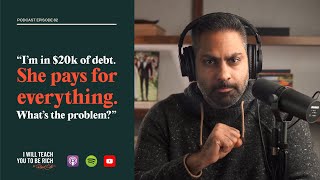
Ramit Sethi hosts a coaching-style conversation with David and Melody about their strained financial dynamic. David has about $22,000 in credit card debt (previously between $15k–$22k for ~3 years), is only paying minimums (~$1,300/month) at very high interest (~26%), and has no concrete repayment plan. Melody (together with David 16 years) pays a larger share of expenses, feels anxious about long-term plans and the couple's differing money behaviors, and has about $5,000 in credit card debt herself. The episode explores their backgrounds, feelings about money, and why the issue has become urgent now.
Chapters
I've got $22,000 in credit card debt and I'm maxed out on all of them.
Oh, currently, are you paying it off?
No, I'm just paying minimums. 1300.
And do you know the interest rate on your loan?
Like 26 and a half?
Yep, yep, 26%.
Yeah, that's what Melody said too, when I told her.
Holy shit.
Yeah, it's horrible. It's hard to put into words. It feels suffocating. It's not all I think about, but it's suffocating.
If you are now making more money than you've ever made before, why is the debt still growing?
Because I'm spending the money. Well, here's the deal with my money, I either have $50 or I have $5,000. That's how it is for me.
I've chosen him as my life partner. Even knowing that, that feels different when you're 25 than when you're 35 than when you're almost 40.
A few weeks ago, I was holding a money coaching session and I got a question from one of our students. I'd like to actually play the clip for you.
Next question, Melody. Melody says.
What do you do if.
Your partner is self employed but overwhelmed, not booking work, has over $20,000 in credit card debt and not open to money talk until he's out of debt, but he has no plan for when that will be because we have time and he's happy with where he's at.
And you pay for everything.
Let's just let the chat room speak. Let's see what some folks say. First of all, everyone's like, go on the podcast. Definitely come on the podcast. That will allow us to get into more detail.
And today I get the chance to introduce you to Melody and David. They live on a large piece of land in Texas, and technically things should be going great since all of their expenses are covered by multiple tenants that they have. Unfortunately, they see money very differently. Melody wants stability. She wants a plan. David has a much more complicated history with money. He's never had a lot of money, and earlier in life he decided to abandon the idea of ever making it. Now it's really starting to cause conflict. As you listen to today's episode, I want you to ask yourself, how do you talk about money if you're living together, spending together, but you see money completely differently? I'd like to encourage you to find this episode either on audio or on video at YouTube. You can just search for my name, Ramit Sethi. Make sure you follow me. There. And you can watch the body language and the facial expressions as we go through today's episode. My name is Ramit Sethi. This is I Will Teach youh to Be Rich.
David and I have been together for 16 years and we have made some really big steps forward. David feels like we've talked about money a lot this year and I feel like we barely cracked the surface. I hold a lot back in the conversation and some of that is because I don't think I know how or have the tools to talk about money productively, especially given that we're in different positions. You know, we talk about, you know, to use your phrase, our rich life a lot, but I don't think that we talk about how we're going to get there. And that makes me me really anxious because it's cool to talk about renovating our house or building the dream that we have for our property. Right now. I feel like if I don't pay for it, it's not going to happen. And so that feels really limiting to me.
You nervous saying that out loud?
Yeah. Okay.
You wrote me a question in the money coaching group. Are you okay if I read the question off that you asked me?
Yeah, it was. I haven't read it to David and I was feeling really alone and isolated and unguarded in my words just to say that.
Okay.
David, are you okay if I read this question that she asked me earlier?
If it's a real question today, just as it was when he wrote it, then I don't have a problem with it. Melody?
Yeah, I mean, I think that there's parts of it that came out of frustration, but the, the theme of it is really, I think the root of how I feel sometimes.
I'm okay with it.
Here's the question Melody asked. What do you do if your partner is self employed but overwhelmed and not booking work, over $20,000 in credit card debt and not open to money talk until he's out of debt, but has no plan for when that will be because, quote, we have time and he's happy with where he's at and you pay for everything.
Melody doesn't pay for everything. Y'. All. Not even close.
Okay, let's stipulate that Melody does not pay for everything. I can see it in the conscious spending plan. David, you certainly pay for things. Want to make sure that we're accurate about that. Putting that point aside, that's a pretty direct language.
I've heard all of those. I made some of those statements that have heard those questions from Melody. But she asked you the question. So.
Melody, when you wrote that question, what was going through your head?
I don't know how to make this change.
How long have you felt that way?
As long as. I mean, You know, I think David's always been David and he's always felt the way that he's felt about money. And I've chosen him as my life partner even knowing that. But I think as you know, that feels different when you're 25 than when you're 35, than when you're almost 40. And I see how hard we both work and how hard we physically work. And both of our parents, like all of our parents are retiring. And you know, I think the urgency shifts. So there's always been themes of that for me.
We've.
We've never aligned on money, but it's becoming. More and more relevant that we start to find some alignment because I feel like our opportunity of creating this life is passing.
David, when you think about the word money, what words come to mind for you?
Melody and freedom and debt.
Why those three?
Well, because me and Melody have been talking a lot about money in the last year. Freedom because I have a newfound love for money. I want to make more, I want to have more. And debt, because I think about debt every hour of every waking moment right now.
Is that true?
It is true.
Why?
Because I've got $22,000 in credit card debt and I'm maxed out on all of them. It's hard to put into words. It feels suffocating. It's not all I think about, but it's suffocating.
How long have you had it?
I've been between 15 and $22,000 in debt for three years.
Melody, when you think of the word money, what words come to mind for you?
A responsibility, sacrifice. And fun.
Fun. Tell me more about that one.
I grew up in a home that was really restricted because of the money we didn't have. And it also plays into my parents story and that's really scary for me.
Do you mind sharing their story?
My parents had a business together, but he never paid the taxes. And when they split up, he left the state. And my mom was burdened with all of that. It dictated everything. Like we could only rent because she couldn't get along because her credit was totally trash. She cleaned houses and a lot of the reason why is because she could work for cash and her income wouldn't be deducted. Pretty serious stuff that shaped the way that I grew up and the things that we had access to. And so I see that money allows you access to experience. It allows you access to the light, like a life that you want to live.
Yeah. And the other two words that you said, tell me about those.
You have to be responsible and sometimes make sacrifices in order to have those things. And money.
And why are we talking now?
Because I know that can't make David feel very good. And I don't want to be.
Like.
I don't want to contribute to, you know, his feeling about where he is. I know that he works really hard and he has the best intentions and he wants to give me and our life everything, but I just feel like right now we don't have the right tools put to use to do that for us.
David, when you hear Melody talking about money like that, how does it strike you?
I. I hear her and I agree with her. I get defensive right off the bat. But, you know, I agree with her that. That. That money will help our dreams come true. You know, I don't know.
Does it hurt to hear some of the things she said?
No, it didn't hurt. It doesn't hurt because at all.
That's interesting, isn't it, Melody? It almost felt like you were tiptoeing, kind of walking on eggshells. And if David is to be believed, which I do, he says, that didn't hurt me. What do you think about that, Melody?
I'd ask, did it not hurt because of the rationalization of why it functioning that way right now? Kind of our agreement is that I buy the goods, David builds what we need, and. And in some ways that works, but I think in. In the larger things that we have planned for the future, it's not. It's not going to.
There are lots of clues even in their introductions. Before I tell you which clues jumped out to me, hit pause and try to think about which three clues you caught.
Go ahead.
All right, welcome back. Here are my three clues that jumped out to me. First, David says he thinks about debt every single day. Melody feels she has to tiptoe around David's feelings, including the fact that she said, you feel different at 25, then 35, then 40.
40.
And there's something about their earnings differences. Those are the ones that jumped out to me. How would you get to the bottom of their situation? If you were sitting in my chair, what would your next question be? I want you to really pause and think about it before we go on, because if you're listening or you're watching this on YouTube, this is really an opportunity for you to hone your own skills, and you can use your skills, hypothetically with some of the guests that I have here on the show. And then, of course, I want you to make sure you can take these skills and transfer them to your own relationship. Ultimately, I want you to get better with money in your relationship. All right, here we go.
Take me back through the last year. Why did money start coming up now? And what's the tenor of the type of conversations that you both have about it?
I started my. My own business a couple years ago. What kind of tree?
Ah, cool.
Carpentry. Building. Furniture. Building. Mostly decks and outdoor structures and then furniture as well. Tables.
Is that what the wood behind you is for?
It is. I'm in my shop.
This is a very unique background for most of the people I've talked to. They've got like, a clock. This is cool.
I'm glad you like it. This hurts to say, but I was actually at about 15 and a half thousand dollars in debt at the beginning of the year, and I decided to get a loan to help have only one payment. I was getting all these advertisements and I was reading them and going through them and doing research, and I thought, this sounds pretty good. I got the loan and I have proceeded to just. Even though I'm more than halfway paid off of that loan, my debt went right back up. And that just pains me every time I look at my credit report or what I owe to know that even though the opportunity wasn't the best in the first place, that I really did kind of waste an opportunity.
What's your current approach to getting rid of the debt?
I don't have one. Oh.
Currently, Are you paying it off?
No, I'm just paying minimums.
Ah. How much is that minimum every month?
1300.
Okay. And do you know the interest rate on your loan?
On the loan? It's like 26 and a half. Yep. Yep.
26.
Yeah. That's what Melody said, too, when I told her.
Holy.
Yeah, it's horrible.
Sorry. Aside from my reaction, What. What does 26 mean to you?
Okay, that was a mistake, but I just couldn't contain myself. Now, the problem with my reaction is, you can tell I'm shocked, but most people don't actually understand what that number even means. It's like me sitting here saying, oh, my dear God, Your car has 206 picometers of mold in it. You're like, oh, my God, that sounds really bad. But also, what the hell is a picometer? I don't even know what a picometer is. I just made that up. Here's a quick way to think about it.
Okay.
If we assume you can get a 7% return on your investments, which means your money doubles roughly every 10 years, can you guess what that means? If you actually owe money to a credit card at 26% interest. That's right. It means your debt doubles incredibly fast. So paying the minimum essentially means you're going to be paying it forever. That is why I lost my composure, which, again, was not good, and I apologize to David. So let me now ask David what he understands about that number.
What.
What does 26% mean to you?
You know, I don't know. Yeah.
If not for my facial horror, like, would you have known? Is 26 good or bad?
No. Yeah, I don't think so.
Okay. That's honest. I appreciate the candor, Melody, when you hear David say that he's got this debt that he thinks about every day, but he doesn't have a plan to.
Pay it off.
How does that make you feel?
I just want to fix it.
Can you. Can you give me that again, though? Because I'm curious. I know what you want to do. I know that's why you set up this call. But I want to know how it makes you feel.
Yeah. Feelings. Really good at the action part. Feelings are where it gets a little tricky. I. It makes me feel really sad for him. I didn't. I don't think that I really realized that he thinks about it that much. I know how I feel. You know, I have about 5,000 on credit cards, but at one point I had 10, and I wasn't making as much as I'm making now. And it felt terrible. And I hate that he feels that way, but it also makes me feel pretty panicked. I know he doesn't have a plan, and I don't know how. I don't know how it's going to change with that one.
Who brings up money when the two of you talk about it?
We don't talk about it.
I don't ever bring up money.
But why is that?
Honestly, for the majority of my life, it is. Had no interest to me.
Okay. What do you remember about money when you were a kid?
My father worked 78 hours, 65 hours a week. I saw him in the mornings, but I never saw him in the evenings. My mom was always worried about money, Money, money, money, money, money, money. Whether she wanted to buy something or she wasn't able to buy something or the bills. I had a wonderful lepering, but money, you know, she would cry a couple times a month about this or about that. And it was just always about money. And, you know, she. Another thing is keeping up with the Joneses, you know, having, you know, just having it all, or at least looking like you had it all, was very, very, very, very, very important to her. Another thing that I know has shaped me in my adulthood, honestly, when I, you know, was 17, I, I, I, I just was like, fuck money, man. Like, I'm not even gonna care about this at all. I was proud of it. I'd go live in the woods for months, not with other people. And we camp, and I'd travel. I'd work for six months and then travel for six months. I'd farm for six months, and then I would go live in Tennessee for six months. And all over the.









