“My entire paycheck goes to daycare. Should I stay home?”
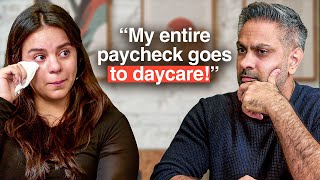
Ramit Sethi interviews Amanda (28) and Carlos (36), parents of two young children, about recurring money conflicts: daycare costs consuming Amanda's paycheck, separate accounts with category-based expense-splitting, differing risk preferences (Carlos favors growth/entrepreneurship/retirement planning; Amanda is more comfortable and risk-averse), and stalled decisions over real estate vs business. The session surfaces gendered role dynamics, emotional barriers to financial conversations, and the practical step they took of running numbers together — which clarified affordability but left them stuck on a decision. Ramit emphasizes combining finances, joint decision-making, and aligning roles to avoid resentment.
Chapters
I've had the conversation with her multiple times that she's much more valuable than what the education system is paying her right now. I want you to be my partner, not just in marriage, not just in parenthood, but in finances as well.
But it's definitely a bittersweet pill to swallow. And we see how much we're paying for daycare. What was the point of going back to work when my whole salary is basically gone at the end of the month?
It kills me as a husband and as a man to not be able to satisfy that for her, not be able to give that to her.
If we continue on the same path that we've been on, of never coming to a decision, continuing the arguments and the tears, there's gonna come a day where one of us says, I can't anymore, you know, and just walks away.
Meet Amanda and Carlos. Amanda's 28. Carlos is 36, and they have two young children and they live in the tri state area now. He wants them to be a power couple. She says she's comfortable with how things are and she doesn't really want to change. But when I start asking questions today, suddenly their story gets a lot deeper. There are tears. They tell me stories about cars being repoed. I hear about gender roles and separate accounts. Let's meet Amanda and Carlos. And as we get started, I notice an interesting comment they made in their applic.
You did say that there are a lot of tears when you talk about money.
That's my fault.
Oh, what do you mean?
Emotions for me are very difficult. Conversations in general, like finances, have always been difficult for me. It's not something my parents ever talked about to me. Being that vulnerable about it with him and sharing the way that I feel about our finances or what we're going to do next is very difficult for me to share. And I just get caught up in the emotions sometimes.
It's interesting. When I asked about the tears, you said it's my fault. You said I get caught up. All words, as if having emotions is a bad thing. Do you think that having emotions about money is a bad thing?
No, I don't. But I think that's kind of where we balance each other out as well. Because he's a little bit more logical, I am a little bit more emotional.
And which one is good?
They're both good. I think we kind of even each other out. Like, I pull him up from the logic, he brings me down from the emotions, and we have learned to kind of meet at a middle ground. It's been Years of growth through these discussions because at first I was very closed off. I've become a lot more open minded to these things. But emotion is just. It comes with my nature.
Just have to cut in here really quickly. In America, we think emotions are weakness. We consider logic to be laudable, even pure. But emotions, well, you heard Amanda. She has a problem with being emotional. Her words. She says it's her fault. She gets caught up. I don't really agree with this view. And it's actually one of the biggest lies we tell ourselves. Basically every one of us is deeply emotional. Emotions are not weakness. And it takes a lot of work, which I'm trying to do myself, to get in touch with our emotions. Notice as we continue in this conversation, Carlos immediately goes back to where he feels most comfortable. Questions about logistics.
I can't say in the beginning of our conversations I really understood her emotions and why she cried when we had more serious conversations. And I used to think of it as bad and impulsive. But again with, with more conversation and just like the, the wanting to understand my wife more, I understand the place that her emotions has in our financial decisions in our life. It's more what to do with the extra money. Right. Like what's next? What is our next step? And we have opposing views on what direction we should take.
Is that your primary question today? What should we do with the extra money?
What should we do next?
Okay.
All right. I also think that we don't have a major age gap, but seven years apart, just about.
What's it, how old are you?
So I'm 36. Amanda's turning 29 this year. So for me, and being in a government position where I'm looking at 20 year retirement plan, pension, et cetera, or I'm at the stage where I'm thinking about retirement. So a lot of my financial moves now are all geared towards that.
Retirement for me has never seemed like. I don't know, it seems so far away. So it's not something I've necessarily thought about at depth or at length. And I'm a teacher. So for me, I'm just kind of living the day to day, especially being a new mom. I don't really spend energy thinking on retirement.
Yeah, that's fine. Most people don't.
I guess the best way to explain that is through scenario. An example, we've been looking at properties and we're considering either moving into a property or buying an investment property. For me, it's just purely numbers. It's a numbers game. I could care less. We could move into a fixer upper. Spend the next two years, you know, redoing little pieces here and there for her, she puts the emotion into it, where it's like, well, we got to move our daughters into it. What is the neighborhood like? We want to be comfortable here. And I think that that's vital because if it wasn't for that, I would have us literally starting from our box, the most financially advantageous situation possible because, you know, we can fix it over time. But if I were by myself, then maybe that would work. But I have a family, so I need to put emotion into it.
Okay. I like that it's a healthy perspective. It's like I can understand where she's coming from. Probably makes me a little bit more balanced. And you can understand where he's coming from looking at some of these numbers.
Yeah.
Okay.
All these conversations take place at home.
It's usually at nighttime, after our kids have gone down that we.
What a surprise. We're around like, 9:30.
Yeah.
Let's talk money.
Both tired, exhausted from the workday.
So who brought it up first?
Me. I always bring it up first.
We actually just had one on our way in, actually.
Oh, fantastic. So you're driving in.
We were driving into the city this morning, and he asked me if there's anything we want to bring up. I think the biggest area where we butt heads on our finances is that he has all these little business ideas. It's the biggest risk versus reward to go into one of these businesses, because I feel a real estate investment has less of a risk in comparison to a startup business.
Okay.
And he disagrees. He believes that it's similar, if not better, to do the business because it's less so cost upfront.
There's multiple parts to it. The upfront cost is where we begin.
Right.
With buying a property, you have your closing costs. And then as I've learned from all of your podcasts, you have all the phantom costs. Right. We've never owned a property, so we can't even list out all the possible expenses. If it's an investment property and we're getting a tenant, then we have to factor in, all right, how long until we get a tenant. And we have to cover the mortgage until that point, including all of our regular expenses. Then when we get a tenant, because I think New Jersey's a squatters. Right state. You know what if we end up in that situation where the person's just not paying the rent, these expenses start to stack up, not to include the fact that we're Taking on a major loan. Right. 180, 200, $300,000, whatever it is. And you can't just get out of that. I've started a couple of other businesses. I ran my own business for a bit. I put my personal business down to take this full time government position, and then I had another business that just failed and went under, unfortunately.
I understand completely. How does this conversation usually go?
We go back and forth. And the pros and the cons. And the pros and the cons.
And how long has it been since you made a decision on this?
We haven't.
We haven't.
It's been a couple months.
Months or longer?
Longer. I would say longer because, I mean, since we've. Since we had our first daughter, he's been trying to do this. We were living at my mom's for a little while, and he decided to take on the spa. The spa basically opened. That went under. Realistically, this is about the first year of our relationship that we've had to live on our own, completely independent of our parents and family. Because since we've lived together six years ago, we've been in and out of our family's home.
Oh, okay. Living with them?
Yes.
Why is that?
Because he was deployed. Or I had a baby. Or he was deployed again.
Gotcha.
Or I had another baby.
Yeah, okay, gotcha.
So since. Since last April, actually, it's been us solely on our own. No parents involved whatsoever.
First time in six years with two kids where you're both functioning independently. Yes.
And we've been having that conversation again and again on other business ideas ever since. So it's been maybe about two, three years that this is an ongoing conversation you're starting.
You're coming with an idea, saying like, hey, we could do this. And then you're saying, well, what about this? What about the risks?
I kind of play devil's advocate. Not because I want to shoot him down, but because I'm afraid.
Afraid of.
Afraid of the failure that comes with it. With the spa business that he opened, I saw one. How much time and energy it took out of him on top of his regular job, the toll that that puts on my plate because he's more absent from home.
Carlos, how would you describe Amanda's relationship with money?
Complacent. Nonchalant would probably be the two words. Those are big words I'd use to describe her relationship with money.
What do you mean by those? For.
For as long as I've known her, we've been together. She doesn't necessarily or ever Had a reason to stress money, you know, where is it coming from? Where is it going to? She's never had debt, so she's never had to climb out of that hurdle or work her way back up because of that. I think that she's just comfortable.
Comfortable means she.
She doesn't have like a sense of urgency to increase her income or sense of urgency to plan for the future. Like these just aren't things on her radar. You know, she's happy where she is. Things are comfortable, things are paid for. Food is available at any time from any place. So there's a level of comfort that comes with that.
Is that good or not good?
For me, it's not good.
Why?
Personally, I've never had comfort with money. I've had to dig myself out multiple times. I've made enough bad decisions, and now that I'm getting older and older and older, retirement, and it's creeping on me. Right? And I have uncles who are still working into their 60s and 70s blue collar jobs. It's just not a lifestyle that I want for myself in the future. That pressure weighs on me. Being a dad, being a husband, these are all new things for me too.
When do you give yourself permission to feel good about money?
I don't know. To be honest with you. I don't know what or when that is or what that's supposed to feel like. So I don't even. I have no idea.
Have you ever felt like that?
No.
But it's funny because your wife feels like that right now.
I don't know why I think I want security.
Okay.
I don't necessarily like. Yeah, of course I want more. Right.
That's not obvious. Wait, you say. Hold on a second. You say, of course I want more, but I'm gonna venture a big guess. Amanda, do you want more?
I don't need more.
No, of course you want more, but that's you. Okay. And you want security. What does that mean?
Security means I don't want to have to work for the rest of my life. Security means I don't want to ever again find myself in a situation where I'm worried about money ever.
Are you worried about money right now? Yes. Okay. You're going to be worried about money a year from now.
I think so, yeah.
You're going to be worried about money when you have double the current money you have?
I don't know. I'll be left behind.
I'll just tell you. You will? That was a trick question. I already know the answer. Yes.
As long as I've known him, he has always wanted more for himself, for us, financially, physically. I mean, he works out like an animal, like you said. Right. Like, that's just his nature.
Yeah. It's interesting because he is on one end of the spectrum where it's, like, really pushing himself in lots of ways. Financial, physical, all those things. And the way you described yourself is like, I don't need more. He described your feeling towards money as complacent. Would you agree with that word?
I would.
Okay. Complacent?
Yeah.
Nonchalant?
Yeah.
I mean, I've always said, like, I'm very happy where I am.
And the dynamic of our relationship, we fall into our gender roles pretty well.
How so?
You know, I handle the finances, the numbers. I worry about where we're gonna live, what the cost of it is, can we buy a new car, et cetera, et cetera. And she focuses on the home. Right. The girls, She's a wizard with our daughters and, like, their calendar and where they're supposed to be, what time they need to eat, what have they eaten today? I mean, just everything.
Ye.
Yeah.
Did you both proactively agree on that?
We did, but I also think we naturally fell into it.
Okay, and are you both okay with those roles or would you like some of them to change?
We have been. Until now, we've been meaning to open.
Up a joint account.
Oh, you don't have a joint account.
We do not.
Okay, so they're separate?
Yes.
Okay.
I don't know what he spends on. He doesn't know what I spend on. Only what we see. Come home, basically. Right?
Hold on, hold on, hold on. Wait a minute. How did I not know this? So let me guess. Amanda, you pay for certain expenses. He pays for certain expenses, right?
Yeah.
Okay, you pay for, like, kids, clothes, groceries, daycare. Okay. And then you pay the rent and the car stuff. Am I getting this right?
Yeah.
All right. He's gonna flip the table. It never fails.
When couples haven't combined their incomes, they break out their spending almost identically. Women tend to pay for anything child related, plus groceries, plus things around the house. Men pay for housing, and they almost always pay when the couple eats out. Can you please stop this? Just stop it. It's not doing you any favors for two reasons. First, when you pick individual categories, it's not fair because those categories are going to change. For example, if you get a bigger house or you have two kids in daycare instead of one, those expenses are.
Going to go way up.
But couples who split expenses almost never recalibrate Their spending leaving one person totally out of money and feeling resentment. Second, your account setup reinforces your roles, including your gender roles. Now, if you and your partner are okay with that, great. That's why I asked them, are you okay with that? But there are so many people, particularly women, who are rightfully fed up with taking on more emotional labor, but they pay for all the groceries and all the childcare expenses. It's not simply about one person being a bad person or being selfish. It's about the way that you have structured your accounts, and it's about the way that you have calibrated your relationship dynamic. For the purposes of my discussion, your account structure determines your rich life. Finally, I just want to say there's good research showing that couples who combine finances experience greater satisfaction and they are less likely to break up. That's research from Emily Garbinski and her co authors at the Cornell School of Management. We'll be right back after this short break. Now back to the show.
What about the feelings of money? How does it feel when you have your account, you have yours.
Either he feels he pays for too much, or I feel I pay for too much. And we're not on the same page. It's not a 50 50. But we've also realized in doing the CSP that, you know, his income is almost at least double mine. So when mine is all gone at the end of the month, it makes sense that his is not completely gone at the end of the month. But we realize if we put all our money in the same account, then we can kind of control and see where. Where the money's going. Yeah, a little bit better.
The question was, how does it feel?
Unfair.
Unfair.
Okay.
Okay. I would say that the way you have your account set up, especially for married couple, parents of two young kids, the word that comes to me is disconnect.
Amanda has never been one to bring up the topic of finances or money or what's next. So I kind of took note of that maybe about two years ago. And I'd say within the last year, I've made. I've made a more intentional effort to bring it up to her often. So whenever I come up with an idea, you know, I do my little tiny research, you know, sit on the toilet and watch a couple YouTube videos, whatever it is, I'll come up with these little ideas and, you know, and I'll crunch numbers in my head. I'll write a couple ideas down, and I'll shoot it by her, right? Just to get her more proactive and. And Interested in what we're going to do with our finances. And does it work? No, not necessarily, no.
I mean, not until the real estate.
Real estate, she. She definitely grasped onto that. And I think because she has outside influencers on that as well, she was more keen to it.
Who, your parents?
Yeah, we've been looking.
We've been okay, actively looking until last week.
Last week I put on hold.
Oh, why?
The numbers just don't make sense. I mean.
What do you mean? Hold on, what do you mean? If you buy real estate, it always goes up. That's what the allegedly. It always works. How can the numbers not work? Real estate always makes money. Isn't that true?
Live in the tri state area and the interest rates are ridiculously high even with a veterans loan. The houses that we are looking at are ridiculously high in the near neighborhood that we want.
But do you just want to pay your landlord's rent? I can't even do this. Okay. Yeah, of course. I know, I know where you live. It makes no financial sense to buy like zero. Would it be fair to say that's the first time you have truly run the numbers when it comes to family finances?
Yes.
Wow.
Absolutely.
What did that feel like?
I've actually become a little bit more addicted to it.
What do you like about it?
Oh, I'm a numbers person. Math has always been fascinating to me. So for me, it's like the simplicity of being able to see everything on a piece of paper and knowing exactly what's what. So we would run the numbers on a potential property and the mortgage calculator, I threw in the taxes myself. Like I could do it and I'd be like, hey, this works. You know, like, let's look at this place or let's look at that place.
And until John Doe throws 50k on top of his offer and now it's.
Yeah, so.
And then I bet when you saw other people buying those properties, were you like, wait, how are they doing that? The numbers don't work.
Absolutely. I even said that to him. I was like, how are people, you know, people like us, the similar, you know, bracket, how are they affording these places? Because if we can't, they definitely can't.
What do you think the answer is?
They can't.
So what are they doing?
They're just in debt. We live comfortably and we rent right now. So to think that we would be paying at least $1,000 more for mortgage and other people are doing this ridiculous to me. Absolutely.
Where do you think that comes from? Like, why would they do that from.
That mindset of I need to buy a house, because that was my mindset for until, you know, we started talking about our finances generationally, we've been taught, especially with immigrant parents. Right. My. My dad came to this country. His first goal was to buy a house. He did it, and then he bought another one and another one, and now he has three, four properties, which pays for all his bills. He makes a very good living, and he lives very comfortably. So when I see that, I think I can do that also. But realistically, the numbers back then don't match the numbers now, and we're making the same amount of money. The interest rates have only gone up, but our salaries haven't changed.
Yeah.
So just, I guess the influence from my parents. My mom was a single mom. She bought a house on her own during the pandemic, actually.
Wow.
I was like, okay, she could do it. We can do it too. We have two incomes, but realistically, now it's just. It's not possible. Okay.
I appreciate you kind of being humble enough to accept that things might be different. So. Okay, you ran the numbers.
Good job.
Did you both run them?
Yes.
Yes, together.
We've been doing this actively together for the past couple weeks.
You've inspired a lot of growth and development.
After watching your podcasts and your videos, we've also realized, you know, we live very comfortably in our apartment living. To sacrifice the comfort and minimize our lifestyle would be very difficult, especially with two kids now. So we've kind of come to a standstill on the real estate.
Honestly, great work. Not because they decided against buying real estate. Please remember, I'm not against buying real estate. I'm against making the biggest purchase of your lives without running a single analysis. Amanda and Carlos did it. They ran an analysis, and they did it together. Great work. But now they are stuck.
If we continue on the same path that we've been on, of never coming to a decision, continuing the arguments and the tears, there's gonna come a day where one of us says, I can't anymore, you know, and just walks away. Because like anything else. Right. It can just build up and it'll be too much. But I also agree that we do need to make a decision. I just don't think my timeline is as rushed as his or as urgent as his is. I understand that his job is temporary, and our finances at this moment are. May not be the same as three years from now, so I understand his sense of urgency, but I don't necessarily agree with the sense of urgency that he has. I do appreciate the fact that he includes me in all these decisions. It kind of makes us partners versus he's the head of the house, you know, So I do see the value. I see the value in it. And with big decisions like a house and a business, yes, I do want to have a say, I think, because I can see where, if it fails, like he says, I may blame him or I may resent him for that, because it does affect all of us.
I have to say I appreciate that you both are talking about the roles that you've taken in your relationship. I think it's very important to interrogate those decisions. In my own personal relationship, it would have been really easy for me to be the money guy. Very easy. But I always thought to myself, what if one day I'm not here? What if one day I get hit by a bus? What if we have to make big decisions together as partners? It can't just be me. It's also not as fun. I see a lot of nods from you, Carlos.
You're saying what I want to say or what I've been trying to say? I guess.
Say it to her.
Time.
Say it in your own words.
I'm not quite as elegant. I want you to be my partner. Not just in marriage, not just in parenthood, but in finances as well. I have to my scale grand visions for our future and the way we could live life. And I want us to live it together and get there together. So pretty pleased.
But I feel like I've always been good at managing money.
Maybe she. She might be better at saving than I am.
What does managing money mean to you?
Being able to distribute. Like, distributing my money, more or less. Right? Like, I make sure I cover the groceries, I cover the stuff for the girls, daycare, what goes into my savings, and then the money I have to spend. Like, I'm. I'm still very meticulous about everything. Even though he does pay for the bills. I mean, I've always been taught to save my money. The stipulation with us moving in together when we first met was we both need to have $15,000 in our bank account before we can rent an apartment together.
Who stipulated that?
He did.
Oh, that's interesting. Really?
Yeah.
Why did you come up with that stipulation?
You want the truth or.
Yeah, he didn't want to do it.
I didn't think she was going to do it. And then it was also a symbol of, like, commitment. Like, she was serious about it. And, you know, if she could do this, then yeah, by all means. I'll get serious about it, too, and we'll make that. We'll make that move.
How did you take that when he said it?
He didn't say that to me until later on.
What did he say?
It was just at the time, he was thinking of moving into New York City, and we were both living in New Jersey, and I was like, well, if you move into a city, it's not going to work. That was too far for him to be away from me because my whole life was over there. I wouldn't see him. I thought so I was like, okay, I could do it. And I was still living at home.
So he said, fine, I won't move to the city.
We'll move together. If you save $15,000.
And how did you take that challenge?
Got it done.
Did it. Wow. She did.
Here we are.
That's interesting. Okay.
Yeah.
So you did it?
Yeah.
It was no problem for you?
No problem.
Kind of funny how big life decisions can be made so arbitrarily, right? Just like 15 plus 15. And, you know, you did a little bit of math.
But really, if that hadn't worked, you.
Might not be together.
Yeah.
You might not have two kids. Isn't it crazy?
Absolutely.
The way we make the most impactful decisions of our life sometimes are just so, so random.
I definitely think we could be a power couple. We have the potential for that because we do communicate very well, or at least we've learned to communicate very well. You know, I appreciate it, and I see where he's coming from. I really do, and I want to be more involved, which is where my effort comes from.
What do you hear him saying?
I love you. And I know that's how he expresses his love to me, especially, you know, asking me for my opinion. I know from him that's a big deal, because like he said, he's always been used to making these decisions on his own.
Right.
Wow. That's powerful. He didn't say the words I love you, but you heard that?
Yes.
And Carlos, that fair to say, right?
Absolutely.
You know what I notice is a lot of tactical thinking. He says, I want you to save $15,000 in order for us to be together. She says, fine. Then she does it, and that's that. He asks for her opinion on some random business idea, she gives it. That's it. Now, I do like that when he asks for her opinion, she sees and feels love. I love that. But what I don't hear is an elevation of thinking. They don't have a philosophy on money, for example, they save $15,000. But do they zoom up one level to reflect on that $15,000? What does it actually mean in our relationship? Now, this is hard. It's a hard skill. It doesn't come naturally. One good way to start zooming up with your money is to start using my journal. You can get it on Amazon or any independent bookstore. It'll help you cut through the thousands of tactical decisions you make with your money and actually have a vision. And that vision makes it easy to decide what to do, when it's worth it and when it's not. We'll open up their conscious spending plan after this I recently took a masterclass with Amy Poehler called Prepare to Be Unprepared where she shares her nine principles of improv. Now, this is really important to me because on this podcast, yes, I do a lot of prep before the conversation, but truthfully, I have no idea where the conversation is going to go. All I can do is show up, be present, listen really carefully, and be ready to pivot like an improv specialist, even trying new approaches if the guest is not responding. Now, I love being able to apply lessons from different industries like comedy, design, writing to my work, and I think that's what makes this podcast special. With Masterclass, you can learn from the world's best for just $10 a month. An annual membership with Masterclass gets you unlimited access to every instructor, and you can access Masterclass on your phone, computer, smart tv, even in audio mode. One thing I loved about this improv class with Amy Poehler, she said, you can't be halfway in. You can't be partially committed. And it reminded me of the exact decision I made when I was thinking about the Netflix show. Until then, I had been very comfortable living my online life. I have this little corner of the Internet. I know how it works. I have a lot of control over my business. But Netflix.









