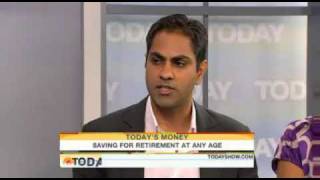
Ramit Sethi and financial experts share retirement savings strategies by age. In your 20s-30s, automate even $200 a month into aggressive funds. By 40, aim for 15% of income saved. Entering retirement, Victoria Woods recommends keeping 24 months of expenses in cash and staying debt-free.
Questions this video answers
11/9/09
15% of income
24 months
$200 per month (example of a monthly check to a retirement account)
$378 per month
Chapters
Back at 8:43. And this morning on today's money, saving for retirement at every stage of life. Here to walk us through the decades are Ramin Sethi, author of I Will Teach youh to Be Rich, CNBC personal finance correspondent Sharon Epperson and Victoria woods, author of It's all about the Money. Honey. Good morning to all of you. You know, not saving for retirement is an issue at any age. So we're going to tackle this beginning with people in their 20s and 30s. Ramitza, let me start with you. At that age, you're probably not thinking about retirement at all. And you're almost not in a position to save. At least you don't think you are. You're barely making enough week to week. So how do you get started?
Well, I'll tell you, you're never going to hear someone in their 20s say, yeah, Meredith, I really want to get financially literate today. We know we need to do something about retirement. We feel guilty about it. We're just not sure what. So for young people, I think there's a couple things that are important. First of all, you don't have to be rich to start saving for retirement. Okay? Even a small amount is going to turn into a huge amount over time. Second thing is you don't have to be a financial expert. You can set up a retirement account in less than a week. You can automate it and get on with your life because the last thing we want to do is think about retirement.
When you say automated, explain that to people in their 20s and 30s who may be watching and not know what that means.
Imagine sitting down and writing a check every month for $200 and sending it to this retirement account you're not going to be able to access for 40 years. You know, I would give up after about three months. So when you automate it, the money that comes in from your paycheck is automatically sent away. And you can feel guilt free when you're doing your day to day spending because you know that your retirement account is being automatically filled every month.
And the point is to make it a habit so that it's every week or every month that money is going somewhere.
Yeah. Don't make retirement about willpower.
Make it automatic and safest place to put the money.
You want to actually be aggressive in your 20s and 30s, pick an aggressive life cycle fund.
Okay, Sharon, now we're moving on to your 40s. And at this point you got a lot of responsibilities, maybe a mortgage. You're thinking about sending the kids to college. Can you still invest. I thought the number was around 15% of income. Is that still doable?
Ideally, you should be saving 15% of your income. That may seem like a lot, but what you need to do is set priorities. This is a time when you're trying to decide how you're going to pay for your kid's education. You may be dealing with parents that are growing older. How are you going to take care of them? What are their financial. What is their financial situation? And you need to have conversations. You need to figure out with your spouse or with the child's parent how you're going to pay for college, how much you're going to pay. Maybe it's not going to be the whole tuition bill because you need to take care of your own retirement or first with your parents and with your siblings. You need to have a conversation about how you're going to take care of them later in life.
And should you be switching where you invest that money versus the way you did it in your 20s or.
Well, one thing you need to do is think about the flexibility you want with where you invest for retirement. So it's not necessarily all going to be in your employer plan, in your 401k plan. You should contribute to that up until the company match, if you're fortunate enough to have one, if companies are still doing that. But the other part, a great place to save is a Roth ira.
And if you haven't started investing yet.
Don'T worry about that. You need to start right now and you need to really do some tough love. You need to figure out what you're going to cut back on. Maybe you need to have a cheaper car. You can't retire in your car. Maybe you need to think about, you're not going to buy the furniture that you really want to get for the living room right now. You're going to put that into your retirement savings. And a lot of what we spend our money on at this age is our children. And maybe there's some things you're going to have to cut back on for your kids right now to make sure that you take care of yourself in your retirement.
Okay, now, Victoria, we've reached our 50s, 60s. We're thinking about retirement. You say there are two goals you need to keep in mind. What are they?
Well, the first goal is because the biggest concern for people getting ready to retire is the fact that they're worried that they're not going to have enough to live the lifestyle that they have become accustomed to. So most importantly is make sure when you go into retirement, you have no debt. Just think about if you have gone through this recession and you didn't have credit card debt and you didn't have that car payment because you can't live, Sheila's right, you cannot live in your car. If you have those things, then you're not going to go through this crisis like we've been in this recession we've been having right now. You would have much more peace of mind if you have no debt. The other very important thing is you should have, and this is very controversial, 24 months worth of cash. Why again, think about the peace of mind. First of all, you would not have panicked during this crisis. And for those people that have panicked, they're going to pay for that for years to come. Because when I say panic, they got fearful and maybe they got out of the market and they changed their financial strategy, which those people that did are going to be very sorry they did long term because you can't recover if you in March, let's say, went to cash.
What about people who are facing retirement and they've lost value, their home has lost value, their investments have lost value. Where should they focus?
Well, the thing is that you have to focus on the things that you can change. You cannot change the housing market. So again, you go back to your debt, you go back to your 401ks balance. I love what Sheila said about balance. Not only do you participate and you participate in your 401k, but even if you have debt, number one, you would suspend your 401k until you got that debt paid off. Because you're paying on that credit card debt. It could be 18, 25% interest. The average return over any 10 year period in the market has been 10%. So it doesn't take a rocket science to figure out, pay off your debt first and then spend all that money in concentrate. Do you know the American public is. $378 is their average car payment. If you started in your 20s, young lady named Jacqueline, right now in her 20s, just paid off her car this Saturday. If she took that same amount of money and she invested it at 65, Meredith, she will have $1,500,000.
Well, I hope those people in their 20s and 30s, Ramit, are listening to this and maybe paying attention that eventually they're gonna be in their 60s.
That is so true.
And they also need to make sure that they have that emergency fund too because so many people are so concerned about retirement right now. What might happen if an emergency happens right now, make sure you have that type of short term savings as well.
All right? Ramit Sethi, Sharon Epperson, Victoria woods, thank you all very much.