“She manages the money. I ignore it. What’s the problem?”
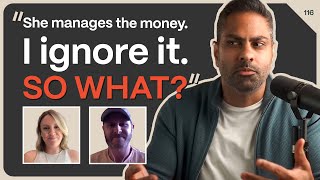
Carrie manages the money while Taylor checks out, a pattern rooted in his grief and upbringing. After eight years together, they built a spending plan, but Carrie's still frustrated Taylor won't engage with the details. Ramit pushes them toward actual shared responsibility.
Chapters
What words come to mind for you when you think of money?
Oh, my God. Better enjoy your life now because you won't get to when you're dead. Get rid of it. You got it.
You got.
You might as well get rid of it and buy some things while you're here.
I don't want a relationship where I feel like I am your mother telling you what we need to do and not to as a couple and making all the decisions for us.
Why is this getting you emotional?
I feel like it's been very unfair to Carrie. Maybe, you know, she doesn't really have all this everything figured out. And yet I still have so much to learn. Just by having a simple conversation about numbers can propel us to a higher ground so easily. Just by having conversation about it and not being afraid of why. Why the hell wouldn't we do. Why would we do that? I have all the resources necessary and accessible to me to figure that out. And if I don't, that's just a sign of laziness.
Have you heard people talking about the hedonic treadmill? The idea that once you start spending money on certain things, you're not going to enjoy it anymore.
And.
And then they usually tell you this, so therefore, don't get on the hedonic treadmill. Don't spend any money. If you get a raise, bank at all. I don't love that advice. It's just getting people to play small. I would rather you have a philosophy or a framework on how to know when you are ready to spend more in my life. If you told me, ramit, you can't stay at nice hotels, that would actually be very difficult for me because those things are important to me. For a lot of people, if they own a house and you say you can't afford it anymore, you've got to rent or move into an apartment, they would find that incredibly difficult. I don't want you to be afraid of the hedonic treadmill and worry about spending money on anything because you're just going to get used to it. So don't do it at all. No, I want you to have a more nuanced perspective on money. That's why this Saturday on my podcast newsletter, I'm going to share six main areas where once you spend money, it's really difficult to go back. And my philosophy is to make sure that you are ready to move up the value chain before you ever spend money on these things. I set my life up so I would never have to take a step back when it comes to nice hotels. I want you to do the same for the important things in your life. Get on the newsletter@iwt.com podcastnewsletter I'm only sending this particular newsletter out on Saturday, August 12th. After that, you will not be able to access it. Iwt.com podcastnewsletter I'd like you to meet Kerry and Taylor. They're both 33 years old. They've been together for eight years. They're not married, no kids, and they both earn healthy incomes in the Nashville area. The problem that we're going to hear about today is that Carrie wants Taylor to get more interested in their finances. She feels like she's in the driver's seat and he's passively riding along. And this is a very common dynamic in relationships with money. One person's reading my book, suddenly they start sketching out their vision of a rich life. But whenever they ask their partner to participate, they get a lackluster response back, like, whatever you want, honey. Or even worse, why do you always need to talk about money? This becomes intensely frustrating with the person pursuing becoming more and more exasperated that their partner is distancing themselves. So you know what they do? They double down in pursuit. Therapists talk about this with the pursuer distancer or chaser chasey dynamic, which I would encourage you to look up. I wanted to talk with Carrie and Taylor about getting on the same financial page. And today I want you to apply this conversation to your own relationship with each other and with money. Carrie, you filled out the application, and when you spoke to my producer the first time, you showed up alone, is that true?
I did. So Taylor's on the road a lot. I heard that. I don't know, the email, it was confused. I was like, I don't know if we're supposed to be together. She just wants to talk to who applied. So, yeah, I did. I showed up alone, and he was out of town.
Now, is that typical? Because you're one of the only couples that's ever done that. And I understand she sent you back and said no, it's got to be both of you, correct?
Yes.
Okay, so is it typical that one of you is handling everything relating to money?
Yes.
And who would that be? As a random guess, Carrie, might that be you?
Yes.
The one who filled out the application. The one who showed up alone. Okay, Taylor's over here laughing. Taylor, would you agree?
Oh, man. Yep.
How long have you two been together?
Almost eight years.
Eight years. Okay. Carrie, when you got together with Taylor, were you already pretty Savvy with money?
Yes. Maybe not great at doing all the things I knew, but I knew what I should be doing and was doing some of those things for sure.
Was it concerning to you at all that Taylor was not at the same level of financial savviness?
Once I realized it, it took him, you know, Took a while. Yeah.
How long?
Probably six months of dating.
So, Carrie, we're here to talk about the role of money in your relationship with you and Taylor. And I was struck by the application that you wrote. Has Taylor seen that application?
He has not.
Oh, no.
Okay. Would you mind if I read some of it out loud here?
Sure.
Okay. Taylor, the reason that I was struck by this was the severity and seriousness of the words that Carrie wrote. I'm a 33 year old woman who's been in an 8 year long relationship with my partner and we still can't figure out how to talk about money together. And I'm at my wit's end. I have been ready to get married for the last three or so years and now that he makes more, he is starting to express his desire to take that step too. However, in the back of my head, I feel hesitant to say yes because I am so frustrated with his lack of care or desire to talk about financial concerns, plans, etc. This is in all capitals. I'm so tired of Venmo requests and figuring out who pays for what. I like to pause there. Carrie, you remember writing that, you know.
The, the wits end part was. I feel like I've tried a lot of different avenues to make it exciting or to ask a question or to draw him in. And we. And he gets really excited about the dream planning. You know, we love to talk about the dreams and the what could it be? But then when I start delving into the details, it's a complete shutdown and block.
Thank you. Taylor. Hearing what Carrie wrote, how do you receive that?
Me being me sucks. I mean it, it's. I don't want to say though, it hurts because it doesn't. I don't care. Like she's the one that's feeling this way. So, you know, it just. It just sucks. Sucks to. Yeah, it just sucks to hear because I should be better and.
Should.
I don't want to say be more of a man in this situation, but be just more communicative and a better partner in general. I don't care about what I'm feeling. I care about what she's feeling.
But I care what you're feeling. So what. What are you feeling? Right now.
Oh, man. Though probably the one emotion I hate feeling.
Tell me.
Disappointment.
At who? Myself. This is the first time that someone showed up to our screening interview alone. My producer was like, what's going on here? And I think it actually reveals a lot when someone fills out an application without their partner knowing. Or when you hear couples who didn't do the conscious spending plan together. It actually reminds me of these case interviews I used to do in college for management consulting firms. You go in there and they ask you a question like, how many ping pong balls fit in a 747? Or how many gas stations are there in the United States? The truth is, they don't really care about your answer. But what they want to hear is how you break down a thorny problem. That's the same thing here. When couples work on their csp, I'm not really concerned if they get the calculations right. What I'm much more concerned with is how do they work on their CSP together? Are they cooperative or do they attack each other? Does one person do all the work? Right now it sounds like Carrie is the one in charge, but she wants something to change. And what I hear from Taylor is that he admits being disappointed in himself eight years ago. What words come to mind for you when you think of money?
Oh, my God. Just to be honest. Terrified. Dad, my bill's paid. Great. I don't really care to talk about money kind of deal.
Got it.
I mean, yeah.
And what about today?
Way different. I would say the three words. I would say excited, eager, and. And I don't have as much knowledge, but, yeah, very eager and excited. I would say those two.
Okay. That's a pretty huge change from terrified to eager and excited. And when did that change happen?
I think the issue today would be a different issue than it was because of my mental therapeutical journey. I lost my dad, like, right before I met Carrie, and.
Sorry to hear that.
It still sucks. I feel like after I got better, I was able to mentally, like, process.
So you were in your 20s? Early 20s. That's tough.
24 years old, man.
Were you and your dad close?
Oh, yeah.
Did you seek help?
Yeah, I had to. It was. Covet came around and I lost both of my careers and I was just kind of stuck at home and I. I was just during detrimental, you know, mental abuse to myself and not catering to anything I needed to do and whatnot. And so I. I decided to take my life back.
And that's.
Without a doubt been. I would say the reason why that I've been able to like move past the fear and be excited because I've been able to like compartmentalize so many things in my brain instead of just being like a. A soup cocktail of just chaos.
Yeah.
And by doing that, I've been able to like process day to day things and not. And that's me. That's how bad it was. I couldn't even process hour to hour things. When you can't do that, then you can't even begin to plan out your life.
Are you still getting help?
Yeah, I still talk. It's very, very sporadic. I've gotten to the point now that I was the end result for when I started. And that was I call and make the appointment when I need it.
Wow.
Instead of having a specific every 10 days, every six days, every Tuesday and Thursday. That was the goal.
Sorry for your loss.
It's okay. It's okay.
What happened in those seven and a half years as it relates to money specifically?
I think it happened when I started making a lot more money than I've ever made in my life. I would say a couple years ago.
Things have changed recently, which is what prompted the kind of, I guess, ah, the application. Because now there's something to work with before. I mean, he's right in the sense that two, three years ago he was making very little money. There wasn't much to work with.
How much was he making?
Taylor, what was your hourly wage?
A total?
Like yearly? I was making less than 40 grand a year.
And then recently you started making a lot more money. So how has that changed things?
It made things really exciting. It's like, hey, all those big dreams and things we. You do love to talk about, they are very much now starting. We can start making some of these a reality. These can be within grasp.
I love hearing all this, but why are we talking like it sounds great, actually. He has achieved a lot. Taylor, you seem to be doing really well in your career. You're making way more than you used to make.40k. Psychologically, you're doing better when it comes to talking about money and dreaming. Why are we talking today? How can I help?
I think it's because of the application. I think there needed to be a. A type of financial mediation between us to like light a fire under my butt and let Carrie speak the way she wants to.
But Carrie, why have you not said this? You've been together for eight years.
I feel like I have tried to say it in lots of different ways. Anytime we've ever moved or made a big Decision together, whether we chose to do something or chose against doing something. It's something I bring up to you. Or anytime we've ever had extra money together, you know, it's something I bring up to you. And the response typically is like, I don't care. Just like, do whatever you want to do. Like, I want to have free flowing, positive conversations with you about our future finances, money, what we want to do with our hard work together at any given, you know, mostly any given time. That's what I want.
Just kind of take and I don't know how to take down my, my walls of fear when talking about money. I have no desire, I have no idea how to do that.
Okay, hold on. Let's not talk about talking about money. Let's just talk about money. So you want to have a conversation about money? Go ahead.
So we filled out the conscious spending plan together and that was the first time legitimately that I have been able to get him to sit down, but not for lack of trying. That was the first time, Taylor, that you and I, and we talked about this were able to sit down and walk through just general life, finances.
Yeah.
Right. I mean, we had never talked about.
Yeah. And it felt great. And it felt great too. It was.
Yeah. We hadn't talked about our, you know, like, I knew a lot of things about maybe some of your debt. I know that, you know, I know more than you knew about me. I would say so. That was a really interesting and really cool moment for me. I think you felt cool in the moment as well. To be able to sit down, be like, whoa, here it is all on the table. I remember you were like, whoa. When you saw the monthly number, you were like, I had no idea. I had no idea. At the end of it all was like, I was like, that was so cool. That was so positive. I told a few people about it. It was just the first time where I was like, oh, he's willing to like sit down and, and do this as a, as a team. And it was just really cool. I loved. Allowed us to talk together about what? Like, look what we have. How do we go to the next step now? We didn't. We haven't had that kind of conversation truly yet. But I saw it as like, oh, that's like a really good sign of like, here's the next thing that can come.
Yeah, agree.
I agree.
100. Well, it definitely opened my eyes to seeing. Well, maybe you don't. Maybe, you know, she doesn't really have all this everything figured out. And yet I still have so much to learn, and you taught me so much that day. Like, as stupid as that sounds, I mean, you did. I really enjoyed it. I. I really thoroughly enjoyed it, actually. I really enjoyed feeling like I was on the same level.
Nice.
But I also really enjoyed her smiling and being happy about it.
Because.
It'S never happened.
It's never happened with money. Yeah.
Yeah.
Well, that makes me happy. I love knowing that this little, modest, little conscious spending plan we created is bringing the two of you together. You guys are smiling, you're crying, you're having conversations about money in a positive way. Yeah. I love that.
It's all building blocks and learning that just by having a simple conversation about numbers can propel us to a higher ground so easily. Just by having conversation about it and not being afraid of it.
Why.
Why the hell wouldn't we do that? Why wouldn't we do that?
Right.
I noticed that you're both crying. I'm curious.
I feel like it's been very unfair to Carrie and what has?
Our.
Our lack of finance. Financial conversation because she has done so many things to fulfill my needs. There's nothing like bringing up something, you know, right in the teeth and.
And just.
It just. Yeah, it just really.
It just.
It hurts. It hurts to know that, you know, you have somebody that's done everything they can for you, everything they can, and you haven't really reciprocated that too well.
I have always seen such extreme potential with Taylor, and it's been really, really cool. I mean, I obviously have extreme, deep love for him, I think, which is where the emotions coming from. But I have seen such. Such strong, incredible potential out of him over the years. And then I've gotten to see him, you know, incrementally, like, meet that potential in areas, and then this is just kind of the one area that just will not get met. It's this piece that I find so important because I. It's. It's everything to take us where we need to go and to have the life we want. But it's. You know, he can't see that. And I have just never been able to, like, make him see that Money is the tool that. The vessel that gets us to this wonderful dream world you. You love to talk about.
This is why money is emotional. It's not enough for me to sit here and throw a spreadsheet at someone and say, cut your fixed expenses to 60% of net. We bring a lifetime of experiences to our money. Love and loss, confidence and insecurity. The numbers on the page are just an output of those experiences. They're not the input. They're like the fingerprints showing us clues of where we've come from. What I want for people is to recognize those clues about themselves. I want them to deeply understand how money works. And then I want them to decide on their future together. That's what I mean by designing a rich life. It's not about swimming in cash. It's about deciding what do I want my life to be and what do we want our lives to be? What would make this life incredibly meaningful for us? It could be as extravagant as buying a supercar or traveling four months a year. Or it could be as simple as building a lifestyle where you can pick up your kids from school every afternoon. But it has to be intentional. And if you're in a relationship, it has to be done together. With Carrie and Taylor, Kerry's in charge of the money. And Taylor has some very valid reasons for the way he's ignored money and felt insecure and incompetent around it for a long time. But it's not working for them. Listen now as I try to get him to make a connection between an area of life he's really good at and his money. If we ended our call right now, how would you feel about your future as it relates to money With Taylor.
I would feel nervous. He feels like he doesn't. Isn't confident in a topic or what's being discussed or had.
Taylor, what's an area of your life where you're really confident?
Music.
Let's talk music. I think that's the industry that you're involved in. So you know music. That's what you do for a living. You've been promoted. You're now making a lot of money. Fantastic. What's a question I can ask you about some music thing right now? Just give me a sample question for what I do.
You could ask me how many lighting. How many lights and lasers I have in my rig.
Okay. Love it. Okay. This is a great. This is a great question because I don't even know the answer. So, Taylor, how many lights and lasers do you have in your rig?
As of right now, we have 288 lighting fixtures and 12 lasers. And I could tell you every spec on every single one of them.
Okay. I love that answer. Thank you very much and thank you for playing along with me. This actually helps me understand you a lot better.
Yeah.
The answer you just gave me had two things that I think were notable. First, it was extremely direct and concise. No Circling back and going forward. And second, you actually laughed.
Yeah.
You're comfortable. So keep going with me for just a second. What would it feel like if you took that same feeling of competence that you just had in that answer and you applied it to our discussion about money?
I would feel great. I'd feel like a superhero.
Love that. Keep going.
It would just feel awesome. It feels cool to. To feel that confident in something that I'm not at all confident in.
Love it. And I see that smile on your face one of the first times I've seen that. I love that. I think you would laugh a little bit more. I think that would be awesome. Yeah. Okay. And I think you'd be engaged. I can even see you physically leaning forward. I love this. So we gain confidence through competence. You may not have the most competence with money on today's conversation. That's okay. But what I want you to try to do is to bring that feeling of confidence with you into our conversation today. Okay. Cool. All right. So, Carrie, how would you characterize your role when it comes to money in your relationship?
Historically, I have been the breadwinner, the main money maker of the family, which has truly never been a contentious point between us.
Who manages the money?
I manage the majority of household things and have slowly asked him to, you know, over the recent years, take on some of that.
Okay, great. All right. So you would characterize your role as the breadwinner, as the primary money manager. Any other ways you would describe your role with money in your relationship?
The planner, the one thinking ahead about what comes next. How do we get there? Do we set aside this much money? Do we not buy this? Do we do that? Do we get this cheaper thing?
You read my book?
Yes.
Okay.
All right.
Now let me ask Taylor. Taylor, I already know you didn't read my book, so let's just get that out of the way. He's laughing. All right, check. Taylor, how would you characterize your role in your financial relationship with Carrie?
I. I'm very much so. The Southern man.
What's that?
The outdoor guy, the physical labor, things like that.
Okay.
Carries, the planner. I mean, that's just as nutshell as.
I can get it.
Okay, got it.
He's a helper.
Yes.
Taylor, if you are the helper, then what is Carrie?
My boss. I'm just kidding. I'm just kidding. I would say she's got her hand.
Over her face right now.
Oh, God. I know the doer. She's an action. She's an action person, not a words person. And I'M the exact opposite.
What are you, Taylor?
I'm words. Words for. If you look at me and tell me that everything's gonna be okay, and you just look me in the eyes. It's all right.
You words guy at work.
Yeah, everybody knows me. The guy that just talks a lot.
Okay, but don't you have that rig with 288 lights and lasers?
I do.
So you. You carry those things around, transport them, put them up, take them down, all that stuff, right?
Yep.
What's the difference? Sounds like you're not just talking, Doing a lot of.
Well, got 90 minutes every night that when the guys are on stage, I'm at my console up front of house and I'm doing the entire show.
What if you're just chatting with people around going, hey, you know, this is so cool. The lasers. Oh, God, 200 megahertz.
I'd probably lose my job.
Really? That's. That's shocking.
I'm just kidding.
I don't think you're kidding. Right. If you just didn't do.
Yeah, I'm actually not kidding.
Make the connection with your relationship. If you just talked, what would happen?
Nothing ever gets done.
And take that to the logical extreme, what would happen?
This becomes no more. This conversation doesn't even exist. This home doesn't exist.
Carrie.
I think that's. Yeah, that's a. Certainly a conclusion that could take place. It's not. It's not necessarily about money. It's about what we look like together in 10 years. Like, what if we have children? What if we decide we want to do certain things with those children? We need money to do that. Money is the vessel to get there.
Let me just cut in here. Whatever you're feeling towards Carrie and Taylor, put it aside for a second and really try to understand his perspective. He identified himself as a Southern guy. He said his job with finances is words. In other words, to reassure her. He works hard and he makes money. If we dig into this, I suspect Taylor would say he's living up to the exact ideal he was raised with. Southern guy, makes money, provides for the family, tells his wife everything's going to be okay. What's wrong with that? And why isn't this working? That question, why isn't this working? That's how I approach the next part of this conversation. I'm not trying to tell him something's wrong with him. It's not. It's just that this unconscious picture of life that he's trying to color in isn't the same picture that Carrie wants the Stakes are high, and I think that talking is good, but it's not enough. Okay, so you mentioned the Southern husband. What'd you call it, Taylor? The southern man.
Southern husband, Southern dad.
Southern dad. Okay. All right. What do you remember about money as a kid? Who'd you grow up with? Mom and dad.
Mom. Dad.
Okay. What did they say about money when you were a kid? What do you remember?
I'm being completely honest, and I say hardly anything.
They didn't talk about money? Yeah. Okay. Who paid the bills?
My dad. My mom was.
Stayed home. Mom.
You ever see your mom paying bills, engaging with money in any way?
Dad made the money. Well, let me tell that. Dad made the money, mom paid the bills.
Oh. Would she write the checks and, like, take it to the post office and the stores and stuff like that? Yeah. Okay. All right. Ever hear any disagreements about money from your family?
Never.
No. Southern.
My dad worshiped the ground my mom walked on.
Your dad never even had a debit card?
My dad passed away at 64. With no debit card, no credit card. No cell phone. No cell phone or anything. He was old school.
As you got older, when you were in high school, do you remember your family ever talking about money at all? No.
The only time I ever remember was my dad telling me at 14 or 15, by about time to get a job so you could save up, buy a truck. Right.
Wow. Was he kidding or was he serious?
Dead serious.
Was there ever discussion of you going to college or. No.
Yeah.
Oh, it was. Did you go?
I was gonna play soccer in college.
Okay.
I didn't do it. I just went to. I wanted to be a normal kid.
How'd you pay for college?
Pell Grants. Up until I almost left school because of bad grades. Then I had to get student loans.
Okay. How much did you walk out of college with?
Oh, I do not. That was so long. It was 12 years, 10 years ago. Goodness. I want to say it was right around, like, 30. 30,000. 30 something. Thousand.
Do you pay that off or is they still around?
I only have about. I think I have. That's on my sheet right here. I think it's just under 14 or whatever it is. It's just right around 14,000.
Okay, if you had to describe the way that you treated money, let's say, from college until your mid 20s. How would you describe it?
Lighting it on fire every chance I got.
Why?
Can't take it with you when you go right.
Oh, wow. Who. Who said that? Who's the first person you remember saying that to you?
My dad, probably. And then the song.
You can't take it with you when you go. What does that mean to you?
Better enjoy your life now because you won't get to when you're dead.
Yeah. And so the implication when it comes to money is what?
Get rid of it. If you got it, you got. You might as well get rid of it and buy some things while you're here.
Carrie, hearing Taylor talk about this, the truck, his dad, anything surprise you there?
No.
No. What do you observe about Taylor as he talks about his early 20s, lighting money on fire, things like that?
I think he was lost in that time frame. He was scared and just trying to find purpose and a sense of who he was. He went the route of, you know, easy, fun, let's do whatever we want, because I could die tomorrow.
I could die tomorrow. In fact, Taylor, your dad had recently died.
Yeah, I mean, one thing that I haven't really, I elaborated on, and I'm glad we touched on that of. They can't take it with you when you goes. From the time of my dad passing until right now, I've lost a lot of people and very close people in my life. And it's. It's definitely taken a toll on me, but it definitely took a toll on that and made that far more worse than I ever heard it as a kid. Like, money burned a hole in your pocket. When dad crazily, just out of the blue, passed away randomly one Tuesday, I was like, oh my God, I have no choice. Like, I have to. Dad was right. I gotta listen to my parents. Like, and it just. It just completely elevated the. Can't take it with you when you go. And I think that there's been so many times in my life in the last eight years that instead of not spending money, I spent money. And I knew I shouldn't have, but how do you. How do you tell. How do you tell your broken self that?
Now we're starting to see these layers of Taylor's life. His dad passed along some lessons of money to him, lessons that might not be applicable today anymore. Then his dad passed away and Taylor spent his early 20s, quote, lighting money on fire. All of this while being influenced by a stoic Southern culture around him. Kerry, you grew up in the south as well.
My dad was the main money maker and my mom was a stay at home mom the majority of my life. He is an entrepreneur. He's owned his own law firm for years, criminal defense lawyer. And then my mom also went and kind of did the entrepreneurial thing and did A lot of multi marketing level type.
Oh.
God. All right, well, that's for another day. All right, so who paid the bills on a monthly basis in your family?
So I've heard my mom state this numerous times, that growing up it was always her, she always managed the money. He brought it home, gave it to her, and she did everything. And then as we got older and left the house, the children, and they aged. She told him she was sick of doing that and she passed it over to him. So now he pays the bills.
Wow, that's interesting. Do you ever ask her about that? How'd she do that?
I've never asked her how she did it. But my, my dad's similar to what Taylor said about his dad and mom, like worships the ground she walks on and, and definitely thinks she is smarter than him. And we have, I would say we have a similar dynamic. Taylor and I's relationship to my parents. Dynamic.
You don't say.
And so I think when she laid, put her foot down and said, I'm not doing this anymore. He said, okay, I'll do whatever you want.
And Carrie, have you put your foot down with Taylor?
In small ways.
Let me ask that again. Have you put your foot down with Taylor?
No, not really. I don't want to have to be that person. I feel I don't want the role of a mother. I view that as my mother. And I view him thinking of me as a mother, like as both his own and what my mom does. We know each other's moms very well.
Yeah.
And I don't want that image in his brain that that's who I am. I'm his girlfriend, I'm his love. I don't want a relationship where I feel like I am your mother telling you what we need to do and not to as a couple and making all the decisions for us because I know better or I'm smarter or have more experience.
Can I point something out to you? When I asked him how he characterizes his role in your financial relationship, do you remember the word that he used to.
The helper.
Yeah. You know's helper. Children are helpers. Here, I have this tangerine. Can you help me peel it? Here, be my helper. And who is handing the child the tangerine?
Mother.
Yeah. So you may not want that mothering dynamic, but the fact is it's already happening.
Oh, I, I, I know. Oh, you know it, I know it, I know it, and I don't. And I, I, I think that's part of that harshness and the application is that I'm don't want that anymore. Never have.
All right, so let me make sure I get this. Totally accurate. In your dynamic and the dynamic of the people around you, the Southern husband or Southern dad is outside physical labor. Are they the primary earner?
Yes.
Okay, so in this relationship, that part's a little different, but they're sort of making money or they're outside fixing things. And then their wife, she is. What? Carrie. How would you finish that sentence for me?
She's paying the bills on time. She's calling the service repairman technicians when things fall apart. She's buying the groceries. Most of the time, she's knowing when we're out of things and have to replace things. Okay, But I am very much wanting to split the responsibility. I want to partner in those things. I don't want to have to maintain all that knowledge myself.
It's pretty different than the people you grew up around, right? What do they think about this? About wanting to split the responsibility?
I think those that are our age would agree with how we feel. And everyone older than us looks at us like, what are you talking about?
What'd they say? What words do they use to describe it?
That's just how it is.
Keep going.
You do these things, the man brings them the money. Oh, and if you're bringing in the money, well, then you take. You know, he can take care of that and just don't worry about it. You know, Just. That's. The roles. The roles, the roles.
Okay, Taylor, anything that Carrie didn't get in those phrases?
No, that's. That's very spot on to. Okay. How it is.
Okay, so you've heard that as well. Okay. All right. And, Carrie, what do these folks say? Do they know that you make more?
Yeah, I think so. Maybe not now, but certainly in the beginnings of our relationship, first five years, I think it was obvious. Yes.
It's so interesting that, you know, Taylor, you had this offhand phrase a little while ago. You said something about manning up. We've all heard the phrase, you know, he's got a man up. And it's so interesting that typically when we think of the origin of that phrase, man up, we think of the man as what? What would you say?
Typically, the man is, you know, breadwinner, blah, blah, blah. And this, the house owner, the. The earner, the driver in the car, you know, just. Just things. Opening the door, you know, watching out for the kids, holding the baby, changing the diaper, you know, when mom is not. When mom is not feeling good. And things like that. It's just that's. That's the Southern mentality way of life for a man. Like, man up, like you said, that's just what it is.
But it's so interesting that you took that and you adapted because Carrie makes more. So you retained some of that old belief that you grew up with, that the man does the outside physical labor, but Carrie earns more, and you've now integrated that into you being a man. And you don't seem to have any issue with it, correct?
No, I think that the old version of the Southern man up needed to be modified. I think my. My version of it, in my opinion, is the best modified version for the man that I need to be. It doesn't matter who makes more money. If you're collectively earning money together and you are creating a life for yourself that you feel like is an abundance of life and a financial abundance for you later in life, then what does it matter?
Very progressive. Okay, I'm with you, Taylor. I'm with you. I have to say, I'm very impressed hearing how the two of you have clearly thought about roles. And when I ask you questions about how you grew up, you just, boom, you know those answers because you obviously grew up around them hearing these phrases over and over again. Southern culture is a very strong culture. I love this podcast because we get to hear about different cultures every single week. I remember the Pakistani couple from episode seven where he was expected to send money to his parents whenever they called. And if you grew up in America without immigrant parents, the entire concept is totally foreign to you. I love being able to bring those stories here to the podcast. And now today, we get to hear Kerry and Taylor talk about Southern culture. Notice how they can articulate the exact words that people around them say. Like, that's just how it is, and that's the roles. That kind of tacit knowledge is never written anywhere, but it is nonetheless very real. So big thanks to Carrie and Taylor here for sharing the culture they grew up with. They may not think it's noteworthy, but I do. I think we all do. What's even more special to me is that they are assessing their culture and deciding what parts they admire, what parts they want to retain, and what parts they want to change. That is extremely advanced and, in my opinion, extremely admirable. By the way, as we're sitting here talking about Southern culture, I was thinking, if I could have any accent in the world, of course it would be Australian. But after that, I really want that thick West Texas accent that Coach Taylor has from Friday Night Lights. Can you imagine listening to this podcast? And I was talking like that this would be the best podcast on the Internet. What is a specific example where the two of you have tried to talk about something and it didn't work?
I can give one. Something that Taylor loves to explore and talk about and dream about is a. Another home in a desirable beach town location. He talks a lot about la. Okay. You know, how cool would it be to have a little condo or a little apartment right by the beach and. Or a studio that I could go to and work from, you know, that sort of thing. Or. And he loves the Zillow hunt.
What cities are you looking in, Taylor?
Oh, man, I love California. I love the Cell. I love Southern California. I love, love Arizona, New Mexico. I know there's not a beach there, but it's just really cool. And Florida, just because that's where I grew up going as a kid.
Okay, all right, got it.
And I'll say, that is cool. You know, I'll be like, it's like not that far reaching of a price. Like, maybe that's something that is in our future. What. What would it look like to get there? And he's like, well, I don't, he's like, I don't want to, I don't want to do that. Like, just like, it would be cool. Like.
Right?
And I'm like, he's like, why can't you just say that? I did say that. I also just said, how else can we do, how could we make that dream a reality? Also, would you be cool with another place that's maybe more affordable? What if it was like Costa Rica and that sort of thing, you know, and he's like, oh, yeah, he'll kind of go on that dream journey there. But then as soon as it gets down again to like, you know, you can buy land there. Maybe we start out with just land and do it like that. He kind of shies away again.
What do you think Taylor is feeling at your response?
Frustrated that I can't just be in the moment.
I think there are whispers in the back of each of your heads, little whispers causing you to behave in peculiar ways. And your partner knows them. And so you start to respond to each other's whisperers, and the two of you haven't actually gotten honest with each other in a long time. Watch. Carrie, what is the whisperer on your right shoulder say whenever you think about Taylor and money?
He's not ever going to be interested. It'll always be something you have to handle and take care of. It's something he has the capability to understand but. And, and learn about, but doesn't, but for some reason doesn't want to or care.
He could do it, but he doesn't because.
He is comfortable with the way things are. And I. I already do it all.
So therefore, in order to get him to care, what I really need to.
Do is pepper him with questions. Ask him all the time about what comes next. How do we do this? What does this look like?
Yeah, yeah. Force him to care. I'll do it one way or another. I'll ask him questions. I'll ask it random times. I'll take a dream and I'll interrogate the logistics of it into the ground. I'll do everything. Because if he doesn't care about money.
Then he doesn't care about our future.
Yeah. Are you a project manager?
She's a Scrum master.
You're a Scrum master. She's like, okay, I got the logistics. Everyone did their five minute stand up. Now we're gonna come up with action items so that we can all sync up for our Scrum tomorrow.
We have a Scrum board in our gar all day.
What do you guys use? Jira. Okay. Oh, God.
All day, every day.
Listen, I love. I love a good project manager, but I've found that it's difficult to apply some of the same principles in an intimate relationship. One thing I want to suggest to both of you, the more you talk, the less your partner will remember. Go ahead, Taylor.
I want you to come to me with a plan about how you are going to use extra money that maybe we have available to us.
I was waiting to see if you're going to fill the silence and you really. You were about to trip over yourself to get some. Some words out. I was like, all right, she's. We're about to have a choking incident on this podcast. Nice work, Carrie. How'd that feel?
Tough.
Why?
It was hard to condense to a simple statement.
Yeah. Why?
I think I'm used to having to constantly justify why I'm asking for it.
In other words, sometimes for the most valuable things in life, what if instead of adding more, we subtract everything non essential? What would that feel like when the two of you are talking about money?
It would probably feel very straightforward and simple, which are things, traits, and things that I enjoy, especially in my job.
Oh, you enjoy being clear and communicating with clarity?
Yeah.
Oh, gosh, I sure would love to see that here. I think you could do it actually. Do you know why you're not doing it? Look at my hand. What's that thing on my shoulder? The little whisperer. Taylor, any surprises hearing that? No. Okay, let's talk about the person who whispers on your ear. What do they say to you about money?
It's terrifying. It's overwhelming.
Keep going.
Scary. Run away. Run away from it.
Wow. Why? Because if you run away, what will happen outside?
Out of mind. It's not important.
Huh? Why is it not important?
Because money's the root of evil.
Okay. What are the only things you need? A home.
Over my head. Money in the bank.
Her. Yeah, that's what that voice says, right? We don't need all that fancy stuff. We just need a roof over our head.
No, not money. Yeah, and some. And a little bit of cash. Huh?
Anything else?
A golf course within five miles.
Okay. The very particular taste this whisperer has.
Yeah, you should see him on the golf course. You should hear him on the golf course. He's a jerk.
This is pretty interesting, Carrie. Any surprises?
No.
For you, Taylor, hearing carries whispers.
No.
Okay, that's good. Do you both realize the impact that these whisperers is having on your life?
I didn't until now. There's got to be a way to get rid of that guy.
In fact, as one of your pieces of homework, I'm going to ask you to really articulate all the invisible scripts or the deep beliefs that your whisperer has taught you. Okay? All right. So, Carrie, I'm back to what you actually want Taylor to do in one sentence. Would you like to give it another crack? Feel free to take a second to think before you speak.
Sure. Taylor, I want you to be an. My equal partner in all important discussions in our life. I want you to contribute equally and share your own ideas for how to get there.
I, too, want those. I want to become that equal partner. And I know it's not going to be an overnight thing, but I'm 1 million percent in this to become that person that I know that I can be, that you know that I can be for our future.
Okay?
And I'm committed to that. I'm very committed to that.
How do you take that, Carrie?
I. I take it well. I. I love the word.
And. And. What is success going to be for you? It's not words. What is it going to be?
Success is seen. Is him coming. Here's a very real example of a success to me is him coming to me and saying, hey, I've set up a direct deposit into the savings account that we've already discussed and I am now contributing 10% of my salary towards that so that we can get to that, like doing it almost all himself, getting the information he needs to do it from me is fine. But actually coming to me with it.
I'm going to share some candid feedback on that. Is that okay? Okay. First of all, I think that's great. That's a great example of a behavior. Taylor could definitely go and set up auto pay and have it coming in all that. In fact, I think you should, Taylor, that's like a no brainer. But that takes like 30 seconds. How can your dream be that small? That your boyfriend potentially fiance, that your dream is that he sets up an auto pay.
Because the bigger dream that is actually there feels unattainable.
Yeah, but the dream is not about the house. It's not about that, is it? What is the bigger dream?
No, the bigger dream is a shared alignment and responsibility. Getting to whatever we want.
Taylor, what are you hearing when you hear her say that.
There's no better time than now than.
To.
Like I said earlier, take back control of the financial aspect. Take control of the financial aspect of my life, whatever that entails.
What does it entail.
Exactly? The way that I feel about my job. Getting the job done no matter what it takes and being dependable. I think being dependable is very important in this regard and trustworthy. And I think that's one thing that if I were, I need to carry into my financial aspect of my life because I have it in other facets of my life and I, I know I can teach myself how to do that and, and becoming very independent in a financial aspect of a person, but yet still dependently living with someone, doing that and accomplishing things together is, you know, I, I think that's a very attainable, obtainable and achievable goal. And it doesn't take a long time to do that. I hear what she's saying. I want to take that to, I want to take that to the bank. No pun intended.
Yeah. As much as you care and have worked for where you are with your career and the job, to get to that level that you are so proud of, I want the exact same care and work towards our future together.
And you deserve that. You deserve that 1,000%.
All right, let's take a look at their numbers. Their assets are $711,000, their investments $37,000, savings $15,500 and their debt, $650,000.
All right, total net worth 113,300 I think.
Okay, 113,000. And you two are in your early 30s, right? All right, so what do you think of that number? Carrie first, then Taylor, total net worth?
I think it is decent.
Okay, Taylor, I mean, $113,000 looks amazing to me, but that's just this, you know, the small town of me.
Okay, you guys still live in a small town?
No, we live outside of Nashville.
Okay.
All right.
All right, let's look at the income. What do we got? Let's start. Taylor, this time you tell me your combined gross monthly income. How much is it?
17,717 bucks.
So you guys make that every month? Gross. So over the course of a year, you make $212,000. What do you think about that?
It's mind blowing.
That's crazy.
I've never known anything like that in my life.
Is. I'm giving you a round of applause for that. That's amazing. Early 30s, outside Nashville, making over $200,000.
A year with two homes.
Yeah, that's amazing.
So cool.
All right, well done. That's great. Your net is about 15,000amonth. That's very nice. Your fixed costs, what number is this? Carrie, your total fixed costs.
44%.
44%. What do you think about that number?
I'm very happy with that.
Okay. And Taylor, what do you think about that number?
I'm very happy with that, too.
All right, your investments, Carrie, tell me this number.
8%.
All right. It's like a little low for someone who only spends 44% on fixed costs. We'll find out the rest. Oh, savings is 21%. What? Okay, and let's just finish it off and then we'll dig in your everything else. Your guilt free spending is 26%. Who makes the 10,733 a year?
I do.
That's you. Okay. And Taylor, you make about 7,000amonth. Okay. All right, fine. All right. So you, Carrie, seems like you have some remnants over what used to happen in the past when you made way more than Taylor did. Have you adjusted this based on Taylor's new income?
Certainly not the investments aspect. And we haven't spoken. He has made his own adjustments in the savings area, but we haven't like.
Okay, I got it. I got it. So you're actually investing. You personally are investing 14%?
Correct.
But he's investing nothing, Taylor. But you're saving 30%. Okay, this is very typical of somebody who grew up, like, with their parents, not talking about money. Taylor, when I say the word investing, what comes to mind for you Putting.
Money away to, for the future.
Well, how come you're investing zero then?
Because I, I, I don't know.
I, I go deeper. With me, investing means what is it good or bad? It's, it's good.
I think investing to me means just putting money in your savings account. But that's clearly, Ah, yeah.
Who taught you that?
Mom and dad.
But they didn't really talk about money at all. Right. So what did they say instead? They ever use the word saving? You should save.
Yeah, just put money. Make sure you got enough money in your savings. Make sure you not got enough money in your savings.
That's a real small town type of thinking. Yeah, and I don't mind it because small town has a lot of great values associated with it. But when it comes to like asset allocation. No, we're not going to do that. I can actually see your values transferred from your family reflected on this spreadsheet. It actually tells me so much tale. Let me show you. So I'm looking at your investments, your own money. You're investing $0. Okay, zero. So just to put a very blunt point on it, if the two of you split up, you have zero dollars that you have invested at least on a monthly basis with your new income. But I want to point this out to you. This is your family's influence in some ways very positive. You're actually saving a lot of money. You're saving 30% of your money, that is $1,800 a month in a long term emergency fund. So you can actually see the whisper from what when you were seven years old and hearing your saving is good and it is now reflected in your behavior Today as a 30 something year old man. What do you think about that?
I think the phrase the apple doesn't, didn't fall far from the tree is really important. But it's very true.
It's true. It's so true. Now again, we can honor our values, we can remember where we came from, but we can also design our own future, our own rich life. I think that's what Carrie's really asking you. She's saying, look, step up. We can't just do the things your parents taught you. They grew up in a different time and they didn't teach you enough. Anyway, I need you to do this with me. Right? Design this with me. And so my question carries like, what are the stakes? Like, because this is an expectation issue. I, I don't think you've been clear about that. You were clear though when you wrote your application to me. Sometimes we're clearer with a third party than we are with our own partner. Not blaming you. That's totally normal. But you asked me here, and so I want you to use my presence as much as possible to really get clear with yourselves and with your partner about what happens in this relationship. How are you going to move forward if you are so easily distracted by Taylor's conscious and unconscious avoidance tactics?
I don't know. That's. That's the problem.
Taylor, you see what just happened there? It's pretty quick, but pretty deep.
Yeah.
Okay. We looked at your numbers. Taylor recognized that now's a very good time to start, that he's got some work to do to understand 401ks things like that. When you wrote me this application, I want you to really reconnect with where you were when you wrote that. And I want you to be honest with yourself about. Have you gotten your questions answered? Have you gotten what you need?
I don't feel like there is much of a plan beyond this call. I am excited that he maybe has more visibility or understanding of, like, you know, what could. If we just do this, what could happen?
Yeah.
But I don't necessarily see a plan in place to continue that enthusiasm or ensure that that continues and takes place.









