“Should we pay off our massive debt? Or invest more?”
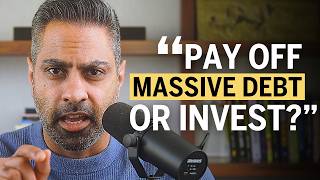
Shannon and Wilson earn six figures but can't agree on whether to pay down their $200k debt or invest more. Ramit Sethi helps them see the real issue: Shannon needs security, Wilson chases returns, and neither has actually talked about what they both want.
Chapters
Do you feel like you currently have a weight on your shoulders?
Yeah. When it comes to money, definitely. It feels heavy. It feels a little bit suffocating.
I took the big risk of not making money for six years, hoping to be successful.
The question is about Wilson wanting to take out a second mortgage on the house to put more money into stocks. What the hell?
This isn't like a blanket approach that you can ask ChatGPT or something and say, should I take out a second mortgage? No. You need to know exactly the details.
Why do you sound angry when you say it? Watching your energy just now, I'm feeling attacked and I don't even understand what the you're talking about. All I know is you're yelling at me.
There's emotional things that come up and it's hard on me too. We just talk about the doom and gloom of everything.
Do you see how the two of you don't agree on the debt? How can you row to a certain destination when the two of you don't even agree with the destination is foreign?
We're going to get to the show in just a second, but I have to share that today is a big milestone for the Money for Couples podcast. This is our 200th episode and I want to give a huge thank you to every single one of you, all the listeners who join this podcast every single week to hear and watch these incredible stories. You know, I started this podcast because like a lot of you, I had questions on how to have healthy money conversations with my wife. And now 200 episodes later, here we all are. So a huge thank you to every couple who's been brave enough to reach out for help and to talk publicly about what is one of the most intimate things there can be.
Their personal finances.
And thank you to you for coming back every single week to hear and.
To watch these stories.
If you enjoy this podcast, I would love it if you click follow or subscribe, whether It's Apple, Spotify, YouTube, because it helps me and my team grow this show and make every episode better and better. Thank you again for supporting Money for Couples. I'm about to open Shannon and Wilson's conscious spending plan, which breaks down their net worth income and where they spend their money. You can download your own free template of the conscious spending plan and@iwt.com CSP.
Let'S take a look at the numbers and then I've got to tell you about their application. Assets, $1.6 million Investments $305,000 savings, 0 debt $247,000 for a total net worth of $1.68 million. Okay, but listen to this. In the application, she writes, my husband wants to take more risky financial decisions when it comes to investing, while I'm more interested in making slow and steady decisions, he thinks I'm, quote, too conservative and frugal. While I think he is a bit of a dreamer and optimizer. We're also 10 years apart, and my husband has said that he feels he doesn't have as much time as I do, which is why he wants to make these aggressive financial decisions. It feels like he's trying to catch up for lost time. Their combined GROSS Monthly income, $13,916 a month, and their take home is 11,600.
Fixed costs at 76%.
That's too high. Investments are at 13%. Wow, that's post tax. That's $1,520 a month. Okay, that's interesting.
Savings are at 22%.
That's interesting. That's $500 a month for vacations, $100 a month for gifts, $2,000 a month for a long term emergency fund, which is interesting because their emergency fund right now. Oh, it's at zero. All right. Makes a lot of sense. That's probably Shannon, who's saying, we need money in savings. That's my guess. And now, oh, their guilt free spending is negative 11%.
So basically they're spending too much.
As we can see, that's not true because I guarantee they are not spending negative $1,280 a month. So I have a lot to understand when it comes to Shannon and Wilson. Looking forward to talking to them. Shannon, do you remember exactly where you were and what you were doing when you decided to apply for this podcast?
It was a few months ago, and we had just had a finance conversation which was around managing debt and equity. We were at our apartment in Brooklyn and we bought a house and put a lot of money into that. And now we're at a stage where it's like, okay, what are our next steps? Are we saving? Are we investing? And Wilson has expressed that he would like to have less invested in the house because we did a lot in cash and to move it over to stocks and that kind of thing. And we have a bit of debt in different things. And that makes me feel uncomfortable and emotional, to be quite honest. And I feel like we're just at a point where we both have a different opinion of where things should go. And ultimately he wants to get the data approach. But I also think that there Are things that you peace of mind that aren't driven by the numbers.
Who usually brings up money?
Shannon brings up spending. Probably. I bring up investing more. I have come to realize that we both approach these issues differently. And my experience has been I love my wife to death, but sometimes the emotional part of something comes out first rather than a clear picture of really what the bottom line is. And I think sometimes I get caught off guard by that because we don't have all of the pieces of the data points to really know our baseline, and so it can be challenging.
You said words like the bottom line. You said words like data. Just so I understand, would you say with your money that you data driven?
For the most part, yes.
Great. And would you say that having an emotional perspective with money is the opposite of being data driven?
Yeah, I would.
I think that's fair.
Yeah.
Okay, cool. Got it. I think I'm understanding where you're coming from. Shannon, would you agree that you tend to lead with emotions when it comes to money?
I think it's kind of hard not to because there's lived experience, family, cultural differences.
I agree. In fact, even the fact of showing emotions is cultural, is gender based, is even geographical. There's so many different ways of it. So I agree with you. All right, so, Shannon, you bring up a topic, and then, Shannon, what. What did you say after he agreed to talk?
I would ideally like to pay down the debt that we have, aside from our mortgage. We have a couple of different debt lanes, and I would love to clear some of them out altogether or focus on the one that has the highest interest rate.
So you say, I want to pay off the debt. And then what's his reaction?
I want to buy Nvidia. I don't know.
A video?
No, Nvidia, the stock.
Oh, I see.
You want to pay off debt.
He wants to invest more.
Yeah.
Okay. Okay, I understand. And so he says, well, why are we going to pay off debt? We can get better returns with this stock that's going up. Okay, and what's your reaction to that, Shannon? Notice her deep breath. Look at that deep breath. What is that?
I am a very emotional person, so I'm just warning you, I will likely cry. Honestly, like, second deep breath.
Can we pause right here?
I just want to cut in quickly to explain why I'm pausing this conversation right now, even though we just got started. It's common for couples to come on this podcast, and they often feel like they have to put it all out there immediately. It's almost like when you shake A bottle of soda, and then you pop the lid, and it just comes pouring out. And I think that's what's happening here. I can tell that Shannon is visibly breathing heavily, and that's a major clue. She's having a physical reaction to what we're talking about. And for me, that's a big stop sign. We have to stop. We have to slow things down. We have to figure out what's going on here, because until we address that.
It'S not even clear if she can.
Hear what I am saying. And the greatest thing about this podcast is that my guests and I have the ultimate luxury of time. Now. I know that if I push her now, she's not going to hear what I'm saying. So I'm going to stop. I'm going to slow things down. I'm going to see if we can reset this energy in a positive way.
I suspect that you're taking a deep breath because it's quite overwhelming when you think about that next part of that conversation. Am I reading that correctly?
Yeah, because I feel like paying off debt gives me peace of mind, And for me, that's worth more than, like, a few points in interest that you can make on something.
Okay, and so the. The deep breaths, the feeling of inability to breathe, what does that represent to you?
Anxiety. You know, we're two people, but we have joined lives. When you have just a difference of opinion, how do you find something that makes both people feel comfortable and safe and secure?
Yeah. I love the question you just raised. You are two separate people. Culturally, you're different. Have you found another area of life where you both are on the same page, even though you're different people?
You know, we both one of a family. We both love our families and enjoy spending time with them. We both love to travel. We both love to eat.
Okay. And picking any one of those, whichever one's most meaningful to you, what does it feel like when you're both aligned?
It feels like we're a team. We can get pleasure out of things. Enjoyment, fulfillment.
Okay, cool. Wilson, how about for you? How does it feel when the two of you are finding commonality in those.
We feel connected. I feel understood. I feel like I'm understanding. Shannon. There is a vivaciousness to everything, to our voice, to our. We're holding hands. We're just super connected and aligned.
Wow. I love that. I love your description, too. Connected, vivacious. These are very positive, vivid words.
Yeah.
Something really special about being connected with your partner. We all have different words, but overall, it feels really Good. So I love knowing that the two of you have areas of life where you feel that way. My goal is to help you find the path from food and family feeling the same thing with money.
I like that.
Awesome. Okay. All right. So you have cultural differences. You view money differently. I understand this is common, Very common. When was the first time that you seriously talked about money?
I would say, like, we first started to have serious conversations around money when we moved in together, because then we had joint expenses, we got a joint credit card, and we're budgeting because we spend differently and that kind of stuff.
Like our second date, we are out to dinner, and I was like, I think I need some milk for my coffee in the morning. And she's like, all right, we'll go to the bodega right here. And so I was like, I don't have any money, you know? And so we walk in, she's like, oh, I have some money. So I got one of those small milks, right? A 16 ounce milk or whatever. A $35 or something. Hand it over. Shannon gives me $2. I hand the $2 to the bodega cashier. He hands me back 65 cents. And I was just going to go about my way, and Shannon says, can I have a receipt, please? And I would turn to her, and I was like, why do you need a receipt for 1:35? She was like, oh, it goes on my spreadsheet. And I was absolutely amazed. I was amazed how diligent she was with tracking her expenses.
You know, I like that. Shannon, what do you remember about that?
I enjoy tracking finances and talking about it and budgeting and that kind of stuff. So for me, it just seemed normal today.
If we fast forward, how often do the two of you do talk about money?
I think it's probably every couple of months.
And at what time does this conversation typically happen?
I think usually, like on a Sunday morning.
Oh, wow. I'm pleasantly surprised. So you talk about money every month or two. And how do you currently track your finances?
It's a spreadsheet, okay. With like a. A notion page. Variable charges, fixed charges. What's the debt?
Who maintains this monstrosity? Me. That's interesting. Shannon, do you access this set of documents? Do you log in? Do you look at them?
I sometimes feel it's a little too complicated to, like, maintain with formulas and that kind of stuff. So it's. I don't feel. For me, it's super usable.
Okay. You're all very good at describing a lot of details. Can I just Ask you guys a simple question. Is it working?
Not. Not for me.
Okay. If it's not working for one of you, it's not working for both. You all see that?
Yeah.
You can have the most sophisticated system. It can be recurring, it can be variable, it can be automated. If it's not working even for one, it's not working. Okay, that's okay. We're just trying to discover what's going on. The good news is misery loves company. And you should know that almost nobody has a system that works for them.
So you're in good company. And the even better news is I happen to know something about making a.
System that actually works. So it's not surprising to me, but I do like understanding. Putting all those details aside, does this work? And the answer seems to be no. You own a property in New York that you sometimes rent out.
Is that correct?
Well, yeah.
Two family. One unit is rented long term, the other unit is short term, or we live here when it's not.
Okay. And then you rent your current place in Brooklyn, is that right?
Yes. We don't own it.
I would like to understand better how your conversations about money go.
So what I would like to do.
Is to go back in time, and I'd like to hear an example from the last six months where the two of you were not on the same page with money.
Okay. So we want to go on vacation in the summertime, and we kind of live between the city and upstate. And so one place would always be rented, and ideally, our dog Luna would stay at our place upstate. And, Will, I think you want to ideally be able to rent both places so that we can make money off of the house instead of paying for Luna to have a dog sitter, right?
Yes and no. I really want to figure out what the numbers are so we can have a educated decision.
That's it. That's how the conversation goes.
To be honest, this is like the classic. Shannon might think I want to do something or. But we're in the dark because we don't have all the pieces, and then there's emotional things that come up, and it's hard on me, too, to be honest. It is hard on me because I haven't really made up my mind. I'm just trying to get to this kernel of truth so I can make plans in mind.
Okay. How long does it usually take for you two to make a decision? Short or long?
Long.
Okay. Long means a week, a month, or several months.
I feel like it's usually several months.
I think it depends the Idea of going to Europe and getting a dog sitter. And I just spoke to her today, so hopefully have an idea in the next two weeks. So six. Six to eight weeks.
Okay, so eight weeks. And this is a decision about pet sitting and traveling? Yeah. Am I hearing that correctly? Okay, so do you all feel fine about that, taking eight weeks to make this decision?
No. I'd like to have a discussion around it and then say, okay, this is the game plan and this is what we're going to do.
Well, we're all here. Should we just have that discussion right now?
Sure.
Yeah. I would like to go to Europe, and ideally, I would like to just have Luna stay at the house. I'm okay with not making extra money on it for the peace of mind, knowing that she's taken care of, she's in her home, she's comfortable.
We have a chance to meet this dog, Border, who is highly recommended from our dog trainer. And we have somebody who wants to rent our place for a month for a lot of money. And for me, I just really want to get what the answer is for how much we would make. If we do feel Luna would be in a good environment, and then we can make that decision.
I feel good about that. I would just like to make that decision and just, like, move forward. I would be okay with that.
Once we know that. Here's my credit card. Let's book the trip, go to Europe.
Okay, so how do you both feel about that conversation?
I feel good. I guess my only hesitancy is that, you know, we'll say that we'll make the decision a week, and then when it comes to make the decision, then it gets pushed.
So if you feel skeptical about your partner's ability or your joint ability to make decisions about money, how does that make you feel?
It makes me feel uneasy. And I think it taps into, like, you know, not feeling safe and secure. If you know, you're good with your money, if you're having productive conversations around money, then you feel. For me, that translates to feeling safe and secure.
Yeah, okay, I understand that. But that's not a feeling I have about money. In fact, when my wife and I sat down with the therapist and he asked us, what does money represent to us? My answer was so fast. I was like, growth numbers compounding growth. And my wife looked up and said, safety. I looked at her like, what? What's that word? And so I didn't understand exactly what she meant. It took me a while to understand that.
What does it mean to you, being able to pay Bills, without having to think about it, having ease with money, having it flow freely, without having to worry if we have to pay rent, pay mortgage debt payments, that kind of thing. And being able to spend money on the things that we want to spend money on rather than the things that we have to spend money on.
So as an adult, you've been worrying about money?
Yes, I'm conscious of it, I'm aware of it. I don't like how much debt that we have. I understand everybody has a different threshold of what they're comfortable with, and that's where we differ too. You know, we're comfortable with different levels of debt.
Hearing Shannon and Wilson talk, it's becoming clear to me that they have very different views of money. Shannon uses words like uneasy, safe and secure. And Wilson uses data driven words like data points, information. Bottom line, we are not rational about money. And the people who believe they are data driven often lie to themselves. They're telling themselves a story. They hide behind logic. The challenge today is for me to get Wilson to see that his need for data is putting unnecessary pressure on his marriage, and not just financially. But I can't lead with that. I have to first understand what's going on to make sure that I can get to the crux of the issue. We're going to hear more after this short break. I want to tell you about a life changing experience I recently had when getting new glasses. Now, since I've been following five years old, I've had thick frames. I have terrible vision. Well, I went into this store, I'm looking at frames as usual. I hate my life because I know.
This is going to look terrible.
And the owner comes up to me, says, can I help you?
I said, yeah, I have thick frames, thick lenses.
And he goes, oh, yeah, let me explain how to find better frames for you. And he explained the physics of lenses to me. He recommended the perfect frames for me. He said, when you get these, they're.
Going to be way thinner than anything you've ever had.
And it occurred to me, it's been 42 years and I finally have an.
Expert in my life when it comes to my glasses.
Somebody who really gets it. There are certain areas of life where it is so crucial to have somebody who really gets it. Your health, your finances, especially your taxes. Because one small mistake could cost you thousands. Now tax day is coming up. If you're working with somebody who's helping you with your taxes, you want to make sure they know what they're doing. And that's why I'm happy to partner with Gelt, the sponsor of this episode. Gelt can help you with your business and personal taxes so you can make sure you're getting proactive expert advice through the power of AI technology and expert CPAs. A colleague of mine works with them and he told me he's saving more than he spends on tax prep now that he works with Gilt and think of them as the ultimate modern CPA. They have an in house team of expert CPAs to work with who can help you determine the most effective tax strategies to minimize risk and grow your wealth. They also have a tech platform that gives you personalized advice to maximize deductions, tax credits and savings, plus a document vault where you can just upload all your files, tag them with the relevant years and even see when your tax team has reviewed each file. No more back and forth emails. As a client you also get their tax library which is full of in depth guides which on things like choosing your retirement plans, taxes for new parents, qualified business income or QBI and so much more. So if you're ready for a more premium proactive tax strategy to optimize and file your taxes, you have to check out ghelt@joingt.com Ramit as a member of my community, you can skip the waitlist again, that's joing.
This episode of Money for Couples is brought to you by Wild Grain. A couple of days ago I was craving a bagel. It was Sunday morning. It was like 7:45. Nobody was awake. It was snowing outside. I walked over, got one of my favorite cups of coffee, continued on to Apollo's Bagels. I think it's some of the best bagels in the city and just had a little solo morning on my own.
Now sometimes we all have a craving.
For a certain type of food.
Not all of us can stroll down the street and just go and pick up a croissant or a bagel at a local bakery where they just baked it. But I'll tell you this, if you love baked goods like sourdough bread and croissants, you love that freshly baked smell in your home. But you're not a baker.
Then listen up.
Wild Grain, the sponsor of this episode, is here to help. Wild Grain is the first ever bake from frozen subscription box for sourdough breads, fresh pastas and artisanal pastries. Wild Grains boxes are fragments fully customizable to your tastes and dietary restrictions. In addition to their classic variety box, they recently launched a new gluten free box and a plant based box that is 100% vegan. The team at Wild Grains sent my team a box with croissants, sourdough breads, Belgian waffles, cookies, ciabatta rolls, and more. And my coworker said it was a.
Huge hit with her family.
She said, I'm obsessed with the croissants. They came out super flaky and buttery. My house smelled like a bakery for hours after. Are you ready to bring all of your favorite pastries and breads right to your doorstep? Be sure to check out Wild Grain so you can begin building your own box of artisanal breads, pastas and pastries. And for a limited time, Wild Grain is offering our listeners $30 off the first box, plus free croissants in every box when you go to wildgrain.com ramit to start your subscription. That's right, free croissants in every box and $30 off your first box when you go to wildgrain.com ramit that's wildgrain.com ramit or you can use promo code ramit at checkout.
Welcome back. Let's keep going. What role do each of you play in your finances?
Because I work with data, it does make sense that I gather everything and get it into a, a sheet or something so that we can look at it.
Okay. And you, Shannon, what's your role?
Maybe I'm the teller or the bank manager.
So they're like moving money from here to there, checking on the account to see the balance, that kind of thing.
Yeah, yeah.
What does it mean that the very role you yourself chose for yourself kind of not that significant in terms of managing personal finances.
Maybe it's redundant. Maybe I'm managing things that I don't necessarily have to.
Yeah, you're playing small. I hate seeing people play small.
I especially hate that the situation you.
Are describing is very common with women in relationships and it drives me insane. You will often see this dynamic and it goes like this. The man will go, oh, you know, I, I do the big picture, you know, the investment stuff. And she manages the day to day. I go, not again. I hate to see it. I'm on a quest to get everybody to live a rich life, to focus on the things that matter. The thirty thousand dollar questions, not the three dollar ones. Do you think you're playing small?
I never thought about it like that. But I'd have to sit with it for a little bit before I can receive it, I guess.
But if you sat with it right.
Now and you realized, wow, I'VE been spending the last X years spending the majority of my time with money, focusing on tracking $1.60 expenses or reconciling this spreadsheet, which is so hard to use anyway. What might it mean about your relationship with money?
Yeah, I guess if we were able to come to a consensus on how to handle certain things, we wouldn't really have to think about those smaller things.
Yes. You would not have to talk about every tiny detail. And when you talk about every tiny detail, it stops you from focusing on the important stuff, the big picture stuff, but also it stops you from connecting on a more meaningful level because you will find yourself. I'm talking about both of you, by the way, getting dragged back into the weeds. You're desperately trying to make an important decision for your rich life, but yet you find yourself delaying for eight weeks talking about a dog sitter. Better to make those decisions in December of last year. And then, like, how much do we want to set aside for the dog sitter? Let's just make a line item. Then when it comes to this, you don't have to sit around and wait for two months. That's playing big when y' all focus on the important stuff. And you do not worry about these tiny logistical questions. Shannon, how's it striking you?
I would love to just make a game plan and roll with it.
Would you be willing to give at least some control?
Yeah. If we, if we got together, made a decision on it and move forward, I would love that.
Okay.
Save a lot of mental energy.
I love hearing that. Can I ask you, why haven't you done that?
I feel like I'm usually a planner. I like to get ahead of things and make a decision. And I feel like Wilson likes to wait.
Why?
I don't know. Going back to the dog sitting situation of last year, I wanted to book our Christmas trips in, like, May, and Will wasn't sure what his work schedule was going to be. And eventually, I think in like, August, I was like, okay, I'm going to book mine and you can book yours later. Later. And I think, Will, you wanted to wait to see if we could rent the house and find a place for Luna. And then in the end, I went home for a month and Will ended up staying with Luna because he wanted to optimize for renting the house.
That's not true, though. I didn't have all the information to make that decision that I can go away for a month while I'm CEO of a startup. And it would have been great if we were Swimming together in. In this new life that we're trying to get to with money. And you said, cool, okay, great. I'll book my ticket. If it works out where you can come, great. If not, no worries. That's the place that I want to get to, but we're not there yet.
What do you notice is happening in this example right here?
I'm coming to realize I'm also not getting what I need. Why is Shannon's decision contingent on mine?
Shannon, what do you notice?
I'm receiving a bit of defensiveness about how it played out. I don't remember in the beginning there being conversation around work. If I remember the conversation being around, I want to rent both Brooklyn and upstate so that we can make money on that.
What I hear is a lack of agreement on basic facts. What happened? That's number one. I hear each partner going back into their respective corners. No shared vision. So, for example, a shared vision would be, hey, we have a value that we spend holidays with family or two times a year. Relationships come before work. I didn't hear that. It was you versus me. And then I heard waiting this quote, need for information. Wilson, you mention this a lot. I need to get the data. Yeah, okay. And Shannon, you never mention it. I haven't. I don't think I've heard you say data once.
It's quite starkly different worldviews.
One person saying, let's be with family, the other person saying, I need to wait for data. And this isn't just about the holiday trip. It's about the dog. It's about a lot of things. So until we come up with a shared way of looking at your finances and, candidly, your entire relationship, you will each always be boxers in opposite corners of the ring. How does that strike you?
I think it's a hundred percent on point.
In your application, Shannon, you wrote, he thinks I'm too conservative and frugal, while I think he is a bit of a dreamer and optimizer. What do you mean by that?
Wilson is an artist, visual, very big picture dreamer. And we joke that I'm sometimes the dream crusher or the dose of reality.
Oh, this sounds familiar.
It feels like if we don't have grounding, that things can get lost.
Aha. And who's the grounder? That's you. She's raising her hand. So in other words, are you saying that left to his own devices, you see Wilson as the dreamer who would go into the clouds? We can do this and that, and we should do this opportunity and that investment and Your role is to, quote, bring him back to earth.
I don't want to be that, you know, person that crushes his dreams. But again, coming back to safety and security, what we talked about in the beginning, sometimes I feel like I have to do that.
The typical word that people use is nag. Often the person who's in that role doesn't want to be there. And they will say that I don't want to have to control or check what my partner does, but if I don't, things will get out of control. Do you see how the dynamic that you're already in with money is very possible to simply extend to different parts.
Of life and it actually gets worse.
Like, nobody wants to have to be the dream crusher. So what do you think the solution is to this dreamer, dream crusher dynamic?
Maybe it's, you know, sitting down and aligning on what our big picture vision is for things so that it's shared goal as opposed to, I want this and I want this.
Love that.
Totally agree. Wilson, what do you say?
I think acceptance and love and kindness, willing to fail and willing to let things get messy. And having faith.
Would you be willing to accept that you are going to lose a certain amount of rent money because you're going to let the house sit empty?
Yes.
You are?
Yes. Okay.
I love that answer.
Have you ever actually had that conversation before? No. 11 years married. How come you guys haven't talked about maybe being willing to accept making a little less from renting whatever property in 11 years?
I didn't make money for like six years building this startup. Six years. And it was a lot of stress on Shannon. And I'm very aware and I regret the harm that I caused her in those years. I do, really. But I think we've turned a new chapter, and now I'm gonna make a lot of money this year. And it's like going from living below the poverty line to living the top tax bracket. And that's the reality that we're stepping into now. The challenge we have is how do we form a new relationship based on this new reality and shed some of the past?
You know, it's a very common thing couples have when something big changes in their lives. In your case, you went from one end of the socioeconomic spectrum to sounds like the other end. Sometimes it's having kids, sometimes it's health change. That recalibration is really hard, but it can be done real quick.
If you enjoy these videos. You want me to make 200 more episodes? Make sure you hit the subscribe button. It helps my team and me grow this show.
I'm curious, Wilson. You mentioned regretting the harm you caused her. What harm?
When we were building the software, it took much longer than we thought. We thought it was going to be three years. It took six, seven years. And I did have to take on credit card debt and do the whole zero interest shuffle and take one card and pay off the other. And I remember we had that moment in Tobago and I was talking to Citibank or something, trying to get like my 18th zero interest credit card to cover one, and Shannon was just like, this is insane. And she was right, you know, it was insane.
That's pretty honest. I really appreciate you, Wilson saying that, Shannon. Have you heard that before?
Yeah.
How does it feel when you hear it?
It feels validating. It also still brings up a lot because it was hard on me and I felt like I had to hold the ship afloat. And we talked a lot about how do we act in the present moment as opposed to based off of precedent and just trying to recalibrate based on the present moment.
Shannon, what do you remember your family saying about money when you were young?
When I was growing up, there was a little bit more of it compared to like my siblings who were older. But there were also times where there wasn't a whole lot of liquidity, liquid money that my parents had and we had to make certain sacrifices with things.
Were you middle class? How would you characterize it?
Say upper middle?
Okay. All right. So your family had wealth in assets like real estate, but less so in terms of just available liquid cash to.
Spend at certain times? Yeah, we never wanted for anything. I guess it was just more, you know, certain luxuries that we didn't have.
Okay, and who worked in your family?
Both parents worked. My dad worked full time and my mom worked part time so that she could be home with the kids.
What was the dynamic between them as it relates to money?
I guess my dad handled bigger things like mortgages, and my mom managed to day to day grocery, cash flow, that kind of stuff. I see where you're. I see where you're going with this.
Okay, that's interesting.
Yeah.
And what feeling did each of them have towards money? So when it comes to money, mom.
What Feels that she doesn't have enough of it? Maybe.
Is anyone seeing any connections here?
Yeah.
Surprise you or.
No, no, it makes sense.
Okay.
You absorb what you see.
Yeah. That's pretty interesting. Was your dad risk seeking?
No, he played it pretty safe. I mean, he put his money in some ventures that didn't always pan out, but it wasn't like a risky business, so to speak.
Wilson, how about you take us back to your childhood? What do you remember about your family in terms of what they said about money when you were young?
My mother was kind of like Shannon, tracking all the expenses. My father definitely more of the dreamer. He was a filmmaker and then he took a job as a tenured professor when he had kids. So I gave him mad props that he put put aside the riskier artist life to raise a family. And he took on some risky or real estate investments that that did well. But my mom was very against them. My mother does not like risk at all. She kind of runs from risk. Whereas my father, I think is a little more risky.
The similarities I see are quite stark. Dad was more risk seeking, so are you. Mom was risk averse. Generally speaking, Shannon is as well.
It's pretty obvious, isn't it amazing how much our experiences as children shape who we are. Decades later, Wilson is willing to take big risks just like his dad. Shannon feels unsafe and insecure about money just like her mom. And they married each other just like their own parents did. It's quite remarkable when you think about those patterns. And Shannon is still feeling the effects of Wilson not earning for many years.
While he was building his business.
Now we're going to get back to Shannon and Wilson after a quick pause.
To support our sponsors.
I really want to help you get in control of your email. And I'm going to share a tool I use and I personally pay for it. Is that good? If you open up your email right now and you have tens or hundreds or even thousands of emails, I'm not.
Going to judge you.
It's easy to get overwhelmed with emails. I know I do because I get thousands of emails. But I'm able to stay on top of them because I use a tool called Superhuman. And this is some of the best money that I've spent on technology. That's because their tool lets me reply to emails incredibly fast. And they've built in all kinds of features that makes it almost automatic. As an example, I was on safari in Tanzania. Limited Internet access. Once in a while, I needed to respond to an email even if I was offline. I could write it and then it would automatically handle sending it once it reconnected. Superhuman easily saves me over 10 hours a week by making my email less cluttered. I use their keyboard shortcuts, which are built into everything, and I can easily go through 50 emails in minutes.
This Way.
To me this is a complete no brainer. You use email every single day. Use it from your desktop, from your mobile. Get the best tool. It is absolutely worth it. Right now all IWT listeners get a free month of Superhuman and you can get started@superhuman.com ramit that is superhuman.com ramit R A M I T I was.
Over at a friend's house the other day and he was telling me how.
People know where he lives.
He an online personality.
He's like, I got to find a.
Way to get rid of this information. I'm like, dude, delete me. I use this service myself. Join deleteme.com ramit Put your information in there. They will scan the Internet, they will remove it. You don't have to play whack a mole. They will do it for you.
He was like, what?
This actually exists? I said yes, I've been using it for years. I pay for it myself. So I want you to use the same thing. Get your information removed online. Your name, address, ages, relatives, names and information. Get it all removed and let this.
Service do it for you.
They do a great job and it only takes a few steps to set it up. You sign up, you submit your information for removal. Delete me experts search for and start.
Removing your personal information.
And in seven days you'll receive a detailed delete me report with what they found so far. Then they continue to scan and remove your personal information regularly all year long. This is a service I personally pay for and I regularly recommend it to.
My friends and family.
So if you want to get your personal information removed from search results on the web, go to joindeleteme. Com ramit for 20% off a plan for you or your entire family. Again, that's joining.









