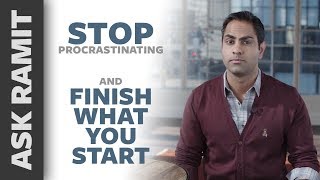
Ramit Sethi shares three ways to stop procrastinating: stop telling yourself you're a procrastinator, admit what you actually prioritize instead of blaming time, and break tasks into tiny steps to build momentum.
Chapters
Perhaps the defining problem of our generation is how lazy we are. How often do we procrastinate? How often do we say stuff like, yeah, I really should do that. I don't know, I guess I'm just lazy. We have a problem with too many choices, too many options, and not following through on any of them. So what do we do about this? I want to give you three pieces of advice that I learned as I became better at committing to the things I really cared about and following through and saying no to the things I didn't. The first thing I want to recommend is to monitor the language you use to describe yourself. I had a friend of mine, he said something like, yeah, I'm not going to buy that book, I'm just a cheap Asian. I was actually very sharp with him. I said, don't call yourself a cheap Asian. That becomes a self fulfilling prophecy. When I used to be really skinny, like 40 pounds lighter, I would say, oh yeah, I can't get any bigger. I'm just a skinny Indian dude. And actually that became my reality. If I had said, you know what, I probably don't eat right and work out enough, that could have become my reality a lot sooner than it happened. So be careful of the way you describe yourself. Don't say, you know what, I'm probably just lazy, because that's exactly what's gonna happen. Instead you could say, you know what? I probably haven't worked hard enough to get what I want yet. The second thing is to be very honest about your priorities. What's the easiest way we use to justify not doing something? I don't have enough time. Hey, do you want to go to this party in your head? You're like, oh my God, I'm going to be really nervous. I don't know anyone there. How am I going to talk to anyone? Sorry, can't make it. I don't have enough time. Hey, I'm starting this business. I know you've been talking about it for a long time. You want to do this thing with me that's going to be really hard. I'm not sure if I can actually follow through on it because I haven't followed through on so many other courses. I don't know, I don't have enough time. We use time as an excuse and it is totally politically correct to do it. Who's going to accuse you of having too much time? Not in this world. So we use it and we get away with it, but we actually only cheat ourselves a better way, a more honest way to Handle that would be to say something like this, you know what? I appreciate the offer, but that's just not one of my priorities for the year. Who do you admire more? The person who says, no, I don't have enough time and fails to show up at anything? Or the person who says, you know what? I appreciate it. Let me think about it for a couple days, and they come back to you and says, you know what? I've thought through my priorities for the year, and that's just not one of them. I really appreciate the offer. Of course you're going to admire the person who has the high competence trigger who, who has the courage to say, you know what? I've thought it through, but that's just not what I want to work on right now. It's very hard to do that. It's actually politically incorrect to say, you know what? I'm just not interested in that right now, and it's not a priority. But when you start to say that, you will also start to say, that is a priority. For me, the third thing I learned was to break it down into baby steps. Like tiny, tiny, tiny baby steps. As one of my mentors, BJ Fogg, says, tiny habits. In fact, he has a whole program on that. And one of his great examples is, if you're trying to start getting fit, don't commit to going to the gym five times a week for an hour. That's just way too much. He said, break it down. Don't even say, I'm gonna do 20 pushups in a day. Say, I'm gonna do two. Two is a number, you know, you can hit two pushups in a day. Come on. Any of us can do that. And once you do two, do it for a couple days, move on to three. So when we talk about breaking a problem down into very small parts, we really mean tiny. You want to write a book? Don't commit to writing 50 pages a day. How about just half a page a day? Give yourself a goal you know you can achieve and then ramp up from there. By the way, I've actually created an entire course on following through. It's called the Finisher's Formula, and I include the exact strategies and tactics I used to to go from someone who would commit to a lot of stuff and not actually do it to someone who was very careful about what I said yes to. But I will always follow through on those items. If you're interested, put your email address below, and I will send you a bunch of free material from the course so you can see how to start following through today.