The Car Payment Trap Almost Everyone Falls For
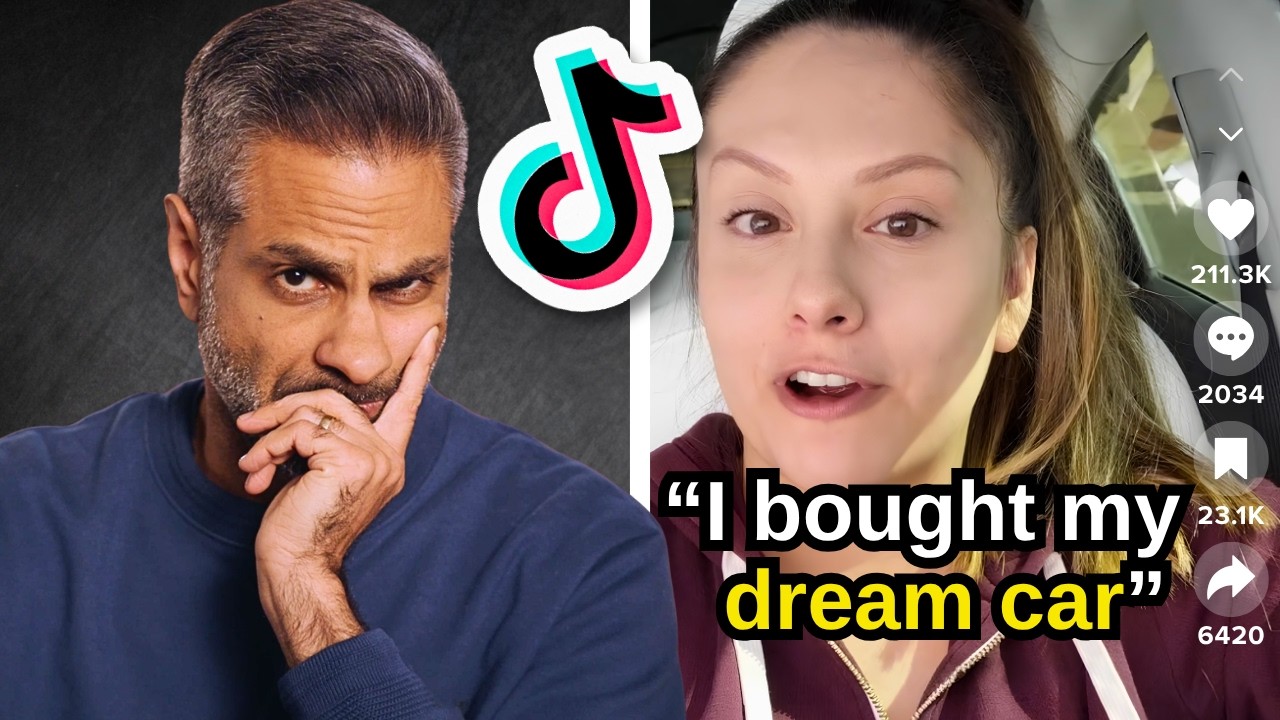
Ramit Sethi breaks down why people overspend on cars, focusing on monthly payments while ignoring the full cost. An $800 payment balloons to $2,000 plus monthly when you add insurance, maintenance, and interest rates of 13-18%. He shows how to avoid the trap: buy used, aim for rates below 6.5%, and invest the money you save.
Chapters
I can afford the monthly payment. I hate that sentence. That sentence has cost people hundreds of thousands of dollars because buying more car than you can afford is one of the fastest ways to stall your finances. And not enough people are talking about this. My team pulled together some of the wildest car regret videos today. We're going to watch them. These are people who bought the car, they thought they were being smart, and now they wish they could just undo the entire deal. My name is Ramit Sethi. I've worked with thousands of people. You may have seen me on Netflix. By the end of this video, I'm going to show you one question that would have stopped almost every bad decision in this video. Let's get started. So now they're doing these man-on-the-street interview things and they're asking people financial questions. I like it. What is one bad financial decision that you regret making in life?
Oh man, lowkey buying a car like young, trying to finance into one, you know, trying to get a little Challenger, you know, that 392. Yeah, man, lowkey that's a bad decision trying to do young, you know.
You Do you guys think I would look good with a neck tattoo? Look at this guy. Looks crazy. You see a guy like me, you go, damn, that guy has a good credit score. Okay, especially back in the day. And so I walk around and, you know, I'm like single at the time, like talking to people and I know what the perception is. Oh, this guy, you know, he has a good credit score. He probably has a very nice job working at Cisco. And I always thought to myself, what if I had a neck tattoo and I just rolled up to the meatpacking and just took off a sweater, boom. Like, what would have happened if that were the case? Does anybody know?
You know, you got a low income, you gotta stay low, you know, keep your head down.
That's wisdom right there. You got a low income, you gotta stay low. I couldn't say it better myself. What was that monthly car payment every month? Man, $800. That was with or without insurance?
And I was with— without insurance, lowkey. I was running without insurance. Oh God. Oh Ramit Sethi.
I mean, I like the honesty. $800 a month for a car payment. Means that you are probably paying $2,000 a month all in. That is mind-boggling. Very few of you properly account for all the expenses. Let me list off some of the expenses that you might not have planned for. Insurance, gas, maintenance. Things will break in year 4. You need to account for that and spread that out over every single month's payments. Parking. I had to pay $200 a month for parking in San Francisco. Or maybe you pay for street parking or whatever. Parking tickets. That counts as well. Speeding tickets. If you get one, that counts as well. What else? Some of you adding rims and aftermarket accessories. That counts as well. How about opportunity cost of the money that you could have invested, but instead you used for the down payment? In this case, let's say it was $5,000, $10,000, $15,000. What if you had simply invested that in a low-cost index fund and let it grow for 5 years? That would have been a lot of money. So when this person says they're paying $800 a month, that's just the beginning. Realistically, it's probably more like $2,000, maybe even more every single month.
Got repo. I'm here. Let her know. You got repo? Yeah.
What, you didn't make the payment or something?
Yeah. Oh God, I was late. Take my L's on it.
Yeah, they repoed his car.
All right. You know, I'm bouncing back though. I got a truck right now. Yeah.
Like, how do I learn how to talk like this guy? On God, I was late. I could talk for 1,000 years and I would never come up with that.
How?
And then he goes, I'll take the L, bro. I want to take the L sometimes too, but I don't know how to talk like this. I'm going to study this video.
You know, I'm bouncing back though. I got a truck right now.
Yeah, yeah, yeah. I'm bouncing back. Now I got a truck. No, you're not bouncing back. Why did you get a truck? I could see you're in the parking lot of a CVS. What are you talking about? You do not need a truck.
Did you have like a high interest rate? Yeah, I did. 18%.
You didn't have like a good credit score, so they gave you like a high interest rate.
Yeah, first time buyer. But I'm glad that that's where they get you though.
No, no, they don't get you. You got yourself. 18% interest rates? You know those thermometers? You're in danger, or like, you're good, excellent health, whatever. If your interest rate for your car payment is above 6.5%, they should have a thermometer on the contract and it should just say, "Dumbass." How can you finance a car for more than 7%? That means you probably should not get a car. That's really what they're telling you. Let me charge you '18% because we have very low conviction that you're actually going to pay us back. So we're just going to jack up that rate to account for our risk.' That's what they're telling you. But the average person who pays this kind of thing does not know that. Like, I've talked to people, 13%, 14%. I'm aghast hearing this. And they go, 'Yeah, that's just what it is.' That's how they get you. No, they're trying to tell you, 'Don't buy this car,' but you're not listening. Of course they're going to take your money.
That addiction, you try to get the hot car. Get the Corolla, bro. Stay down till you come up, bro. Oh my God. Do you feel like you're going to get that car again or a different one this time? Yeah, I'm already knowing, 'cause it's all about belief, belief in God.
No, it's not.
You see the tats, on God. Now I'm telling you, money working, it come and go.
I actually think that we could be friends. This guy's pretty funny. But whatever you're gonna do with your decisions about money, here's the suggestion. Take that decision and then do completely the opposite. Like, do not do whatever you're gonna do. Hey, I'm gonna buy a truck with an 18% payment. No, you're not. No, you're not. You're gonna get in a little red wagon and have your brother push you down the sidewalk until you get to work every day. That's the move, on God, bro. You know, the funny thing, we spend all this time worrying about our car payment or the price of bananas, but nobody asks ourselves, what happens if something goes wrong? Will my family be okay if I'm suddenly not here tomorrow to help support them? And that's where today's sponsor, Fabric by Gerber Life, can help. Fabric by Gerber Life is term life insurance you can get done today. It's made for busy parents like you, all online, on your schedule, right from your couch. You could be covered in under 10 minutes with no health exam required. And the best part? Fabric has flexible, high-quality policies that fit your family's needs, like $1 million in coverage for less than $1 a day. Even if you have life insurance through your employer, it may not offer enough protection for your family, and it can disappear the moment you leave your job. Fabric follows you wherever you go. There's no risk. There's a 30-day money-back guarantee, and you can cancel at any time. So if you've got kids, especially if you're young and healthy, locking in low rates now is one of the smartest moves that you can make. Join the thousands of parents who trust Fabric to help protect their family. Apply today in just minutes at meetfabric.com/ramitsethi. Meetfabric.com/ramitsethi. All right, let's get back to it. This next one is very interesting.
I bought my dream car when I was 27, and this is why I regret it.
First of all, What an amazing hook. How do I learn how to do hooks like that? I'm an elder millennial. Can somebody teach me?
At the time, I had recently gotten a raise and I thought I was on the path to making a lot of more money. So I went and bought a Tesla because it was one of my goals. You see, the people in my community were making a lot more money than me and I wanted to fit in as an entrepreneur. And I thought buying a nice car was—
This creator is very perceptive. She says, I I got a raise and I thought I was on track to make a ton more money. Already insightful because a lot of people, let's say they make an extra $5,000, they go, oh cool, that's gonna happen every single year. So me buying a car is nothing. You know, $500 a month, $700 a month, easy. Mistake number 1. And then I like how she says, I wanted to fit in. You would not believe how few people actually are honest with themselves about the purchases they make are designed basically just to fit in. People buy certain types of makeup just to fit in. People buy certain types of cars just to fit in. And we know what the ultimate purchase people make to fit in many times is a house, because God forbid you be a renter. Even worse, in an apartment. Oh my God, who the fuck would want that? I actually don't mind if you make purchases to fit in. We are social creatures. Of course we want to do things that fit in, but very few people like this creator are honest enough to admit it. Let's keep going.
The way— this is what I know today. The money that I spend on my monthly car payments, I could be taking my family to Disneyland every month. I could be living in a much nicer neighborhood. I could be saving money so that we could actually buy and own our own property. I could have reinvested that money into myself and my learning, my education. I could have reinvested that money into my business.
First of all, these examples are magic. She didn't just say I could use it to buy property, although she totally could. She said I could use it to take my family to Disneyland every single month. I like the range because so often we think if I did not make this purchase, then I would have to put it in the stock market. But that's not true. If you did not have a fixed expense that you currently have of, let's say, $500, $1,000, $1,500 a month, You could take $1,000 of it and guilt-free spend it. You could take $500 and invest it. There's so many different ways. It's not all or nothing. And I appreciate that she's acknowledging that.
Advertising and scaling my business. I could have used that money to hire help to help me achieve my goals in my business. I share this story with you because if you're an entrepreneur who wants to grow, who wants to scale, and you see these people who are driving fancy cars and all these nice things, like, honestly, that's not going to help you grow as a person. That's not going to help you grow as a business. So remember to focus on what actually matters. It ain't fancy cars.
One of the best TikTok videos I've ever seen. When I started my business, my website started in 2004. Even back then, there were other people whose websites looked way better than mine. And I specifically remember because they had better headshots than I did. My headshot looked like shit. In fact, it was so bad. This is the headshot. It was just a picture. I had these glasses that weren't even very fashionable. It's like, was this guy hiding his identity? No, I just don't have a better photo. And I decided early on, I do not want to focus on making my website look that beautiful because number one, I don't know how. I don't even know how to take a better headshot. And number two, I want to focus on just creating amazing content. That was what I focused on. And I knew my website was ugly, but I knew that one day I would fix that. It is so important for you as you start to live your rich life to think about what is important to you today and what do you get to earn the right to do later. For example, I want to stay in a beautiful hotel or I want to have this particular type of $120 shampoo. Okay, cool. If you want that, amazing. Set a milestone. What do I need to earn in order for that to happen? But do not delude yourself into thinking, if I use this shampoo, it's going to make me more productive at work, which will allow me to get more money. Don't lie to yourself. Your shampoo is not an investment. Your car is not an investment. Your mattress is not an investment. None of it is an investment. Be clear on the difference between a luxury and an investment. And actually, it's really good to have luxuries to save for. I find that people who have started on their personal finance journey sometimes do not know when they have done enough. Like they'll constantly ask, what did I miss? I need to read 10 more subreddits. What about this one obscure thing that might happen, and it doesn't feel good to constantly worry that you got something wrong. That is exactly why we created Road to $100K. For most people, reaching your first $100,000 invested is a massive financial milestone. It's often the point where you stop feeling like you are guessing because you can finally see that the decisions you've made are really starting to add up. Inside Road to $100K, you will get a personalized path based on your actual numbers, not generic advice. You'll see exactly where you stand today, what's holding you back, and what to focus on next. You will also get access to live coaching and a community of people working towards the same goal. If you are ready to start making real progress towards $100,000 invested, scan the QR code on screen or click the link below to learn about Road to $100K. Let's look at the next thing.
The worst financial mistake I've ever made, I'll be honest with you guys, is this car that I'm currently driving. And it's not the car itself, like, I literally love this car. I can't imagine myself driving anything else. It's the fact that I have car payments, which is so stupid. It literally makes me sick thinking about it.
I'm sorry, it's 7 seconds into this video. I have a couple of observations. First of all, have you noticed how everyone who's creating videos about regretting their cars is still sitting in those very cars. Kind of funny and really shows you that when you make a purchase like this, it's not easy to get rid of. These purchases are sticky. They are not easily reversible. So be very careful. Second of all, how is this person recording this video while driving? She's literally looking at the camera like 75% of the time. What the hell is going on here?
I wish we would have just waited like a year and maybe saved up like $20,000 in cash and bought a used car because purchasing a Buying a brand new car was so dumb. Not only did it lose value like the second we drove it off the lot, but now we're paying interest payments on top of that, and this car is already 2 years old. Like, it was only brand new for like 5 minutes, so might as well have bought a used car. But at least I learned that lesson in my early 20s so that I never do that again in my life.
Good video, but please look at the freaking road when you're driving. So this person bought a new car and they regret it because They could have saved a ton of money buying a used car. Absolutely true. My question is, so what are you going to do about it? And the only solution in my eyes is you better keep this car for the next 15+ years. The mistake that people make is not necessarily buying a new car. I actually bought a new car and I did it eyes wide open. I could afford it, but I knew this, which many people do not follow. I'm going to buy a nice car.— in my case, it was a 4-door Honda Accord— and I'm going to run that thing into the road. I'm going to drive it forever because after the payments, that's your golden period. That is when your payments stop and the total cost of ownership slows way, way down. Let's just say you're paying $500 a month for 5 years. Okay, fine. That's a little pricey. Whatever. Plus all the other stuff for TCO, total cost of ownership. But now your car payment is gone. All you're doing is paying for gas. That is that golden period. Keep that as long as possible and take the money you would have ordinarily spent on your car payment and redirect it elsewhere, preferably investments, maybe savings, maybe even a little bit guilt-free spending. Or if you're really smart, you can save for the next time you purchase a car. But just to put a very blunt point on it, when you finish your car payments, every additional year you drive it for you are saving a huge amount of money. All right, I want to see what's next. This is a Reddit comment from the personal finance subreddit. I'll read it. I just bought a new car with a 1.9% finance rate for 72 months. It's $36,000 out the door. I can afford the monthly payments and I'm living at home, so I don't pay rent. I make around $3,500 a month after taxes, which lets me max out my Roth IRA and still add to my high yield savings account. I still have my old car, a 2007 Prius with relatively low mileage. I bought my new car thinking it's better to invest in something new now that I can afford it and don't have many expenses. But now I'm feeling tied down with less financial room to travel or potentially move. Before I scroll down, the advice is you probably made a financial mistake. And now you have to accept it for the next 6 years or actually like 10+ years because you need to keep that car so you can amortize that total cost of ownership. I think this is an unfortunate situation, but I will say this. This person got a car, $36K with a very low interest rate. In the grand scheme, this will cost them dearly. That $36K could have been invested. It could have turned into a lot of money. Part of it could go to travel, especially when you're young. It's really powerful to be able to do that.. But in the grand scheme, at least they learn this lesson now because some people never learn it at all. And to learn this now, I almost promise this person will not randomly go and make a $40,000 purchase without carefully weighing it. They will probably, hopefully hold this car for a long time, not just buy another one just cuz basically they will be a lot more thoughtful. Whenever I look at how people are spending their money, the two biggest areas that they can typically cut are their housing costs and their vehicle costs. But the problem is those are two of the hardest to cut. They are the biggest bang for the buck, but it's really hard to move. Sometimes you can't sell your house. Sometimes you're in a school district, whatever. Same for a car. There's no easy way out. What y'all need to do is open up this little app on your phone called Calculator. Have you ever used it? Use it. Run 3 numbers. Slow down. And before you make some of the biggest purchases of your life, you should know the math cold. If you're not sure how to do these calculations, join my money coaching program. I will show you how to do them in the program. Here's a mistake that everyone in this video made. They bought based on the monthly payment, not on the total cost of ownership. Now, when I evaluate a car, I do not ask, 'Can I afford the monthly payment?' Never talk like that. That is for people who don't know anything about money. Instead, I ask, 'What is the total cost of owning this car, and what is it costing me elsewhere in life?' That question should be answered with things like your monthly payment, your insurance, gas, maintenance, repairs, registration, and one that nobody ever accounts for— opportunity cost. The amount you might make if you were to, say, invest it. Instead of buying this car. When you include everything, it's very likely that you're spending over $1,000 a month on the car. And even if you took half of that and invested it over 35 years, you would have almost $900,000. Remember, most cars lose value over time. So unlike an investment, the best you can expect here is a decent trade-in value. And for some of you that buy these shitty cars, you're not going to get anything. I've seen the cars you buy. They're horrible. Freaking Ford Taurus. Never talk to me about a Ford Taurus. Get this right. Find a car that fits what you want and make sure that you are using your money to fulfill your vision of what your rich life is. If you want to go deeper on how to make the right car decisions, watch this video next.









