The Retirement Math No One’s Taught You (Until Now)
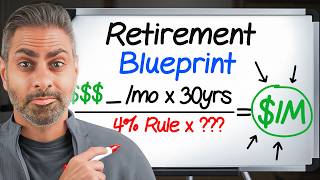
Ramit Sethi breaks down retirement math with a simple framework: three questions about age, longevity, and spending, plus Social Security ($24k/year average) and the 4% rule. A $1.5 million portfolio funds $62k annually. Starting at 45 with $250/month contributions can grow to nearly $1 million by 65 through compound interest.
Chapters
What if everybody panicking about retirement is actually wrong? The truth is you might retire with more than you think. And today I'm going to prove it. I'll show you the exact math to cut through all the fear around you, and I'll show you how to stop stressing and actually live your rich life. So many people think that saving for retirement is this snooze fest that means sacrifice and struggle and still possibly not having enough. But have you ever considered that you might have way more money than you ever thought? Today, I'll break down the retirement math step by step and show you how to retire with confidence, even if you're 40 and starting late. We've all seen the alarmist headlines about retirement. So-called experts love to keep you stuck in fear because it keeps you watching. The media loves to sound the alarm about retirement shortfalls because it keeps you scared and it keeps you watching. They actually don't run the numbers on what they're going to need in retirement. They don't even think about what their retirement's going to look like. We're going to do that in this video. It's kind of like going to the doctor. The longer it's been since your last visit, the more afraid you are to go because you're going to get bad news. And so a lot of people, they make assumptions. They assume they're going to need the same income they earn now to retire, when in reality, retirement spending usually looks quite different. Now, I will say there are some reasons to be afraid. Everybody get ready. I'm going to scare the shit out of you. The median retirement savings for all families, meaning singles, couples, with children, without children, is just $87,000. That's probably far less than they thought they would have to live off in retirement. Please remember that most Americans do not think long-term with their money. They can't even think beyond 3 months. If you ask the average American, what is the effect on your retirement that buying this $60,000 truck will have? In my experience, less than 1% of people can answer that question. A generation ago, people used to have pensions. Now retirement planning has essentially been handed off to individuals, and frankly, most people are not good at it. But here's the twist. On the other end of the spectrum, plenty of retirees actually die with tons of money unspent. What a tragedy. That's like me going to freaking Levain Cookies, having an unlimited ability to buy as many cookies as I want, and then you come in the next morning and I'm just sitting there with like 5,000 cookies. I ate one. Oh, I'm so scared I'm going to run out of cookies. Dude, there's fucking chocolate chips melting on the ground. What's wrong with you? I want you to think of your retirement like a barbell. On one end, you end up with nothing. Abject poverty. Do not do that. That is really bad. But on the other end, you hoard so much money, you don't even calculate how much money you're going to have or how much you need, that by the time you can actually use it, you're too old, too sick, or taking care of someone else. Nobody wants that either. Now, because you're watching this video, neither of those things is going to happen to you. And the first step is to create a plan so you can live a rich life today and a richer life tomorrow. Which brings us to 3 questions to create a real plan. You only need to answer 3 questions. Number 1: When do you want to retire? If you don't know the answer, just go with my number, 65 years old. Number 2: How long are you going to live? Some of you, I've seen what you eat. You're not going to live as long as you think. Plan for 30 years in retirement. The average is actually 20 years, but let's give some of you a buffer. We've seen some people who continue living even though we wonder, how are they still alive? Number 3: How much will you need each year? Well, you can start with your current income as a placeholder, but I think this is where it really gets interesting because often spending drops in retirement, sometimes a little, sometimes a lot. For many retirees, life often becomes simpler and less expensive. For example, a lot of work-related spending goes away or dramatically decreases, like commuting and clothes for work and retirement contributions. Sometimes people change their spending in terms of the family vacations they used to take 2 times a year. Now, They go, we're happy at home. We don't want to take those vacations. Or maybe they're a little hard on us. Dining out typically runs a couple hundred dollars a month for older households, not thousands. And as people hit retirement, their mortgage burdens typically shrink. For example, the average annual housing costs drop to about $15,800 by age 65. Remember, many older homeowners are completely mortgage-free by this point. Now, your kids will likely be out of the house. Your mortgage may be close to paid off, and you no longer have to save for retirement. So yes, your spending will shift, but it doesn't necessarily go through the roof. It could if healthcare costs increase or you travel a lot or you pick up an expensive hobby. Can you imagine someone who's like 78 years old? They're like, I would like to become an equestrian. Like, mm, okay, can we look at your retirement numbers? But that's why we plan. For many people, spending often levels out or even goes down in retirement. Now, before we get to the next topic, which is a big piece of your retirement income, there's something else I want you to protect first: your personal information. And that's where today's sponsor comes in. Google yourself and the city that you live in. You're going to see your name, email, phone number, home address, even family members. I do not want you to have your personal information exposed to a bunch of freaks online. And that's what happens when data brokers take your information and sell it. It happens to almost everyone, and I hate it when When your information is out there for other people to find, that means more spam calls, more phishing emails, and you're at higher risk for identity theft. That is why I personally use DeleteMe, this video's sponsor. DeleteMe is a subscription service that goes out and helps remove your personal data from the dozens or hundreds of data broker websites that profit off your information. You do not have time to do this yourself. It's like playing whack-a-mole. You get rid of one, two more pop up, but DeleteMe does it for you. For you quietly and automatically in the background. DeleteMe was recently named by Wirecutter as the number one data removal service. I love this service so much, I even bought it for my parents too, because I know that parents are even more vulnerable. If you want to remove your personal information from the web, go to joindeleteme.com/ramit and use code RAMIT at checkout for 20% off a plan for you or your entire family. Or you can click the link in the description below. All right, now that your personal information is handled, let's move on. This is a piece that a lot of people forget about when they panic about retirement. The average Social Security benefit is around $24,000 a year. That's roughly $2,000 a month showing up in your account. Now, the exact amount you'll get depends on your lifetime earnings and when you claim benefits. The government actually has a really handy Social Security quick calculator where you can get a rough estimate. I'll link it below. But what about inflation, Ramit Sethi? Social Security is inflation adjusted annually, so that benefit is designed to keep pace with prices. So yes, inflation is real, but the numbers that we are using are in today's dollars, so you can actually picture what that money means. Now that we're on the same page, let's cut through the noise and see what you actually need for retirement. We're going to use something called the 4% rule, and please listen to me, this is just the back of the napkin calculation. You should go deeper and adapt this for your own needs, but I'm going to give you a number right now. We'll take the current median US salary, $62,712. $1,000,000 divided by 0.04 is around $1.5 million. That means if you have $1.5 million in your retirement account, then you can safely withdraw $62,000 a year. To me, that's revelatory. It tells me I don't need $5 million or $20 million. I need $1.5 million. Now, $1.5 million is still a lot. But remember, you might not even need that much during retirement. Social Security will cover some of it. Maybe your spending will go down. That is why we built the I Will Teach You to Be Rich retirement calculator. It's free. You can plug in your numbers and instantly see what you will actually need for retirement. I'll link it below. Now imagine you're 45 years old. You're just getting started. No retirement savings, which again, some people have some, but let's say you have nothing saved. You make $100,000 a year and you are ready to start now. Just for easy math, $250 a month, and you ramp it up over time because even 5 to 7 years of higher contributions can completely change your retirement picture. I don't think you guys realize how powerful compound interest really is. Even with that late start, by age 65, you could have hundreds of thousands of dollars saved. Now, yeah, you would probably need to get aggressive if you're starting out in your 40s, but the longer you wait, the more aggressive you will have to be with your retirement savings. And by doing so, you can end up with almost $1 million by retirement age. That's a little over $37,000 a year you can safely withdraw using the 4% rule. Add in Social Security, which is about $26,500 a year, you're looking at a more realistic retirement income with more than $60,000 you can spend every year. If all of this sounds a little complicated, that's because most of us have never run the simple calculations on our own retirement. Don't you find that shocking? That we work our entire lives, but we never actually calculate how much money we need. It's like we're running a race for 65 years of our life, but we never stop to say, what's the map on this freaking race? Where does it end? Why don't we spend just 10 minutes calculating this math? I want to tell you why. Most of us rarely think beyond a month with our money. Math feels like calculus when in reality it's just multiplying a couple of simple numbers on your phone. In fact, you can use our calculator to do it for you. And honestly, some people avoid opening up a retirement calculator altogether because they are afraid of what they will see. They're in denial, and then they wake up at 62 and go, oh no, I should have started earlier. I don't want that for you. I get these heartbreaking emails all the time about, I'm 62, I'm 63, I never really paid attention to money, what are my options? I don't want that for you. But here's the good news: you don't need to be perfect. Even if you just make a basic plan, even if you use rough assumptions, you are light years ahead of everyone else. You are going to run the numbers, and that is going to change your entire future. Right now, all you have to do is automate your investments into your 401(k) or IRA and let compound interest do the rest. Now, I'm going to give you an overview of the details that I cover in my I Will Teach You to Be Rich book so that you can apply them right now. You can set up automatic contributions to your 401(k) or your IRA if you are self-employed. You can also take advantage of an HSA if you're eligible. That's tax-free money that goes towards health expenses, but anything you don't spend, you can invest. That's even more money to add to your nest egg when you reach retirement age. Check those two boxes off. You're going to be in better shape. Then add a small annual bump. I love this strategy. Increase your investments by 1% every single year. That makes a huge difference. If you're older, you may want to change that number to 2%, 2.5%. So instead of investing 10% this year, you're going to 12.5% next year. If you see somebody using a whiteboard and talking about Annuities? Get the hell off that video. You do not want to get scammed. The vast majority of people should be sticking to low-cost index funds or target date funds. You don't need meme stocks. You don't need to gamble on whatever your freaking brother-in-law who's been unemployed for 29 years won't shut up about. Stick to the basics. Move on. Next, reality check once a year. Log in, do a quick review of your accounts, and then close your laptop and go live your life. Investing is boring. It's automatic. It's powerful. And it's profitable. That's exactly how it should be. You know, there is no one-size-fits-all retirement, but a lot of you end up doing mostly the same thing. Hey, let's wake up at 10 AM and watch TV all day and loaf around and dream about renovating our house because we watched 3 hours of HGTV. It's funny how all those dreams of learning Spanish and traveling around the world seem to fly out the window as soon as people retire. Now listen, your retirement is up to you. I don't care if you want to watch TV all day. Why don't you turn on Netflix and watch a little show called How to get rich. But what I want you to do is to live life based on what you want, not out of fear that you are going to run out of money. So let's talk about some options. If you are more of a stay close to home retiree, that probably means fewer flights, fewer hotel bills, maybe a paid off house. So let's say you want $50,000 a year in retirement spending. Using the 4% rule, that suggests you need approximately $1.25 million in investments. What if instead you like to travel 3 months a year? Okay, bigger travel budget, maybe luxury hotels if that's your thing, a different type of car. I don't know. It's up to you. Maybe you choose to work part-time because you want to, not because you have to. If you target $100,000 a year in spending, that means you'll need a portfolio worth $2.5 million to support that. Just remember, in both of these scenarios, you probably won't need your portfolio to cover everything because you will have Social Security helping. Thank you, United States government. I love Social Security. You should Thank the government every single day that it exists. Now, let's keep it simple. You made around the median salary of $62,000. You retire at age 67. Your Social Security check would be around $28,000 a year. That's pretty good. That's guaranteed income. And over a 30-year retirement, it adds up to about $840K. Now, there are a lot of nuances here, but I just want you to understand the broad strokes of how retirement works so that you can run the numbers yourself. Take what I am showing you, adjust it to your own situation, and you can see The lifestyle you want will set your target. But here's the part that almost nobody realizes. Even tiny adjustments along the way can completely change your investments. Let me show you. If you start in your 30s and you bump up your investments by even a couple of hundred dollars a month, that compounding adds up to hundreds of thousands of dollars more by retirement. If you add $200, that's an extra quarter million dollars. If you add $500 a month, that's over half a million dollars more by retirement. Now, the point here is not the exact number. It's that tiny changes plus a lot of time can completely shift your retirement picture. It's not magic. It's just math. Start now, even if now is later than you would like, and let the system work quietly while you go live your rich life. Now that you have your numbers, I want you to watch this video about how to hit your number at any age so you can retire with the rich life you want.









