This One Script Could Be Worth $100K (Most People Never Use It)
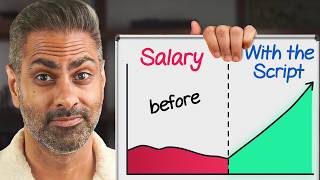
Ramit Sethi walks through a negotiation system that starts six months before you ask for a raise. Build a one-page brief with market data, your past impact, and projected ROI. His ARMS script handles objections. Students who used it landed $5K to $80K raises. A $25K raise compounds to $1.2M over 30 years.
Chapters
Many people never negotiate their salary because it feels awkward. But skipping that conversation can cost you more than 6 figures. But if you ask for a raise the right way, you will be ahead of 99% of other people. Let's break down the technique I've used to help real people negotiate raises of $25,000 or more. Whether you're interviewing for a new job or you want to get paid what you deserve right now at your current job, The best time to start is now. So let's get started. I know, especially in America, asking for more money can feel greedy, but it's not because there is a good chance that you are underpaid and the only person who can fix that is you. Now, it'd be nice if your boss sat around with their little cat on their lap going like this. Hmm, who should I pay more money to? We should really pay Joe more. He deserves it. That's not how it works. Your boss doesn't own a cat because your boss hates animals. And they're certainly not thinking about how to pay you more when you're not even asking for it. People don't pay you what you're worth. They pay you what you ask for. And you know this intuitively. You would probably not buy the first house you saw. So why would you sell 40+ hours of your life every single week without negotiating? Well, I know the answer to that. You're afraid of negotiating. You think it's weird. You think you're being cheap. You have this little voice in the back of your head telling you all the reasons you shouldn't. Oh, I'm so lucky just to have a job. But you never thought about the other voice that says, hey, if you don't negotiate, you are leaving serious money on the table. Let's say, for example, that you currently make $80,000. Then you negotiate a $25,000 raise at this new job for a total salary of $105K. Let's also say you get a cost of living increase of 3% every year after you start working. After 30 years, if you negotiated, You've earned a total of $4.99 million. Without that $25,000 raise, you've only earned a total of $3.8 million. That's $1.18 million more from one conversation. Now, I know you may not think this is possible. Who's negotiating $25,000 raises? I don't even make $80,000. Okay, what if we don't negotiate a $25,000 raise, but just a $5,000 raise? Just once. That still gives you a difference of nearly $238,000 over the course of a 30-year career. And what if you took 50% of your raise and invested it in an index fund with 7% real returns? After 30 years, you would have an extra $236,000. That is a lot of money. And if you do this multiple times in your career, those wins compound. I'm sharing this so that you understand how big negotiation can be. So many of us agonize over tipping or how much asparagus costs at the grocery store. Stop focusing on $3 questions. Focus on these big strategies that can change your life. Remember, once you negotiate a raise, that often becomes your floor, and people who negotiate tend to negotiate over and over. But a successful negotiation starts before you schedule the meeting with your boss. In fact, 6 months before you expect a raise, you should be laying the groundwork and building your case. I'm going to show you exactly how to do it starting right now. I want you to start by gathering data. You can use sites like Glassdoor and Salary.com to research the exact salary range for someone in your role and with your experience. You can even narrow it down further by location, and type of company. Now, I have to tell you, when I have done this with my audience, it is staggering to see the results. Something like 40% of people are just jaw-droppingly shocked. They discover they are underpaid by well over $10,000 to $15,000. They can't even believe it. But how would they know? They never actually zoomed out of their day-to-day responding to emails and looked at the marketplace. That is what I'm going to show you how to do. For example, the salary range of an entry-level project manager in Chicago called Project Manager 1 is $65,000 to $91,000. This is incredibly valuable because now you know your market value and the reasonable raise that you can ask for. But you also need to be honest about where you fall in that range. Don't shoot yourself in the foot by setting your expectations too high. For example, I have had people who came to me to negotiate their salary, and they use the very same strategies that I talk about. But the problem was they estimated their skills at higher than where they actually were. So there is an art and a science to it. Let's keep going. I'll show you how to do it. If you are a project manager with 1 year of experience and you've received great reviews, perhaps you aim for the median $78,000 rather than the top of that range because you're probably genuinely not qualified. Next, leverage the value of your network. I want you to ask your network for informal salary intel. You know, a lot of people just look at some website like Glassdoor, they see some range and they call it a day. That's not the way it works. That's like checking Zillow once and thinking you're ready to buy a house. You know what? I'm not getting into the house thing today. That's for another day. What I want you to do is combine the intel you find online with the subtle tacit knowledge that people in your industry have. That stuff never shows up on a website. Okay, now you know exactly how much money you deserve. It's time to build the case for why you deserve it. Y'all think you just walk into your boss's office and say, pay me money, and then they open up some cabinet, they go, you're right, why didn't I think— they just hand you stacks of cash. That's not the way it works. That's why you haven't negotiated, because you think there's some caricature of negotiation actually happening behind closed doors. Wrong. The best way to negotiate a higher salary is to be a top performer with proof to back it up. How do you do that? Enter the briefcase technique. The briefcase technique is how you sell yourself by showing, not telling. Don't ever walk into my office and tell me, I'm the best at my job and I resent that you have not paid me more money. That is not how you do a salary negotiation. Instead, you show your boss exactly why you deserve to be paid more. Now, whether you have an actual briefcase or not, the idea here is that you are pulling out a 1 or 2-page document that has the answers the company is looking for. Now, if your one-pager just has a big picture of you smiling, it's like this: I work hard. Congratulations, you got a Hallmark card that only your mom will love. But we're not doing that. We're building a negotiation plan. Now, the briefcase technique works. It's worked for thousands of people. It's a little different depending on whether you're interviewing for a new job or negotiating your salary for your current role. For now, if you are looking to negotiate the salary of your current role, the first step is to take inventory of everything you've done for your company. Let's take my student Jesse, for example. He used this technique, the briefcase technique, to secure an $80,000 raise. Look at my mouth. I'm going to say that number again. The numbers are going to show up on screen. $80,000. $80,000. If you're going, Ramit, I don't even make $80,000, how am I gonna get it? Just knock a zero off that freaking thing. Okay? That's still a lot of money. Before he met with his boss, he prepared a document that communicated his goal, established his performance year to date, identified what's missing and what he needs, and then set a timeline. What do you notice about his briefcase technique? First of all, no feelings. Finally, for once in my life, I don't have to be the bearer of your emotional burden. Just the facts. In fact, just show them what you have done and show them what you are going to do. And best of all, show them proof. Basically, you can think about the briefcase technique in two main sections: past wins, which is proof of impact that shows the results he's already delivered, and then future plan or specific ROI, return on investment. This is where he outlines what he will do to justify and exceed the raise. By the way, if you want to download the entire copy of Jesse's briefcase technique so that you can use it yourself and get a large raise, I'm going to put a link in the description below. This works because it shifts the conversation from I want more money to here's how I will make you more money. Jesse's briefcase technique also uses specific numbers and outcomes, which is exactly how businesses think. You are making specific, measurable outcomes. You are showing what you've already done to make the company more money, and you are telling your boss what you're going to plan to do in the coming year. Does this seem hard? Good. It's supposed to be hard. If you want to get a $5,000, $15,000, $25,000+ raise, you will have to do extraordinary work beyond just showing up to work and doing what everybody else does. I want you to understand what it takes to be a top performer in life. This YouTube channel is not called, "I will teach you how to do a mediocre job." It's called, "I will teach you to be rich." And in order to be rich, you have to do extraordinary things. Welcome to the real world. This is the truth. I'm telling you this not to scare you, but so that you understand what top performers are doing. Now, what if you are interviewing at a new company? This is actually amazing. You can still use the briefcase technique to create your one-pager, but you just skip that first part. Instead, you focus entirely on how you will add value, getting as specific as possible. Mention the problems that you've noticed and how you will solve them. By the way, if you're like, how the hell would I know what problems this company has? I don't even work there yet. That's not the way that top performers think. Instead, they go, I've networked. I've talked to people who used to work at the company. I've asked them. I've looked at interviews that the CEO has done in the last 6 months. I've noted down what their priorities are. I've read press, I've talked to other folks during the hiring process, and now I've created what I think is most relevant. Now look, your briefcase technique is probably going to be 80% wrong. I don't care. Just the mere fact that you prepared something and you have ideas is jaw-dropping because nobody else does it. Most people showing up for an interview with a freaking moldy bagel half done on their beard, they're like, what the fuck you want? And the interviewer's like, You applied to me. What do you want? That's not how we do it. Top performers come in, they got a nice collar, okay? They come in, they're prepared, they've read some interviews, they pull something theatrically out of their briefcase. Boom. They set themselves apart. Now, maybe you have an idea for streamlining internal communication. Maybe there's a new project you could lead that'll bring in $100K of additional revenue. Whatever it is, I want you to create a specific plan for the problems that you have identified and what the results will be. In fact, this is how one of my students used the briefcase technique to land an 18% raise in a past job and secured a brand new role that gave her a $40,000 pay increase. You're literally talking to the person who invented the briefcase technique, who then had it used against him multiple times. And guess what? I loved it. I recently went on tour to talk about my book, Money for Couples. After I gave a talk in Boston, Somebody from the audience sent me an email, said, Ramit, nice talk. By the way, here's what I would do differently if I were you. Gave me a 15-minute Loom video on all the things he would do differently. You know what I said? Hire him. Now he works with us because he used the briefcase technique to show, not just tell. And you can do exactly this.
And then the next year, when we were about to do the salary negotiation again, I read about your briefcase method. So what I did was I prepared 3 sheets. One was the job requirement of the next level, which is technical officer 2 versus the 1, which was where I was at that time. And the second is a sheet of what I have done that matched up how each of the requirements I already did in the past year through all of these different achievements. And the third is actually like just the salary bands of the DC office in general, and I showed how my current salary was like at the lower range and how, why it was unfair. So as I was presenting the arguments to my manager, as he's pushing back, I presented another piece of paper and another pushback, another piece of paper. And he was so impressed that I was so prepared. And I got the jump of about 18% of the salary increase. And I got to technical officer 2, which is what I was expecting.
Now it's time to talk about you getting a raise. But it's not just what you say,. It is how you frame it. Whether this is a job interview or a salary negotiation at your current job, I want you to anchor your pitch to value, not need. One common mistake that people make is they talk about their needs. Oh, my car is having trouble, therefore I need a raise. I'm going to be very blunt right here. Companies don't care about your needs. That is not how they set salaries or raises. Companies make financial decisions based on the value that you are delivering. For example, if you are a salesperson generating $1 million for the company, you're going to be paid more than somebody who's not generating as much value. You get a raise by demonstrating how you contribute to the company's success. And the briefcase technique actually keeps you focused on the value you are bringing to the table which should be the backbone of your conversation. So when your boss asks you why you think you deserve the raise, don't say what I once said in my early 20s. Well, I've been here for a while and, you know, I'm more efficient. My boss literally laughed at me and said, get out of my office. Don't ever come in here like that again. I said, holy shit. He put me in my place. I walked crooked for the next 3 days. That's how bad my spine felt just thinking about what I had said in his office. Well, good news. I'll never make that mistake. —again, and I don't want you to make that mistake either—you make it collaborative. You put your value at the forefront of the conversation. I'm excited about what we can accomplish together, and I believe that my contribution aligns with the upper end of the salary range that I shared based on market research. Remember one last thing: hiring managers actually want you to negotiate. We have this thing called competence triggers. They are the signs that people give off when they are competent. Like, a major competence trigger is people speaking slowly. High competence people do that. People who are low competence or even low confidence, they speak very quickly because, "Hurry up, I don't have any time, and I know that you don't value my time. I don't value my time either, so I'm going to speak really quickly so I don't bother anybody." Same thing is true in negotiation. It is a major competence trigger for top performers to negotiate. So when you negotiate, you are immediately placing yourself in that top-tier cohort. Here's what one of my students told us about negotiating a raise with her boss. Last December, before I went on vacation for Christmas, I told my boss I wanted a promotion, and I told him all the reasons I deserved it. He said that in 15 years of being a manager, this was the first time anyone had ever asked for a promotion. He told our VP and I got a $10,000 raise. We have to ask for what we want. Yes, we need to be good enough to deserve it. But first, we need to ask for what we want. Now, if you are negotiating a salary at your current job, send your boss a note asking for a 15-minute chat. Explain, hey, I want to be a top performer in my role. What specific things will it take for me to get there? Then get those down on paper. Send them an email summarizing what you talked about. Make a plan for achieving that in the next 6 to 12 months. Then stay in touch. Every 1 to 2 weeks, you want to be sending them an email. Here's what we discussed on August 8th. Here's the key priorities that I've been working on, which would make me a top performer. And assuming that I do, we can discuss a compensation adjustment later. Here are updates. Stay in touch. That way they know you are top of mind and you are quickly becoming a top performer. And what if you're interviewing for a job and you have another offer? Well, this actually puts you in a great position to negotiate because now you have multiple offers. You can basically engineer a bidding war. My suggestion, though, be careful to focus on the value that you add rather than merely the difference in compensation. You want to show companies that you are excited about the role, and ideally, you want to talk to the company who you are most excited about and tell them, "You are my first choice. I would like to work with you, but right now, it just doesn't make financial sense. Help me get to a level where it does." Now, stay with me because in the next step, I'll show you how to handle the part of the interview that really trips people up, that pushback and objection stage. Like, what if they say, "We don't negotiate here," or, "We don't have the money"? Well, before we go to step 4, let's take a second. You just learned how the right preparation can get you $10,000, $20,000, even $80,000 more. And yet I haven't seen you click subscribe. That is wild. Click subscribe. This is the easiest win you will get today, and I will show you more ways to get major wins in your life. Now we've got one more crucial step coming up, and it's one that a lot of people do not prepare for. Even with a rock-solid case, you might hear no. In fact, you're going to hear no. Just expect it. That's fine. This is where most people give up, but it's actually where you have a major opportunity. See, your goal is not simply to win an argument. Your goal is to keep the conversation alive and to position yourself as a high ROI investment. Remember, you have negotiating power and ideally you have the facts on your side and you can use something I call the negotiation arms technique. ARMS stands for Agree, Reframe, Make the Case, and then Shut Up. Too many of you talk too much in negotiations. Silence is okay. I'm gonna show you how to do it. Be prepared for these common objections. Be ready to respond and reframe. Pushback number 1: A raise isn't in our budget right now. You agree with them. I understand, of course, times are tough, and I agree that for an average applicant, the budget would definitely be a good place to start. Reframe. However, I intend to make an above-average contribution. Now make the case. And I've demonstrated a track record for doing so. I'd simply ask that my compensation reflect that. Now shut up. Let them process it. Pushback number 2: That's above our range for this role. Agree. I totally understand where you're coming from. Having comparable pay among employees of a similar job title is important. I totally get that, because if word gets out, One person is getting paid more than the other. I know the effect it could have on team dynamics. Reframe. On the other hand, I do think there's a bit of a gap here. Make the case. And I need to consider the fair market rate that I've been seeing elsewhere, which is really in the X to Y range. What can we work out in this range? Shut up. Pushback number 3. We can't meet that number, but we can offer X. Agree. I understand what you're saying, especially in light of the budget constraints you mentioned. Reframe: I'm open to being flexible on the exact compensation number, but are there other options we can discuss, like a performance bonus, equity, or a shorter review cycle to revisit salary in 6 months? This is where you can get creative. Ask about training or an education budget or more PTO or flexible work arrangements. Make the case: Based on the value I'm bringing to the table, as I demonstrated in my one-pager, I believe that X is fair compensation. Conversation, but adding a bonus and a shorter review cycle would go a long way towards closing that gap. And then— shh— if the company can offer any of these, it can sometimes make up for the salary difference. That's your call. The worst thing you can do after all of these conversations is nothing. So every day you wait, you are leaving money on the table. Remember, one conversation could be worth $25,000 this year. And more than $1 million over your career. Don't let the money just sit there. You now have the tools. Your only job is to use them effectively. And now that you know exactly how to negotiate your raise, make sure that you are not invisibly sabotaging your career. Watch this video to identify the biggest career mistakes you might not even realize you're making.









