“We have 3 cars, 2 kids...and only 1 month of savings”
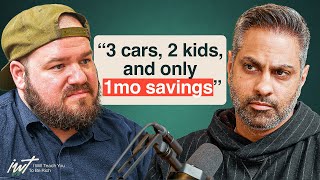
A transcribed episode of Ramit Sethi's YouTube/podcast where Ramit interviews Paul (37) and Morgan (33) about their finances. The couple completed a conscious spending plan (CSP) and Ramit walks through their numbers, revealing high fixed costs (initially ~84–92% of take-home pay, rising to 98% when additional real costs are included), minimal investing (1%) and small savings (6%), and less than one month of cash savings. Key cost drivers: home renovations (unaccounted phantom costs raising mortgage-equivalent from $1,800 to ~$2,800), three cars for two adults (ongoing maintenance, gas, insurance), high grocery ($1,500/month) and childcare/camp (~$1,440–$1,996/month). Ramit connects behavioral patterns (avoidance vs chasing, separate accounts) to poor financial outcomes and guides them to model concrete cuts (groceries, sell a car, apply savings to debt) and to apply project-management discipline to money.
Questions this video answers
Paul is 37; Morgan is 33.
1%.
6%.
Reported mortgage $1,800/month; when factoring renovations/maintenance Ramit estimated at least $2,800/month.
Up to about 98% of take-home pay in one scenario (various points cited ~84% → 92% → 98%).
Chapters
What happens if it doesn't last?
We fall more into debt or have, like, a bigger issue and then. Then have to make emergency, drastic decisions.
Yeah. It affects our family or.
Affects our family.
Like what?
I guess selling the house or foreclosing on your house. Not having a place like bankruptcy, I guess. Right. I don't know.
Our lifestyle would change drastically. I can't carry the weight of this anymore. And, like, our relationship would probably crumble apart. I want, like, big changes. Tell him I want big changes.
Okay, so pick something.
I don't want it to be on me.
Okay.
Welcome back to my conversation with Paul and Morgan. Paul's 37. Morgan is 33. This is part two of our conversation. Last week we learned that Morgan is the chaser and Paul is the avoider when it comes to money. Interestingly, Paul also constantly reassures Morgan everything's going to be okay without ever really knowing how their finances work. Now, I want to point something out about today's conversation. It is striking that we're about to spend so much time talking about how they need three cars. But when I finally actually look at the numbers, it becomes clear how severe their situation really is. What do you think the psychology is behind debating some random purchase for hours when your financial house is on fire? Well, that's a very common thing, and we're going to explore that in today's conversation. If you're listening, check out the YouTube video, especially today, because we shot this in person in New York. You want me to take a look at your numbers? In my Saturday newsletter, I break down the real spending of anonymous readers. Real numbers, real spending, real income, real.
Debt, all of it.
If you want to be considered for an upcoming newsletter, here's what to do. Download the conscious spending plan for free@iwt.com CSP fill it out. Then email it to cspwt.com with your ages, whether you have kids and where you live now, you may be anonymously selected to have your income and spending analyzed by me in an upcoming newsletter. And in that newsletter, I'll tell you what I see. I'll give you my personal recommendations for what I would do if I were in your situation. Of course, you can only read those thoughts if you're signed up for my newsletter@iwt.com podcastnewsletter so again, here are the steps. Download the free CSP@iwt.com CSP Fill it out, email it to cspwt.com with your ages and city, and make sure you are signed up for the newsletter@iwt.com podcastnewsletter. Because I break down the best examples I get every single week. Now to today's conversation. I started by asking them to imagine a different dynamic, one where they're not chasing and avoiding each other. What would it look like?
Paul and I both having more discussions and planning and having, like, a clear idea and being more intentional about what we're spending and what we're buying.
Both talking things out and having goals, what we want and how we're gonna get there.
What would it look like and feel like to you if you actually felt good about money?
Feeling like I didn't have to carry.
The weight of all of it like you do now.
And that weight you're carrying, like, where do you feel it?
Like, in my chest, in my back, like, in my stomach.
And you feel that weight because what?
Because it's like. It feels like it's on me to restrict. Or I could say, all right, whatever, let's go to Florida. Let's do it. And then we have a lot of fun. Then in the back of my head, okay, now we're in this much debt. I don't even know what it is because I can't see the credit card. And, like, we'll just figure it out.
Are you both caring the weight equally?
No.
You're carrying more of it?
Yeah.
All of it, Probably.
Yeah.
That can't feel good.
No.
You carry the. All the weight of parenting.
Not all of it. I carry, like, the emotional weight, I think.
Okay. Yeah. You talk about how you kind of spread out the weight of household tasks, parenting, things like that. I think we've got both nods.
Look at that. Talk about it a lot.
We do.
We have a lot of coordination.
Wow.
Like, two kids. We both. Morgan asked to be at work at 7:30. The kids are out at the door. 6:45am Gotta do it.
We move.
I am in New York City sometimes 7am okay.
And if one of them gets sick, that kind of throws everything off. Right.
You need to adapt.
We talk about it, and one of us has to take off, and we've gotten.
Hold on.
How come you just came to life, Paul?
Like, that was really cool. The coordination in your nods was, like, in complete innocent.
What do you think?
How come you came to life on that?
When I asked about, do you two coordinate and share the weight with household tasks?
I think because I'm. I'm confident that. That, like, we have that down.
Yeah.
You know. So did you all just naturally become good parents who share coordination?
No, I think we've had to Have a lot of conversations about it and like sharing, like low, like load and different responsibilities. It's a lot.
Yeah, it's a lot.
Making a lot of mistakes too.
And having arguments.
Having arguments.
And adapting.
Yeah, and adapting.
I wonder what it would be like if you were to apply that to money.
Right.
It would be less uncertainty and more. Maybe logistical or goal oriented or.
Talk to me about the specifics. Just the same way you talk to me about all the parenting specifics that you do. The kids out the house at this.
Time and that and this and that.
Tell me the same thing for money.
What would it look like, Morgan? There's this much in the account right now. This is going to this. That is going to that. We're going to have this left over for our vacation. We're going to have this in savings.
Okay. I love that.
I'm curious, how come you just got like very. Almost like a caricature?
Why, like, it feel kind of cartoonish to you to say that?
No, I think I. No, I would love to be like that.
Yeah. I like the way you created that vision.
That's basically right. What do you think, Morgan? What would it look like if the two of you were the same with money as you are with parenting and household tasks?
I think we'd have to talk about it a lot more. Like, for us to have gotten to the point where we are now with those tasks, we had to have a lot of hard conversations and really be intentional about divvying it up.
Right.
Would you only talk about money at 10pm at night?
No. Yeah, you'd find time.
And would you be the only one bringing it up? No. What do you all make of this? This analogy between how you handle your household tasks and how you're currently handling money. Find that interesting?
Yeah.
I thought that moment when I asked Paul to take the parenting skills that they've developed and apply it to money was really fascinating. Did you notice how he unconsciously shifted into that cartoonish voice, almost like he couldn't truly accept the role of. That he might be someone who was skilled with money, sitting down and calmly, confidently talking about money. So he just unconsciously made it a joke? Of course. I could be wrong, but I thought it was fascinating. What I notice more generally is that every couple has at least one area of life where they are really good. They're totally dialed in. And for two working parents, it's often childcare. They touch base frequently. They know what's going on. They've developed contingency plans if something goes wrong. In my role, the simplest thing I can do is help them connect the dots between their area of competence and money. Because money is just a skill like any other skill, and if you work at it, you can get better at it. We'll be right back after this short break. Before we get back to their numbers, I want you to see something.
Paul, you went through the CSP and you sent a little update to me on how humbling it was to go through this process.
You almost looked a little like struck.
After doing the csp. Do you remember that?
Yeah. When putting the numbers into the current spending plan and seeing all our fixed costs, how it's 89% of our income, was pretty eye opening. I don't think we've put that all on paper in a long time. We're in just kind of this equilibrium, at least in our minds. Seeing that all into perspective was definitely eye opening, nerve wracking, stressful. When Morgan and I were doing this together, there were a lot of, like, definitely the two of us being overwhelmed, coming to kind of hitting walls where we feel like there's not much we can do on these fixed costs.
What did you feel after you got to the end?
Uh, stressed about money, really? A little bit.
Is that the first time you felt stressed about it?
Probably one of the times where I. The times feeling more stressed about money was after completing this.
Seems like a tough way to live. One partner constantly feeling stressed out by.
Money.
Trying to use random opportunities to bring up the importance of money to the other partner. Partner number two, feeling like we're good.
I don't really want to talk about this.
In fact, we're fine.
Like it used to be worse.
Now we're fine and then never really getting anywhere.
Yeah.
Yeah.
That seems like it can go on for decades. Yeah, but it's not really healthy.
No, totally.
Do you think that it's possible to.
Feel good about money?
I think so. It feels like, I guess, scary just thinking about how to get. For me to get to the point of feeling good about money. Feel scary because I think there's going to be a lot of changes and steps involved.
This is why I always ask couples.
About their experience doing the csp. Yes, the numbers help me understand their situation. But I really want to see if you did it together with your partner. I want to see if one partner had to drag the other one to do it, or if one person simply typed all the numbers and the other rolled their eyes and said, okay, whatever, trying to get out of there as soon as they could. There's this phrase, the way you do anything is the way you do everything. And I have started to see this more and more across my life. In fact, when I mentor young people, I share this advice. I tell them someone is always watching. If you're running cross country, your partner's noticing. If you cut corners at practice, if you're at work, your boss is noticing. When you volunteer for a project, they're noticing how communicative you are. And if you deliver excellence, especially if you deliver it early and later in some closed meeting, that boss will use that moment and a hundred others to. To make decisions about your promotion. You may never know, but she was watching. Ultimately, though, the person watching who really matters is you. Are you performing at your best when you show up to do the csp? Are you simply going to relive the same pattern that you and your partner always have around money, or are you going to show up fresh, ready to make a change and focus on connecting over money together? Someone is always watching, and we see that, because the way you do anything is the way you do everything. That shows up with your csp, and it shows up throughout your financial life.
What's the number on investments?
1%.
Okay, so you're investing 1%. All right. And your savings?
6%.
6%, which is going towards home improvements, basically. Whatever. Let's not even get into that. Let's go back to your fixed costs, which are at 84%.
Shall we go line by line here?
Sure.
All right, good. Your housing is pretty low. 1800. That's 15 or 16%. Really good.
That's with taxes.
That's taxes.
And very good.
You have a low mortgage rate.
We got a good rate.
It's way higher than that. Do you notice that with. With the renovations and maintenance and all that, it's probably more like 30%. If we were to actually factor in how much you've spent in the last 12 months on renovations, could you ballpark it for me? 10,000?
Yeah, probably 10,000.
So this number here is not fully accurate. Your mortgage amount, if you were to actually factor in all the other phantom costs, it would be at least 2,800.
Yeah.
So do you now see that you're basically spending every dollar you make on your fixed costs?
Yeah.
That'S the haunting reality.
We bought this house with plans to do stuff to it. And, you know, we're in it four years now, and we're not where we want to be. So like, like saying, okay, we. We need to fix. Fix, not fix the finances. Fix the house now and Start moving it in the direction that we want it.
Right. Because fixing the house will mean what?
Gratification, I guess.
Will it?
In my head, maybe, or.
Have you ever walked in your house and felt gratified, you know?
Yeah, sometimes.
What kind of answer is that?
More gratification?
I don't know. I feel overwhelmed in our house because it is, like, not a very functional home.
Yeah. So when you walk in and when you look around, what do you feel like?
Overwhelmed and stressed.
Okay, Paul, what do you think? I would think you feel a little pride. You were able to save up a lot of money.
It is a functional house. We've lived in it for four years. It's our home. It's safe and it works.
And there are moments of like, I know. I feel like I'm being negative. There's moments of appreciation. We live in a really beautiful place. Our kids are outside. Like, we have this lake near our house, and it is like, it has the potential to be something really great. But we've always been, like, holding. I've been holding onto, like, the potential of what it could be versus appreciating.
What, like, fantasizing. Like, when we bought the house, we're like, okay, great, we're gonna do this, we're gonna do that. It's gonna be like this and not being there yet.
And even, like, how we bought the house was really impulsive. Like, we had the money saved, but it was not like, okay, we found a realtor, we're going house hunting. It was like, Saturday night, we're hanging out. I'm on like, Redfin or something, and I see like, oh, look, look at this house. It's in this area on a lake. Let's go look at it. We went to look at this house. The realtor was like, sharky and was.
Like, hold on, is there any other kind of realtor?
No. Okay. But she was very much like, let me take you to these other houses. And then all of a sudden it was like, oh, we're house hunting.
Yet again. I am shocked at how casually people make life changing decisions with their money. On this podcast, people routinely go out for a casual weekend looky loo around the neighborhood, and then suddenly it's like they trip and fall and buy a house. Do you know how many years I've been tracking real estate prices and calculating TCO of ownership in multiple cities? Yet people will agonize over the extra $30 they spent at Safeway last week. I simply do not get it.
Let's take a look here you have A car payment of 775 bucks.
That's gas.
That's gas. We don't have. Car payment.
That's your truck. Gas.
Yes.
Well, we have three cars.
I know.
How many driving adults in your household? Just.
Who.
Two adults, three cars.
What am I missing? So.
Morgan, she got a new car.
What car? A supra. How much?
35.
Okay.
Yeah.
All right.
Her old car, I took it as 270,000 miles on it. It's an Acura. I use it. I commute with it. So it's kind of like the beater car. Okay. If. If something big goes on it, it's. We'll trash it.
Okay. What's number three?
The Toyota Tacoma, which was my primary car, and where there's nothing owed on that, that I. It has 175,000 miles. I just want to use it as. As needed. Getting rid of the beater, it's.
But it's costing money to upkeep. Like, we just had to take it in. Like, it's just. It feels like it's just money.
Probably get a thousand, two thousand.
We're talking about the Acura.
Yeah.
$2,000.
Okay, so what's the.
And it takes premium gas.
So what's the conclusion? Or what are you doing with it?
I use it to commute.
I want to get rid of it.
But how do you make this decision?
Even when we were making this. This conversation came up, this exact one. Um, and I think Paul speaks in very, like, extreme, like, I need this. I need this other car. And it's, like. Doesn't feel like there's room for negotiation.
Paul.
It's. The truck has, like, a small cabinet. We have two kids. So ideally, commuting and, like, bringing the kids around. It has a full back seat. So have the two car seats in there for the truck.
For the Acura.
The Acura.
Okay.
He wants the truck for work.
No, the truck. I mean, there's, like, stuff I pick up, or if we go camping a lot, and it holds, like, a lot of stuff.
You guys realize you have three cars for two adults?
We spin the wheels in, like, kind of frustration.
But there was no discussion on getting rid of the car until we started going through these numbers.
Right.
That's when it came up.
In general, people don't understand that owning things, especially expensive things, costs you in lots of ways that don't immediately show up on your monthly spending. Think about it. If you have an extra car, you have to maintain it. You have to pay for gas registration. You also have the mental load of deciding which car to take. And, oh, no, we got to go to the junkyard to get that extra part because it's about to break on the car. You also have the opportunity cost of using that money for something else, like paying off debt. Now, in this conversation, I hear two things. I hear a lot of stories, and I hear a lot of sloppiness. They both admit that the $750 in the spreadsheet for debt payments is inaccurate. Instead, they both randomly throw money at the debt, along with kids and renovation, and that's why the balance never really seems to change. Then groceries on the CSP, they put 1500amonth. Morgan admits that it's not correct. Stories and sloppiness. We also got into a bunch of details about their cats, which I'm going to spare you, including in today's conversation. They wrote 300 bucks a month. But as you can imagine, like most people, they are spending a lot more on their pets than they realize overall, they're not being honest with themselves about where the money's really going. And one critical thing to living a rich life is you've got to be honest. Honest with yourself and honest with the people around you. Hold that thought. We'll be right back.
Can I show you what it would look like if we actually added in $1,000 a month to your mortgage? I want you to look at the fixed cost number. What just happened?
Went up to 93%.
Yeah. From 84% to 93%. So that's a lot. Now, who knows? Are you actually spending an extra thousand dollars a month? Is it 800, 500? Who knows? But it's probably at. I know for a fact it's at least 500amonth because you told me you spent 5,000 on the renovation so far.
Yeah.
And then childcare is big.
Yeah.
$1,440 per month. That's for one.
The cost is 1,996 per month.
2,000Amonth.
Okay, so one child is in child care, and then we pay $180 for, like, before care for the older daughter.
I got you.
And then there's a camp. We have to pay for camp for her now. Okay, so that's the 1996 is camp and all the childcare.
There's nothing in here for miscellaneous expenses that you haven't counted, which we know there's a lot when it comes to pets, cars, home, kids, kids. We're talking hundreds and hundreds of dollars a month in here. If we added an extra, can we say 500 bucks a month?
Yeah.
Would that be fair? I'm just going to add it right here under blank. What just happened?
That's all our money.
98% of your take home pay is going to fixed costs. Makes sense that there's nothing being invested. There's essentially nothing being saved because that money's just going to home stuff. I mean, you did account for it here, so we could take out a little bit here. Let's drop this down to 400.
All right.
You're back down to 92%. Fine. And then you have 1% or $60 on guilt free spending. I don't think so.
No.
We all know that that's just what's left over in the spreadsheet.
Right.
All right, so.
I just want to.
Zoom out for a second. How would you describe the state of your finances right now, Paul?
Drastically in bad shape.
Yeah, it's a mess.
It sounds like there's no urgency to change at all. Why would you? You have three cars, you have a house, you're renovating it, you're taking trips. Why change?
Because it's not gonna last.
Yeah.
What happens if it doesn't last?
I think I get, you know, I worry.
Let me ask it again, what happens if it doesn't last?
We fall more into debt or have like a bigger issue and then decisions.
Yeah. It affects our family.
Affects our family. I don't know if super drastic would be like, I guess selling the house or foreclosing on your house. Not having a place to live.
That's not that far.
Not being you. Did you know that from what?
From where you are today?
No, I didn't.
One of you loses your job.
Yeah.
How long do you have with the amount of cash you have in savings?
Oh, no.
A month.
And I, like on my salary, I don't afford to live.
Did you hear what Paul just said?
Less than a month.
Less than a month.
So you can see why it's striking to me that we're over here having a 10 minute discussion about three cars when I'm sitting here saying if one of you loses your job for any reason, you have less than one month of money in savings. And the whole like, let's spin and spin and not make decisions. You can keep doing it, just skating closer to the edge and hopefully things don't go bad. But if they do, they go really bad really fast.
Yeah.
Yeah.
Our lifestyle would change drastically and I think, like, I can't carry the weight of this anymore and like, our relationship would probably crumble apart.
I just want to pause here to reflect on the difference between what their concern was when they walked in versus now. Remember that on our last episode, part one of this conversation, we spent a ton of time talking about some random $12 a month music subscription. And now in today's conversation, we realize they are essentially spending everything they make every single month. Most couples I speak to who are in financial trouble do exactly the same thing. They fixate on one random expense because frankly, it's easier than facing the truth of their real financial troubles. My wish for everyone who listens to this podcast is that you have the courage to get honest. Honest about how much money you're making, honest about where the money is going, honest about what your rich life is. If you know those things, then you can redo your puzzle and make sure the pieces are going exactly where you want.
Can we talk about your accounts? The way you have your account set up, how does it work?
It was Morgan's original account, and the way she describes it, and I agree, is she. Her. Her responsibility was daycare and that money would be in there, and she wanted to make sure it was always there to pay daycare on time and was worried that if we commingled both accounts, there would be times where daycare couldn't get paid on time.
So reading back what I just heard, Morgan, you were concerned that you needed to split out an account just for childcare because that's. You were decided to take responsibility for that and if you had left all the money in one account, like a checking account, you thought it just would have gotten spent.
Yeah. Like, it are the check. The joint checking feels very, like, volatile.
And up until this past year, we had two kids in daycare, so the cost was like three. It was double that. Yeah. That's a lot.
What do you make of that? The fact that you had to create a separate account for childcare because you were worried that the money in your checking account would all get spent?
Part of it feels validating of, like, why I'm stressed about money, but it, like, I wish it didn't have to be that way. Yeah.
Does it have to be that way?
No.
Why? Why is it?
I think because there hasn't been conversations or behavior change to, like, have that. Like, we just. I had to adapt to what was happening versus, like, us adapt to our life.
Yeah.
If that makes sense.
Yeah, it makes sense. It sounds like it's been pretty tough to have to basically set up a whole separate account and squirrel money away so that, you know, your kids are taken care of instead of having a series of real conversations with your adult partner. What do you think, Paul?
Yeah, agreed.
Why is childcare Morgan's responsibility? Why do couples split their money up by random expenses? And why does childcare and kids clothes always fall to women? I'm so sick of this. I'm going to tell you exactly why this is such a bad idea. Most couples simply slide into combining their financial lives together. They actually don't have a serious single conversation about money. So what happens is one person starts to say, oh, I'll take care of the groceries. The other person says, oh, I'll take care of the rent. One person pays for childcare, et cetera. But as things change, like instead of having one kid in childcare, they have two, or they get another car, they have higher car payments, they never talk about it. They simply struggle more and more with one person paying a disproportionate amount, the other not paying enough, and then one day they just blow up. What if instead you actually combined your income and you could have a single bird's eye view of your finances? Wouldn't that make it easier and wouldn't it make it easier for both of you to be able to handle life's inevitable changes together instead of separately? You have to remember that most people are not bad people, they're good. But when you set your accounts up to be separate, you will handle your finances separately, Change your accounts to be combined, and you will be structurally aligned, financially aligned, and in fact, even much more intimately aligned too.
It suggests two things. First of all, lack of communication about the fact that you're not talking about this in a healthy way. And second, it also suggests to me that, wow, you really put your kids.
First because you knew childcare needs to get covered.
So I'm going to move heaven and.
Earth to make that happen.
Right?
You ever missed a child care payment?
No, we don't really. We haven't missed payments, but we're like just there. Like we're just at that point, like the credit, like my student loan debt, I just like pretend it doesn't exist. That's how I've like lived the last 10, 15 years of like, this doesn't exist.
But on the flip side, like, like mortgage and taxes have always been my responsibility out of my paycheck.
Also, why do you all have different responsibilities? Why not just combine your money?
I think it was an evolution of like, we're not married. We had a kid like earlier in our, we were together like four years and it just kind of like evolved. Like again, like adapting to the situation. Not like us adapting the situation. You know, like.
Yeah.
And I think it was just past, from years ago that that's just what we were doing. Morgan made X. She covered this, this, and that from that paycheck.
Yeah.
And I covered this, this, and that from that paycheck.
You see why that doesn't work in the long term, right? One person makes more money or less money. You have expenses that come, that go, and you never really adapt it. I guarantee you never sat down and said, oh, wow, like our. We have extra renovation costs, therefore we should talk about how to apportion that. Or childcare has changed. Let's talk about it right now.
It doesn't scale.
Mm.
It's not a healthy way of doing things. One person paying for groceries, one person paying for childcare. It seems like it makes sense in that instant moment, but it never makes sense over the long term. Is either of you passive in real life? Like in day to day life at work, things like that?
No.
I have to. As a manager, I'm in charge of people. So I think, like, I. I have to be direct. I think sometimes I try to put a line between work and personal, and then I regress when I get into my personal life because it's it. That's my job to do that.
And he manages the budget at work.
Like, really?
He manages projects. It's his job.
Okay. It's funny because usually when I talk to project managers, they're the ones who are really proud to show me their conscious spending plan. They totally took my conscious spending plan and made it into a Frankenstein monster. It has like 500 categories.
I'm like, that's not the point of the CSP. My point is to protect you from you.
Right.
But in this case, opposite.
Yeah.
You're saying I make a ton of decisions at work. When I come home, I don't want to have to make all those decisions. Therefore, Morgan, she's good with money.
I'm. I'm not good with money, though. That's where. That's where I'm like, constantly feel like I'm sounding like alarms, like I'm not good with money.
And have you told him that?
Yeah.
And have you received that?
Yeah, I think I'm aware of that.
But then how come your response is, we're going to be okay. We'll figure it out?
Because I'll have to figure it out. I guess not. I guess I will have to figure it out when.
It'S been a decade.
Yeah. It's like another reactive like we're just reacting to what we've made versus being proactive.
Yes.
Yeah.
Let's buy a house impulsively, then let's react to all these expenses that come up. Let's get a car and then let's react.
Let's have a kid. Let's. Everything.
Yeah.
Yeah.
Right. You think it's possible to make big, big changes with your money and get on top of it?
I do.
Okay. Yeah. What would it look like?
There would have to be, like, a fundamental shift in how we're communicating.
Yeah.
The conversations we're having and, like, where.
We'Re prioritizing it and staying on top of it. Like, not letting it. Taking the initiative.
Yeah. Like we could easily slip back into. Well, I wanted that. So it's, you know, let's do that.
Yeah. Do you think you'd be willing to make big changes right now in order to get in a healthier position with your money?
I would.
Okay.
I would be open to that.
We can do that. It's your money. I'm simply here to help. I can't drive you anywhere you don't want to go. Right. This is your rich life. So why don't we make some small changes and then let's see what happens.
Okay.
Right here we are at your fixed costs, which are at 92%. What would you like to change?
Groceries.
Groceries.
Right now it's 1500.
I would like love for it to be 700.
This isn't fantasy world.
No, I know.
This is a realistic number that you can actually get.
I think, like 800.
That's basically half of what you're spending right now. Can you do that.
In the conscious spending plan? We calculated it. We calculated how much we would spend at the farmer's market, how much we would spend at Trader Joe's to supplement. And I think it was. We came to a thousand month.
Can I just ask. Y' all are spending 100% of what you make, basically. And you're talking about shopping at the farmers market.
I know.
Just for produce in the summer, spring.
I know.
You want to change it to a thousand bucks. I'll change it to a thousand bucks. I'm just telling you it's not going to do much. Watch the numbers. Fixed costs are currently 92%. I just changed it. You drop 500 bucks a month, you're at 88%.
Okay.
We're moving in the right direction. What do you want to change next?
I want to take some cash that we have and pay off the debt. So after a couple months to be debt free. So we won't need debt payments anymore.
Let's talk about that. Where is the money coming from?
It would come from savings. And in May I would get about $3,000 commission. Okay, $3,000 plus another 3,000 from savings puts that at $500.
I think that's like going back to what we've been doing versus, like making real changes.
But I'm saying after a couple months, the 750 debt payment wouldn't be on there.
Well, we have. But we have a choice right now to make changes. The behavior has to change, which it's not. We're not doing that in this conversation. Like, we're just kind of spinning the wheels. Feels like right now.
Ask him what you want him to do. You're totally right. You are spinning. Tell him what you want.
I want like big changes. Tell him I want big changes.
Okay, so pick something.
I don't want it to be on me.
Okay.
Let's pause. Let's get you a tissue. Thank you. How you doing?
I'm okay.
Let me know anytime you need.
Thank you.
Yeah.
I can see it's difficult for you.
Looking at these numbers.
It is difficult.
But if I'm here as an observer, and I know Morgan is here, she's trying to get inside your head and understand what's going on. It's difficult if we can't get anything from you. So do us a favor, talk out loud. She's dropped 500 bucks a month off groceries. What do you want to do? I guess.
We have the. The car payment, the. The gas expense, insurance expense of three cars we can sell. Get rid of one of the cars, recoup that money. I'm not sure how much it would go down.
I'm taking your car payment down by 300 bucks a month. Okay. Look at the fixed cost number. What just happened?
Not much.
Dropped from 88 to 85.
Yeah, I'm avoidant on wanting to change the mortgage or child care cost. Those are the big numbers.
It doesn't feel like how.
I don't feel like I could and I. Those are the big expenses.
Right. What would you do at work?
What?
Take off your home hat and put on your work hat? Where You're a project manager, managing people. I come to you, I go, I got this problem and I just. I'm spending 85% of my budget on blank, blank, blank. Manage me.
Drive it like you would drive it at work.
Well, we see what. What the total cost is of the job. And we would have to make changes to get to that cost. And you wouldn't just wait. No, you can't. You'd have to do it. And you'd have to forecast in advance what the changes are going to be.
What the happening right now? I like this. I like this. Okay, tell me more. So how does that apply here?
We have to make drastic decisions.
What all it took was me asking, what do you do at work? And suddenly you turn into this killer.
What is happening?
Yeah. All right.
What do you call yourself at work? I feel like you have a nickname at work.
What do you mean?
Killer Paul. Don't with me.
I pm this all day long.
What is it?
No.
Well, now, that's your name. Killer Paul. Tell everyone at work, send them an email.
Killer Paul's on the. On the case. All right, tell us, what are we going to do, Paul?
We're gonna make bigger changes.
Wow.
Tell her. Yep.
So.
So tell me.
I'm gonna tell you right now what to do.
Okay.
Take out the four. I just want to run a.
Do it.
Run a formula, scenario. Take out the 400. The 400 for the rent, mortgage. Just take it out.
All right. Zeroed it out.
Okay. Take out the 500 for miscellaneous.
Okay, 500's gone.
500 is gone. And take out. Hypothetically, take out the 700 debt payment. And I want to see what it looks. All right, zero took out what? We took out nine. Sixteen hundred dollars. Right.
All right, tell us what the fixed cost number was.69.
It was at 88%.
Now what is it at?
It's at 69. All right, so it went somewhere.
It definitely went somewhere. Tell us what you just did.
I ran a scenario.
All right, what was the scenario?
I wanted to see if, hypothetically, if the debt was paid off and we didn't have to make a debt payment, the 500 that's in there, it was thrown in as miscellaneous, but it's a number. Assuming that there's a cost in there.
Fine, we took it out. Okay, and what Was this rent? 400 bucks. You took off the mortgage.
That was for maintenance for the house. Right.
Okay, tell us, why did you make that? I like. I like what you're doing right now.
It's a hypothetical cost. Okay? It's not. Yes, there's maintenance within the house. The home improvement right now has been on a credit card that's going. That's. That's not even in the state.









